
← Back To Blog
Master How to Shorten Your Sales Cycle

You log into Upwork, find a promising job, read it carefully, think through the angle, polish the proposal, step away to revise it, then submit.
By then, the client has already skimmed a stack of proposals, replied to a few, and mentally narrowed the field.
That’s the mistake most agencies make when they try to apply traditional sales advice to a marketplace. They treat every opportunity like a long B2B courtship. Upwork rarely works that way. The sales cycle is compressed, competitive, and heavily influenced by who gets into the conversation first with something relevant.
If you want to master how to shorten your sales cycle, you need a different operating model. Not sloppy speed. Structured speed. The kind that combines qualification, automation, fast replies, and disciplined follow-up so your team moves from job post to booked call in days instead of weeks.
I’ve found that the agencies who win consistently on Upwork don’t just write better proposals. They build systems that remove lag at every stage. They know which jobs to ignore, which ones to attack immediately, how to personalize without starting from zero, and how to keep momentum alive once the first message lands.
The Velocity Advantage Why Speed Wins on Upwork
A buyer posts on Upwork at 9:12. By 9:40, they may already have a shortlist.
That window is why generic advice about nurturing, waiting, and polishing every touchpoint breaks down on freelance marketplaces. Upwork is closer to real-time triage than a traditional agency sales process. Buyers want to see who understood the brief fast, who can communicate clearly, and who looks ready to start.

Early relevance beats late perfection
On Upwork, timing changes how quality is perceived.
A strong proposal sent early gets read in a different context than a strong proposal sent later. Early in the cycle, the client is still forming their standards. They are deciding what a good response looks like, which questions matter, and who seems easiest to work with. If your agency shows up during that decision window with a relevant angle, you influence the frame before competitors do.
That is the first-mover advantage most sales articles miss. In marketplace sales, speed is not only operational. It is positional.
A fast proposal usually signals a few useful things to the buyer:
- You are active: They see a real operator, not an abandoned profile.
- You have a system: Clear responses delivered quickly suggest your team is organized.
- You can match urgency: Clients with internal deadlines notice agencies that move at the same pace.
I have seen agencies lose winnable deals because they treated the proposal like the final exam. On Upwork, the proposal is an entry ticket. The actual sale starts once the client replies.
Upwork compresses the sales cycle
A normal B2B sale might include research, outreach, discovery, qualification, stakeholder review, and scheduling spread across days or weeks. Upwork often compresses the first half of that process into a single session on the client side.
The buyer posts. Reviews proposals. Replies to two or three people. Books a call. Sometimes all before lunch.
That changes the operating model. Agencies that win here do not rely on effort alone. They use compliant automation, clear qualification rules, and message workflows that keep response time tight without sounding robotic. If your team wants ideas for setting up that kind of pipeline, this guide to AI for sales prospecting on fast-moving channels is a useful reference point.
The trade-off is real. Move too slowly and you miss the window. Move too fast without qualification and you waste connects, attract poor-fit buyers, or create account risk with sloppy automation. The right answer is disciplined speed.
What buyers reward on a marketplace
Marketplace buyers cannot see the work behind your process. They only see what reaches them, how quickly it arrives, and whether it reduces uncertainty.
That is why responsiveness carries more weight on Upwork than many agency owners expect. Quick, useful replies create momentum. A buyer who asks a question and gets a sharp answer a few minutes later is more likely to keep the conversation going than one who waits hours and starts comparing other freelancers instead.
The advantage is simple. Agencies that remove dead time get more conversations while buyer intent is still high.
That is the velocity advantage on Upwork. You are not trying to rush clients into a bad fit. You are using speed, qualification, and compliant automation to enter the conversation before the opportunity cools off.
Building Your Automated Prospecting Engine
Most sales cycles drag because agencies start too early on the wrong leads.
The fix isn’t “work harder on outreach.” The fix is building a prospecting engine that filters for the right jobs before your team invests attention. On Upwork, that means your first system isn’t proposal writing. It’s opportunity selection.

Start with your real ICP
A lot of agencies describe their ideal client too broadly. “SaaS companies,” “ecommerce brands,” or “anyone needing SEO” isn’t a useful filter. Your Upwork ICP has to reflect the jobs that close cleanly, the buyers who respond quickly, and the project types your team can deliver without friction.
Optimizing CRM platforms to capture and analyze sales data reveals high-velocity buyer patterns and ideal customer profiles. Analysis of closed-won data can show that directors of digital marketing in online retail close in the shortest time, which lets teams focus on ICP-matched accounts for faster conversions, as explained in this CRM and sales cycle breakdown.
That same logic applies on Upwork. Look at your own wins and identify patterns such as:
- Buyer profile: Repeat client or first-time client. Clear hiring history or vague account.
- Project shape: One-off audit, ongoing retainer, quick build, or messy “everything” brief.
- Budget posture: Reasonable budget range versus bargain hunting.
- Scope quality: Specific deliverables versus broad requests with undefined outcomes.
- Skill match: Work your team already sells well, not work you “could probably do.”
A good ICP narrows the field. That’s the point.
Build filters that save your team from false positives
Once your ICP is clear, automate around it.
Use filters based on positive signals and negative signals. Positive signals pull good jobs forward. Negative signals keep bad jobs out of your team’s queue.
A practical filtering setup usually includes:
- Budget thresholds: Ignore work that cannot support your model.
- Category matching: Focus on service lines where your portfolio already converts.
- Client history: Favor buyers who have hired before and communicate clearly.
- Urgency cues: Prioritize posts with immediate need and concrete deliverables.
- Negative keywords: Exclude terms that correlate with poor-fit work, unclear scope, or chronic underpricing.
This is where automation earns its keep. Instead of reading every posting manually, your system should surface only the jobs that look like your fastest path to revenue.
For teams building that workflow, the guide on AI for sales prospecting is a useful starting point for thinking about automated qualification on marketplaces.
A shorter sales cycle often starts with saying no faster, not yes faster.
Make the engine learn from outcomes
Static filters help. Feedback loops help more.
If your team keeps winning a certain kind of website redesign, content sprint, ad account cleanup, or analytics implementation, your engine should gradually favor those patterns. If certain job types generate views but never replies, demote them. If certain clients ask for calls quickly but never buy, flag that too.
Many agencies stall at this point. They automate discovery, then never refine the system. A real engine improves because it learns from wins, losses, ghosting, and time-to-reply.
Here’s the discipline I’d use:
- Review wins weekly. What type of client, scope, and wording led to the reply?
- Tag non-starters. Separate “no reply” from “bad lead” so you don’t learn the wrong lesson.
- Refine inclusion rules. Add keywords, buyer traits, and project types that correlate with movement.
- Tighten exclusions. Remove categories that create activity without progress.
After you’ve built the first version, use video walkthroughs to standardize the team’s understanding of the workflow.
What doesn’t work
A few prospecting habits subtly lengthen the sales cycle:
- Chasing volume without fit: More proposals to weak opportunities creates busyness, not pipeline quality.
- Letting each bidder choose jobs by instinct: Team inconsistency produces uneven results and duplicated mistakes.
- Using broad templates as your only filter: Proposal quality can’t rescue a bad-fit client reliably.
- Ignoring lost-time patterns: If certain briefs always lead to long threads and no close, stop feeding them into the system.
The fastest agencies aren't just more aggressive. They're more selective at the top of the funnel.
From Proposal to Reply in Minutes Not Hours
A job goes live. Your team sees it quickly. The budget fits, the scope is clean, the client has credible history, and the brief matches work you already sell well.
Most agencies still lose time at this point.
One person reads the job. Another hunts for samples. Someone edits an old template. Hours pass. The proposal is decent, but the timing is gone.
The better model is a compressed workflow that turns a qualified opportunity into a personalized proposal in minutes.
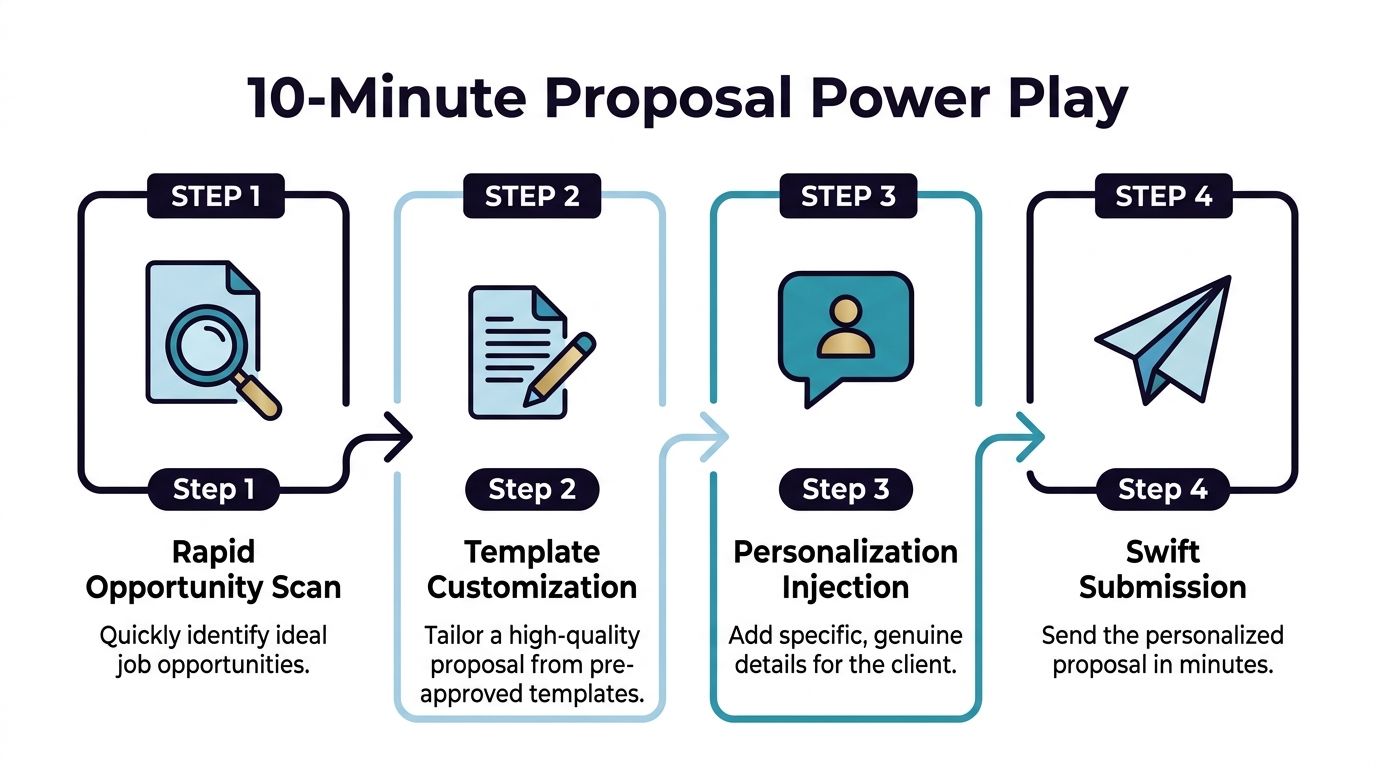
The 10 minute proposal power play
Here’s what that flow looks like in practice.
A strong system does four jobs fast. It identifies the opportunity, matches it to the right proposal structure, injects relevant personalization, and gets the bid submitted before the client inbox becomes crowded.
The underserved reality on freelance marketplaces is that AI-driven automation changes the sales cycle dramatically. Members of platforms like Earlybird AI report double-digit reply rates and cycles shortened to days through automated proposals submitted in 10 minutes and replies in under 5 minutes, as noted in this discussion of sales cycle rules.
Build a proposal component library
Fast personalization only works if the building blocks already exist.
Your team should maintain a library of approved components such as:
- Opening angles: Different first paragraphs for lead generation, SEO, paid ads, design, development, and content work.
- Proof snippets: Short project examples by industry, use case, and deliverable.
- Capability blocks: Clean explanations of how you handle audits, builds, strategy, implementation, reporting, or optimization.
- Objection answers: Prewritten language for timeline concerns, handoff concerns, or scope uncertainty.
- Call-driving closers: Short endings that move the client toward a reply, not a generic “let me know.”
This isn’t about sending canned proposals. It’s about reducing blank-page time so human judgment goes where it matters.
Personalization should be narrow and visible
Most bad proposals fail in one of two ways. They’re generic, or they’re overpersonalized in a way that wastes time without improving relevance.
Good marketplace personalization is concise and obvious. The client should see within a few lines that you understood the brief.
That usually means referencing details like:
- the exact deliverable they asked for
- a likely risk in the project
- a similar engagement shape you’ve handled
- a practical first step you’d take
- a question that proves you noticed what others missed
If the client can’t spot the custom part in the first screen of text, the proposal probably isn’t personalized enough.
What the workflow looks like in real life
Before building a system, many agencies operate like this:
- someone manually refreshes the feed
- good jobs sit for too long
- proposals get written from scratch
- client replies wait in a queue
- follow-up depends on memory
After systemizing, the sequence changes:
- Qualified job appears
- A matching proposal framework is selected
- Relevant proof and service blocks are inserted
- Client-specific details are added
- Proposal goes out quickly
- Any incoming message gets a near-immediate reply
- The thread moves toward a call or a clear decision
That’s how you shorten the sales cycle without lowering standards. You remove hesitation, hunting, and manual coordination.
For teams looking at this specific motion, automating Upwork proposals is the operational mindset to study: fast identification, structured customization, and rapid response.
Response speed after the proposal matters just as much
A lot of agencies think the proposal is the key event. It isn’t. The first client reply is where momentum either compounds or dies.
If the client asks a question and your team answers much later, the interaction cools off. If the client gets a quick, competent response, they keep engaging. That’s especially true on Upwork because buyers are often messaging several freelancers at once.
This is one of the biggest hidden levers in how to shorten your sales cycle. Proposal speed gets you seen. Reply speed gets you considered.
What doesn’t work here
The failures are predictable:
- Overwriting the proposal: Long copy slows submission and often lowers response quality.
- Using one master template for everything: Clients can smell that instantly.
- Treating every lead like a custom pitch deck: That model is too slow for marketplace timing.
- Waiting to answer messages manually: Responsiveness drops as workload rises.
- Stuffing in every credential: Relevance beats completeness.
The agencies that win fastest don’t sound robotic. They sound prepared.
Systematizing Follow-Ups and Securing the Call
Most proposals don’t die because the buyer said no. They die because nothing specific happened next.
That’s why follow-up needs structure. In B2B sales, one of the most useful frameworks for this is the Mutual Action Plan, or MAP. On Upwork, the same idea works when you shrink it into a lightweight version that fits a faster buying rhythm.
Use a micro MAP for every live opportunity
A marketplace deal doesn’t need a heavy document. It needs a simple map of the next few actions.
That micro-MAP might look like this:
- Proposal sent: The initial message makes one clear promise and one clear next step.
- Client reply received: Your response answers directly and pushes toward a call or project clarification.
- Call invitation issued: Scheduling options are offered immediately.
- Post-call path defined: The client knows whether the next step is a scope summary, sample task, or contract start.
The value is in specificity. Vague threads create stall points.
Implementing a Mutual Action Plan methodology can accelerate deals by 30-50%, and teams using MAPs and automation reduce time-to-first-meeting by up to 50% by removing vague next steps. Vague next steps are responsible for 80% of stalled deals, according to this breakdown of MAP-driven sales acceleration.
Follow up like a system, not like a hopeful seller
Most agencies either under-follow-up or overdo it awkwardly. The middle path is better. Follow-up should feel consistent, calm, and useful.
A good sequence usually includes:
- A short first nudge: Confirm interest and restate the practical next step.
- A context-based follow-up: Reference the project outcome, timeline, or question they raised.
- A friction-removal message: Offer a simple call option or a concise scope recap.
- A clean closeout: If there’s no movement, end professionally and leave the door open.
The tone matters. Don’t chase. Advance.
Field note: Every follow-up should answer one question: what is the easiest sensible next move for this client?
Remove scheduling friction
Getting from “sounds good” to “let’s talk” often breaks because scheduling becomes manual.
That shouldn’t happen. Once a client shows interest, the path to a call needs to be immediate. If your team delays while asking what time works, checking calendars, or relaying options across bidders, you lose speed at the exact moment the buyer is warm.
For practical ideas on this stage, the playbook on how to follow up with clients covers the mechanics of turning message threads into booked conversations.
The handoff from chat to call
The cleanest handoff usually includes three elements:
- A summary of what you understand
- A proposed next action
- A low-friction booking option
That combination reassures the client that you listened, know what comes next, and won’t create administrative drag.
What doesn’t work is leaving the thread open-ended. “Let me know” invites drift. “If helpful, I can walk you through the approach on a quick call and outline the first deliverables” gives the client something concrete to accept.
The Analytics Feedback Loop for Unstoppable Growth
Most agencies track activity. Very few track the right activity.
That difference matters. Sending more proposals won’t teach you much by itself. What shortens the sales cycle is understanding where speed helps, where it doesn’t, and which behaviors show up in faster wins.
According to a McKinsey & Company study, companies that integrate data into their sales processes achieve 5-6% higher profitability and productivity than competitors, and analyzing pipeline metrics to replicate top-performer behavior can produce a sales cycle reduction of up to 50%, as summarized in this article on data-driven sales acceleration.
Track cycle metrics, not vanity metrics
You don’t need a complicated dashboard. You need a useful one.
For an Upwork agency, the most practical metrics are:
- Time from job post to proposal submission
- Reply rate by project type
- Interview rate by proposal angle
- Time from first reply to booked call
- Time from call to hire
- Win rate by service line
- Ghost rate by client type
These metrics tell you where the delay lives. Sometimes the issue is speed. Sometimes it’s the proposal opening. Sometimes it’s the kind of client you’re chasing.
Look for fast-close patterns
Your best data often comes from your quickest wins.
Review those deals and ask:
- What kind of client posted them?
- Which wording in the job post correlated with fast replies?
- What proposal structure got the response?
- Was the first client message answered quickly?
- Did the deal go straight to call, or through a longer Q&A thread?
That review helps you isolate high-velocity patterns. Once you know them, you can build your outreach around them instead of guessing.
Use data to coach behavior
A lot of sales analytics stay abstract. The better use is behavioral.
If one bidder consistently gets replies, inspect what they do. Maybe they ask sharper opening questions. Maybe they keep proposals shorter. Maybe they move to scheduling faster. In broader sales settings, teams have reduced cycle length by coaching reps to copy the habits of top performers. The same principle works on Upwork because the signals are visible in writing and timing.
A simple review cadence works well:
- Weekly: scan replies, interviews, and stalled threads
- Biweekly: compare project categories and proposal styles
- Monthly: adjust ICP filters, component library, and follow-up language
Good analytics don’t just tell you what happened. They tell your team what to repeat and what to stop doing.
What agencies often measure too much
There are a few traps here.
Proposal count can create false confidence. Profile impressions can be interesting but not actionable. Long internal notes about every interaction often create reporting work without changing behavior.
Keep the loop tight. Track what changes decisions. Then act on it quickly.
That’s how the system gets smarter over time. Each proposal isn’t just a chance to win a client. It’s also a data point that sharpens your next move.
Scaling Your Agency and Protecting Your Account
An agency usually hits a wall right after early traction.
One person can monitor the inbox, write every proposal, remember every client thread, and keep quality high. Then volume rises. A second bidder joins. Replies start landing at the same time. Handoffs get messy. Two people answer the same client, or nobody answers because each assumed the other owned it. Sales slows down for operational reasons, not because demand disappeared.
That is the point where agencies blame automation for problems that stem from weak process design.
Multi-user scale needs clear ownership
Upwork rewards speed, but agency scale only works when speed has structure behind it. In practice, that means every lead needs an owner, every stage needs a handoff rule, and every proposal needs to come from the same approved system instead of each bidder improvising.
Set the rules before adding volume:
- Assign job types by owner
- Define how opportunities get routed
- Approve proposal blocks and proof points in advance
- Set the exact handoff from bidder to closer
- Log client context in one place
- Make one person responsible for each follow-up thread
Without that operating model, adding more bidders just adds more variance.
The marketplace trade-off is real. Agencies need first-mover speed because clients often review early proposals first, but they also need consistency because one sloppy thread can damage trust across the whole account. The answer is not to slow the team down. The answer is to make fast actions repeatable.
Safety comes from constraints
Good automation should narrow behavior, not widen it.
The safest setup uses approved messaging logic, qualification rules, normal reply patterns, and tight access controls. Human judgment still matters at the points where nuance matters most: deciding whether a job fits, adjusting the angle for a high-value client, and handling objections once a conversation turns specific.
That structure protects both conversion and the account itself.
A tool like Earlybird AI can support that model by connecting to an Upwork account, learning from project feedback, automating proposal submission and replies, supporting multi-user workflows, using clean regional IPs, and avoiding password storage.
Where agencies usually create risk
Account issues rarely start with one dramatic mistake. They usually come from repeated small failures in team coordination.
Common examples include:
- one bidder chasing poor-fit jobs just to raise activity
- another using messaging that does not match the agency's positioning
- inbox replies sitting untouched because ownership is unclear
- two team members engaging the same lead
- faster outreach exposing a generic profile that was never tightened up
Those are management problems. Automation just makes them visible faster.
Protect the account by designing the sales process correctly
Agency owners should treat account protection as part of revenue operations, not as a technical side note.
If the workflow feels unsafe, the team hesitates. Response times slip. Qualified leads cool off while someone checks who should reply or whether the tool can be trusted. On Upwork, that delay costs more than it would in a traditional B2B pipeline because the buying window is shorter and competition is sitting in the same feed.
The practical model is simple. Automate repetitive actions. Keep qualification strict. Review high-judgment moments manually. Use tools built for marketplace workflows instead of forcing a generic outbound stack into a platform with different rules.
That is how an agency scales without turning speed into account risk.
Frequently Asked Questions About Sales Cycle Automation
Does automation make proposals sound generic
It can, if you automate the wrong part.
The fix is to automate speed and structure, not thought. Use automation to identify jobs, select the right proposal framework, insert approved proof blocks, and trigger quick replies. Keep the actual client-specific angle narrow and visible. That’s what preserves relevance.
A generic proposal usually comes from weak inputs, not from automation alone.
How fast should an agency respond on Upwork
Fast enough that the client still feels active urgency.
On marketplaces, delay changes the buyer’s attention. If the proposal lands while they’re still reviewing early options and the reply comes back quickly when they engage, you stay in the active set. If you respond later, you often end up reopening a conversation the client has already moved past.
That’s why agencies that shorten their sales cycles treat responsiveness as part of sales execution, not as admin work.
Should every job get a follow-up sequence
No. Only qualified opportunities should get structured follow-up.
If the lead was weak from the start, follow-up won’t rescue it. But if the opportunity matched your ICP and the client showed some signal of intent, then a disciplined sequence helps keep the thread alive and reduces the odds that momentum dies from vagueness or timing drift.
The key is matching persistence to fit.
What should I track first if I have no analytics setup
Start with a small set:
- time from job posted to proposal sent
- reply rate
- interview rate
- time from first reply to booked call
- time from call to hire
- win rate by project type
That gives you enough visibility to find the biggest leak. Once those numbers are visible, you can adjust qualification, proposal style, and follow-up speed with much more confidence.
Is this playbook only for large agencies
No. Solo freelancers can use the same logic.
The difference is scale, not principle. A solo operator still benefits from tighter qualification, faster submissions, reusable proposal components, quick replies, and analytics. Agencies just feel the payoff more dramatically because coordination problems multiply with team size.
How do I keep automation compliant and safe
Use a system with clear safeguards. Keep messaging frameworks approved. Limit automation to workflows that fit normal marketplace behavior. Avoid unsafe credential practices. Make sure the team knows who owns each stage of the conversation.
The biggest compliance mistakes usually come from improvisation. Safe systems are explicit. They define what gets automated, what gets reviewed, and how the team works inside those boundaries.
What is the biggest reason agencies fail to shorten the cycle
They optimize one stage and ignore the rest.
A faster proposal won’t fix weak qualification. A great follow-up sequence won’t fix slow initial response. Better analytics won’t help if nobody uses the insights to change behavior. The shortest sales cycles come from chaining small reductions in delay across the whole path from discovery to call booking.
When should a client conversation move to a call
As soon as there’s enough clarity to make a call productive.
If the client is asking detailed questions, comparing options seriously, or showing urgency around delivery, a call often beats a long message thread. The goal isn’t to force a meeting too early. It’s to avoid letting useful momentum dissolve into endless typing.
A short, well-timed call usually compresses uncertainty faster than a long back-and-forth.
If you want a system that helps your agency qualify jobs, submit personalized Upwork proposals in about 10 minutes, reply to clients in under 5 minutes, follow up until a call is booked, and coordinate multiple bidders without messy handoffs, take a look at Earlybird AI. It’s built for agencies that want a faster, more structured path from opportunity to conversation while keeping account safety in view.