
← Back To Blog
How to Write Cover Letter in Upwork: Win More Jobs
Most freelancers learn how to write cover letter in Upwork the hard way. They send proposal after proposal, hear nothing back, then assume the problem is price, bad luck, or too much competition.
Sometimes it is competition. Upwork’s freelancer base exceeded 18 million in 2025, which means every decent job attracts attention fast, and clients move through proposals quickly according to this 2025 guide. But the bigger issue is usually simpler. The proposal reads like a résumé summary instead of a sales message.
A strong Upwork cover letter isn’t formal. It isn’t long. It isn’t about sounding impressive. It’s a short decision-making tool that helps the client answer one question fast. “Does this person understand what I need, and do I trust them enough to reply?”
That’s why structure matters more than most freelancers think. Empirical tests found that stronger proposal styles reached 51 to 52% hiring success, while weaker variants landed at 31 to 38% according to this source data. That gap tells you the outcome isn’t random. The format, opener, proof, and close change what happens next.
If you run an agency or send proposals every day, the challenge gets harder. You can’t spend an hour writing each one. You also can’t blast copy-paste templates and expect replies. The work is finding a repeatable system that still feels personal.
Introduction
The cover letter is the first sales asset the client sees, and on Upwork it often does more work than your profile.
Clients aren’t reading proposals like a hiring manager reads a traditional application. They scan. They compare. They make quick decisions with limited attention. If your first lines are weak, the rest of the proposal might as well not exist.
That’s why generic intros fail so badly:
- “I’m excited to apply” says nothing useful.
- “I have X years of experience” puts the focus on you too early.
- “I can do this job perfectly” sounds like every other proposal in the queue.
A winning proposal does four things in a tight sequence.
- It proves you read the post.
- It shows you understand the actual problem.
- It gives one piece of believable proof.
- It asks for a clear next step.
That’s the practical frame. Not clever writing. Not long storytelling. Just relevance, proof, and momentum.
Practical rule: Your cover letter is not there to close the deal. It’s there to earn the reply.
When people ask how to write cover letter in Upwork, they usually want a template. Templates help, but only if you understand what each line is supposed to do. Otherwise, you end up with polished filler.
The good news is that small changes have outsized effects on Upwork. A sharper opener, a more specific proof point, or a better call to action can turn ignored proposals into conversations. Once you build that into a system, you stop relying on one-off luck and start creating steady client acquisition.
The Anatomy of a High-Converting Proposal
Open any busy Upwork job and the pattern shows up fast. A client posts a clear need, then gets a stack of proposals full of recycled intros, vague experience claims, and long paragraphs that delay the point. The proposal that gets a reply usually feels easier to evaluate. It gives the client a reason to keep reading, a reason to believe, and a reason to respond.
That is the job of proposal structure. Good writing helps, but structure carries more weight because it reduces decision friction for the buyer.
The four parts that actually matter
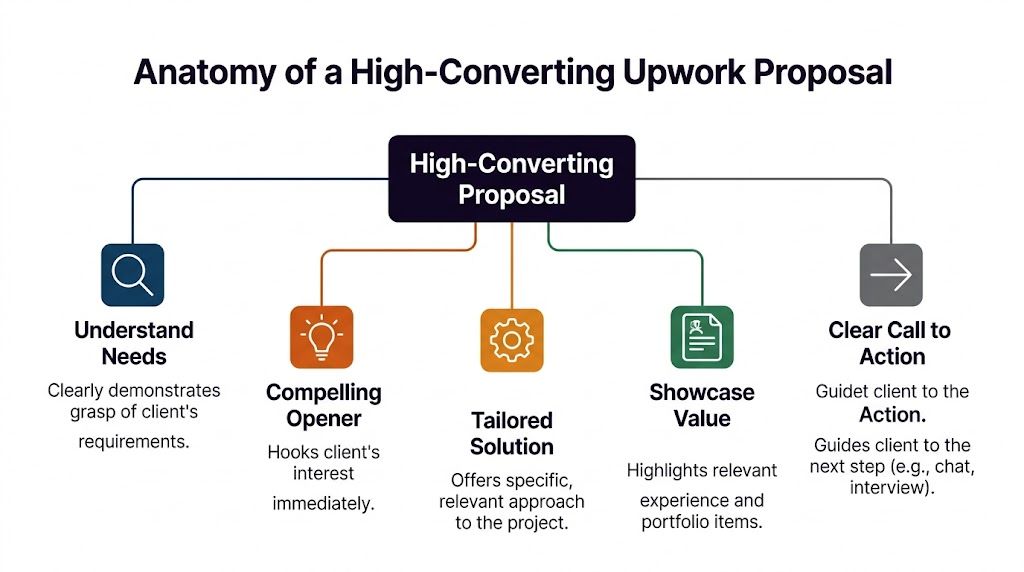
After sending thousands of proposals across agency and freelancer accounts, I have found that high-converting proposals are usually built from the same four parts:
- The hook
The first line proves relevance. It points to a detail in the post, the likely bottleneck, or the outcome the client is trying to get. - The approach
This is the brief diagnosis. Show how you would handle the work in practical terms. One to three concrete steps is enough. - The proof
Give one credible signal that lowers risk. That could be a similar result, a portfolio sample, a short case example, or a specific process you use to avoid common failures. - The next step
End with a low-friction action. Suggest a short call, offer to review one asset, or propose a small first milestone.
This order works because it follows the buyer's internal checklist. Relevance comes first. Capability comes second. Trust comes third. Action comes last.
What changes when you write for scale
A lot of advice about how to write cover letter in Upwork assumes you are sending a few hand-crafted proposals a week. That breaks down when you are managing volume.
Agencies and power freelancers need a system that keeps quality high without turning each proposal into a 20-minute writing exercise. The fix is not a generic template. The fix is a repeatable framework with swap-in components for different services, client types, and job post patterns.
That means the structure stays stable, while the details change. The opener reflects the post. The approach matches the scope. The proof matches the industry or deliverable. The call to action fits the deal size.
Before and after opening lines
Here is where proposal quality usually drops.
Weak opener:
- “Hi, I’m interested in your project and believe I’m the perfect fit.”
Better opener:
- “Your landing page likely needs sharper message hierarchy before you spend more on traffic. I’d review the hero, CTA flow, and objection handling first.”
Weak opener:
- “I have extensive experience in web development and design.”
Better opener:
- “From the post, this looks like a trust problem as much as a design problem. Slow load times and dated visuals usually hurt conversions before users read the offer.”
Weak opener:
- “I’ve worked with many clients and always deliver quality work.”
Better opener:
- “If you want fewer revision rounds, I’d set acceptance criteria early and send milestone drafts so feedback happens before final delivery.”
The stronger versions do more than sound better. They make evaluation easier. The client can quickly see what you noticed, how you think, and whether your process fits the job.
A flexible framework beats a rigid template
Use a simple build order:
- Line 1 identifies the problem or goal
- Line 2 shows your angle or approach
- Middle adds one piece of relevant proof
- Final line offers a clear next step
That framework gives you speed without turning your proposal into filler. It also makes delegation easier if you run a team and need proposal quality to stay consistent across multiple senders.
If you want the operational side to match the writing, this guide on submitting a proposal on Upwork is a useful companion because it ties message structure to the actual send workflow inside the platform.
A strong proposal reads like a short client diagnosis with proof, not a self-introduction.
That distinction matters. It is how you keep proposal quality high while still sending enough volume to create a reliable pipeline.
Crafting an Opener That Demands a Reply
A client posts a job at 9:00 a.m. By 9:20, there are already 20 to 50 proposals in the queue. They are not reading every word. They are scanning for one sign that a freelancer or agency understands the job.
That is why the opener carries so much weight. Upwork notes in its own guidance on how to write a proposal that stands out that strong proposals should address the client’s specific project needs early, not lead with a generic self-introduction. In practice, that first block of text decides whether the rest gets read.

What a good opener does
A good opener reduces client effort.
It gives the buyer a fast reason to believe three things: you understood the job, you see the risk correctly, and you know what to do first. That matters even more if you send proposals at scale, because volume only works when the first lines still feel job-specific.
The strongest openings usually do one of three jobs:
- Name the problem
“Your Shopify product pages likely need stronger structure before ad spend scales.” - Identify the decision risk
“From the post, this looks less like a design issue and more like a messaging clarity problem.” - Point to the first useful move
“If your goal is cleaner client reporting, I’d standardize attribution before touching dashboard design.”
Each version gives the client something concrete to react to. That is what gets replies.
Build opener blocks, not one template
Writing every opener from zero is slow. Sending the same intro on every job burns your response rate. Agencies that win consistently use a middle system: reusable opener blocks with clear variables.
I keep these blocks organized by service line and buying situation. A paid ads opener is different from a UX opener. A rushed rescue project needs a different first sentence than a long-term retainer.
Examples:
- “You’re hiring for [task], but the bigger issue looks like [business problem].”
- “Your post suggests two priorities: [priority one] and [priority two]. I’d handle them in that order.”
- “The quickest way to improve this is usually [specific action], especially since you mentioned [constraint].”
Then swap in details from the post:
- platform
- audience
- bottleneck
- deliverable
- timeline
- approval or handoff constraints
That system keeps quality high without forcing a full rewrite every time. If you want to systemize this across a team, this guide on automating Upwork proposals without losing relevance covers the operational side.
Three opener mistakes that kill replies
Weak openers usually fail in predictable ways.
- They start with a biography
“I am a professional freelancer with 7 years of experience” gives the client no reason to keep reading. - They open with enthusiasm instead of judgment
“I’d love to work on this” is harmless, but it does not help the buyer evaluate fit. - They explain too much too early
A long first paragraph creates friction. The opener should create interest, not cover the whole solution.
Here’s a useful breakdown of proposal writing in motion:
If the first sentence could fit any job post, it is filler.
That is the failure point I see most often. Freelancers spend time personalizing the middle of the cover letter, but the opening line stays generic, so the client never reaches the part that took real effort.
Tailoring Your Proposal Without Wasting Time
“Personalize every proposal” is correct advice. It’s also incomplete.
If you’re a solo freelancer sending a few proposals a week, manual writing is manageable. If you run an agency or send proposals daily, it turns into a bottleneck fast. You need a system that keeps the message relevant without rebuilding it from zero every time.
Read the post like a buyer, not a bidder
Most freelancers read a job post looking for qualification signals. Smart bidders read for buying signals.
Look for:
- Urgency
Do they need help now, or are they browsing? - Risk
Are they worried about quality, speed, communication, technical complexity, or reliability? - Decision style
Do they sound detailed, rushed, skeptical, technical, or vague? - True outcome
What do they really want beyond the task itself?
A client asking for “a website redesign” might want one of four things:
- better conversions
- cleaner branding
- improved speed
- easier maintenance
Your proposal should speak to that real outcome. That’s tailoring.
Build reusable blocks, not one giant template
The fastest agencies don’t use one proposal template. They use modular components.
Create a library with:
- opening lines by service and problem
- proof snippets by niche
- portfolio references by deliverable
- CTA options by project type
- questions for vague job posts
That lets you assemble a custom letter quickly.
For example, your proof library might include:
- an e-commerce redesign example
- a SaaS onboarding flow example
- a cold email deliverability example
- a paid social audit example
Then you choose the closest fit and adapt the wording to the post.
Proof beats promises
Clients have seen every promise already. “I can do this perfectly.” “I deliver high quality.” “I’m detail-oriented.” None of that helps.
What helps is evidence:
- a relevant portfolio piece
- a similar project
- a process artifact
- a specific before-and-after outcome if you have one and can state it truthfully
- a short explanation of how you’d reduce risk
This matters even more because freelancers with Upwork portfolios are hired 9 times more often if you have relevant portfolio items with public feedback, mention them directly in the proposal.
A simple line works:
- “I’ve attached the closest example from my Upwork portfolio. It shows the same kind of checkout flow cleanup you’re asking for.”
That is more persuasive than three paragraphs of self-description.
Where automation fits
Manual-only advice breaks down when volume rises. If your team handles many proposals across multiple bidders, the process needs support.
Tools can help with first drafts, component selection, timing, and analytics. The key is to keep human judgment on job fit, proof selection, and final tone. For teams exploring scale, this overview of automate Upwork proposals is worth reading. Earlybird AI is one option in this category. It connects to an Upwork account, learns preferred job types from feedback, and drafts personalized proposals based on the job post.
Use systems to speed up assembly. Don’t outsource judgment.
Showcasing Your Value and Guiding the Next Step
A client opens your proposal between meetings, scans it for 10 seconds, and asks one question: “Does this person look like the low-risk option for this exact job?”
That is the standard your proposal has to meet.
Once the opener has done its job, the middle and close need to do two things well. First, prove fit with evidence the client can verify fast. Second, make the next step easy enough that replying feels lighter than ignoring you.

Show outcomes, not job history
Long background summaries rarely help here. Relevant proof does.
Clients care about overlap between your past work and their current problem. The closer the match, the less explanation you need. I have won plenty of projects with a short proposal and one sharp proof point because the sample made the decision easier.
Strong proof usually falls into one of these buckets:
- Relevant project match
“I’ve handled B2B SaaS onboarding email projects where activation dropped right after signup, which is close to the issue you described.” - Specific artifact
“I can share the audit template I use before any SEO rewrite starts, so you can see how I’d evaluate the current pages.” - Process clarity
“I’d run this in four stages: review, draft, revision, and implementation, so approvals stay clear and the work does not stall.”
Hard numbers help when you have them and can verify them. If you cannot, use concrete detail instead of vague claims. Specificity still signals competence.
Put proof where the client can check it quickly
Use proof that is one click away, not buried in a long explanation.
Good options include:
- Upwork portfolio items
- public feedback on similar projects
- GitHub repos
- live pages
- Loom walkthroughs
- sample audits
- wireframes
- approved drafts
Keep the proof tight. One highly relevant sample usually beats a folder of loosely related work.
Relevance matters more than volume. A web app client does not need to see branding work. A copywriting buyer does not need a general admin portfolio. Strong proposals reduce decision friction by showing the closest comparable win.
Build a proposal system, not just a good paragraph
This is the part generic advice skips. Writing one thoughtful proposal by hand is manageable. Sending high-quality proposals every day across multiple services, team members, and client types is an operations problem.
Agencies and power freelancers need a repeatable system:
- one step for fit review
- one step for selecting the right proof block
- one step for final tone check
- one step for tracking replies by service and proposal type
- one step for follow-up ownership
That structure matters because top freelancers often win through disciplined volume, not just brilliance on a single bid. Upwork notes in its freelancer resources that a strong profile and portfolio improve hire likelihood, which supports the same operating principle: proof and consistency beat generic effort at scale.
The trade-off is real. Full manual customization can raise quality on a few bids, but it collapses when volume rises. Full automation keeps output high, but quality drops if nobody checks fit, proof, and CTA. The workable middle ground is templated assembly with human review on the parts that change outcomes.
End with a next step the client can say yes to
A weak close forces the client to decide too much. A strong close gives them a small next move.
Use CTAs like:
- “If helpful, I can send the closest sample and outline the first milestone.”
- “I can review your current version and point out the first fixes I’d make.”
- “If scope is still flexible, send the main constraint and I’ll suggest the cleanest starting point.”
Each one gives the client a simple action and a reason to reply.
After the proposal is sent, timing and structure still matter. This guide on how to follow up with clients after sending an Upwork proposal covers that part well.
Good proposals do not just describe value. They make the next decision easy.
Advanced Strategies and Common Mistakes to Avoid
Most proposal mistakes aren’t dramatic. They’re small habits repeated over and over.
Quick answers to the mistakes that cost replies
Should you write longer proposals to sound thorough?
No. Tight writing signals confidence. Long proposals usually bury the useful part.
Should you open with your background?
Only if your background is the most relevant thing in the room. Usually it isn’t.
Should you discuss price immediately?
Not unless the post asks for it or your pricing model is part of the solution. Early pricing talk can distract from fit.
Should you answer screening questions with one-liners?
No. Treat them like mini sales assets. Short is fine. Empty isn’t.
Should you use the same CTA every time?
No. Match the CTA to the buying context. A vague exploratory project needs a different close than a ready-to-hire client.
The role of boosted proposals
Boosting can help visibility, but it won’t rescue weak writing. Boosted proposals are 17% more likely to be seen according to the 2025 reference. That helps only if the proposal preview earns attention once seen.
Use boosting selectively:
- for jobs that closely match your strongest proof
- when the client has clear intent
- when your opener is sharp
- when you can reply quickly if they engage
Don’t waste boosts on bad-fit jobs with vague scope and weak client history.
Scaling without breaking quality
Manual customization remains necessary, but it doesn’t scale cleanly forever. Verified data notes that many top earners submit high proposal volume, and response quality drops without a scalable system. That’s the point where you need process.
A practical agency workflow looks like this:
- Triage first by fit, urgency, and budget quality
- Assign proof blocks based on niche and deliverable
- Personalize the opener from job-specific signals
- Review tone and clarity before sending
- Track reply patterns by offer type and client segment
The bottleneck usually isn’t writing speed. It’s decision quality under volume.
The agencies that win consistently don’t write magical proposals. They remove sloppy decisions from the process.
Upwork Cover Letter FAQ
How long should an Upwork cover letter be
Keep it short. Best practice from the verified sources puts strong proposals around 150 to 250 words, depending on the source and situation. Shorter works when the fit is obvious. Slightly longer works when the project is technical and you need one layer of proof.
What if the job post is vague
Don’t complain about the lack of detail. State your best read on the project, then ask one smart question.
Example:
“From the post, it sounds like the main priority is getting the campaign live quickly without messy handoff. If that’s right, I’d start with asset review and tracking setup. Is speed or reporting accuracy the bigger priority?”
Should I include my rate in the cover letter
Usually no, unless the client asks for it or the pricing structure helps clarify scope. In most cases, lead with fit and approach first.
How should I answer screening questions
Answer them directly. Don’t repeat your cover letter word for word. Use each question to add one new piece of proof, process, or judgment.
When should I follow up
Follow up when enough time has passed for the client to review proposals and when you still have something useful to add. Don’t send “just checking in.” Send a small insight, clarification, or next-step prompt.
If you’re sending a high volume of Upwork proposals and need a way to keep personalization without turning your team into full-time bidders, Earlybird AI is built for that workflow. It helps agencies and freelancers identify fit, draft customized proposals, automate replies and follow-ups, and manage outreach across accounts without relying on copy-paste templates.