← Back To Blog
LinkedIn Lead Generation Services: A Buyer's Guide
You're probably looking at the same problem most agency owners and service firms hit after referrals stop being enough. The pipeline looks uneven. Your closers are capable, but they're spending too much time finding conversations instead of running them. Someone on the team says, “Let's get help with LinkedIn,” and then significant confusion starts.
Because linkedin lead generation services can mean very different things. One provider is doing careful account research, personalized outreach, and CRM handoff. Another is blasting connection requests from a half-automated setup that can irritate prospects and put your brand at risk. On paper they both sell “lead gen.” In practice, they are nowhere near the same product.
LinkedIn is still where B2B buyers and sellers naturally overlap. By 2026, LinkedIn reports more than 1.3 billion members globally, and industry roundups note that 89% of B2B marketers use LinkedIn for lead generation while 62% say it actively produces leads for them, which is why it remains such a strong B2B discovery channel according to Sprout Social's LinkedIn statistics roundup. But that doesn't mean outsourcing it is automatically smart. It only works when the provider's process, safety practices, and handoff discipline match how your sales team operates.
What Are LinkedIn Lead Generation Services
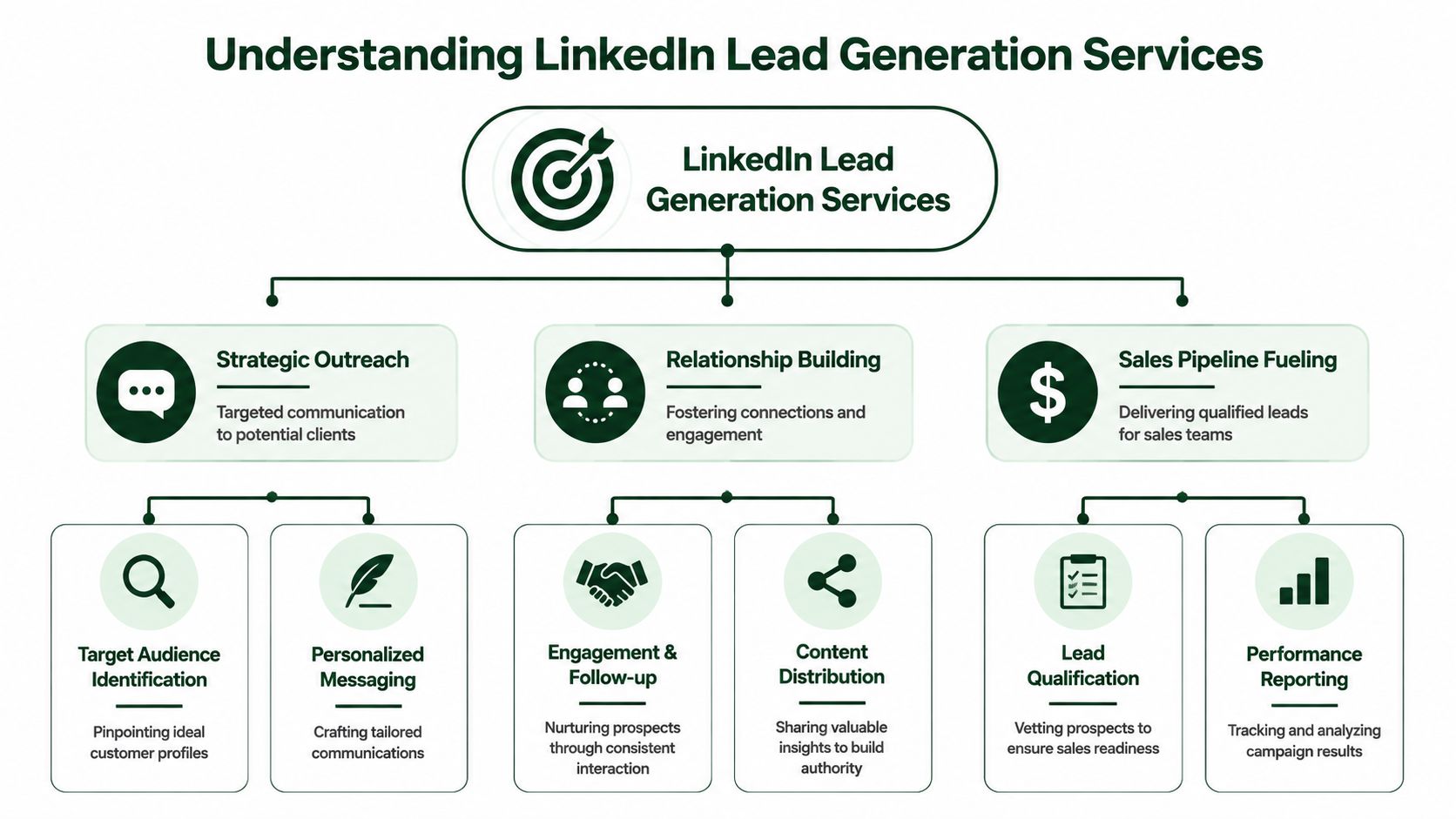
At a practical level, linkedin lead generation services are outsourced top-of-funnel sales operations. A provider helps define who you want to reach, builds prospect lists, writes outreach, manages follow-ups, qualifies interest, and routes opportunities to your team.
A good service is not just “someone sending DMs.” It's closer to hiring a specialized outbound function that happens to work inside LinkedIn's professional graph. That matters because the work is only valuable if it creates a repeatable flow of sales conversations, not just vanity activity.
What the service should actually include
Most credible providers handle a mix of these jobs:
- ICP definition. They help narrow the ideal customer profile by role, company type, market, and buying context.
- List building. They use tools such as Sales Navigator to find the right people instead of broad, low-fit audiences.
- Message development. They write outreach that sounds like a person, not a template stitched together with merge fields.
- Sequencing. They plan follow-ups, not just a first touch.
- Qualification and booking. They identify who is worth handing to sales and who still needs nurturing.
- Reporting. They show whether outreach is creating replies, meetings, and pipeline movement.
What you're really buying
The outcome isn't “more LinkedIn activity.” The outcome is sales efficiency.
If your account executives or founders are spending hours prospecting, a strong provider removes that burden and lets them focus on discovery calls, proposals, and closing. The provider becomes an extension of your sales team, but only for the repetitive work that requires discipline and process.
Practical rule: If a vendor talks mostly about connection volume and barely talks about qualification, handoff, or CRM routing, you're not buying pipeline support. You're buying activity.
LinkedIn works especially well when the service understands that trust builds before meetings do. Some prospects respond from direct outreach. Others need to see profile credibility, relevant engagement, or your content before they reply. That's why the best services think in touches, not blasts.
Comparing Service Models Agencies Freelancers and Tools
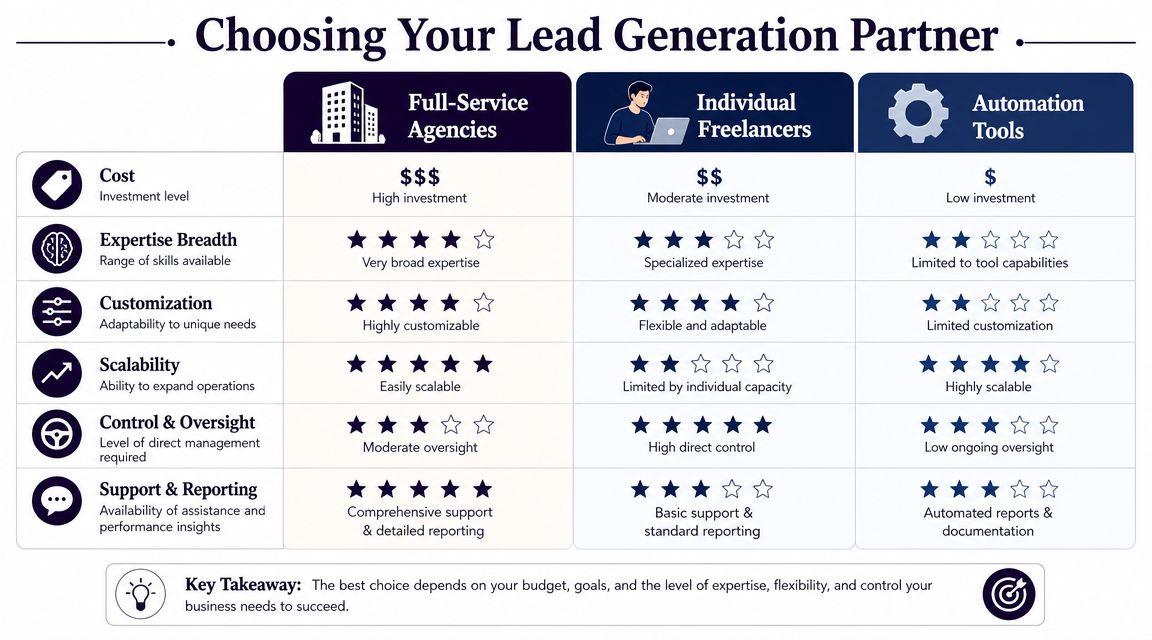
Choosing a provider starts with a blunt question. Do you want strategy, execution capacity, software, or some mix of the three?
Different models solve different problems. The mistake buyers make is comparing them as if they're interchangeable.
Agencies
An agency is usually the best fit when you want a managed program with strategy, execution, reporting, and some accountability around outcomes. They're useful if you need campaign design, copy, prospecting, follow-up logic, and operational oversight without building that capability in-house.
The trade-off is cost and distance from the customer voice. Some agencies are excellent. Others put junior operators on your account, learn slowly, and default to generic messaging.
Agencies make the most sense when you need a team, not a contractor.
Freelancers
A skilled freelancer can be a smart middle ground. They often write more naturally, adapt quickly, and work closely with founders or lean sales teams. For smaller firms, that can be a better cultural fit than a larger agency.
The downside is bandwidth. One person can only manage so many campaigns, accounts, and follow-up threads well. If that freelancer gets overloaded, quality slips first and reporting slips next.
Tools
Software provides an advantage, not judgment. Tools can help with list building, sequencing, enrichment, messaging workflows, and reporting. But tools still need a clear ICP, sane targeting, useful copy, and human review.
That's where many in-house teams underestimate the workload. Buying software is easy. Running a safe, coherent outbound system inside LinkedIn is not. If your team is exploring automation more broadly, it helps to understand how software fits into a larger outbound stack, including AI for sales prospecting.
Later in the funnel, most strong programs combine premium LinkedIn tools, organic outreach, and paid distribution because each channel supports a different stage of buyer readiness, as discussed in Penguin Strategies' guide to LinkedIn lead generation.
Here's a useful lens for deciding:
- Choose an agency if you want done-for-you execution and can invest time in onboarding and oversight.
- Choose a freelancer if your market is narrow, your offer is clear, and you want hands-on adaptation.
- Choose tools if you already have outbound talent in-house and need process efficiency, not outsourced thinking.
A quick walkthrough can help frame the differences in setup and execution:
Most service failures aren't caused by the platform. They're caused by a mismatch between the buyer's expectations and the operator's actual capability.
Inside a Typical Lead Generation Workflow
When a linkedin lead generation service is run well, it feels methodical. When it's run badly, it feels busy but vague.
A normal engagement should move through a clear sequence from strategy to handoff. If a provider can't explain its workflow in plain language, that's a warning sign.
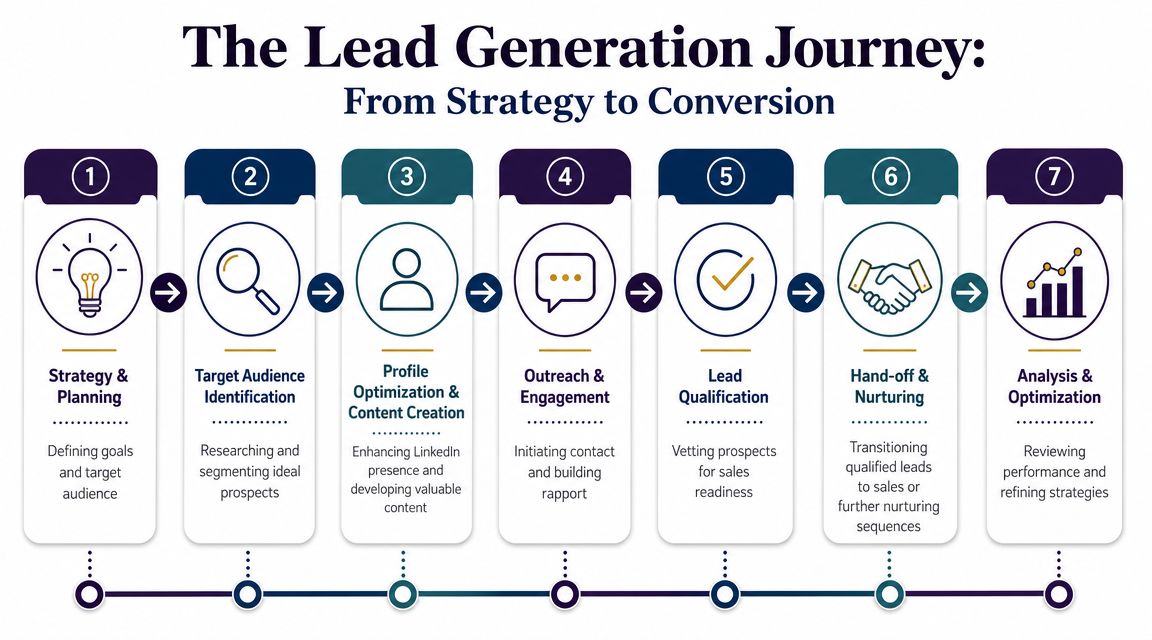
Kickoff and targeting
The work usually starts with a discovery session. During this session, the provider should pin down your offer, buyer pain points, exclusions, and what counts as a qualified conversation.
Then comes list building. Good operators don't just search by title and industry. They refine for relevance. They look at company context, likely buying triggers, and whether the person is close enough to the pain you solve to care.
Messaging and launch
Next comes profile and message review. If the LinkedIn profile that prospects will see is weak, outreach underperforms no matter how good the copy is.
Then the provider drafts the first-touch messages and follow-up sequence. You should expect to approve these. If the vendor launches without your signoff, they're treating your brand too casually.
Daily execution and response handling
Once live, the service sends outreach, monitors replies, and keeps follow-up moving. A lot of providers reveal their true level at this stage. Some know how to continue a conversation naturally. Others can only send canned prompts and fall apart when a prospect asks a real question.
A strong workflow includes:
- Daily review of replies so warm prospects don't sit untouched.
- Lead classification to separate curiosity, fit, objections, and low-quality responses.
- Calendar or sales handoff only when interest is real and context is captured.
- Campaign adjustments when a segment or message angle stalls.
If positive replies sit in an inbox waiting for someone to notice them, the campaign is leaking value before sales even gets a shot.
The best providers also close the loop after handoff. They ask whether meetings were qualified, whether the pitch matched what was promised, and which segments are converting into genuine opportunities. Without that feedback, the campaign can keep booking meetings that look good on a dashboard and go nowhere in the pipeline.
Understanding Pricing Models and Key KPIs
Pricing for linkedin lead generation services usually looks simple at first. It isn't. What matters isn't the monthly fee by itself. What matters is what work is included, what risk sits with the provider, and how cleanly the campaign connects to revenue.
Common pricing models
You'll usually see one of three structures.
- Monthly retainer. This is the most common and often the healthiest if the provider is doing research, copy, outreach, optimization, and reporting. It supports ongoing testing instead of forcing shortcuts.
- Pay per appointment. This can sound attractive because it looks performance-based. The risk is obvious. The provider gets paid for meeting volume, not meeting quality.
- Hybrid pricing. Some firms combine a base fee with incentives tied to meetings or outcomes. This can work if qualification rules are explicit.
Cheap pricing often hides expensive failure. If a vendor underprices the work, they usually make up for it with thin personalization, weak account research, or aggressive automation.
Which KPIs matter
Vanity metrics are easy to report and easy to misuse. Sent messages, connection requests, and profile views only matter if they lead to qualified conversations.
Track the metrics that show commercial movement:
- Acceptance quality. Are the right people connecting, or just anyone?
- Reply quality. Are replies positive, relevant, and from real buyers?
- Meeting conversion. How many positive conversations turn into booked calls?
- Sales acceptance. Does your sales team agree these meetings are worth taking?
- Pipeline contribution. Which campaigns produce opportunities that progress?
One useful benchmark is that a 2026 study reported LinkedIn's cost per qualified lead is 28% lower than Google Ads for B2B campaigns, despite higher CPCs, and cited a 2.74% B2B conversion rate, according to Digital Applied's 2026 LinkedIn statistics analysis. The practical takeaway is simple. Paying more for traffic can still be economical if the downstream lead quality is stronger.
What good ROI conversations sound like
Ask your provider to connect campaign results to your own sales stages. Not just booked calls. Ask what becomes a sales-qualified opportunity, what stalls, and what closes.
If they can't work with your CRM and your definitions, you'll end up with outsourced activity and internal confusion. That's not a lead generation system. That's a reporting mismatch.
Your Checklist for Evaluating a Service Provider
Most buyers ask providers the wrong questions. They ask how many messages get sent, how fast launch happens, or whether the vendor has worked in their industry. Those questions matter, but they don't expose operational risk.
The better approach is due diligence. You want to know how the provider thinks, how they work inside constraints, and what happens when prospects engage.
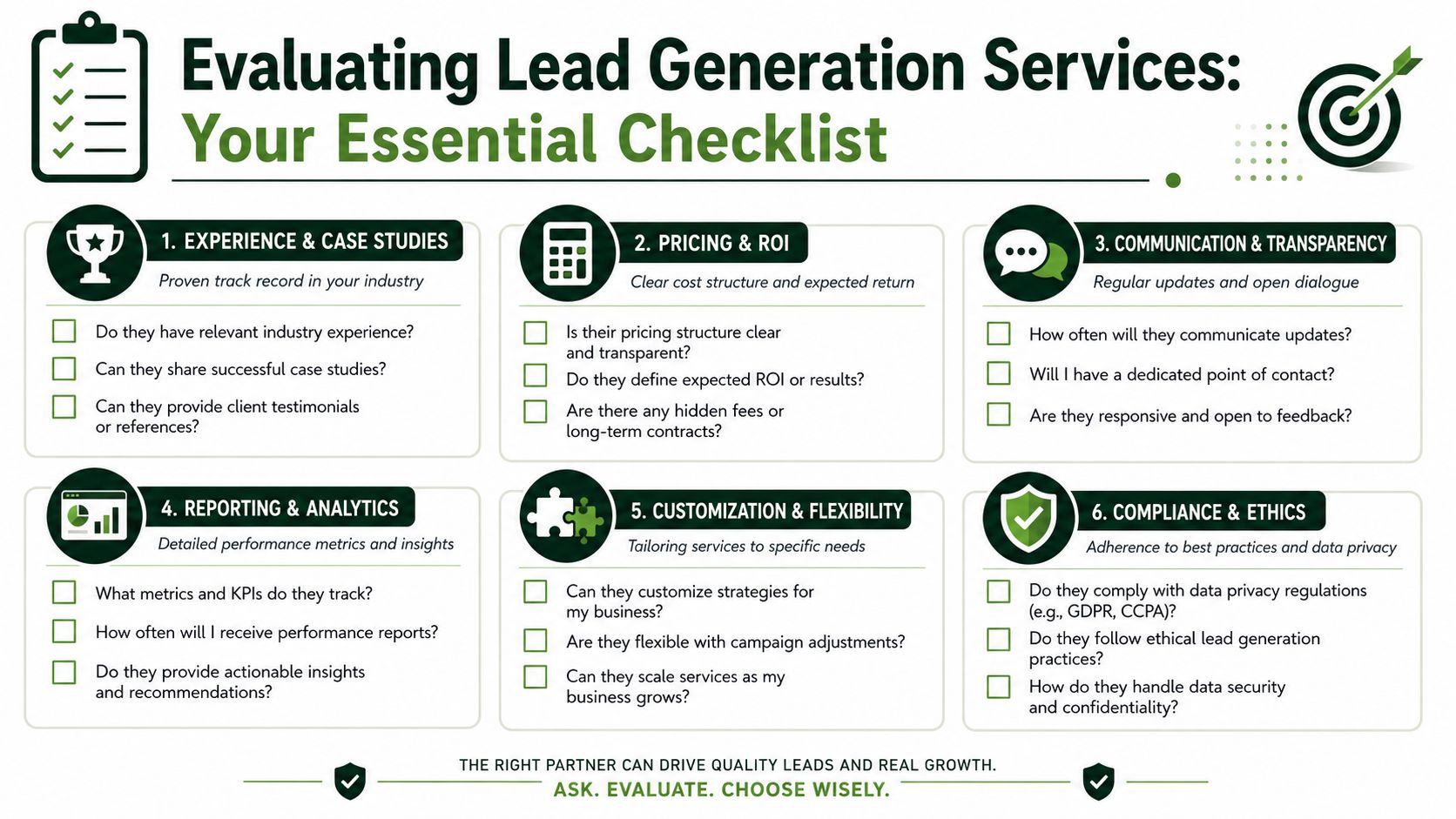
Strategy and targeting questions
Start here:
- How do you define our ICP? If the answer is broad, the campaign will be broad.
- How do you build lists? Ask what filters, exclusions, and review steps they use.
- How do you handle small TAM markets? Good providers know when precision matters more than volume.
Smaller, tighter prospect lists often outperform large loose ones because list quality controls message relevance and response quality. Providers that chase scale first usually create noise.
Messaging and personalization questions
Numerous services fall short when put to the test in practical scenarios.
Ask:
- How do you personalize beyond first name and company name?
- Who writes the copy, and who approves it?
- How do you continue live conversations when prospects reply with specifics?
If they can't answer cleanly, they're probably running templates at scale and hoping a few people respond.
Ask this directly: “Show me how you adapt messaging for different roles inside the same account.”
Workflow and reporting questions
Operational rigor is a major differentiator. Strong services treat outreach like a conversion system with personalization, immediate CRM sync, structured follow-up, and optimization around reply and meeting metrics, as outlined in Join Valley's LinkedIn B2B lead strategies.
Use questions like these:
- How quickly do positive replies reach our CRM or sales team?
- What happens to unbooked but interested prospects?
- How do you report lead quality, not just activity?
Safety and brand protection questions
This is the most ignored category, and often the most expensive to ignore.
Ask:
- What level of automation do you use?
- How do you avoid generic or premature pitching?
- Who has access to our account, and how is that managed?
- What signs tell you a campaign is becoming too aggressive or off-brand?
Providers should be able to explain their safety practices without sounding evasive. If they're vague about execution, assume the risk sits with you.
A decent provider generates meetings. A strong provider protects reputation while doing it.
Sample Outreach Templates and Measurement Tips
Templates help, but only if you treat them as starting points. Copying a script word for word is usually the fastest way to sound like everyone else in a crowded inbox.
Value-first outreach
Use this when the prospect may not be actively looking but would respond to a relevant observation.
Hi [Name], I work with [type of company] on [specific problem].
I noticed your team is focused on [relevant initiative or context]. We've seen that this usually creates friction around [specific issue].
I'm happy to share a brief idea on how teams approach that without adding more tools or process overhead. Open to it?
Why it works:
- It shows relevance without pretending you know everything about their business.
- It offers insight instead of pushing a meeting immediately.
- It leaves room for a low-pressure reply.
Problem-aware outreach
Use this when the pain is likely obvious and role-specific.
Hi [Name], reaching out because teams in [industry or role] often hit a wall with [specific challenge].
Usually the issue isn't effort. It's that [common operational bottleneck].
If that's on your side too, I can share how others structure the process so sales gets cleaner opportunities instead of more admin. Worth a quick chat?
Why it works:
- It names a real operational pain
- It frames the problem clearly
- It ties the solution to workflow impact, not hype
Measurement tips that matter
Don't rely only on the provider dashboard. Measure campaign quality inside your own systems too.
- Track source to stage progression. Did LinkedIn-sourced leads move past intro calls?
- Review meeting notes. Were prospects aligned with your ICP and offer?
- Compare operator performance. One message angle or rep may outperform another.
- Watch delayed wins. Some LinkedIn conversations convert later after re-engagement.
If you're refining your outreach process more broadly, these tactics pair well with a more detailed look at lead generation with LinkedIn.
Integrating LinkedIn Leads into Your Sales Process
A lead generation service creates value only when the rest of your sales process can absorb what it produces. Otherwise, meetings get booked, context gets lost, and your team treats outsourced leads like second-class opportunities.
Build the handoff before you launch
Before any campaign goes live, decide four things:
- Who owns first response
- Where lead data lands
- What qualifies for sales handoff
- What happens to interested but not-ready prospects
That usually means routing replies into a CRM, assigning owners automatically, and triggering a task or follow-up sequence. The exact stack varies. Some teams use HubSpot. Others use Salesforce with middleware. Leaner agencies may use simpler automation layers plus a scheduling system.
For teams comparing systems, this overview of the best CRM for agencies is a useful starting point.
Keep messaging consistent across accounts
Agencies and multi-rep teams have an added challenge. Several people may be speaking to the market at once. If those accounts use different positioning, different promises, and different follow-up standards, prospects notice.
Set rules for:
- Offer language
- Meeting qualification
- Response tone
- Escalation of objections
- Re-engagement timing
If you use software in the workflow, keep it tightly governed. As AI-driven outreach expands, operational risk and compliance matter more. Safer execution depends on human-like behavior and manual personalization instead of generic sequences, which is one reason providers increasingly emphasize higher-touch methods in Sopro's LinkedIn lead generation best practices.
One example from the broader automation category is Earlybird AI, which is used for outreach workflow automation and multi-user coordination. In a mixed prospecting environment, tools like that can help teams manage message flow and handoff logic, but they still need clear human review standards and account-level governance.
The real failure point isn't usually prospecting. It's what happens in the hour after a prospect replies.
The more mature your process becomes, the less linkedin lead generation services look like a standalone tactic. They become one input into a coordinated sales system. That's when outsourced lead gen starts producing actual advantage instead of extra noise.
If your team wants a more controlled way to manage outreach workflows, lead routing, and multi-user coordination, Earlybird AI is one option to evaluate. It's built to automate prospecting and response workflows while keeping humans involved where judgment, personalization, and account safety matter most.