
← Back To Blog
2026 Marketing Agency Salaries: Benchmarks & Growth
The hard part usually isn’t deciding that you need help. It’s deciding what that help should cost without putting your agency in a hole.
Most agency owners hit the same wall. A client roster grows, response times slip, delivery gets messy, and you know the next hire matters. But salary guides rarely answer the key question. They tell you what a role might earn in the market, not what your agency can responsibly afford, how compensation should connect to revenue, or when a full-time salary is the wrong answer entirely.
That’s why a useful guide to marketing agency salaries has to do more than list ranges. It has to help you decide how to pay people in a way that protects margin, rewards output, and keeps the business healthy enough to keep hiring.
Why Your Agency's Salary Strategy Is a Growth Engine
A weak salary strategy creates slow damage. You underpay and attract people who leave as soon as they get trained. You overpay too early and lock the agency into fixed costs that don’t match revenue. You hire based on urgency, then discover the new salary solved today’s pain and created next quarter’s cash problem.
Good agencies don’t treat compensation like admin. They treat it like operating design.
The first meaningful hire usually exposes that. For a small agency, that person might be an account manager who keeps clients calm while the founder focuses on sales. For another shop, it’s a paid media lead who can own execution without constant review. In both cases, the decision isn’t just “what should this role make?” It’s “what kind of agency are we building, and what must this person make possible for us?”
Pay isn’t only about attracting talent. It’s about buying leverage.
That advantage shows up in a few ways:
- Enhanced Capacity: The right hire frees founders from low-value work and opens room for sales, strategy, or client retention.
- Quality Advantage: Better compensation can attract specialists who need less hand-holding and make fewer expensive mistakes.
- Fostering Stability: Clear salary bands reduce internal friction when your team grows beyond a handful of people.
- Profit Protection: A disciplined pay structure stops one emotional hire from distorting the whole P&L.
The agency owners who handle this well usually share one habit. They don’t copy numbers from a salary page and call it a day. They build a compensation system around role value, service model, and delivery economics.
That matters more now because salary pressure isn’t uniform. Some roles remain broadly priced. Others carry premiums because they directly influence revenue, retention, or measurable performance. If you run a modern agency, your comp model needs to reflect that reality instead of pretending every title should fit into a neat spreadsheet.
Decoding 2026 Marketing Agency Salary Benchmarks
Salary data is useful, but only if you read it with context. Benchmarks tell you where the market is. They don’t tell you what your agency should pay without considering margin, client mix, and how much responsibility the role entails.
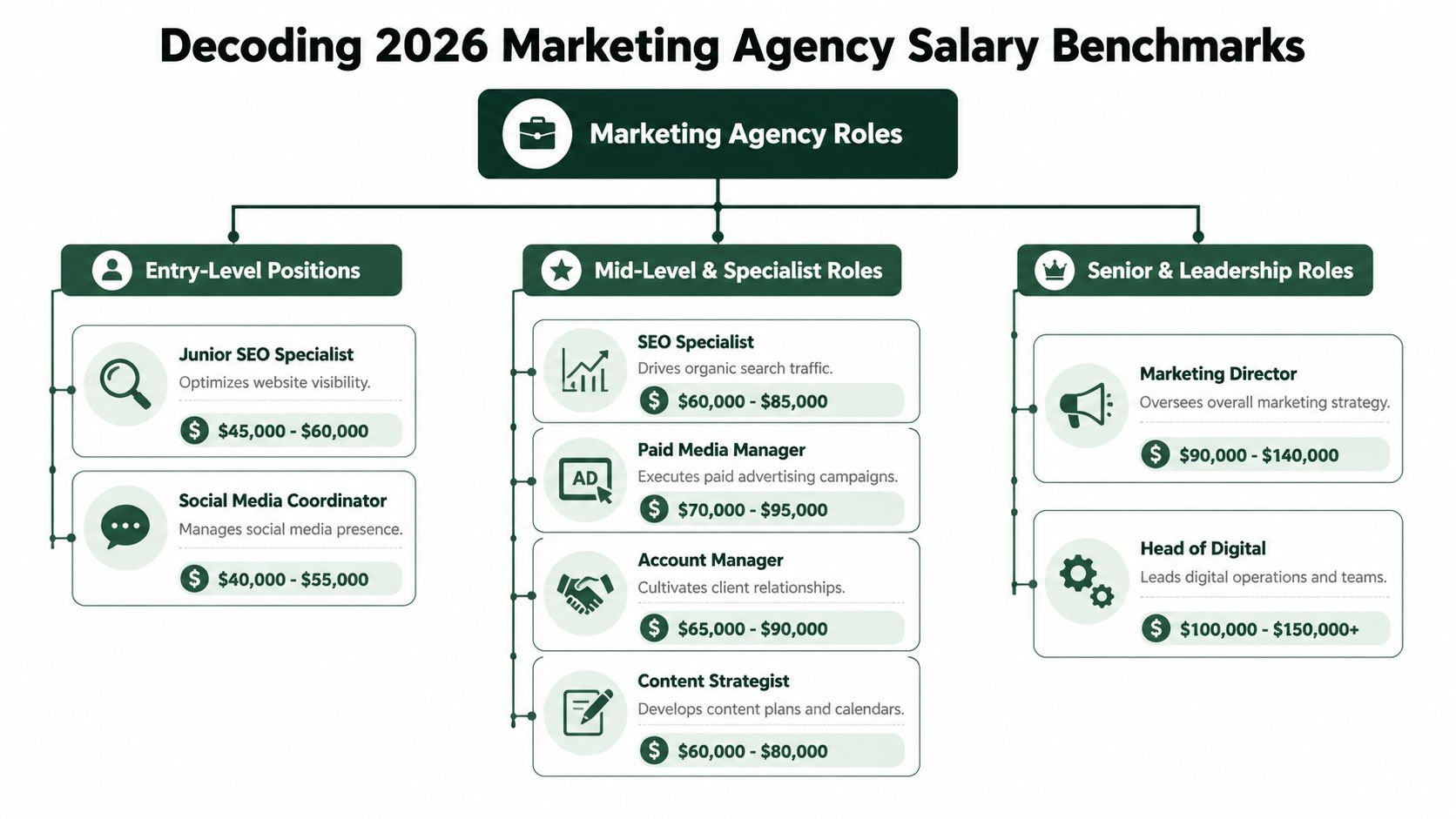
In 2025, the overall average marketing agency salary was $90,000, with entry-level professionals at $50,000 to $65,000 and senior roles at $100,000 to $145,000, according to the Marketing Salary & Skills Report 2025. That same report shows large location gaps, with Washington state averaging $143,000 and North Dakota averaging $55,000.
What the broad salary bands actually tell you
The cleanest way to use benchmarks is by seniority first, then by function.
- Entry-level talent: The market range of $50,000 to $65,000 is a starting point for people in their first years of agency work. These hires usually need process, review, and a narrow scope.
- Mid-level professionals: The same 2025 report places this group at $70,000 to $95,000. Agencies often find the best value at this level because these team members can own workstreams, not just tasks.
- Senior operators and leaders: The $100,000 to $145,000 band reflects people who can manage clients, coach teams, and protect delivery quality without founder intervention.
That structure is more useful than title-shopping because agency titles are loose. One agency’s “strategist” is another agency’s coordinator with a nicer LinkedIn profile. Scope matters more than title.
Role benchmarks that matter inside agencies
Some role-specific ranges are especially relevant for agency owners building delivery and client-service teams. Freeman+Leonard’s 2025 salary trends, as summarized in the verified data, put common agency roles in these ranges:
- Media Planner or Buyer: $60,000 to $100,000
- Paid Search or Digital Media Manager: $90,000 to $130,000
- Data Analytics roles: $95,000 to $150,000
- Account Director: $110,000 to $160,000
- Integrated Media Director: $125,000 to $165,000
Robert Half’s 2026 guide, also summarized in the verified data, gives another useful lens for account management roles:
- Account Manager: $53,500 to $86,250
- Account Supervisor: $80,750 to $108,250
- Account Director: $96,750 to $143,500
Those ranges are a reminder that client-facing leadership gets expensive fast. If your agency relies on founder-managed accounts because senior account talent feels costly, that can work for a while. It usually breaks when the founder becomes the bottleneck.
Executive and leadership pay sits on a different curve
The same verified salary summary reports these 2025 averages:
- VP of Marketing: $250,000
- Chief Marketing Officer: $180,000
- Creative Director: $145,000
These aren’t numbers most small agencies need to match. But they do matter if you’re trying to hire leadership talent out of in-house teams or larger firms. You’re not competing only with other agencies. You’re competing with companies that can offer bigger salaries, narrower responsibilities, and less client chaos.
A senior hire who can own revenue, retention, and team management is rarely “too expensive.” They’re usually expensive because they remove multiple founder-level problems at once.
Geography still matters, just differently
Agency owners need to read location data with nuance. Local market rates still influence expectations, especially in expensive metros. But distributed work has widened your options and also widened competition.
If you hire in a premium market, expect pressure toward the top end of ranges. If you build a remote team, you may gain flexibility, but candidates with specialized skills still know what they’re worth. Remote work didn’t erase pricing power for strong operators. It mostly erased the assumption that every agency had to recruit inside commuting distance.
What to do with the benchmark data
Use salary benchmarks as guardrails, not commands.
A practical approach looks like this:
- Anchor to level, not title: Decide whether the role is junior, mid-level, or senior before naming compensation.
- Map responsibility clearly: Client ownership, revenue responsibility, and management scope should move pay upward faster than a vanity title.
- Hire for your real model: A productized SEO agency, a creative shop, and a performance agency shouldn’t pay the same way, even if they use similar titles.
- Budget the full cost: Salary is only part of the decision. Onboarding time, management load, and risk of mis-hire matter just as much.
Benchmarks are where the conversation starts. They’re not where good salary strategy ends.
The Key Factors That Influence Agency Compensation
A salary range by itself tells only part of the story. Two agencies can hire for the same title and land in very different compensation territory because the job behind the title is different.

In digital marketing agencies, Sales roles average $219,605, while Admin roles average $49,002, according to digital marketing agency salary data from Comparably. That gap makes the main point better than any theory could. Compensation follows business impact.
Revenue proximity changes everything
The closer a role sits to revenue, the easier it is to justify higher pay.
A salesperson brings in new logos. An account director protects renewals and expansion. A paid media lead can directly influence client retention if they consistently produce results clients can see. Those roles are expensive because their contribution is legible.
Internal support roles matter too, but they’re harder to tie directly to growth. That doesn’t make them unimportant. It means agency owners need discipline when setting pay because the economic case is different.
Here’s a simple way to think about it:
- Direct revenue roles: Sales, account leadership, and certain strategic specialists can often justify premium compensation.
- Revenue protection roles: Delivery leads, analytics talent, and client success operators protect churn risk and support expansion.
- Support roles: Operations and admin functions help the machine run, but usually can’t command the same pay unless the scope is unusually broad or mission-critical.
If you pay every role as if it has the same commercial weight, your payroll structure gets distorted fast.
Agency model shapes the market rate
Service mix matters more than many owners admit.
A performance agency selling measurable acquisition work can usually support higher salaries for media buyers, analysts, and technical specialists. A brand agency may pay more for creative leadership and less for analytics. A content-led shop may put more budget into strategists and editors than into account layers.
That’s why copying another agency’s comp model rarely works. Their economics may be stronger in one department and weaker in another.
Practical rule: Don’t ask whether a salary is “high.” Ask whether the role increases revenue, protects retention, or removes founder bottlenecks enough to earn its seat.
Geography and remote work complicate salary decisions
Location still influences salary expectations, but remote work changed how agencies hire and compete.
The verified data notes that 58% of marketing and creative roles now involve distributed teams, and it also highlights a remote-work paradox. Agencies can access talent beyond their local market, but they also have to decide how to price services and set pay when competing against lower-cost regions. That creates real tension for owners building teams across markets.
A few practical consequences follow:
- Remote widens the talent pool: You can often find stronger specialists without hiring locally.
- Remote widens comparison sets: Candidates compare your offer against more employers, not fewer.
- Service pricing matters: If your clients expect premium strategy and senior communication, low-cost staffing alone won’t save you.
- Specialized skills still command premiums: Remote work lowers some friction, but it doesn’t erase market demand for scarce skills.
Experience is only useful if it converts into output
Years on a resume don’t create value by themselves. Agencies overpay when they confuse time served with practical effectiveness.
A mid-level operator who can run client meetings, catch delivery issues early, and coordinate a freelancer bench is often more valuable than a senior candidate with impressive logos and weak execution habits. The salary conversation should follow demonstrated operating range, not just tenure.
That’s also why trial projects, paid assessments, and structured interviews matter. You’re not hiring credentials. You’re hiring judgment, speed, and client trust.
Scarcity raises the price of certain capabilities
Some capabilities travel across departments and make people disproportionately valuable. Technical fluency, analytics literacy, process design, and automation awareness tend to raise a person’s utility across the agency. These people often improve not just one account but the whole system around it.
When owners miss that, they end up paying average salaries for above-average value, then act surprised when those hires don’t stay.
Budgeting Payroll How to Link Salaries to Agency Revenue
The biggest payroll mistake agency owners make is treating salary decisions as isolated events. One hire here, another contractor there, a raise for a loyal employee, and suddenly payroll is steering the business instead of supporting it.

That’s why salary planning has to start with revenue design. Not hope. Not pipeline optimism. Actual revenue and realistic delivery capacity.
Public data on owner pay is thin, but the available benchmark is broad enough to be useful. Verified data shows that marketing agency owner earnings can range from $60,000 to over $500,000, depending on size and profitability, and that there’s still a large visibility gap in how owner compensation should scale in growing agencies. That gap is exactly why owners need a house model instead of relying on scattered anecdotes.
Start with a revenue allocation model
Think of agency revenue like a pie you have to divide before you spend it emotionally.
At minimum, your revenue needs to cover:
- Delivery payroll: Salaries and contractor costs tied directly to client work
- Non-delivery overhead: Admin, software, tools, rent, recruiting, legal, and finance
- Owner compensation: What you earn for the role you actively perform
- Profit: The part that remains after the business pays everyone, including you
Many owners blend owner pay and profit together. That muddies every staffing decision. If you do strategy, sales, or account leadership, you should pay yourself for that role. Profit is separate. Profit is what the business keeps after operating obligations.
Build around role capacity, not just affordability
A salary becomes dangerous when the role doesn’t have enough work behind it or when the agency sells too little to support the position cleanly.
Before approving a hire, answer three questions:
- What work will this person own within their first month?
- What founder time will this role remove?
- What client or revenue risk exists if you don’t hire?
If you can’t answer those clearly, you’re probably hiring for relief, not strategic advantage.
That distinction matters. Relief hiring feels good for a few weeks. Strategic hiring compounds.
Set owner pay deliberately
Owner compensation usually becomes a mess in agencies because founders pull money inconsistently. One month the business is flush, so the owner takes more. Next month collections slip, so personal pay drops. That creates anxiety and hides whether the agency is healthy.
A better approach is to separate your compensation into two buckets:
- Role-based pay: What the business pays you for active work such as sales, strategy, or leadership
- Profit distributions: What you take because the company performed well after covering its obligations
This makes hiring decisions cleaner. If you’re still doing the job of an account director, head of sales, and strategist, your owner pay reflects labor plus ownership. If you replace yourself in those functions, salary expense rises and your role-based pay may change. Profit should come from the system working, not from underpaying the team or starving the business.
Pressure-test payroll before you hire
Run every hire through a simple set of scenarios.
- Base case: Revenue stays roughly where it is. Can the agency carry the new salary without strain?
- Slow case: A client pauses or churns. Can you absorb the hit without panic cuts?
- Growth case: The hire succeeds. What new capacity, revenue, or retention upside appears?
If the business only supports the salary in the best-case scenario, the hire is premature.
Most payroll mistakes happen when owners hire based on expected revenue that hasn’t landed yet.
You should also distinguish between a strategic hire and a convenience hire. A strategic hire creates capacity that directly improves delivery or growth. A convenience hire removes tasks the founder dislikes but that don’t materially change outcomes.
Use simple compensation structures first
Compensation gets messy when agencies layer on too many exceptions. Base salary, a clear scope, and a simple variable component for roles with measurable commercial impact usually works better than elaborate bonus logic.
The key is alignment. If someone can directly influence retention, upsells, booked meetings, or another clearly measurable outcome, variable pay may fit. If their work is collaborative and hard to isolate cleanly, force-fitting a bonus plan can backfire. People get confused, and managers spend more time defending formulas than improving performance.
For a useful grounding on agency economics beyond payroll, this guide on how marketing agencies make money is worth reviewing alongside your compensation plan.
Review payroll as a system, not a line item
Once your team grows, payroll reviews should happen on a rhythm. Not only when someone resigns or asks for more money.
That review should include:
- Which roles are driving the most value
- Which functions are overstaffed relative to current demand
- Whether your highest salaries match your highest-value work
- Whether owner compensation is masking weak profitability
- Whether a contractor, automation layer, or process fix would solve the need better than another full-time hire
A healthy payroll model gives you options. An unhealthy one removes them.
To ground the financial side further, this video offers a useful lens on thinking through business revenue and cost structure before expanding headcount.
Choosing Your Staffing Mix Full-Time vs Freelance vs Automation
Staffing decisions usually get framed too narrowly. Owners ask, “Should I hire?” when the better question is, “What’s the best way to get this result consistently?”

That’s where the three-way choice matters. Full-time employees, freelancers, and automation each solve different problems. Trying to force every need into one model is how agencies end up bloated, brittle, or both.
The verified data highlights the current tension well. 58% of marketing roles now involve remote teams, and agencies are dealing with a remote-work paradox around pricing and pay, while specialized skills still command salary premiums above 3% in some cases, according to ZipRecruiter salary context summarized in the verified data. That makes staffing mix a strategic decision, not a sourcing preference.
When full-time hires make sense
A full-time employee is the right choice when the work is ongoing, central to your offer, and closely tied to your standards.
Full-time hires are best for work you need done your way, every week, with no gaps in ownership.
That usually includes:
- Client relationship ownership: Account management and client communication often benefit from continuity.
- Core delivery functions: If a service is central to your offer, internal ownership usually improves consistency.
- Process-heavy roles: Team members who manage repeatable workflows often add more value over time because they improve the system itself.
- Culture carriers: Senior people who train others and reinforce standards are hard to replace with ad hoc help.
The downside is fixed cost. Once you hire full-time, you’re carrying salary through good months and bad ones.
Where freelancers outperform employees
Freelancers are often the cleanest answer when you need specialist talent, uneven capacity, or short-term support.
A good freelancer bench helps agencies avoid premature headcount. It also gives you access to narrow expertise without pretending every role must live on payroll all year.
Freelancers often win when:
- The work is specialized: Technical SEO, analytics cleanup, design systems, and niche channel expertise often fit well.
- Demand fluctuates: Seasonal campaigns, launches, and project-based work don’t always justify salary.
- You need fast testing: It’s easier to validate whether a service line works before building an internal team around it.
- You want optionality: Contractors let you scale up or down with less disruption.
The trade-off is consistency. Some freelancers are excellent operators. Others disappear, juggle too many clients, or need more management than expected. The model works best when your agency has strong SOPs, scoped work, and clear quality control.
If you’re comparing outsourced talent platforms and solo specialists, this breakdown of freelancer vs Upwork vs Fiverr is a practical place to start.
What automation should own
Automation is the right choice when the work is repetitive, time-sensitive, rules-based, and high-volume.
If a task depends more on consistency and speed than on original judgment, automation deserves a seat in the staffing plan.
For many agencies, that includes:
- Outbound prospecting workflows
- Lead qualification steps
- Follow-up sequences
- Proposal administration
- Routine reporting prep
- Internal handoff reminders and task triggers
Automation isn’t a universal replacement for people. It’s a force multiplier when the process is already clear. Agencies get into trouble when they automate a broken workflow and expect software to create strategy where none exists.
Build a blended staffing model
The strongest agencies rarely choose only one route. They combine the three.
A practical blended model often looks like this:
- Full-time staff own client relationships, recurring delivery, and internal standards.
- Freelancers cover specialty execution and variable demand.
- Automation handles repetitive tasks that would otherwise consume high-value human time.
That mix protects margin and reduces hiring pressure. It also prevents a common agency failure pattern, where founders solve every new problem with another salary.
The core decision isn’t philosophical. It’s operational. Use people where judgment matters most. Use freelancers where flexibility matters most. Use automation where repetition is draining skilled labor.
Smart Hiring and Retention Tactics for Sustainable Agency Growth
Retention is a salary issue, but it isn’t solved by salary alone.
Many agencies lose good people because the compensation package is incomplete, not because the base pay is embarrassingly low. Strong employees want fair pay, but they also want clarity, progress, and a role that doesn’t trap them in endless reactive work.
That matters even more for scarce talent. Verified data shows that Technical Marketing roles average up to $198,000, with the top 10% exceeding $291,000, based on Glassdoor salary data for technical marketing roles. Agencies pay those premiums because these operators connect automation, analytics, and commercial outcomes. Replacing them is hard.
Hire for slope, not just polish
Agencies often overvalue polished communicators and undervalue high-learning operators. The person who interviews smoothly isn’t always the person who can improve a workflow, spot failure patterns, and grow into broader responsibility.
When hiring, look for signs that someone can compound value:
- Systems thinking: They improve process, not just complete tasks.
- Commercial awareness: They understand client goals, not only channel mechanics.
- Tool fluency: They can work inside modern platforms without needing hand-holding.
- Comfort with ambiguity: Agencies change fast. Rigid specialists often struggle.
These hires tend to stay longer because the role keeps stretching them.
Give people a path they can see
A surprising amount of churn comes from fog. Team members don’t know what seniority means, what skills lead to promotion, or what kind of work earns more responsibility.
Fix that with simple progression language. Junior people should know what good looks like. Mid-level people should know what ownership looks like. Senior people should know what leadership looks like.
That path doesn’t need a corporate ladder graphic. It needs clarity on:
- what scope increases over time
- what decisions they’ll be trusted to make
- how compensation changes with that scope
- which skills make them more valuable to the agency
When people can see advancement, they’re less likely to leave to get a title elsewhere.
The cheapest retention tool is a credible future inside your agency.
Use non-cash levers that skilled people actually value
Not every retention tool has to raise fixed payroll.
Good agencies hold onto strong people by improving how work feels. That includes flexible schedules, sharper feedback loops, focused professional development, and better project assignment. A technical operator may value paid training on an analytics stack more than a small pay bump. A client lead may care more about autonomy and cleaner account ownership.
The key is relevance. Generic perks don’t retain serious people. Useful ones do.
Don’t let top performers drown in low-leverage work
Many agencies waste their best people. They hire a strong specialist, then bury them under admin, client chasing, status updates, and repetitive coordination.
High-value employees stay longer when their calendar reflects the work for which they were hired. If your most strategic talent spends half the week on low-value tasks, you’re paying premium rates for work someone else or some system should handle.
That’s also why sustainable growth depends on operating design, not just recruiting. A better process is often a better retention move than another small raise.
For owners thinking about team structure and operational maturity, this guide on how to scale a service business is a useful companion read.
Building a Profitable and People-First Agency
Agency compensation gets easier when you stop treating it as a salary lookup exercise.
The core job is building a system. One that matches market reality, reflects the economic value of each role, and protects the business from reaction-driven hiring. Salary benchmarks matter, but they only become useful when tied to capacity, service delivery, and owner economics.
The agencies that handle this well usually do four things consistently. They benchmark roles with context. They connect payroll decisions to revenue and margin. They choose a staffing mix that fits the work instead of defaulting to headcount. And they put real thought into retention so they’re not rebuilding the team every year.
That approach creates a healthier business on both sides of the ledger.
On the financial side, it keeps payroll from creeping ahead of delivery capacity. On the people side, it gives strong employees a fair deal, clearer expectations, and a better reason to stay. That combination matters more than any single salary number.
A modern agency also has to accept that not every problem should be solved with another full-time hire. Some should. Many shouldn’t. Strong owners know the difference. They know when to pay for continuity, when to buy specialized help, and when to remove repetitive labor from the system entirely.
That’s the practical center of smart compensation strategy. Pay well for what drives outcomes. Keep role design clean. Protect profitability. Don’t ask expensive humans to spend their best hours on work that doesn’t need their judgment.
If you get that right, marketing agency salaries stop feeling like a constant source of stress. They become what they should be: one of the clearest tools you have for building an agency that grows without breaking.
If your agency wants to reduce the cost and management overhead of manual outreach, Earlybird AI can help. It acts like an always-on sales team for Upwork, automating project discovery, proposal writing, follow-up, and replies so your team can spend more time on client work and less time chasing leads. For agencies balancing payroll, growth, and sales capacity, that can be a far cleaner lever than adding another full-time SDR too early.