

← Back To Blog
Outsourced Lead Generation: A Practical Agency Guide
Your best client just paused, referrals went quiet, and your calendar has two delivery calls and no new business conversations this week. You're doing the prospecting yourself between client work, which means it happens late, inconsistently, or not at all. That's the point where outsourced lead generation looks attractive, and also where agencies make the most expensive mistake. They buy meetings.
A cheaper partner who fills your calendar with poor fit prospects costs you more than a pricier partner who produces fewer, better opportunities. Judge the work by cost per qualified opportunity and stage level conversion, not by cost per lead. Everything below builds toward that number.
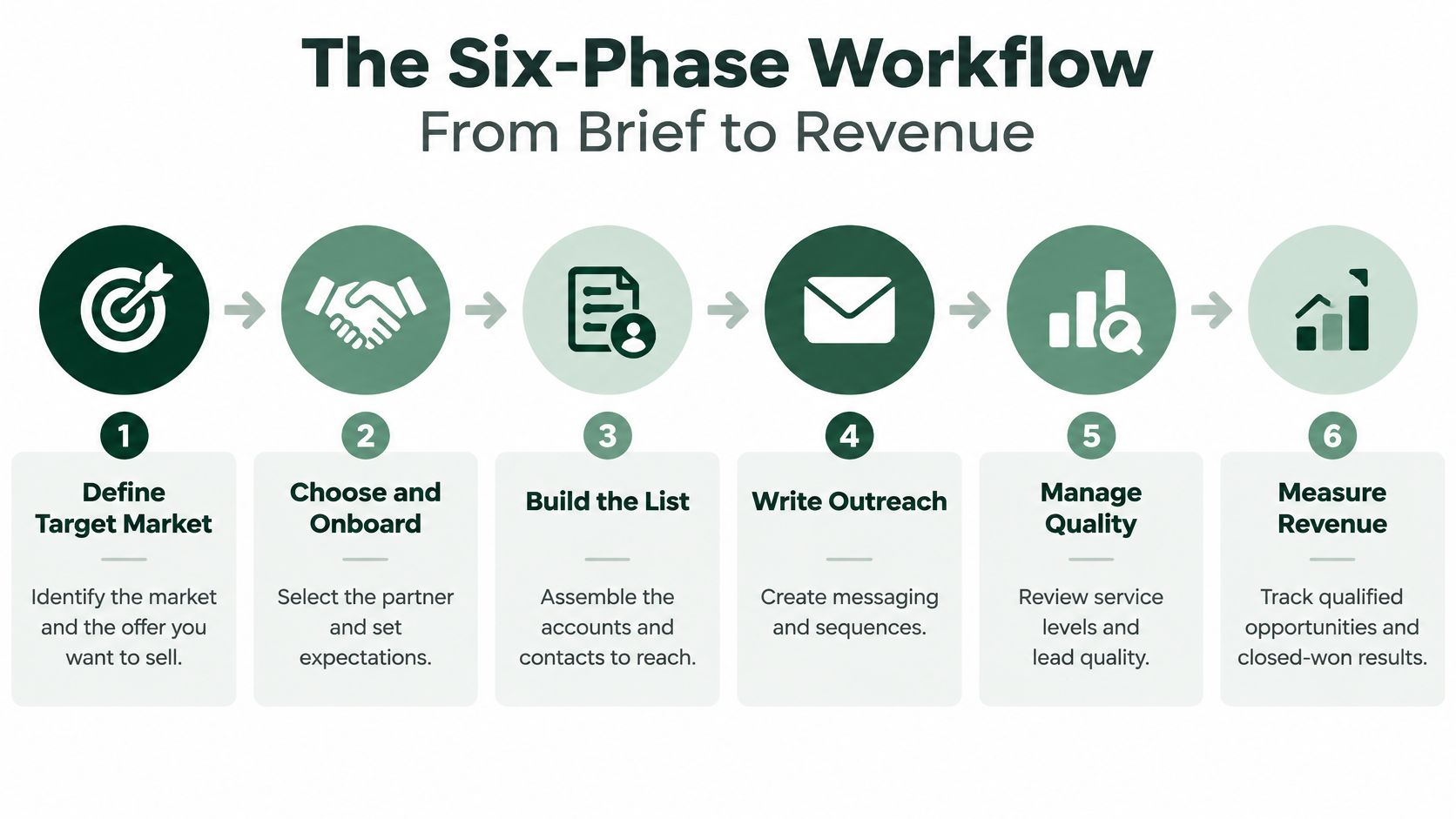
The Six-Phase Workflow From Brief to Revenue
Say an agency owner loses momentum in one quarter. Delivery is strong, but no one's owning outbound, so pipeline dries up while the team waits for referrals. Outsourcing fixes capacity only if the owner runs it as a sequence, not as a handoff and hope exercise.
The market context supports taking it seriously. One 2024 market estimate summarized by Stealth Agents valued global lead generation services at approximately $4.1 billion in 2022 and projected growth to $9.9 billion by 2028. This is a mature services category, not a temporary workaround.
Who Owns Each Phase
- Define the target market and offer. You name the buyer, the problem, and the specific service you're selling.
- Choose and onboard a partner. You select the partner and set up access, tools, and expectations.
- Write the brief and qualification rules. You define fit, proof points, and disqualifiers in writing.
- Run outreach under a response time standard. The partner researches accounts, sends outreach, and follows up.
- Review quality and hand over. The partner passes qualified leads with context, and your closer owns the conversation.
- Measure outcomes. You decide to scale, adjust, or stop based on qualified opportunities and revenue.
The split stays consistent through all six phases. You keep the offer and the closing. The partner runs research, outreach, and appointment setting.
Map your current pipeline onto these six phases and mark the one that breaks first. That's where outsourcing helps, or where it'll fail fastest.
If phase one is vague, phases four and five will produce volume without fit. If phase six only counts meetings, you'll never know whether the partner is making you money.
Deciding Which Lead Work to Hand Over
A partner can cut the cost of prospecting and still make each qualified opportunity more expensive. The decision depends on which stages it can run reliably, and whether its work converts into opportunities your sales team can close.
Compare the cost of list research, account monitoring, outreach, and follow-up with the time and expense of handling those tasks in-house. Then measure conversion at each stage: from researched contact to reply, reply to qualified lead, and qualified lead to opportunity. A low cost per lead is a poor result if few leads fit your criteria or progress to a real sales conversation.
What to Hand Over and What to Keep
- Hand over list research. Have the partner build and verify account and contact lists against criteria you define.
- Hand over account monitoring. Ask the partner to track job posts, funding, hiring, and other triggers relevant to your offer.
- Hand over first-draft outreach and follow-ups. Approve the angles and have the partner draft messages. When comparing marketing and sales email copy, check that the wording fits a real prospect conversation rather than reading like a generic campaign.
- Hand over appointment setting. The partner can manage scheduling, reminders, and calendar logistics, but a booked meeting should not count as a qualified opportunity by itself.
- Keep ICP definition, offer design, and pricing. These decisions depend on your positioning and margin requirements.
- Keep objection handling and closing. Your team needs context about the prospect's situation to judge fit and make commitments.
Automation can help with monitoring, prioritization, and response timing. Human review still matters for replies that require judgment about a prospect's needs or your offer. Teams using AI for lead generation should define which messages can be sent automatically and which need approval.
Practical rule: Keep any task that requires knowledge of the client's situation in-house.
Vetting Partners and Writing a Brief They Can Use
Most partner failures are visible before you sign, if you ask for evidence instead of promises. Run every candidate through the same sequence so you can compare answers directly.

A Four Step Vetting Sequence
- Request recent outreach samples. Ask for anonymized messages from the last 30 days, including reply rates by segment. Generic samples with no segment breakdown tell you they're sending one script to everyone.
- Ask how they define a qualified lead. Ask who decides whether a lead is qualified, them or you. If they decide alone, you'll get meetings that meet their definition, not yours.
- Call two references in your niche. Ask each reference how many meetings became opportunities, not how many meetings were booked. Ask what reporting they receive each week.
- Run a paid 50 prospect test. Pay for a small, defined batch before any monthly retainer. Judge the list quality, message relevance, and handoff notes, not just replies.
Document scope, definitions, and payment triggers properly before the test starts. Understanding the difference when you're comparing a master service agreement and a statement of work stops qualification disputes from becoming invoice disputes later.
What Your Brief Must Contain
- Ideal customer profile. Company size range, industry, geography, and two buying triggers, such as a new funding round or a job posting for developers.
- Offer and proof points. The specific service, the outcome you can credibly claim, and the evidence the partner may cite.
- Disqualification rules. Budget below your floor, no decision maker access, or a project outside your services.
- Approved angles and banned claims. Message themes they can use and statements they must never make about price, timelines, or results.
- CRM fields for every contact. Source, trigger, role, outreach status, reply summary, and next step.
- Handoff owner and calendar. One named person who receives qualified leads and the booking link they should use.
Red Flags to Walk Away From
Walk away from pricing based only on booked meetings with no written definition of a meeting. Walk away from any partner who refuses to share call recordings, message logs, or the underlying list.
One generic script for every vertical is another warning sign. A partner who won't adapt messaging by segment will protect their volume by weakening your targeting.
Take the brief checklist above into your next vendor call. If a candidate can't work from a one page brief, they won't work from a longer one either.
Setting Up Account Access Without Sharing Passwords
Start with the platform rule, because it shapes everything else. Upwork's guide on adding or removing agency members states that Upwork prohibits sharing personal account credentials, including between an agency owner and an agency member, and that owners should never request or attempt to access a freelancer's credentials.
That prohibition protects you as much as the freelancer. Upwork also says users granted permissions can act on an account owner's behalf, but the owner remains responsible and liable for those users' actions, including payments, contracts, and terms of service compliance.
In practice, a partner's mistake on your account is still your violation. Access design is risk control, not admin detail.
Map Tasks to the Narrowest Role
Upwork's guidance on setting team roles describes roles such as Finance Admin, Account Admin, Recruiter, and Hiring Manager, and notes that a Recruiter can post jobs, invite freelancers and agencies to interviews, and review proposals, but cannot send offers or hire.
That separation is exactly what you want for outsourced lead generation. A partner can manage proposals and candidate flow without authority to commit your business to a contract.
- List every task the partner will touch. Include proposals, chats, files, and work diaries.
- Assign the narrowest role for each task. Don't grant admin access to solve a proposal review job.
- Give each operator a personal login. Never use one shared login across several people.
- Keep offer approval internal. Name one internal owner who can approve offers and contract terms.
- Review permissions monthly. Remove access the day someone leaves the partner's team or yours.
Apply the same logic outside Upwork. Give CRM seats, email accounts, and sending domains personal logins, use view only access where a task only needs viewing, and require an audit trail for sequence changes.
End with one audit question. Can you see who sent each proposal and when? If you can't answer that in under a minute, your access setup is too loose.
Service Levels and Quality Control That Hold Up
Speed is the service level most partners underdeliver on, because it's the hardest to staff consistently. The workflow below shows how response handling should look in practice.

Lead response guidance in a Lead Spot overview of B2B lead nurturing cited research covering 2,241 companies that found firms responding within an hour were about seven times more likely to achieve a meaningful qualifying conversation than firms delaying by another hour. Set your standard as a first human quality response within one hour in business hours, measured from signal creation, not from an automated acknowledgment.
The Response Workflow to Put in Writing
- Capture the signal. Log the inquiry or target account trigger with a timestamp.
- Route it immediately. Send it to the named representative, not a shared inbox queue.
- Reply with relevance. Use the prospect's stated problem and one proof point.
- Follow up by channel. Add appropriate touches, with cadence tested by segment.
- Pause, recycle, or disqualify. Apply written rules, using structured lead qualification frameworks so two operators don't judge the same reply differently.
This short walkthrough shows the response and follow up loop in action.
Quality Checks and Compliance in the Same Agreement
Review a random sample of 20 conversations weekly. Route sensitive or negative replies to a human on your team, suppress anyone who has declined, and keep an audit trail for every automated action.
Require CRM discipline as a service level, not a request. Define the field map in advance and require every touch, reply, and status change to be logged within 24 hours.
Put compliance in the same document. Confirm the consent basis for each list, honor opt outs immediately, and name who handles complaints.
Sign off on five items before launch. Response time, escalation path, CRM logging, handoff owner, and monthly stage data for the ROI review.
Measuring Real ROI Beyond Meetings Booked
A partner can hit a meetings target and still lose you money. That's qualified meeting inflation, where meetings satisfy the provider's definition but fail your ICP, budget, urgency, or conversion criteria.
Analysis of common outbound lead generation challenges from Martal makes the same point in practical terms. When reporting stops at meetings booked, you can't distinguish weak targeting by the partner from poor follow up by your own team.
The Worked Example That Changes the Decision
Say Partner A costs $2,000 a month, books 20 meetings, and produces 5 sales accepted opportunities. That's $400 per qualified opportunity.
Partner B costs $1,500 a month, books the same 20 meetings, and produces 2 opportunities. That's $750 per qualified opportunity.
Partner B looks cheaper on the invoice and costs almost twice as much where it matters. Partner B also burns more of your closer's time on unsuitable prospects, which for a small agency often means displacing delivery work.
Track the Full Stage Chain
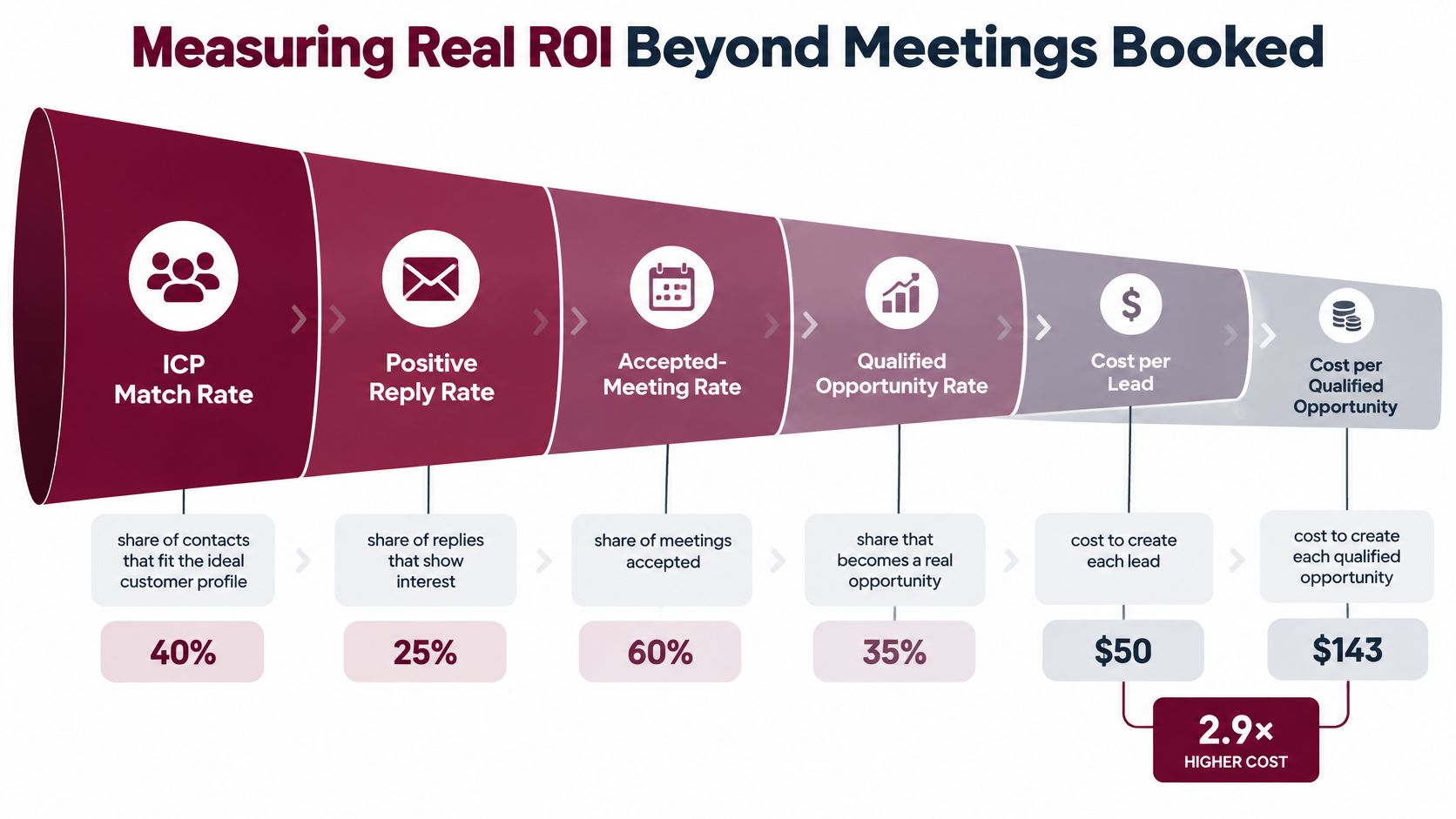
- ICP match rate. Share of contacted accounts that fit your profile.
- Positive reply rate. Share of replies showing genuine interest, not just any response.
- Accepted meeting rate. Share of booked meetings your team accepts as worth taking.
- Sales accepted opportunity rate. Share of accepted meetings that become real opportunities.
- Opportunity to close rate. Share of those opportunities that become revenue.
- Revenue per sourced account. Total closed revenue divided by accounts the partner sourced.
- Time to first response. Elapsed time from signal to human quality reply.
If you sell software or services to SaaS buyers, the same stage logic applies when you're modeling lead generation ROI for SaaS, because the denominator still has to be qualified pipeline, not raw leads.
Don't Forget Platform Costs
Proposal costs belong in your denominator too. Upwork's freelancer pricing page states that Freelancer Basic accounts may include 10 free Connects per month, while additional Connects cost $0.15 each, and Connects are also used for boosted proposals. Indiscriminate bidding therefore creates a real variable expense, not free applications.
Add retainer fees, Connects spend, tool seats, and your internal owner's review time. Divide that total by sales accepted opportunities. That's your true unit cost.
Assign Ownership for the Grey Areas
Decide who owns disqualification and write down the reason codes. Decide how duplicate and recycled leads are handled, including how long a recycled lead stays dormant before reactivation.
Tie payment to outcomes where you can. Accepted meetings or sales accepted opportunities align the partner's incentive with yours far better than calendar bookings do.
A lower cost per meeting can represent worse economics if it increases your closer's time spent on poor fit prospects.
End each month with one question. Is revenue per sourced account rising while cost per qualified opportunity falls? If both answers aren't yes, change the brief, the targeting, or the partner.
Run a 30-Day Pilot Before You Commit
Don't sign a quarterly retainer to test an unproven partner. Run a contained pilot and let stage numbers make the decision.
- Pick one service line and one ICP segment. Don't test your whole business at once.
- Set stage targets before the first message. Write down first response time, positive reply rate, accepted meeting rate, and target cost per qualified opportunity, using a structured B2B pilot success criteria template so targets don't shift mid pilot.
- Review weekly for four weeks. Sample conversations, check stage conversion, and log each partner's results separately.
- Decide at week four. Scale, adjust the brief, or stop.
If you test automated outreach against human run outreach, judge both on identical stage numbers. For context, we submit proposals within 10 minutes of a job posting and reply to leads in under 5 minutes, automatically, which gives you a concrete speed benchmark to test against any manual process.
If you evaluate a platform for the automated side, ask for proof on a live account before committing to a plan. You can book a demo to see the whole loop of finding jobs, sending proposals, and booking calls live on your Upwork account.
Your decision rests on your stage numbers, not on a demo or a sales pitch.
If you're outsourcing Upwork prospecting and tired of counting meetings that never become revenue, Earlybird AI finds relevant jobs, sends personalized proposals from your own account, replies within minutes, and follows up until a call is booked. Visit the site to book a demo and watch the full loop run on your live account, then judge it by qualified opportunities, not proposal volume.


