
← Back To Blog
Lead Qualification Frameworks: A Guide for Upwork Agencies
Your Upwork inbox looks busy. The calendar doesn't.
You get invites, direct messages, and job posts that seem promising at first glance. Then the pattern repeats. The client disappears after one reply. The budget turns out to be unrealistic. The person who interviewed you can't approve anything. Or the job was never serious in the first place.
That's not a proposal problem. It's a qualification problem.
Most agencies on Upwork lose time before they lose deals. They spend energy on the wrong conversations, then assume they need better copy, lower pricing, or more aggressive follow-up. In practice, the bigger win usually comes earlier. You need a way to decide which opportunities deserve attention, which ones need light nurture, and which ones should be ignored.
Why Most Agency Leads Go Nowhere
A familiar Upwork week looks productive on paper. New invites come in. A few prospects reply quickly. Someone asks for a call. By Friday, nothing closed, two proposals went nowhere, and one lead admits they are still "exploring options."
Many agencies on Upwork lose time before they lose deals.
The problem usually starts at the top of the funnel. Agencies treat every inbound message, invite, or job post as a real opportunity, even when the buying signals are weak. On Upwork, that mistake gets expensive fast because the platform creates a lot of activity that looks like demand but often lacks budget, authority, urgency, or even a defined project.
I see the same pattern across agency teams. One account manager spends 45 minutes scoping a project for a client with no hiring history and a placeholder budget. Another jumps on a call with a marketer who can collect proposals but cannot approve spend. A founder writes a custom response to a job post that has already been copied across multiple platforms. The pipeline feels full. Revenue does not.
Activity is not pipeline quality
Upwork rewards speed and responsiveness. That does not mean every fast-moving lead deserves attention. A client can reply in five minutes and still be a poor fit. A polished brief can still hide a tiny budget. A long interview process can still end with "we decided to pause."
Good qualification fixes that by forcing a clearer standard for what counts as a real sales conversation.
The agencies that waste the least time usually do three things consistently:
- They define fit early. They know which project types, budget bands, client histories, and scopes tend to turn into signed work on Upwork.
- They screen platform signals, not just the message. They look at payment verification, hire rate, past job activity, average spend, and response behavior before investing real effort.
- They disqualify without hesitation. They do not keep weak opportunities alive just because the inbox is quiet.
Practical rule: If your team cannot explain in one or two sentences why a lead is qualified, it has not earned proposal-level effort.
Classic B2B sales thinking demonstrates its value in a very practical manner. On Upwork, qualification is less about running a formal sales process and more about reading the clues the marketplace gives you. Client history often tells you more than the initial message. Budget range usually matters more than enthusiasm. Response velocity helps, but only when paired with real buying intent.
What qualification actually does
Qualification helps agencies make a resource decision early. Who gets a custom proposal? Who gets a short reply with one clarifying question? Who gets ignored?
That matters because Upwork creates a constant temptation to over-invest in weak leads. Uneven deal flow makes agencies chase volume. Volume without filters usually leads to slower follow-up on the opportunities that were worth winning.
On this platform, the best qualification process is specific to how Upwork works. It uses marketplace signals before the first call and sales framework logic after the conversation starts. That is the difference between being busy on Upwork and building a pipeline you can trust.
Understanding BANT CHAMP MEDDIC and Beyond
The classic lead qualification frameworks still work. You just need to use them like tools, not commandments.
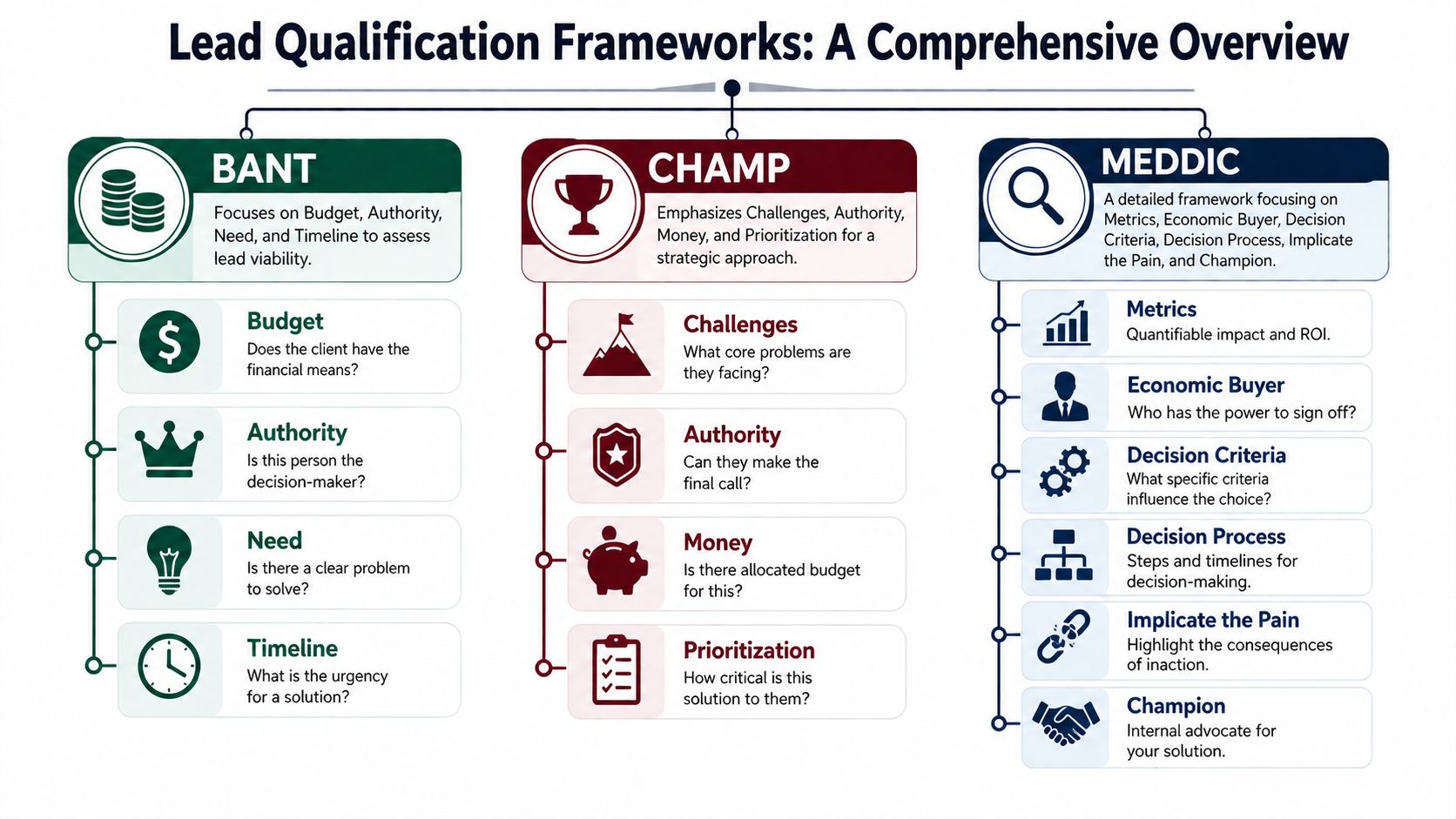
BANT, CHAMP, and MEDDIC solve different qualification problems. One helps you screen fast. One improves discovery. One helps you avoid getting dragged through long, vague buying processes with complex clients.
BANT for fast screening
BANT is the simplest place to start. It was originally developed by IBM, and it requires four checks: Budget, Authority, Need, and Timeline, as outlined in RevenueHero's explanation of BANT.
Here's how those questions sound in real life:
Budget
Can this client pay for the kind of work they want?Authority
Are you talking to the person who can approve the project, or just an intermediary?Need
Is there a real problem to solve, or are they collecting ideas?Timeline
Do they need movement soon, or is this a vague future project?
BANT works well when you need a quick sniff test. For many Upwork agencies, that's enough to reject obvious time-wasters before a proposal becomes a custom sales document.
CHAMP for better discovery
CHAMP shifts the emphasis. Instead of starting with budget, it starts with Challenges. That's useful when the client's pain is clear, but budget and structure aren't yet.
A CHAMP-style discovery sounds more consultative:
- What's broken right now?
- Why is this issue important enough to fix?
- Who's involved in choosing a provider?
- Where does this project sit against other priorities?
CHAMP is often a better fit when agencies sell strategy, creative direction, complex builds, or ongoing retainers. Clients in those cases don't always arrive with neat buying criteria. But they do arrive with pressure, confusion, and internal friction. CHAMP helps surface that.
If BANT tells you whether the lead qualifies at all, CHAMP tells you whether the problem is painful enough to create momentum.
MEDDIC for larger deals
MEDDIC is heavier. That's a feature, not a flaw.
It pushes you to understand six things: Metrics, Economic Buyer, Decision Criteria, Decision Process, Implicate the Pain, and Champion. On a simple Upwork project, that's overkill. On a large multi-stakeholder engagement, it can save you from weeks of false progress.
MEDDIC matters when a client says things like:
- “We need buy-in from the operations team.”
- “Procurement will review the contract later.”
- “We're comparing a few approaches internally.”
- “The founder likes it, but finance still has questions.”
In those situations, you don't just need fit. You need visibility into how the deal gets approved.
Use frameworks in layers
High-performing sales teams don't force one model onto every lead. They use a layered approach. BANT for rapid initial screening, CHAMP during discovery, and MEDDIC for enterprise deal qualification, as described in Salesforce's overview of lead qualification.
That's the right way to think about lead qualification frameworks on Upwork too. Start simple. Add complexity only when the deal justifies it.
Choosing the Right Framework for Your Agency
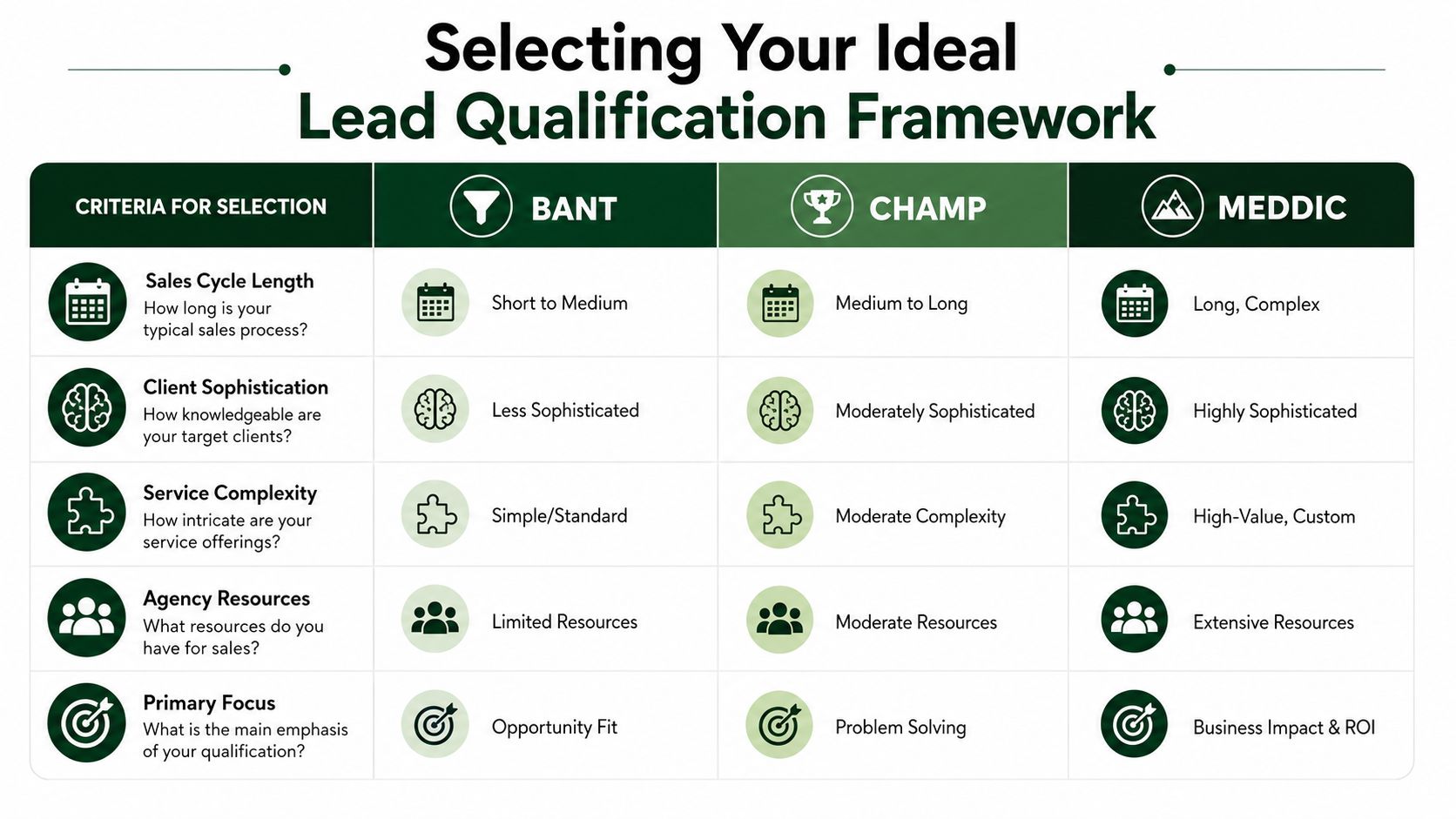
The right framework depends less on your agency size and more on the kind of deals you pursue.
A design agency handling fixed-scope landing pages doesn't need the same qualification depth as a dev consultancy selling long implementation projects. If you use a framework that's too light, you'll accept weak leads. If you use one that's too heavy, you'll slow yourself down and miss fast-moving opportunities.
When BANT is enough
BANT fits agencies that live on volume and speed.
If your typical work looks like audits, page builds, ad account cleanups, content packages, or short-term support, the sales risk usually isn't in the complexity of the buying process. It's in wasting time on poor-fit leads. In that environment, a fast qualification pass is more valuable than a deep discovery workflow.
BANT is usually the right default when:
- Projects are standardized. You already know what delivery looks like.
- Sales cycles are short. Clients want to hire soon.
- One person usually decides. You're not navigating a committee.
- The main question is fit. Can this turn into a real project quickly?
The downside is obvious. BANT can be too shallow when a client's budget isn't clear yet, or when the main issue is organizational alignment rather than immediate purchasing power.
When CHAMP works better
CHAMP is stronger for agencies that sell expertise before execution.
If you run SEO strategy, lifecycle marketing, positioning work, revamp projects, or advisory-led retainers, many buyers don't open the conversation with a clean budget and plan. They open with friction. Leads say traffic is flat, conversions are weak, internal teams are stuck, or growth has slowed. CHAMP helps qualify around that pressure.
Use CHAMP if your deals often depend on:
- Problem diagnosis
- Stakeholder education
- Priority setting
- A stronger business case before the client commits
This framework gives your team better discovery calls because it starts where the buyer is most verbal. Clients may hide the budget. They rarely hide the headache.
When MEDDIC earns its keep
MEDDIC belongs in agencies pursuing larger, more complex engagements. That could mean enterprise UX work, product development, CRM implementation, analytics setup, or multi-market growth projects.
These leads often look great early. Then they stall because nobody mapped the actual approval path. You had a positive call, but not with the economic buyer. You sent a proposal, but didn't understand the decision criteria. You thought urgency existed, but the internal process said otherwise.
A lead can be enthusiastic, well-funded, and still be unqualified if nobody knows how the decision gets made.
MEDDIC is useful when your agency sees frequent complexity around procurement, executive approval, ROI expectations, or internal champions.
Most agencies need a blended model
For Upwork agencies, the cleanest answer is usually not “pick one.” It's “pick the first filter, then add depth if the lead survives.”
A practical stack looks like this:
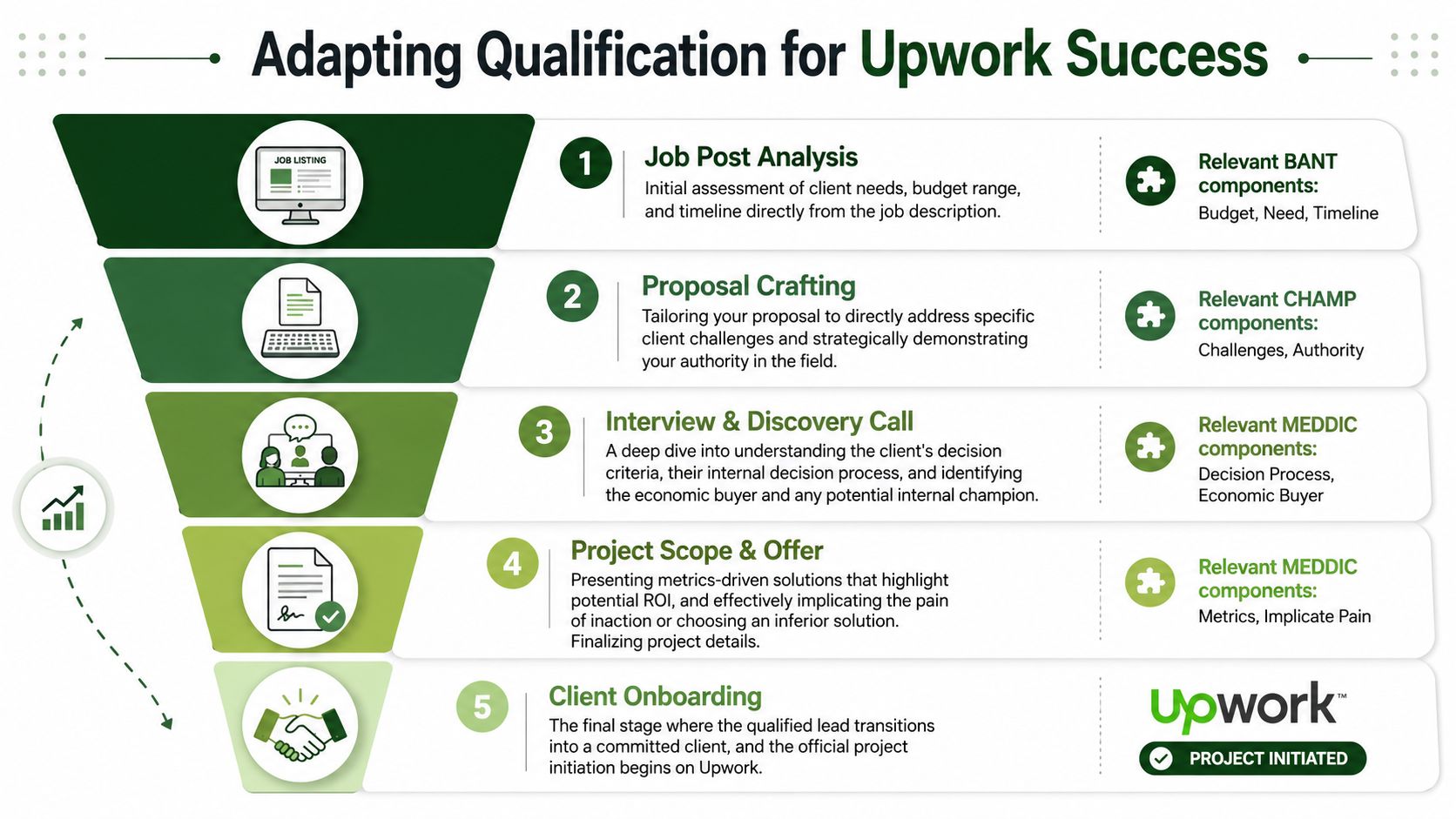
- Use BANT on the job post and client profile
- Use CHAMP in chat or the first call
- Use MEDDIC only when the project grows in size or complexity
That keeps your system lean at the top and serious where it matters.
Translating Frameworks for the Upwork Marketplace
Classic frameworks were built for sales teams with forms, CRM fields, and long discovery cycles. Upwork gives you a very different environment. You see a job post, a budget range, some client history, maybe a few reviews, and a small window to decide whether to engage.
That means the framework can't stay abstract. It has to map to marketplace signals.
What BANT looks like on a job board
On Upwork, Budget isn't just a number in a post. It's a combination of posted range, payment verification, prior spending behavior, and whether the scope matches the money on the table.
Authority is rarely stated directly. You infer it from language. If someone says “my team needs this,” “I'm collecting options,” or “I need to show this to my client,” you may not be dealing with the final decision-maker.
Need shows up in specificity. A serious buyer usually describes a concrete outcome, existing pain, or delivery constraint. Weak buyers write broad shopping-list posts.
Timeline appears in phrases like “need this week,” “starting immediately,” or “interviewing today.” It also appears in behavior.
That last part matters more than most freelancers realize. Most qualification frameworks ignore platform-specific signals, yet 78% of Upwork clients award projects to freelancers who respond within 15 minutes, according to Default's analysis of platform-specific lead qualification. Response velocity isn't just a speed tactic. It's a qualification signal tied to urgency and active buying intent.
Upwork needs extra signals that classic models miss
A client might fail traditional BANT and still be worth engaging. Another might pass BANT on paper and still waste your week.
On Upwork, I'd add a second layer of marketplace-specific checks:
Client hiring history
Have they hired consistently, or do they post and disappear?Scope clarity
Is the job tied to a real business need, or does it read like exploratory research?Budget transparency
Even a modest budget can be workable if the client is realistic and decisive.Reply behavior
Fast, specific replies usually indicate active evaluation.Proposal timing
Your ability to respond quickly matters because urgency is part of the signal set.
For agencies trying to build a more repeatable system, many of the habits in this guide for agencies on Upwork prove useful. The win isn't just writing better proposals. It's matching proposal effort to lead quality with much better discipline.
On Upwork, the client profile is part of the qualification framework. Ignore it, and you're working with half the picture.
Automating Lead Qualification on Upwork
Manual qualification breaks once lead volume rises.
At first, it feels manageable. A founder reviews every post. A bidder checks client history by hand. Someone drafts custom responses and keeps mental notes about who looked promising. That works until the inbox gets crowded, reply times slip, and nobody can explain why one lead got attention while another didn't.
Automation fixes the consistency problem first. Scale comes after.
What should be automated
Not every judgment belongs in software. But a lot of repetitive filtering does.
A solid Upwork qualification workflow can automate:
- Job scanning based on service keywords, exclusions, and ideal project types
- Client filtering using signals like spend history, post quality, and fit indicators
- Initial scoring so the best opportunities surface first
- Proposal triggers for jobs that match your baseline criteria
- Reply monitoring so interested leads get quick follow-up
This is especially useful when your agency has multiple bidders or service lines. One team may want ecommerce design work. Another wants long-term SEO retainers. Another only wants technical development projects. A good system lets each segment apply its own qualification rules without forcing everyone into one generic process.
Where automation often goes wrong
The common mistake is automating outreach before defining standards.
If your rules are weak, automation just helps you pursue bad leads faster. Agencies run into trouble when they tell a system to chase “all web design jobs” or “all marketing posts” without clearly defining fit, urgency, budget logic, and disqualifiers. That creates more noise, not better pipeline.
A better workflow looks like this:
- Define your ideal projects
- Identify hard disqualifiers
- Set quality signals for proposals
- Route borderline leads for human review
- Follow up quickly when the client engages
For teams exploring Upwork lead automation systems, the true value is operational discipline. The technology matters, but the rules matter more.
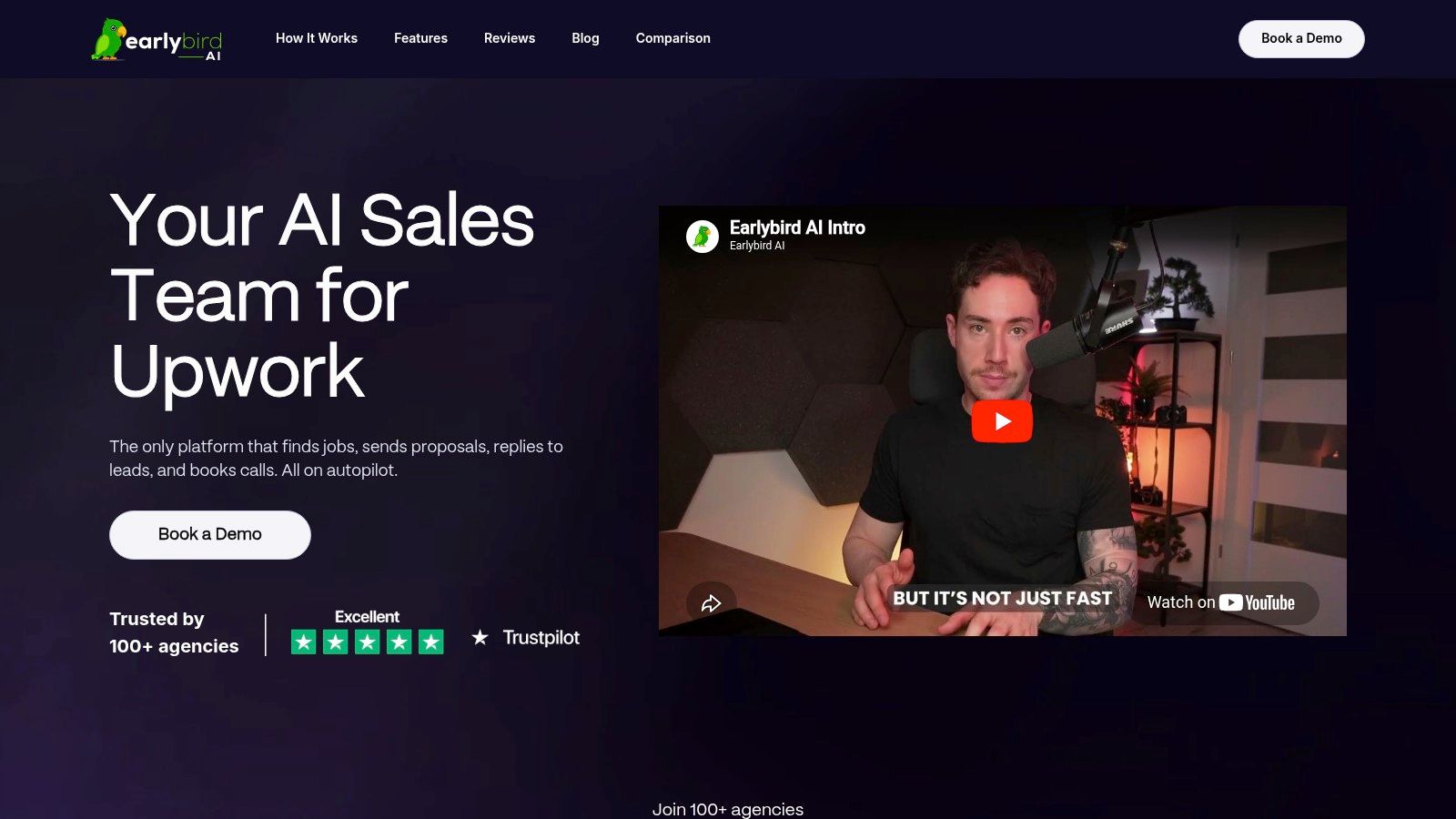
Here's a useful product walkthrough that shows what this looks like in practice:
The practical payoff
The best automation setups don't try to replace judgment. They preserve it.
They make sure your team responds quickly to leads that match your standards, ignores obvious mismatches, and spends human time where nuance matters. That's what agencies need on Upwork. Not more activity. More consistent decision-making under speed pressure.
Measuring Success and Refining Your Process
A qualification framework starts to gradually fail on Upwork.
An agency wins two or three solid projects, gets comfortable, and keeps using the same rules for the next six months. Then the pipeline gets crowded with clients who reply slowly, ask for strategy on a bargain budget, or post vague jobs that turn into long sales cycles. The team still stays busy, so the problem hides in plain sight. Hours go into proposals and calls that never had a real chance to close.
That is why qualification needs measurement, not just good intentions.
Track the signals that expose quality
You do not need a large reporting setup. You need a short list of indicators that show whether your Upwork filter is producing real opportunities or just creating activity.
Track the points where weak-fit leads slip through:
Proposal-to-conversation quality
Which proposals lead to serious back-and-forth with a client who has a defined project, realistic budget, and intent to hire?Lead-to-call ratio
Are the leads you mark as qualified booking discovery calls?Call-to-win quality
Which calls turn into funded contracts, not stalled discussions?Late-stage disqualification reasons
Why are leads getting rejected after a call? No budget, unclear scope, unrealistic timeline, stakeholder confusion, or poor client history?Time spent per won client
How much proposal time, follow-up time, and call time does it take to close one good-fit project?
On Upwork, I also watch platform-specific signals that classic BANT or MEDDIC never covered directly. Client hire rate. Average hourly paid. History with freelancers. Response velocity after the first message. Those clues often predict deal quality earlier than anything said on the call.
Leakage is the metric that matters.
If obvious mismatches are reaching discovery, your top-of-funnel rules are too loose. If very few leads get through but the ones that do close well, the filter may be doing its job.
Field note: When a team keeps saying, “they looked promising on paper,” the real issue is usually missing criteria. The framework did not account for the warning signs available inside the Upwork job post or client profile.
Use score thresholds carefully
Scoring helps when it stays tied to actual outcomes.
For an Upwork agency, that usually means setting simple thresholds based on fit and intent. High-fit leads get immediate pursuit. Borderline leads get selective follow-up or a lighter proposal. Poor-fit leads get filtered out before anyone spends 20 minutes writing custom outreach.
The mistake is treating the score like truth instead of a working model. A lead rated 78 is not good because the number is high. It is good if leads in that range consistently become calls, funded contracts, and profitable projects. If they do not, adjust the model.
Keep the score explainable. Anyone reviewing a job should be able to say why it ranked high:
- Clear scope
- Budget range that matches your minimums
- Positive client history on Upwork
- Fast, serious replies
- Reasonable timeline
- Service fit with your offer
Review those thresholds on a regular schedule against closed-won and closed-lost deals. Salesforce's guidance on lead scoring best practices makes the same point in plain terms: scoring models need ongoing review against real sales outcomes, or they drift out of sync with buyer behavior.
Build a real feedback loop
Good agencies review qualification the same way they review delivery margins or client retention.
A simple cadence works:
- Weekly: check rejected leads that should have been pursued, and pursued leads that should have been filtered out
- Monthly: review wins and losses by project type, budget band, and client profile
- Quarterly: revisit score thresholds, disqualifiers, and any Upwork-specific signals you have added to the framework
Use engagement behavior as part of that review. Looking at client engagement metrics that indicate real buying intent helps separate polite replies from clients who are moving toward a hire.
The goal is not perfect prediction. The goal is a cleaner pipeline, fewer low-value calls, and faster action on clients who are worth pursuing.
Earlybird AI helps Upwork agencies turn qualification into an always-on system instead of a manual chore. It learns which projects fit your agency, finds matching jobs, drafts personalized proposals, and handles fast follow-up so your team can focus on real sales conversations. If you want a smarter way to apply lead qualification frameworks on Upwork, take a look at Earlybird AI.