

← Back To Blog
Outsourced Sales Team: Costs, Risks and How to Decide
The most popular advice on hiring an outsourced sales team is also the most dangerous. Pick the vendor with the lowest cost per lead, book more meetings, and scale what works. Don't do that. Meetings booked and cost per lead tell you almost nothing about account safety, data ownership, message quality, or whether your offer can survive more outreach. Judge a provider on permission design, buyer readiness, and what happens when something goes wrong. The cheapest team can become the most expensive one fast if it burns an account, leaks client data, or sends the wrong pitch to the wrong people at volume.
What an Outsourced Sales Team Actually Does
Think of an outsourced sales team as renting a sales department instead of building one. You get the people, the process, and the daily execution. You still own the product, the pricing, and the final yes or no on a deal. Say an agency wants pipeline for a new service but has no SDR, no list process, and no time to hire. The external team finds prospects, qualifies them, books meetings, and in some models closes deals on your behalf.

The Scope Ladder
Start at the bottom rung. Appointment setting means the deliverable is a booked call, nothing more. The next rungs add lead qualification, pipeline development, account expansion, and technical pre-sales support, and a MarkWide Research overview of the outsourced sales service market notes providers may perform all of those functions through dedicated teams or project-based engagements governed by defined key performance indicators and service-level agreements. That same estimate says the ten largest providers collectively hold 46% share, leaving 54% to independent regional firms, so specialization and geography matter more than brand size.
At the top rung, a full-cycle provider recruits, manages, and pays people who close revenue for you. That's a different purchase from appointment setting, with different risk. Your contract should let you specify response times, contact volume, qualified opportunities, meeting attendance, pipeline value, and handoff requirements. If you can't state those obligations in one page, you're buying a vague promise to generate leads.
Name the single outcome you're buying before you sign, a booked call, a sales-accepted opportunity, or closed revenue. Everything else is activity.
If you don't have internal leadership to define that outcome, fix that gap first, and ask about marketing leadership support before you hand messaging to an outside team. A clear owner on your side decides targeting, approves claims, and kills campaigns that miss. Without that owner, even a competent provider will drift toward easy volume.
Outsourced Team Versus In-House Sales Staff
This isn't a niche staffing trick. Grand View Research estimated the worldwide sales-and-marketing business-process-outsourcing market at $30.70 billion in 2023, with a projection of $57.46 billion by 2030, according to Virtustant's summary of Grand View Research estimates. Reports define the category differently, so don't treat any single market size as exact. Treat the direction as settled. Companies buy external sales capacity at scale.
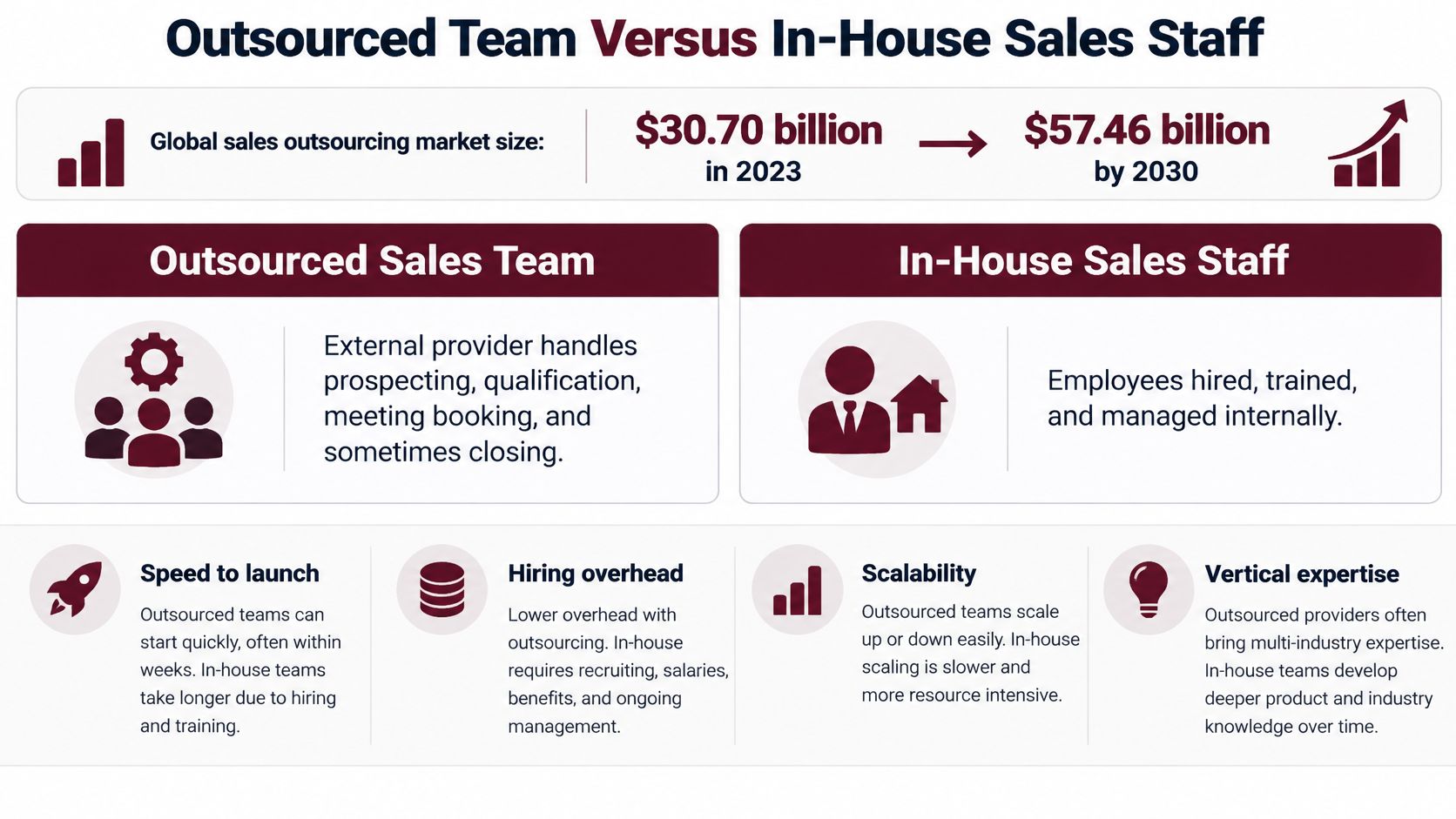
Compare the models on six criteria, not on salary alone.
If you want the in-house cost before you decide, Filta's agency staffing cost breakdown is a useful check on loaded costs beyond base salary. Use it to pressure test your assumptions, then decide based on the work itself.
The video below walks through how an external team operates day to day, which helps you see where handoffs and control points sit.
Outsourcing wins when you're testing a new segment, need seasonal capacity, lack a sales leader to build a team, or want to avoid fixed headcount. In-house wins when deals are long and complex, the product needs deep internal knowledge, or you want sales know-how to compound inside the company. Say an agency wants to test three service categories in one quarter. Run that as an external pilot. Say you sell a six-month enterprise retainer that depends on relationships and technical scoping. Keep that close in-house.
Most firms that make this work use a hybrid pattern. An external team handles prospecting and qualification. An in-house closer runs discovery, proposals, and negotiation. That keeps your best judgment on the money conversations and puts rented capacity where volume matters.
Pricing Models and What Each One Costs
There are three common structures, and each one rewards different behavior. The Neowork sales outsourcing guide reports retainers at roughly $2,500 to $10,000 or more per month for a dedicated representative or small sales pod, and describes a hybrid of retainer plus commission as the most common model in B2B selling. That framing is useful because it separates the base operating cost from the incentive.
Monthly Retainer
A retainer buys capacity and attention. You pay for a rep or pod whether the month is strong or weak, so demand clear inputs in return, such as accounts worked, touches completed, replies handled, and qualified calls delivered. Retainers suit ongoing prospecting where consistency matters. They fail when you pay for seats and get activity reports instead of pipeline.
Commission Only and Hybrid
Commission-only arrangements cut upfront expense, but they're better suited to simpler, high-volume sales motions. Good providers rarely accept pure commission for complex B2B work because they carry all the risk on your unproven offer. The hybrid model is usually the right answer for agencies. You cover predictable operating costs, and the provider earns more when qualified opportunities or closed deals arrive. Tie the variable part to accepted opportunities, not raw meetings, or you'll pay for calendar filler.
Pricing units vary, so compare like with like. One cited provider lists $11,950 per four weeks for each SDR and another lists $6,667 per pod per month, according to Provena AI's roundup of sales outsourcing companies, which also describes engagements beginning with a three- to six-month pilot. A pod price may include management and tooling that a single rep price doesn't. Ask what's included, then review recruitment contract terms with the same care you'd give an employment agreement, because exit rights and data return matter as much as price.
Compare any quote with a fully loaded internal SDR. That means salary, benefits, sales tools, management time, and ramp-up cost, not base pay alone. If you need salary context for that math, use current marketing agency salary benchmarks as a starting point and add the overhead on top. The Neowork guide cited above also references potential savings of 30% to 50% versus a fully loaded internal SDR, but treat that as a vendor-side estimate and run your own numbers.
Run one calculation before you sign. Say you pay $5,000 a month and get 20 qualified calls. That's $250 per qualified call. Now calculate your in-house cost per qualified call using loaded payroll, tools, and manager time. If the outsourced number isn't clearly better, or the call quality is weaker, don't buy it. Cost per qualified call is the metric that matters. Cost per lead hides bad fit, no-shows, and unqualified curiosity.
Benefits and Risks Worth Weighing Up Front
The benefits are real, and they're easy to state. You get faster coverage of a new market, no recruiting or onboarding overhead, capacity that scales with demand, access to reps who already sell into a vertical, and a lighter management load for owners on hiring and training. Those are good reasons to rent capacity instead of building it slowly.
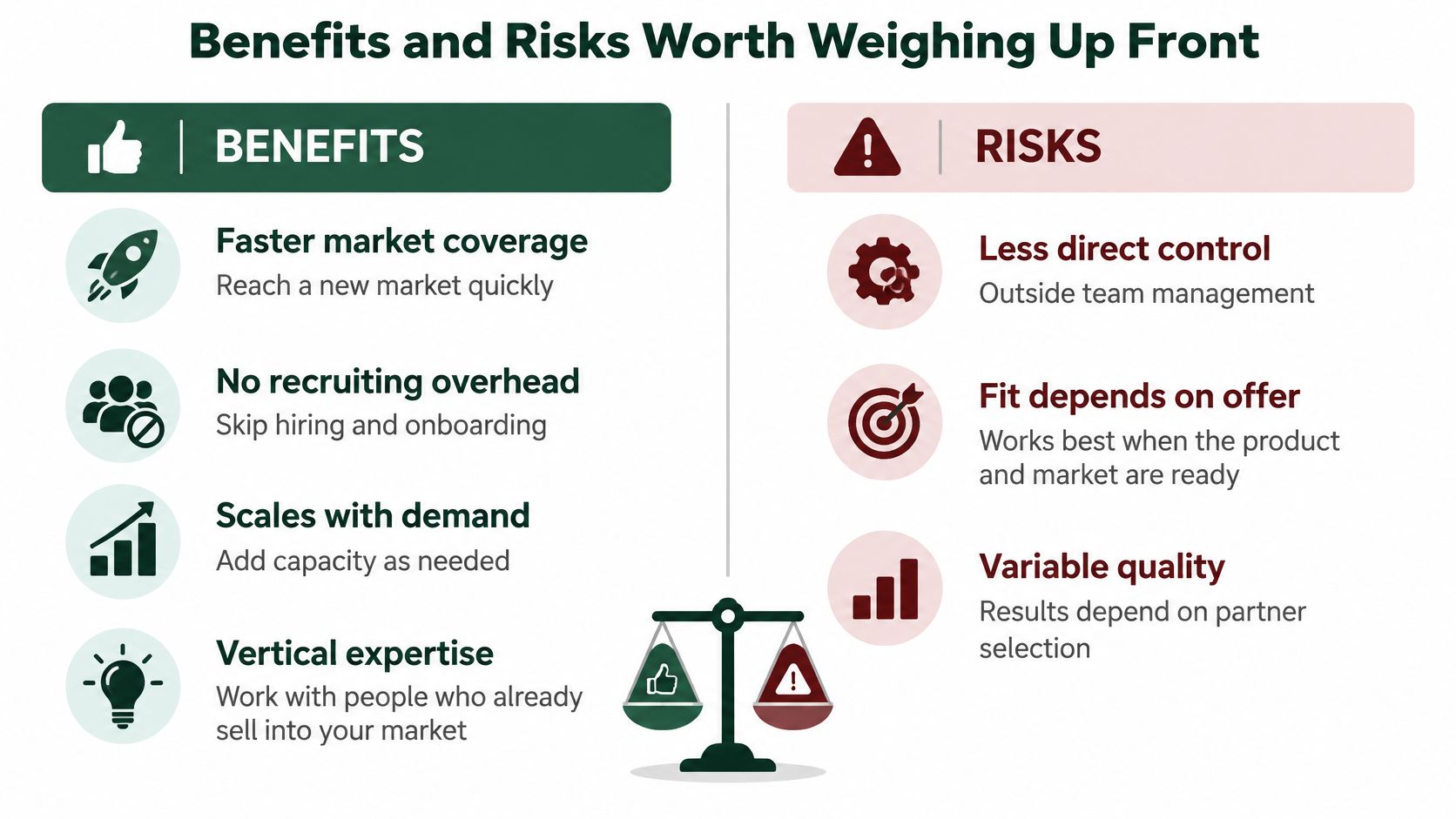
The risks get skipped in most sales pages, so spend your time there.
Automation sharpens every one of those risks. It amplifies whatever targeting you give it. A weak offer sent carefully produces a few bad meetings. A weak offer sent automatically produces bad meetings, angry replies, and account problems much faster. Volume doesn't fix positioning. It exposes it.
Say an agency signs a low-cost outsourced SDR contract, sends 400 messages in a month, books five calls, and loses two existing clients because a rep pitched them as if they were cold prospects. The agency saved money on the retainer and paid for it in churn, cleanup calls, and a damaged reputation in a small market. That's how the cheapest option becomes the most expensive one. Weak controls cause account suspension, client-data exposure, or reputational damage that costs far more than a better provider would have charged.
For every benefit a provider promises, ask what it costs you to reverse the decision if it fails. If the reversal cost is high, the benefit needs a control attached to it.
Governance Terms to Put in Writing
Governance, not lead volume, decides whether outsourcing stays safe. Most buyers ask about price and meetings. Ask these questions first, and listen for specific answers.
Access and Account Separation
What access does the provider need? A safe answer names the minimum, such as a CRM seat, an approved mailbox, or a limited platform seat, with named users and no shared passwords. A dangerous answer asks for your main login and promises to be careful. Whose account does outreach run from, and can you revoke access in one step? If access removal takes a support ticket and three days, you don't control the account.
How is activity audited? You need message logs and an audit trail you can read without asking the provider to prepare a summary. Who approves AI-generated claims, and above what threshold does a human review a message before it sends? Prices, timelines, guarantees, and client names should always require human approval. Set that threshold in writing.
Data Ownership and Legal Exposure
Who owns prospect data, and can you export records and switch providers without losing pipeline history? A safe answer is simple. You own it, it lives in your CRM, and you can export contacts, messages, and notes on demand. An Upwork investor filing on legal and AI risks identifies worker classification, confidentiality, intellectual property, consumer protection, taxation, privacy, and data security as relevant legal obligations, while warning that AI outputs can create legal and reputational risks. Use that list as your contract checklist, especially if you operate across countries and multiple freelancer accounts.
Where is data stored and processed? Privacy and digital-platform rules differ by jurisdiction, so a provider that can't answer where data sits isn't ready for your client information. What happens when a message is inaccurate, inappropriate, or potentially infringing? You need a named incident response path, who gets notified, how fast sending stops, and who contacts the affected prospect.
Put the answers into the contract as named obligations, not handshake promises. Your agreement structure matters here, so align these duties with your master service agreement and statement of work instead of scattering them across emails. Include a termination right if logs, reports, or exports aren't delivered.
Write one clause exactly this clearly. The provider must deliver a full export of contacts, messages, and notes within five business days of termination, in a format you can import into your CRM. Add the same precision everywhere else. Access is revoked the day the contract ends. Human approval is required for any claim about price, timeline, or results. Sending stops immediately after a reported incident until you approve a restart. If a provider resists this language, walk away. A good operator expects it.
Measuring Performance From Pilot to Scale
A pilot isn't a discount trial. It's your evidence period, long enough to train the team, test messaging, build pipeline, and observe conversion before a longer commitment. Run it with a fixed routine, or you'll end the pilot with activity charts and no decision.
In week one, give the provider access to the shared CRM and an approved mailbox or platform seat, name the person who owns each handoff, and agree on one weekly report format. Don't let the pilot start across spreadsheets, inboxes, and chat threads. You'll never reconstruct what happened later.
The Six-Step Pilot Routine
Each step exists to protect the same thing, your ability to make a clean decision. A pilot with shared records and weekly corrections produces evidence. A pilot with monthly summaries and vague optimism produces a renewal argument.
Scale only after the pilot proves the funnel works. Never scale because a contract offers a discount for more volume up front.
If a service category misses its threshold, cut it and keep the categories that convert. If handoffs fail, fix the owner and the response standard before blaming lead quality. If margin is thin despite good calls, your pricing or qualification rules are wrong. The pilot should tell you which problem you have.
Readiness Test and Fit Decision
Outsourcing usually fails for buyer reasons, not because external sales can't work. A summarized SaaStr community survey reported that only 7% said outsourced SDRs worked well, while 26% said they worked only somewhat well, with the cited explanation being a proven offer, a clear ideal customer profile, and active management, according to Martal's guide to sales outsourcing companies. That same source cites a 2025 Bridge Group study of 351 B2B companies, reporting median SDR on-target earnings of $80,000 and an average three-month ramp. Use those figures as context for cost and patience, not as a promise that outsourcing performs the same way for you.
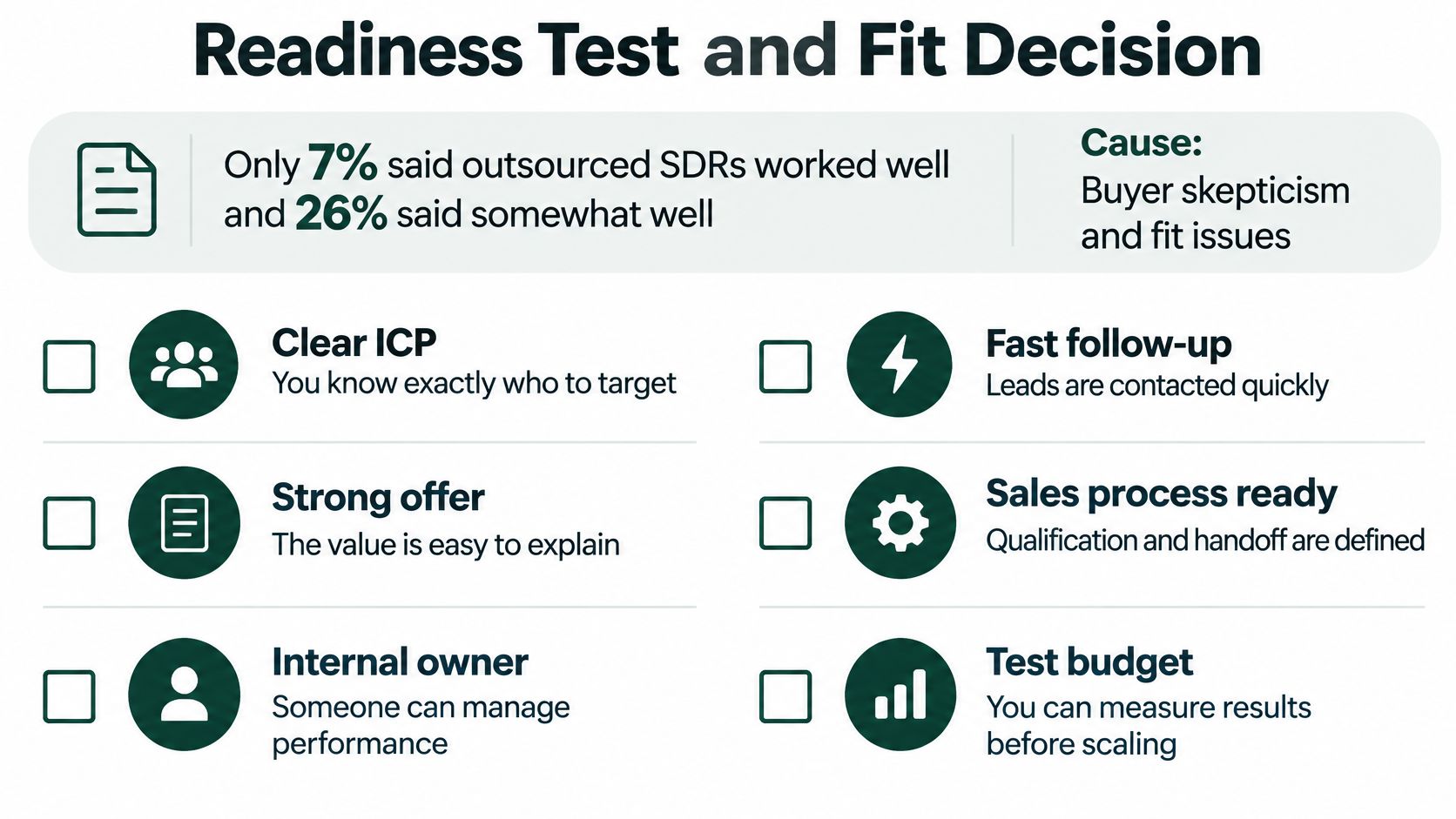
Run this readiness test. A no on the first three items means you're not ready, no matter how good the provider sounds.
The Readiness Checklist
For Upwork-focused agencies, apply the test through proposal-to-reply and reply-to-call rates by service category, alongside call-to-hire, project margin, and account health. Proposals sent is an input. It doesn't tell you whether the right clients answered, whether the calls were worth taking, or whether the work made money. One category with strong replies and weak margin needs a pricing fix. One with weak replies needs better targeting or proof. Judge them separately.
Automation can amplify poor targeting just as efficiently as good targeting. Readiness decides which one you're scaling.
Three Decision Paths
If your offer, profile, proof, response standard, and pilot budget are ready, run a controlled pilot with written stop-loss thresholds. Pick one or two service categories, not your whole offer set. Expand only after a category clears your reply and margin thresholds.
If your offer or targeting is unproven, don't outsource yet. Fix positioning first. Narrow the audience, sharpen the promise, collect proof on a few manual wins, and write your qualification rules. Outsourcing an unproven offer doesn't buy learning. It buys faster rejection and a burned list.
If your sales depend on long, relationship-heavy cycles that need a senior closer, keep closing in-house and outsource top-of-funnel work only. Let the external team research, prospect, and qualify. Your senior person runs discovery, scoping, and negotiation, where judgment and trust decide the deal.
Compare automation on the same metrics you'd apply to a human team. We built Earlybird AI as an Upwork automation platform that finds jobs, writes proposals, replies to client messages, and books calls from your own account, then follows up until a call is booked. Because it runs inside your own account, permission design and data history stay under your control, which is the same standard you should demand from any outsourced provider. Prospects can book a demo to see the whole loop of finding jobs, sending proposals, and booking calls live on their Upwork account.
Your next step is simple. Run the readiness test and mark every item pass or fail today. Fix any fail in the first three items before you talk to providers. Then pick one metric set, set your stop-loss thresholds, and book either a demo or a pilot conversation based on which model fits your sale.
If your readiness test is green, put the same governance standard to work with Earlybird AI. It runs the full loop from finding Upwork jobs to sending proposals, replying, following up, and booking calls from your own account, so your team spends its time closing instead of chasing. Visit Earlybird AI and book a demo to see the loop live on your account before you commit to any outsourced team.


