
← Back To Blog
Pipeline Sales Stages: A 2026 Guide to Closing More Deals
You can have 30 open conversations and still feel stuck. One prospect says they'll “circle back,” another has a proposal in their inbox, and a third went quiet after a great call. The pipeline looks busy, but it doesn't feel controlled, and that's usually the moment founders and agency owners realize they're managing activity, not revenue.
Pipeline sales stages solve that problem only when they're built around buyer movement, not seller effort. A stage list becomes useful when it tells you what happened, what still needs to happen, and whether a deal is progressing toward a close.
Why Your Pipeline Feels Broken (And How Stages Fix It)
Most messy pipelines start with good intentions. A freelancer adds a prospect after a discovery call, an agency owner marks a deal as “proposal sent,” and the CRM starts filling up with opportunities that all look active until you ask a simple question, which ones are moving?
The break happens when stage names describe what the seller did instead of what the buyer confirmed. A deal that sits in “proposal” because you emailed a PDF isn't the same as a deal that sits in “proposal” because the buyer asked for pricing, reviewed the scope, and agreed to decision next steps. When stage labels are based on your activity, they become a logbook. When they're based on buyer action, they become a forecast.
Activity based stages create false confidence
I've seen teams celebrate a full pipeline while half the deals were basically waiting rooms. The rep had sent follow-ups, the CRM had notes, and the dashboard looked healthy, but the buyer had never taken the action that justified advancement. That's where forecast quality dies.
Practical rule: If the buyer hasn't done something observable, the deal hasn't advanced.
That rule matters even more once automation enters the picture. Automation is useful when it speeds up a clean process, but it only amplifies confusion when the process is fuzzy. If your team can't agree on what “qualified” means, software will just move the ambiguity faster.
The healthier approach is to make every stage answer one question, what did the buyer do that proves this deal moved forward? That's the difference between a pipeline that helps you close and a pipeline that keeps you busy.
The Core Pipeline Sales Stages Framework
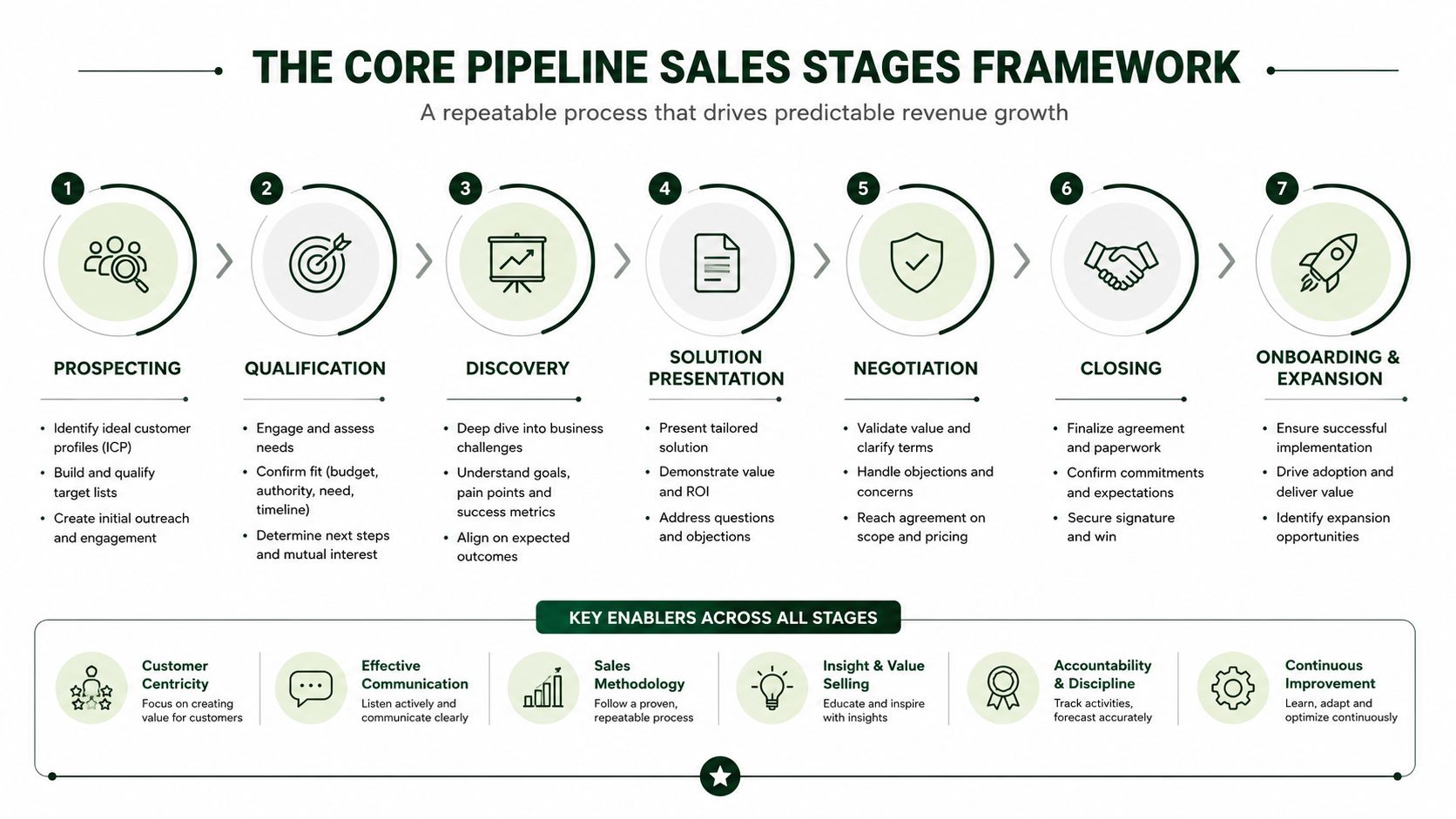
Most B2B pipelines use five to seven core stages. Salesforce describes common stages such as prospecting, qualification, discovery, proposal, negotiation, close, and post-sale follow-up, and the exact sequence depends on the sales motion (Salesforce pipeline stages). The point isn't to force every business into the same ladder, it's to define each rung so the team knows when a deal can climb.
Prospecting and qualification
Prospecting ends when the buyer responds in a way that justifies a conversation. That can be a reply, a booked call, or a direct request for more information, but it shouldn't be “I sent three messages.” Qualification begins only when the buyer fits your target profile and agrees there's a problem worth discussing.
For agencies, that may mean the prospect confirms budget range and a real project need. For an Upwork seller, it may mean the client replies with context instead of just an auto-generated inquiry. A resource like the 2026 guide to sales pipeline stages is useful here because it reinforces the same discipline, stage movement should follow a buyer milestone, not a rep's optimism.
Discovery, proposal, negotiation, and close
Discovery is the first structured conversation where the buyer's pain, timeline, and decision process become visible. The deal should move out of discovery only when the buyer agrees to continue and gives enough context for a specific next step. Proposal starts when you've got enough information to present a solution with relevance, not just a generic price sheet.
Negotiation begins when the buyer engages on terms, pricing, scope, or risk. Close happens when the contract is signed or the order is accepted. If you need a practical operating model for all of this, the cleanest companion framework is documented in what is sales pipeline management, because stage discipline only works when management, CRM hygiene, and rep behavior line up.
Post sale follow up belongs in the pipeline
Most guides stop at closed won. That's a mistake for agencies and service sellers, because onboarding, retention, and expansion are part of revenue motion too. Pipefy's seven-stage model explicitly includes post-sale follow-up as a formal stage, which reflects how implementation and nurturing affect renewals and expansion (Pipefy sales pipeline stages).
If your business depends on repeat work, referrals, or upsells, post-sale shouldn't live in a separate universe. It should sit inside the same revenue system, with its own exit criteria and owner.
Conversion Benchmarks and KPIs That Actually Matter
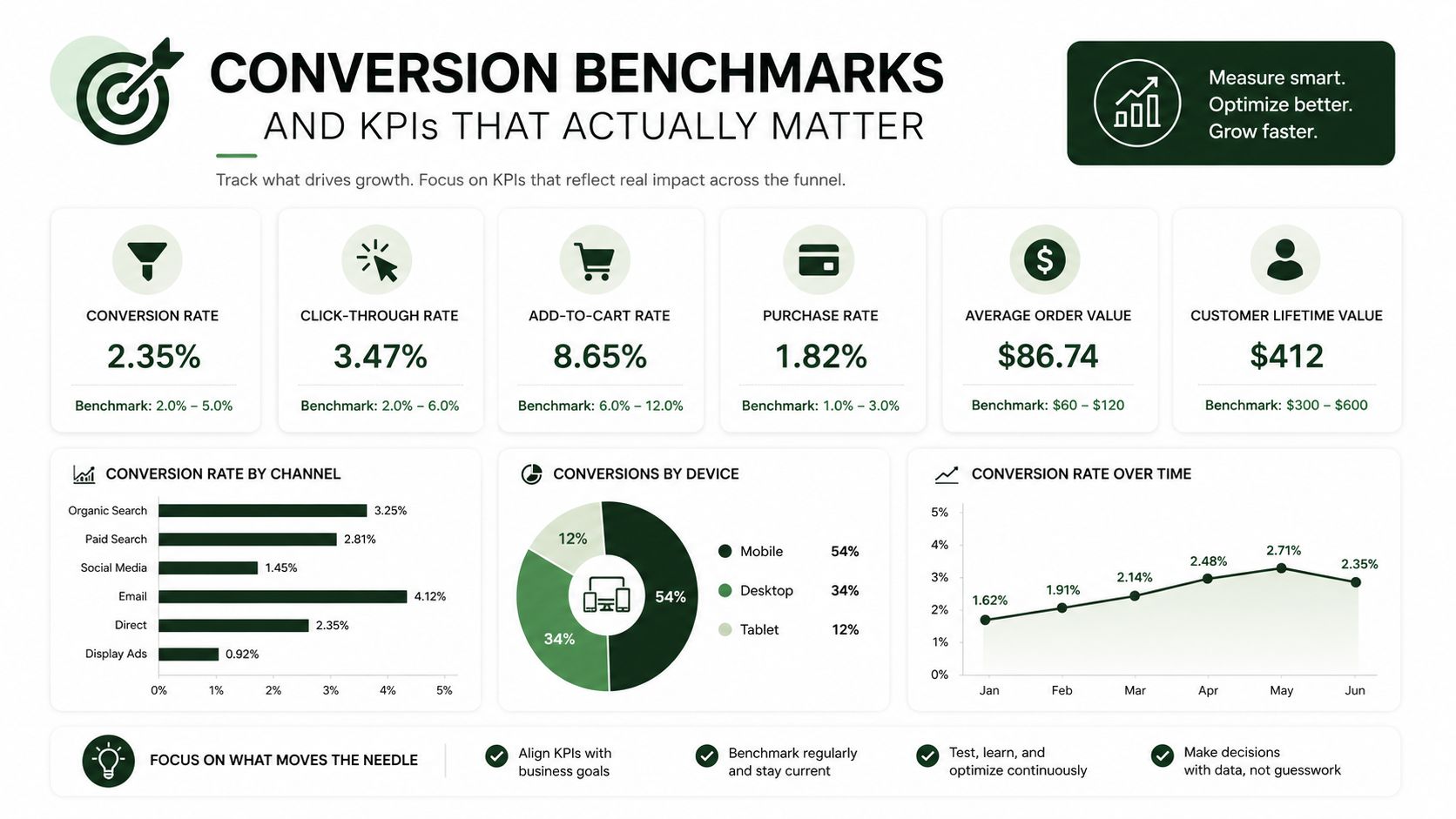
A stage framework only helps if you can see where deals slow down. Apollo's guide points to 1 to 2% for prospecting to MQL, 20 to 25% for lead to MQL, 10% for MQL to SQL, 22% from opportunity to close at proposal, and about 29% at negotiation for qualified opportunities (Apollo sales pipeline). Those figures are not a target to copy. They give you a baseline for spotting which stage is leaking.
The metrics that actually tell you something
ZoomInfo identifies pipeline velocity, win rate by stage, average deal size, sales cycle length, pipeline coverage ratio, and deal age as the core diagnostics (ZoomInfo sales pipeline). HubSpot's velocity formula is straightforward, opportunities × win rate × average deal size ÷ sales cycle length, which turns speed into a financial measure instead of a vague productivity score (HubSpot pipeline velocity). That formula is worth keeping close because it shows exactly what to inspect when revenue starts to drag.
A proposal-to-close drop is not always a rep performance problem. The issue may be weak scope clarity, pricing that does not match the buyer's risk tolerance, a proposal that does not answer the buyer's concerns, or a missing decision path. If deals stall earlier, qualification is usually the first thing to check.
How to diagnose a leak without guessing
ZoomInfo also cites independent industry sources showing that only 1 to 3% of awareness-stage prospects become leads, 10 to 15% of leads become qualified opportunities, and 20 to 30% of qualified opportunities close (ZoomInfo sales pipeline). On the same page, another guide points to roughly 15% of MQLs becoming SQLs, 10 to 12% of those becoming opportunities, and 6 to 9% of opportunities closing (ZoomInfo sales pipeline). The point is simple. Final revenue often hides weak conversion math much earlier in the pipeline.
If a stage is underperforming, fix the stage before you ask reps to work harder.
That is why key sales enablement metrics matter. The resource is useful because it keeps the focus on behavior as well as outcomes. In practice, that means watching deal age, stage conversion, and cycle length together, since a healthy pipeline needs all three to line up.
Pipeline Examples for Agencies and Upwork Sellers
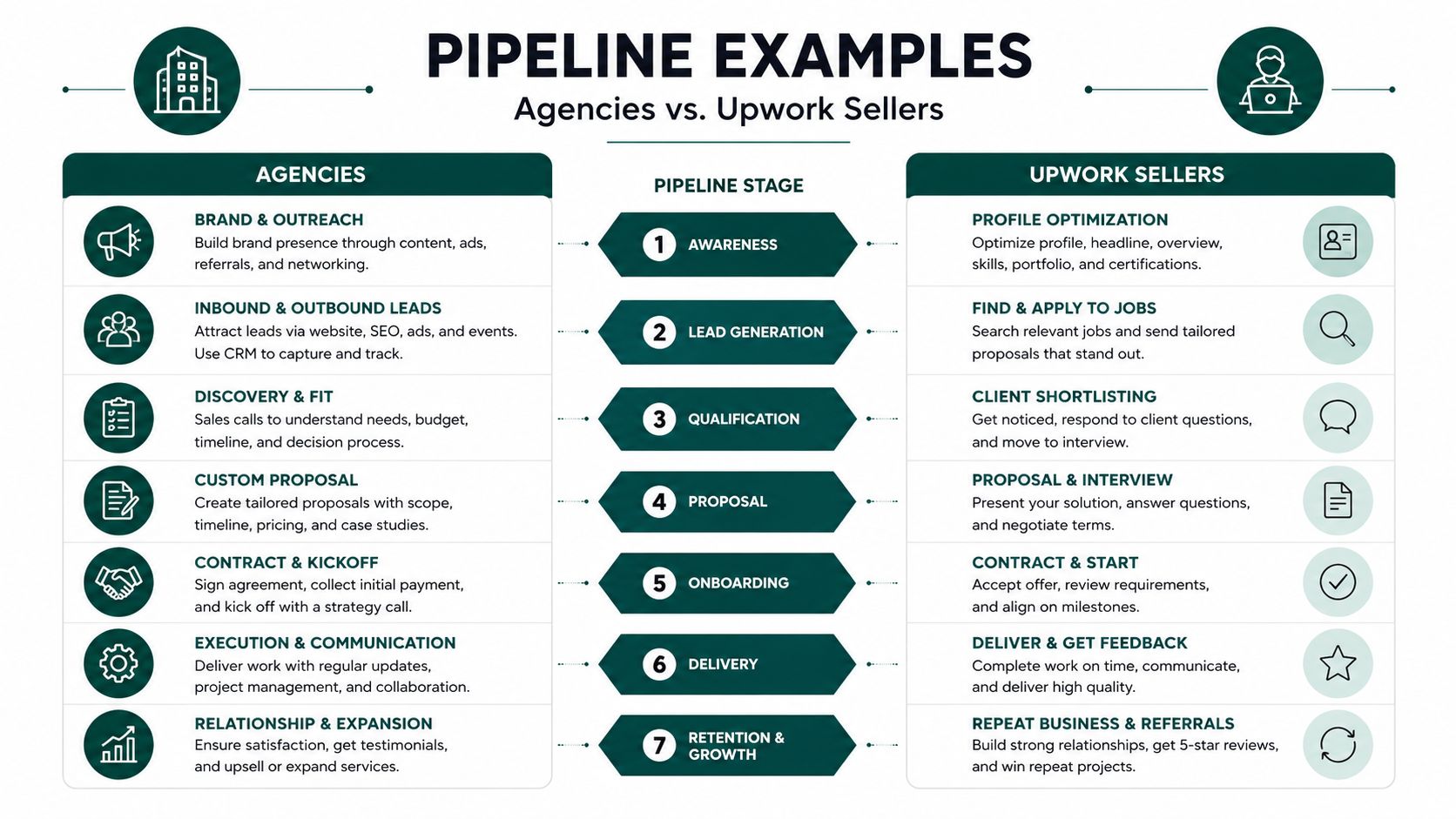
A service business pipeline works best when it follows buyer behavior, not a generic enterprise template. An agency selling strategy work moves through a different decision path than an Upwork freelancer bidding on active jobs, so the stages should reflect how each buyer exits one step and enters the next.
Agency pipeline example
A lean agency pipeline usually starts with an inbound inquiry or referral, then moves to a scope call, proposal, negotiation, contract, onboarding, and expansion. The useful part is not the label, it is the exit criteria behind each stage.
- Inquiry received: The prospect has shared enough context to justify a response.
- Scope call completed: The buyer joined the call and confirmed the project is real.
- Proposal submitted: The buyer asked for, or accepted, a scope and pricing.
- Negotiation active: The buyer is discussing terms, timeline, or deliverables.
- Contract signed: The buyer approved the agreement and is ready to start.
- Onboarding underway: The implementation has begun and the account is now part of retention and upsell measurement.
I keep post-sale stages visible in agency pipelines because referral conversations and expansion opportunities usually show up after the first project is live. If you want a more tactical build sequence, the how to build a sales pipeline article is a useful companion for turning these stages into CRM fields and rules.
Upwork seller pipeline example
Upwork sellers work in a faster, more reactive environment. A job is posted, the proposal goes out, the client replies, an interview is scheduled, an offer is received, and the contract starts. The sequence is shorter, but the exit criteria still need to be strict.
Speed matters more than polish in the early stages. A proposal sent within minutes of a relevant post is often better than a carefully polished one sent too late, because the buyer's inbox fills quickly and attention drops fast. Once the client starts replying, the focus shifts from volume to response quality, especially in the interview and offer stages.
The right pipeline for Upwork is not about looking enterprise-grade. It is about helping the seller see which jobs are worth chasing, which replies deserve immediate attention, and which contracts are about to start. A practical setup also leaves room for repeat work and post-contract follow-up, since many sellers overlook those stages until the pipeline goes quiet.
How Automation Streamlines Stage Progression
Manual pipeline management breaks down fast once you are juggling too many opportunities. Admin work grows faster than selling time, and deals stall because nobody wants to spend another evening copying notes, sending reminders, or checking replies one by one.
Automation does its best work at the edges of the pipeline, where repetition is high and judgment is light. It can handle initial outreach, track responses, and keep follow-up moving without turning the whole process into canned noise. For a clear definition of the systems behind that approach, see what sales automation actually does.
Where automation earns its keep
Appointment-setting workflows are a good example. A service like Hire Appointment Setters fits the logic of top-of-funnel stage handling because it replaces repetitive follow-up with a structured response process. Once a deal gets close to pricing, scope, and terms, a human still needs to make the call.
Earlybird AI sits in that same category for Upwork sellers and agencies managing multiple bidders. It connects to an Upwork account, learns ideal project patterns from thumbs-up and thumbs-down feedback, submits proposals quickly, replies to client messages, and keeps following up until a call is booked. The value is not only speed, it is consistency across stage transitions that usually disappear when a team gets busy.
Automation should carry the repetitive part of the motion, not the decision that closes the deal.
Where human judgment still matters
Negotiation is the obvious one, but complex proposals also need a person. If the buyer is comparing scope options, asking about edge cases, or revising deliverables, a template will not save the deal. The rep or founder needs to read the room, adjust the offer, and decide whether to hold firm or flex.
The smart split is simple. Automate prospecting, first-response handling, and reminders. Keep proposal structure, pricing judgment, and high-stakes objections human. That balance protects both deal quality and account safety, especially in platform-based selling where behavior still has to look natural.
Optimization Tips to Fix Leaky Stages
Leaky stages usually tell you exactly where the system is weak, if you're willing to look. Qualification stalls point to bad targeting, weak discovery often points to poor questioning, and negotiation drag usually means the buyer doesn't feel enough urgency to act.
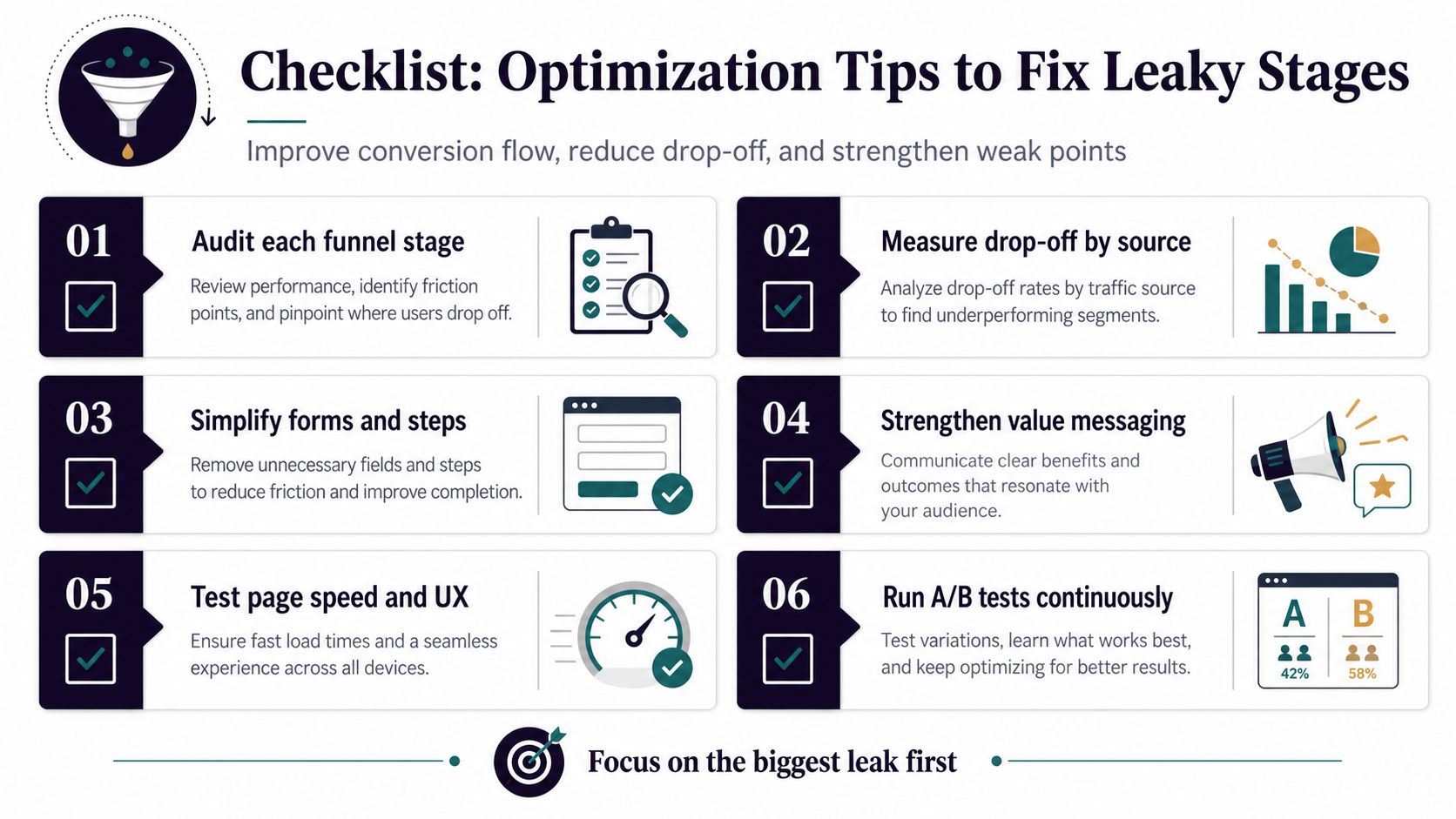
Tighten the gate where deals get stuck
If prospects keep stalling at qualification, sharpen the disqualification criteria. A stronger ideal client profile saves more time than a better follow-up email ever will. In practice, that means forcing clarity on budget, need, timeline, and authority before the opportunity gets real CRM space.
If proposals aren't converting, the issue is often the format, not the effort. Tighten the scope, make the outcome easier to understand, and add proof that the buyer can trust. Social proof helps, but only when it matches the buyer's world.
Use source patterns to focus effort
If deals from one channel consistently close better, spend more time there and less time on weak sources. That's not a vanity exercise, it's resource allocation. A good pipeline manager doesn't just ask, “How many deals do we have?” They ask, “Where do the strongest deals come from?”
A few practical triggers help keep the process honest:
- Stalled qualification: Remove deals that can't confirm fit or urgency.
- Weak proposals: Simplify scope and show proof tied to the buyer's problem.
- Dragging negotiation: Set an expiration window or escalation path.
- Old close dates: Reconfirm the buyer's real decision timeline.
- Single-threaded deals: Add another contact on the buyer side.
- Low-activity opportunities: Re-engage fast or move them out.
The hardest choice is often stage redesign versus stage coaching. If the rule for advancing a deal is vague, fix the stage definition. If the rule is clear and the rep is just not executing, fix the behavior. That distinction keeps the pipeline honest.
Building a Pipeline That Scales With Your Business
A scalable pipeline starts small and stays disciplined. Pick five core stages, define exit criteria for each one, and track a few metrics that tell the truth about movement, not just volume. That setup is usually enough for a small team to stop guessing and start managing.
As the business grows, add stages only when visibility starts breaking down. Remove stages when the admin burden gets heavier than the insight they provide. The test is whether every stage helps you see a buyer action that matters.
Scale gets easier when the team treats the pipeline as a living system, not a static CRM layout. AI and automation will keep making stage tracking faster, but they won't replace the need for clear rules. The teams that win will be the ones that make every stage measurable, every handoff obvious, and every post-sale motion visible.
If your pipeline feels busy but unclear, Earlybird AI can help you automate Upwork proposals, replies, and follow-up while keeping stage movement tied to real buyer actions. Visit Earlybird AI if you want a system built for faster responses, cleaner pipeline progression, and less manual work across the deals you want to win.