
← Back To Blog
How to Post a Job on Upwork to Attract Top Talent (2026)
You post a job on Upwork, expect a manageable shortlist, and end up with a wall of proposals that all sound the same.
A few mention your project. Most don't. Some clearly didn't read the brief. A few promising candidates disappear because you took too long to reply. By the time you start sorting it out, the hiring task has turned into another project.
That usually isn't a freelancer problem first. It's a job post problem.
After hiring across design, development, content, SEO, and operations, the pattern is hard to miss. Strong freelancers don't need to chase vague work. They choose clear clients, defined projects, realistic budgets, and briefs that signal competent management. Weak job posts attract available talent. Sharp job posts attract selective talent.
That matters because Upwork can be a very efficient hiring channel. Clients who hire through Upwork can reduce overall project and operational costs by as much as 30% compared to traditional hiring methods, according to Upwork's freelancing stats. But those savings disappear fast when the wrong hire creates rewrites, missed deadlines, and scope drift.
Your Guide to Finding Elite Talent on Upwork
The most common mistake clients make is treating the post like admin work.
They fill in a title, write a quick paragraph, choose a budget they hope is “good enough,” and assume the best people will sort themselves to the top. Then they wonder why the inbox fills with generic bids.
Top freelancers read job posts like risk analysts.
They scan for three things right away:
- Clarity: Can they tell what the business needs?
- Seriousness: Does the client sound prepared to make a decision?
- Fit: Is this a clean project with a realistic chance of success?
If the answer is unclear, they skip it. They don't spend time decoding vague briefs when better opportunities are available.
A strong post does two jobs at once. It attracts the right people and repels the wrong ones. That's the part many clients miss. You don't want more applicants. You want fewer, better ones.
Practical rule: The best job posts reduce ambiguity before they increase reach.
That changes how you should think about the whole process. You're not just trying to post a job on Upwork. You're trying to create a signal that top-tier talent recognizes instantly.
The signal comes from specifics. What exists today. What's broken. What success looks like. What the first deliverable is. Who owns feedback. How decisions get made.
When those details are present, good freelancers write better proposals because they can see the path to doing strong work. When those details are missing, even capable people send guarded, noncommittal responses.
A good post takes longer to write. It saves more time than it costs.
Laying the Groundwork for a Successful Hire
Before you write the post, decide what you're buying.
Most failed hires start before the listing goes live. The client hasn't defined the scope tightly enough, hasn't chosen the right contract model, or hasn't separated must-haves from nice-to-haves. Then the post becomes fuzzy because the project is fuzzy.

Pick the contract type before you write the brief
Use fixed-price when the deliverable is clear.
Examples:
- Landing page build: One defined page, approved design direction, known CMS.
- Article package: A set number of articles with a set length, topic, and review process.
- Audit project: Technical SEO audit, UX review, analytics cleanup.
Use hourly when the work will evolve.
Examples:
- Ongoing design support: New requests each week, changing priorities.
- Development maintenance: Bug fixes, small features, troubleshooting.
- Research or strategy: The work depends on discoveries made during the engagement.
The trade-off is simple. Fixed-price rewards efficiency but punishes vague scope. Hourly gives flexibility but requires tighter communication and oversight.
If you're unsure, ask one blunt question: Can I describe the first deliverable in one sentence without hand-waving? If yes, fixed-price may work. If not, start hourly.
Define the project in operational terms
Most briefs fail because they describe a role, not a problem.
“I need a developer” is a role.
“I need a developer to rebuild our pricing page in Webflow, match Figma precisely, improve load speed issues, and hand off reusable components” is a problem with boundaries.
Write these notes before posting:
- Current state
What exists now? Site, app, content library, ad account, CRM, design system. - Immediate objective
What needs to happen first? Not eventually. First. - Deliverables
What will the freelancer hand over? - Constraints
Brand rules, tech stack, deadlines, approval chain, access limitations. - Success criteria
What will make you say, “This was a good hire”?
Separate required skill from preferred background
Clients often mix these together and create bloated posts.
A better filter looks like this:
- Required: Must write conversion-focused B2B SaaS copy in English.
- Preferred: Has worked with CRM or RevOps products.
- Useful but optional: Familiar with founder-led brands.
That structure gives strong candidates room to self-qualify without making the brief read like a wish list. It also protects you from rejecting capable specialists because they don't match every minor preference.
Elite freelancers don't fear detailed briefs. They avoid messy ones.
Crafting a Job Post That Attracts Top Talent
The title and first few lines do more filtering than most clients realize.
Experienced freelancers scan fast. If the opening feels vague, bloated, or unserious, they move on. If it feels sharp, they keep reading.
Write the title like a specialist is reading it
Bad title: “Need help with website”
Better title: “Webflow developer to rebuild SaaS pricing page from approved Figma file”
Bad title: “Looking for writer”
Better title: “B2B SaaS content writer for product-led SEO articles with SME interviews”
The strong version does three things fast:
- Names the skill
- Defines the deliverable
- Signals the business context
That attracts the right experts and discourages volume applicants who rely on broad matching.
Use a brief structure that answers real freelancer questions
The body of your post should be easy to scan. I like this order:
Start with context
Tell them who you are and why this project exists.
Keep it practical. Not brand theater.
Example:
- We run a small SaaS company serving finance teams.
- Our current pricing page is outdated and no longer matches product packaging.
- Design is approved. We need execution and clean handoff.
That gives enough context for a good freelancer to frame their proposal.
Define the problem
State what's not working or what needs to be built.
Examples:
- Existing page doesn't reflect current pricing tiers.
- Blog content ranks, but doesn't convert trial users.
- Ad account structure is messy after repeated campaign launches.
Freelancers do better work when they understand the friction, not just the asset request.
List deliverables and decision points
Use bullets. Here, top candidates decide whether the project is worth pursuing.
- Primary deliverable: Rebuild one pricing page in Webflow
- Secondary deliverable: Create reusable sections for future pricing updates
- QA requirement: Mobile responsiveness and browser testing
- Handoff: Clean class naming and short Loom walkthrough
This is also where a more detailed Upwork job description guide can help if you're struggling to translate internal notes into a client-ready brief.
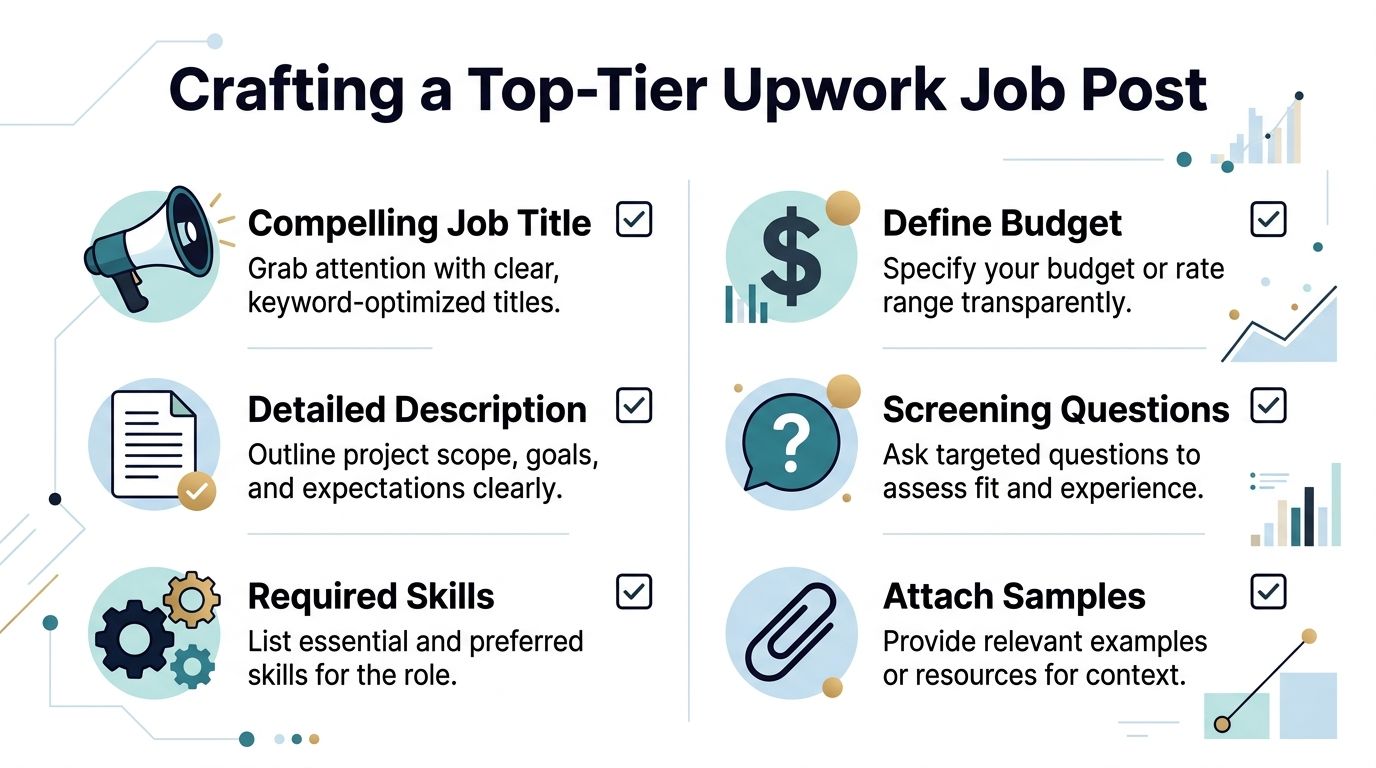
A quick visual checklist helps if you're writing from scratch:
Describe the ideal candidate without turning it into a fantasy profile
This works:
- Has shipped production Webflow sites
- Can match Figma accurately
- Communicates clearly about trade-offs
- Shares 2 to 3 relevant examples
This doesn't:
- Rockstar
- Ninja
- Expert in every platform
- Available all day
- Cheap and fast
The second version attracts the wrong psychology. It tells good freelancers the client may be difficult, unclear, or rate-sensitive in the wrong way.
Two job post templates that work
Template for a web developer
Title
Webflow developer to build approved SaaS pricing page
Description
We need a Webflow developer to build one pricing page for our SaaS product. The page has already been designed in Figma. This is an execution-focused project, not a branding exercise.
Our main need is pixel-accurate implementation, responsive behavior, and a clean structure we can maintain internally after handoff.
Deliverables
- Build one pricing page in Webflow
- Match approved Figma design
- Ensure mobile responsiveness
- Set up reusable sections where practical
- Provide short handoff notes or walkthrough
Please apply if you
- Have relevant Webflow examples
- Can explain how you handle responsive issues
- Communicate clearly and don't disappear mid-project
When applying
Please send 2 relevant examples and a short note on how you'd approach this build.
Why it works: It sounds contained, serious, and executable.
Template for a content writer
Title
B2B SaaS writer for decision-stage blog content
Description
We need a writer who can produce decision-stage content for a B2B SaaS audience. This isn't generic top-of-funnel blogging. The articles need clear structure, product understanding, and a commercial angle without sounding salesy.
We already have topic direction and internal notes. We need someone who can turn that into strong first drafts with minimal hand-holding.
Deliverables
- Write one trial article to start
- Follow our structure and voice guidance
- Incorporate internal product context
- Revise based on editorial feedback
Best fit
- Has written for SaaS or software buyers
- Can show work that explains complex topics clearly
- Understands the difference between traffic content and buyer content
When applying
Send 2 relevant samples and tell us how you handle source material from internal experts.
Why it works: It clearly signals the level of thinking required. That helps strong writers self-select in.
Good freelancers aren't impressed by long posts. They're impressed by posts that remove uncertainty.
Setting Your Budget Visibility and Screening Rules
Once the brief is strong, the settings provide an advantage.
Weak settings can undermine a good post fast. Strong settings make the applicant pool easier to manage because they communicate seriousness before the first proposal arrives.

Budget signals more than price
A low budget doesn't just attract cheaper proposals. It tells experienced freelancers that the client may undervalue expertise, revise endlessly, or expect senior output at junior pricing.
A more grounded starting point is this: the average freelancer on Upwork earns around $39 per hour, with a range from $29 to $54, according to Upwork's stats and trends guidance. That doesn't mean every role should be priced the same. It means your budget should align with the skill and complexity you're asking for.
If you're still deciding how Upwork fees and client-side costs fit into your hiring model, this breakdown of whether Upwork is free is useful context.
Visibility changes applicant quality
Use public visibility when you want market discovery. This works well when you're open to being surprised by talent and your brief is already sharp.
Use invite-led hiring when the role is specialized or the project needs discretion. In that case, your job post still matters because the invited freelancer is evaluating you just as much as you are evaluating them.
The practical trade-off is simple:
- Public posting: More range, more noise, more discovery
- Invite-heavy approach: More control, less serendipity
- Restricted visibility: Useful when confidentiality matters, but weaker for broad discovery
Screening questions should test reading, not trivia
Most clients waste this feature.
Don't ask generic questions like “Why are you a good fit?” You'll get polished nonsense. Ask questions that reveal whether the freelancer read the brief and can think inside your project.
Better examples:
- For developers: What would you check first before rebuilding this page in Webflow?
- For writers: How would you turn internal notes into a publishable draft without losing the subject-matter detail?
- For marketers: What information would you need before changing campaign structure?
Use a few questions, not a long exam. The point isn't to make applicants work hard. The point is to make weak applicants expose themselves quickly.
From Proposals to Project Kickoff
The first review window matters more than most clients expect.
Between 60% and 75% of all proposals arrive within the first 6 hours of a new job post. If you post a strong job and wait too long to engage, you often lose the best applicants to faster clients.

Review proposals in passes
Don't read every proposal with equal effort.
Use three passes:
- First pass
Remove anyone who ignored the brief, missed the core requirement, or sent an obviously recycled proposal. - Second pass
Review portfolio relevance. Not overall talent. Relevance. A brilliant logo designer isn't automatically the right fit for a UX-heavy SaaS dashboard. - Third pass
Shortlist based on judgment. Did they identify the core challenge? Did they answer your screening questions directly? Do they sound easy to work with?
This process keeps you from getting distracted by polished profiles that aren't matched to the actual work.
Interview for working style, not performance theater
A short interview should answer practical questions:
- How do they handle ambiguity?
- What do they need from you to succeed?
- How do they communicate risks or delays?
- Can they explain their process without jargon?
Ask situational questions. Those are harder to fake.
For example:
- If the brief is missing a key detail, what do you do first?
- If you disagree with the requested approach, how would you raise it?
- How do you usually structure the first few days of a project?
If you also work from the freelancer side, this guide to submitting a proposal on Upwork is useful because it shows how serious applicants think when they respond to a listing.
Fast replies matter, but rushed hiring doesn't. Move quickly on communication, not carelessly on selection.
Set the contract so the work can succeed
The offer stage is where many clean hiring processes get messy.
For fixed-price, define milestones by output, not by vague phases. “Homepage draft delivered for review” is better than “Phase 1.”
For hourly, set expectations around priorities, communication cadence, and approval flow. Weekly limits help, but clarity helps more.
Before kickoff, confirm these points in writing:
- Scope: What is included right now
- Process: Where updates happen and who approves
- Timeline: First checkpoint and expected response windows
- Assets: Access, files, brand docs, examples
- Revision logic: What counts as iteration versus added scope
A clean kickoff reduces the chance that a good hire turns into a frustrating engagement.
Common Pitfalls When Posting a Job on Upwork
A client posts a job at 6 p.m., writes two vague sentences, sets a bargain budget, and waits. By morning, the inbox is full. That feels like demand. In reality, it is often a filter failure.
Strong freelancers do not read a post the way inexperienced clients expect. They are not asking, “Can I do this work?” They are asking, “Will this client be clear, decisive, and worth the slot on my calendar?” Your post answers that before you ever send a message.
Vague posts attract uncertainty
“I need help with marketing” is not flexible. It signals unclear scope.
The best applicants know what vague posts usually create: extra discovery work, shifting priorities, and disputes about what was included. So they pass or they bid high to cover the risk. The applicants who remain are often generalists, proposal spammers, or people willing to say yes before they understand the assignment.
A better post gives enough detail to let a specialist recognize a real fit. Name the outcome, the channel, the current situation, and the first deliverable. Clear scope does not scare away top talent. It helps them trust the opportunity.
Slow response sends the wrong signal
Elite freelancers screen for client behavior early.
If a client posts a job, gets solid proposals, and then goes quiet, experienced talent reads that as a warning. Slow review often predicts slow approvals, unclear feedback, and stalled invoices. Many of the best candidates will move on before the client ever opens their proposal.
Speed matters, but not the kind that leads to sloppy selection. Review quickly, respond quickly, and keep momentum once a good candidate appears.
Cheap rates repel the people you want
Low budgets do not just reduce quality. They change who bothers to apply.
Top freelancers usually know their market, their process, and the cost of taking on a messy client. If your rate is far below the appropriate scope, they assume one of three things: you do not understand the work, you will keep expanding the ask, or you are shopping for compliance instead of judgment.
That does not mean every good hire is expensive. It means the budget has to make sense for the problem. A fair budget attracts professionals who protect outcomes. An unrealistic one attracts people who need the job badly enough to ignore the warning signs.
Weak client signals create avoidable hiring mistakes
These mistakes show up often:
- Overpromising flexibility: If everything is negotiable, the scope probably is too.
- Asking for too much too early: Long unpaid test tasks push serious freelancers away.
- Using generic screening questions: Strong applicants can spot copy-paste filters immediately.
- Confusing polished proposals with real fit: Good salesmanship is useful, but relevant thinking matters more.
- Hiding decision makers: If no one knows who approves the work, the project usually stalls.
I have seen average briefs produce decent hires when the client communicated well. I have also seen strong budgets fail because the post felt chaotic. Good freelancers are not only selling. They are screening. The job post is the first proof that working with you will be productive.
Frequently Asked Questions About Upwork Job Posts
What should I do if I get no good applicants
A weak applicant pool usually means strong freelancers screened you out.
Start with the title and first two lines of the brief. Top talent decides fast. If the post looks vague, underpriced, or overloaded with mixed responsibilities, they move on. Clarify the deliverable, state what success looks like, and make the budget fit the actual work. For specialized roles, send targeted invites instead of waiting for the marketplace to solve it for you.
Should I hire an agency or an individual freelancer
Choose based on failure risk, not just cost.
A strong individual freelancer is often the better hire when the work needs direct execution, fast feedback, and one accountable owner. An agency makes more sense when the project needs multiple skill sets, coverage during absences, or a bench that can handle volume. If you want agency proposals, write a tighter brief than you think you need. Vague posts attract generic agency responses because no one can price or staff unclear work with confidence.
Is it better to hire locally or globally
Hire wherever the best fit is likely to be, then account for coordination costs.
Local talent can help when the work depends on market nuance, live collaboration, or stakeholder access during your business hours. Global hiring widens the pool and often gives you stronger specialists for technical, creative, and research-heavy work. The trade-off is management. If the job depends on async updates, clean handoffs, and written decisions, global works well. If your team still relies on ad hoc calls and loose feedback, local may save time.
How many screening questions should I use
Use enough to filter for judgment, not enough to create friction.
Three good questions usually beat eight generic ones. Ask for a brief example of similar work, one practical recommendation for your project, and one constraint they would want clarified before starting. That tells you far more than stock questions that invite rehearsed answers.
Should I post one big role or split the work
Split the work when the skills, decision speed, or accountability lines are different.
Clients often combine strategy, execution, design, writing, analytics, and project management into one post because it looks efficient. Strong freelancers read that as a warning sign. It suggests unclear priorities and too many moving parts for one person to own well. A smaller, well-defined role usually attracts better applicants than a broad role that tries to cover the whole business.
If your team uses Upwork as a serious lead generation or hiring channel, Earlybird AI helps you move faster without turning the process into manual busywork. It automates proposal drafting, replies, follow-ups, and analytics for agencies and freelancers managing multiple accounts, while keeping the workflow structured enough to scale.