

← Back To Blog
Proposal Writing Manual: Templates, Checklists and Samples
A new proposal took approximately 50 working days to prepare and, at the observed success rate, about 300 person-days were required to produce one funded proposal, according to a 2023 cost-benefit analysis of research proposal preparation. That arithmetic changes how you should think about a proposal writing manual. It's not a style guide for nicer sentences. It's a production system that decides where labor goes, what every section must prove, and which bids should never be written at all.
Why Every Team Needs a Written Proposal Manual
A proposal writing manual is your team's controlling reference. It sets the required components, style rules, reusable templates, compliance matrix procedure, go or no-go screen, and pre-submission checklist that every bid follows, no matter who drafts it.
The labor cost alone justifies writing one. A 2015 peer-reviewed survey of 113 astronomers and 82 psychologists who had applied for federally funded research found a typical proposal required 116 hours from the principal investigator and 55 hours from co-investigators, or 171 person-hours in total. Revenue is also at stake. In 2024, RFPs influenced an average of 37% of company revenue, according to Loopio and the Association of Proposal Management Professionals' 2025 global RFP trends report.
What happens without one
Writers rebuild the structure from scratch each time. They reuse unchecked boilerplate and verify compliance from memory. A small team sending a few bids a month, an agency where several people bid for the same accounts, and any organization scored against published criteria all need the same fixed standard.
Watch for three signs a manual is overdue:
Go or No-Go Screen Before Writing
Your manual must decide whether a bid is worth writing before anyone drafts a paragraph. The cost includes writing hours, bid fees, account attention, delivery capacity, and the work you'll displace. A proposal you shouldn't pursue isn't free just because the writing feels quick.
Score each opportunity from 0 to 5 on five criteria before drafting:
The two thresholds
Apply both rules, not just the total. Any criterion below 3 means no-go, regardless of the sum. The total must also reach at least 18 out of 25 to proceed. This stops a strong budget from masking zero capacity.
Log the score, the decision, and the reason before drafting starts. If there's no log entry, there's no bid.
Settle conflicts with a fixed order of authority. The posted job or solicitation and its amendments come first, general guides and platform norms second, and your manual's style defaults last. If you're unsure how a buyer expects responses to be structured, understand RFP and RFQ response requirements before you score evaluation clarity. A structured approach to qualifying leads before you spend time on them works the same way in a sales pipeline.
Review the no-go log monthly. Check whether your threshold rejected bids a comparable team won, then tune the screen instead of trusting it blindly.
Core Proposal Components and What Each Must Prove
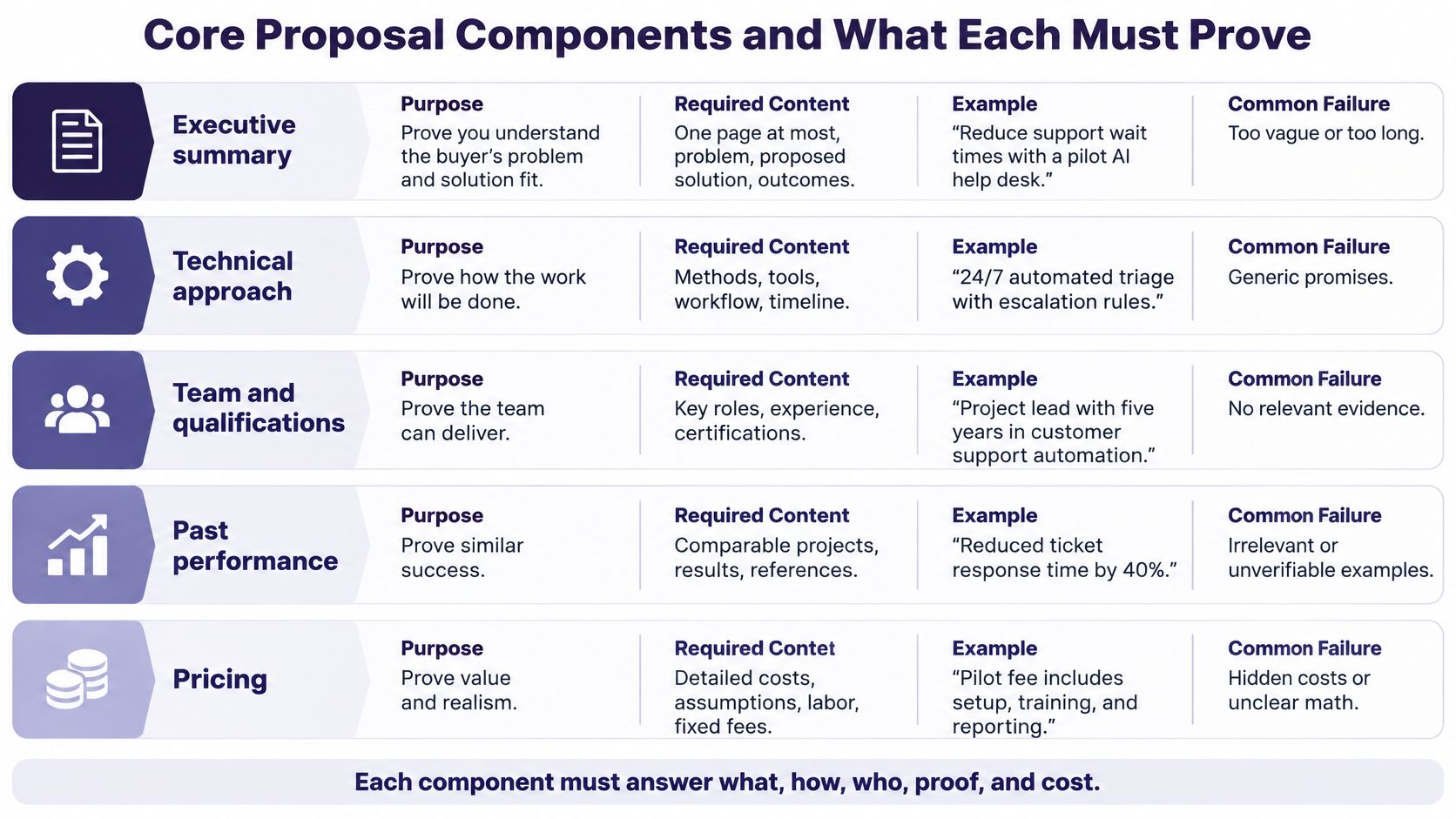
Give every component a fixed job. If a section can't state what it proves, reviewers will fill the gap with doubt. The diagram below summarizes the main pieces before the detailed entries.
Executive summary
Purpose: Prove you understood the problem and have a credible answer. Keep it to one page at most, naming the buyer's problem, your proposed answer, and a measurable outcome. For example, "We'll pilot an AI help desk to cut first-response waits on routine tickets." The common failure is a summary about your company's history instead. Reviewer question: Can I state their solution in one sentence?
Understanding of the need
Restate the problem in the buyer's own terms, using their words for volumes, users, and constraints. This proves you read every requirement. A generic restatement that could fit any buyer proves the opposite. Reviewer question: Do they describe our situation, or every situation?
Technical or delivery approach
List activities in sequence. For each one, give the owner, tools, output, dependencies, assumptions, and risks. Don't repeat the requirement and promise you'll meet it. Show the sequence that produces the result. Reviewer question: Could I picture week one? Tight project scope definition makes this section possible, because vague scope forces vague method.
Team and key personnel
Connect each named person to duties on this project, relevant qualifications, and recent results. Replace generic biographies with assignments. "Ana leads implementation, owns configuration, and led two support automation rollouts last year" beats a career summary. Reviewer question: Who does what, and why them?
Timeline and milestones
Break the work into phases with durations or dates. Attach a deliverable to each gate so the buyer can verify progress. A timeline without deliverables is only a calendar. Reviewer question: How will we know each phase finished?
Pricing or budget narrative
Explain the basis of your estimate. State assumptions, exclusions, and payment terms, and keep them consistent with the scope and timeline. If the approach promises training, the price must include it. Reviewer question: What are we paying for, and what's excluded?
Past performance and evidence
Use two or three relevant projects. Give the problem, your action, the result, and a citable metric, and confirm you have permission to cite each one. Irrelevant or unverifiable examples weaken trust. Reviewer question: Have they done this before, for someone like us?
Risks and mitigations
Name specific risks with likelihood, impact, mitigation, and an owner. Buyers don't expect zero risk. They expect you to see it early. Reviewer question: What could go wrong, and who's watching it?
Appendices and forms
Collect required certifications, attachments, and signed forms exactly as requested. A missing form can end an otherwise strong bid. Reviewer question: Is the package complete?
Style Rules That Keep Every Proposal Consistent
Consistency isn't cosmetic. Evaluators compare bids side by side, and they score faster when your structure matches their checklist. State each rule in your proposal writing manual as a short imperative, then show writers what breaking it looks like.
Mirror the solicitation's headings and terminology exactly. If the buyer says "service desk," don't rename it "support hub." Evaluators searching for their own terms should find them instantly.
Use claim, evidence, impact. Make a specific claim, support it with a metric or example, then explain how it lowers the buyer's delivery risk.
Keep one idea per paragraph. If a paragraph needs "also" twice, split it. Reviewers skim, and a buried second idea often goes unscored.
Rules writers break most often
Keep two lists in the manual, an
for filler like "we are passionate about excellence."
Formatting follows the buyer first. Their font, margins, spacing, and page limits override your defaults. Your manual's formatting applies only when the buyer is silent.
Building a Compliance Matrix Step by Step
A compliance matrix maps every requirement to its response so nothing depends on memory. Build it before drafting, and update it after every amendment. Federal rules require proposals to be evaluated solely against the stated factors and subfactors, per the U.S. federal acquisition rules on source selection, so your structure should mirror the evaluator's.
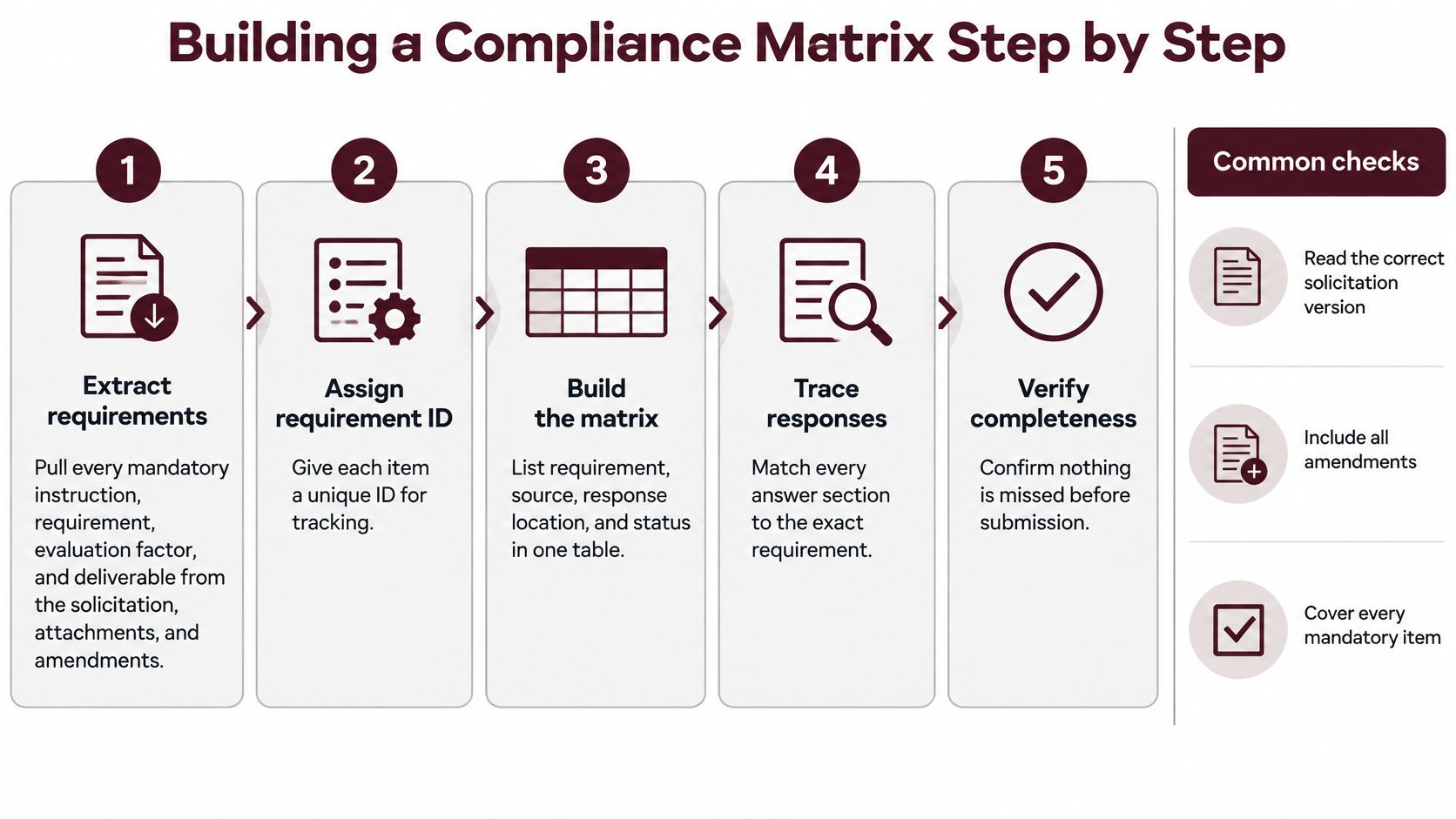
The nine steps
For a worked example of this discipline in government work, see how to build a proposal compliance matrix as part of a full contract proposal.
Where teams get confused
Evaluation weights should decide how much effort and proof each section receives. A heavily weighted factor earns more evidence, not just more pages.
Capped and uncapped sections need different checks. A capped section needs a numerical fit check, while an uncapped section needs a completeness check for every required element. Trimming text can't fix a missing element.
Follow this instruction priority. The funding notice or solicitation controls, its amendments update it, and general guides plus your manual's defaults apply only where the buyer is silent. NIH states that page limits in a funding opportunity announcement supersede the general application guide, per its application guide redirection notice.
Count every word on a capped page, including headers, footers, and cover text. NIH specifies that enforced page limits include all text on the page, including headers, in its formatting requirements for attachments. NIH also warns that applications violating specified limits may be rejected during electronic submission or withdrawn, per NOT-OD-11-080. Run the fit check before content review.
Reusable Templates for Recurring Proposal Sections
Templates save time only when they force better content. A template with bracketed fields tells the writer exactly what's missing. A paragraph of prewritten prose invites copy and paste errors, which is why your proposal writing manual should store fields, not finished paragraphs.
Keeping templates alive
Add a version line to each template with an owner and review date. Refresh templates after every won or lost bid so they reflect what evaluators responded to. When a reviewer rewrites the same field three bids in a row, the template is wrong, not the writers.
If a template has no owner and no review date, treat it as expired and don't send it.
Annotated Sample Proposal Walkthrough
Say a regional logistics company wants a pilot that automates first-line customer support. Scoring covers approach, team, evidence, and price. Every name and figure below is an illustrative placeholder, not a real result.
The review meeting below shows the moment these excerpts have to survive, a buyer checking claims against scoring criteria.

Executive summary in three sentences
"Your team answers the same delivery-status questions all day while urgent tickets wait [problem in buyer's terms]. We'll pilot an AI help desk that resolves routine status queries and escalates exceptions to your staff [proposed answer]. In eight weeks you'll see first-response times on routine tickets, measured weekly against your current baseline [verifiable outcome]."
Understanding and approach
The understanding section restates the buyer's ticket backlog using their categories, such as status queries, damage claims, and address changes. That specificity proves reading, not guessing.
The approach runs four phases, each with an owner and output. Phase one maps ticket categories, owned by the project lead, output a signed category list. Phase two configures triage and escalation rules, output a tested rule set. Phase three pilots with one support queue, output weekly response reports. Phase four reviews results and recommends rollout, output a go or no-go report.
The short video below walks through structuring a proposal in this same order, problem first and method second.
Team, pricing, risk, and evidence
One team entry might read, "Maya Chen, project lead. Duties: category mapping and escalation design. Recent result: led a support automation rollout for a freight broker, illustrative placeholder." Duties tie to requirements, not biography.
The pricing narrative lists assumptions, such as access to the ticket system in week one, and exclusions, such as phone support. A risk entry names misrouted urgent tickets, with mitigation through confidence thresholds and a human review queue, owned by the project lead. The evidence entry cites one comparable project with a metric and permission status marked "on file."
One weak paragraph, revised
Weak, illustrative: "We have years of experience and many satisfied clients." There's no claim an evaluator can score.
Revised, illustrative: "We have configured support triage for two delivery businesses [claim]. One cut routine ticket handling time, shown in their weekly reports [evidence]. Your pilot therefore starts from tested escalation rules instead of a blank page [impact]."
End with the sixty second test. Within a minute of opening your draft, a reviewer should find the problem, the answer, the owner, the price basis, and one proof point.
Using AI and Templates Without Losing Accuracy
Automation helps when it handles extraction and checking. It harms when it invents commitments. Your proposal writing manual should draw that line explicitly, because writers under deadline pressure won't draw it themselves.
The controls that make it safe
Verify every credential and metric against a source file. Mark AI-assisted sections internally so reviewers know where to look harder. Require a named human approver for scope, price, and claims. Keep a source reference for each result you cite, define who may submit, and record how client data is handled and where it's stored.
Personalization must name a specific problem the buyer stated. Using their company name or industry alone doesn't count.
Track reply quality by template version. You'll learn which wording earns responses instead of guessing.
Pre-Submission Checklist and Quick Reference
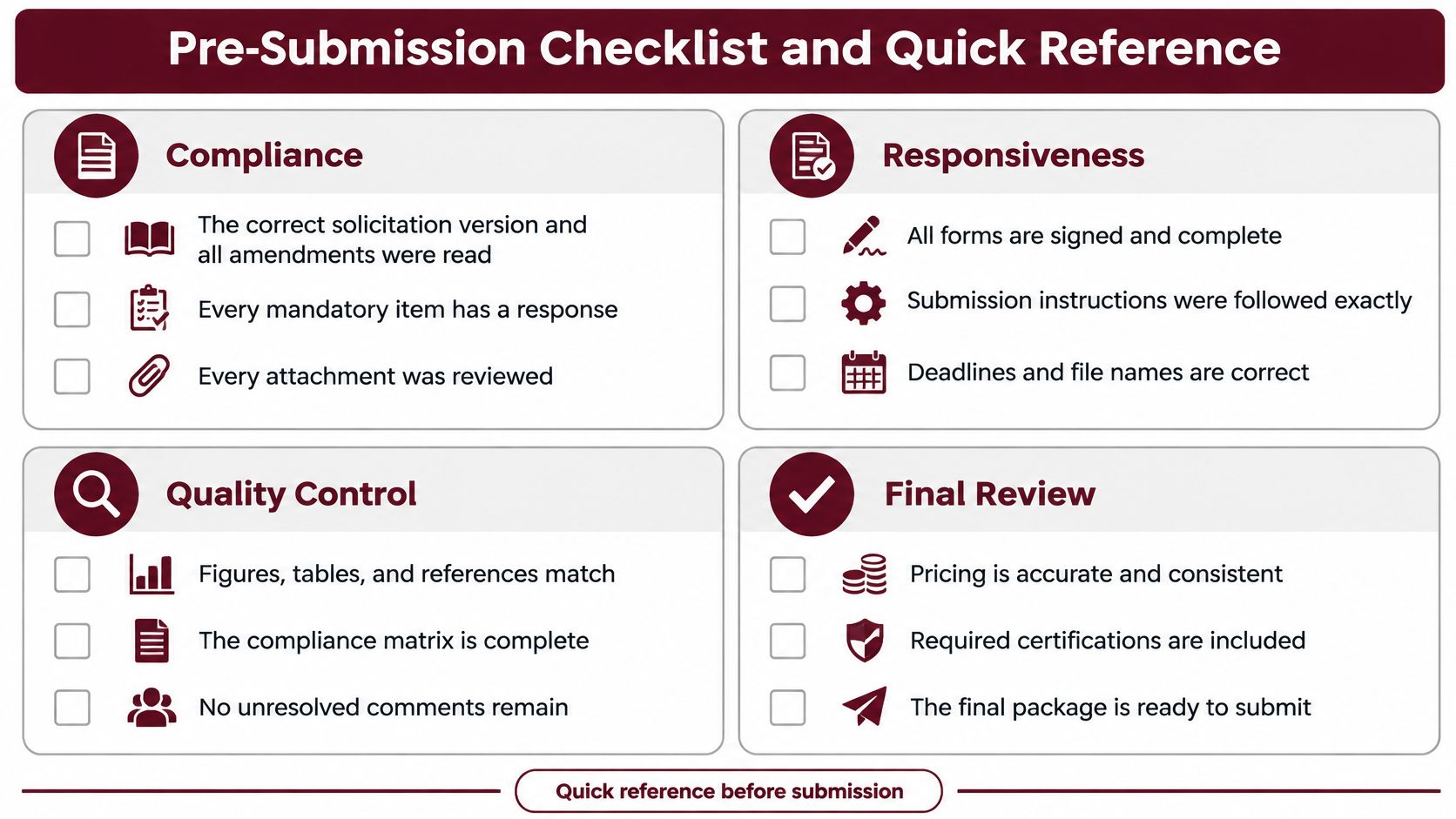
Run this checklist as a pass or fail gate, not a final read-through. Each item is a yes or no question. If the answer is no, submission waits.
Quick reference when an item fails
A failed compliance item sends you to the compliance matrix procedure. A format failure sends you to the buyer's instructions and the fit check in that same procedure. Content failures point to the style rules and component entries. Approval failures point to the AI and accuracy controls, since no draft ships without a named approver.
Troubleshooting Weak Results and Common Errors
Judge your manual over a batch of bids, not one painful loss. In 2024, organizations reported a median new-business proposal win rate of 37%, with most respondents reporting win rates between 25% and 49%, according to QorusDocs' 2025 Proposal Management Benchmark Survey. A single rejection doesn't prove the system failed.
Symptom, cause, fix
1. No shortlist invitations. Likely cause: weak fit or a generic opening. Fix: run the go or no-go screen and rewrite the first paragraph with claim, evidence, impact. Revisit the screen and style sections.
2. Rejected as nonresponsive. Likely cause: a missed mandatory item. Fix: rebuild the compliance matrix and verify every row before drafting. Revisit the matrix section.
3. Low score on one criterion. Likely cause: uneven coverage, where one strong section can't rescue a weak one. A European Commission evaluation framework required a minimum score of 3 for every criterion and a total minimum threshold of 18 out of 25, per Commission Decision 2004/213/EC. Fix: map every claim to a stated criterion and balance coverage. Revisit the components section.
4. Over the page limit. Likely cause: headers, footers, and cover text weren't counted. Fix: count them and follow the buyer's format rules instead of shrinking body text. Revisit the matrix and checklist sections.
5. Reviewers confused. Likely cause: terminology drifted from the solicitation. Fix: enforce the glossary during review, not after. Revisit the style section.
6. Reviewers call it vague. Likely cause: claims without metrics or impact. Fix: apply claim, evidence, impact to every major claim. Revisit the style section.
7. Inconsistent quality across bids. Likely cause: outdated or unused templates. Fix: version them and refresh after each result. Revisit the templates section.
Fix one recurring cause per batch. Changing everything at once tells you nothing about what worked.
Put the Manual to Work on Your Next Bid
Start small and in this order. First, pick one recurring bid type and build its compliance matrix using the nine steps above. Second, draft that bid type's templates from the bracketed fields, with an owner and review date on each.
Third, score your next three opportunities with the go or no-go screen before writing a word, and log every no-go reason. Fourth, run the pre-submission checklist on each of those three submissions as a pass or fail gate.
Fifth, log outcomes, revise your style rules and glossary after the batch, and set a monthly review date with a named approver. You'll learn more from three measured bids than from ten improvised ones.
For freelancers and agencies bidding on Upwork, Earlybird AI is one option. It customizes proposals for each job, finds jobs, replies to client leads, and books calls from your own Upwork account. Prospects can book a demo to see the whole loop of finding jobs, sending proposals, and booking calls live on their Upwork account. Whether a person or a tool drafts the text, the output still has to pass your approval and verification rules, and your manual stays the controlling document.
If your team bids on Upwork, Earlybird AI can run the repeatable parts of this system for you, finding matching jobs, customizing each proposal, replying to leads, and booking calls from your own account. Pair it with the manual you've built here so every automated draft still passes your go or no-go screen, compliance checks, and named approval. Visit the site to book a demo and watch the full loop run live on your account.


