

← Back To Blog
Proposal Writing Skills That Win Clients: A Practice Plan
Most freelancers don't lose work because they can't do it. They lose it because the client can't see, within seconds, that this specific person understood this specific problem. Proposal writing skills close that gap. You build them the same way you build any craft skill, with short exercises, honest scores, and revisions tied to replies rather than taste.
Skills That Decide Whether Clients Reply
Proposify's 2024 State of Proposals report analyzed 1,280,657 proposals across 27 industries and found an average close rate of 36% for proposals sent through its platform, compared with an industry-average close rate of 20%. That gap doesn't prove writing alone caused the wins, since the dataset is observational. It does confirm the commercial stakes. Treat every bid as a buyer-facing sales document, not paperwork, and connect the client's problem to a solution, expected value, and an easy next step.
Five skills drive that quality. First, read for the underlying problem. A post asking for a landing page redesign may describe falling trial signups. Name the signup problem, not just the page. Second, match one capability to that problem. One relevant proof point beats a list of ten services. Third, state your workflow and timeline in plain steps so the client can picture delivery.
The Two Skills Most Bids Skip
Fourth, ask one or two specific questions. If a post mentions a migration but not the current platform version, ask about it, because that detail changes scope. Fifth, end with a clear next step, such as a brief chat or video call. Vague sign-offs like "let me know" hand the work back to a busy client.
Practical rule: If your opening lines don't state the client's problem and the expected result, you're asking the reader to do your job for you.
Clarity comes first because clients skim under time pressure. A strong cover letter runs two to three short paragraphs and leads with what you can do for this project before listing credentials. Concise language, shorter sentences, and evidence that you understood the need are the writing traits tied to better conversion. Long, polished intros about your background bury all three.
Try this today. Highlight three phrases from a job post, such as the deliverable, the deadline, and the business goal. Check whether each phrase, or a clear response to it, appears in your draft. If one is missing, the client has to guess at fit. Teams that track these handoffs at scale often pair proposal work with pipeline systems, and MakeAutomation's CRM automation buying guide is a useful reference when you start organizing follow-ups beyond a spreadsheet.
Now audit your last three lost bids. For each one, identify which of the five skills was weakest or missing entirely. That pattern, not your general writing ability, tells you what to practice next.
A Six-Week Practice Plan for Proposal Writing
Skill grows through repeated short exercises, not marathon rewrites. Time-box each session to thirty minutes so the plan survives alongside client work. Each week produces one artifact you keep.
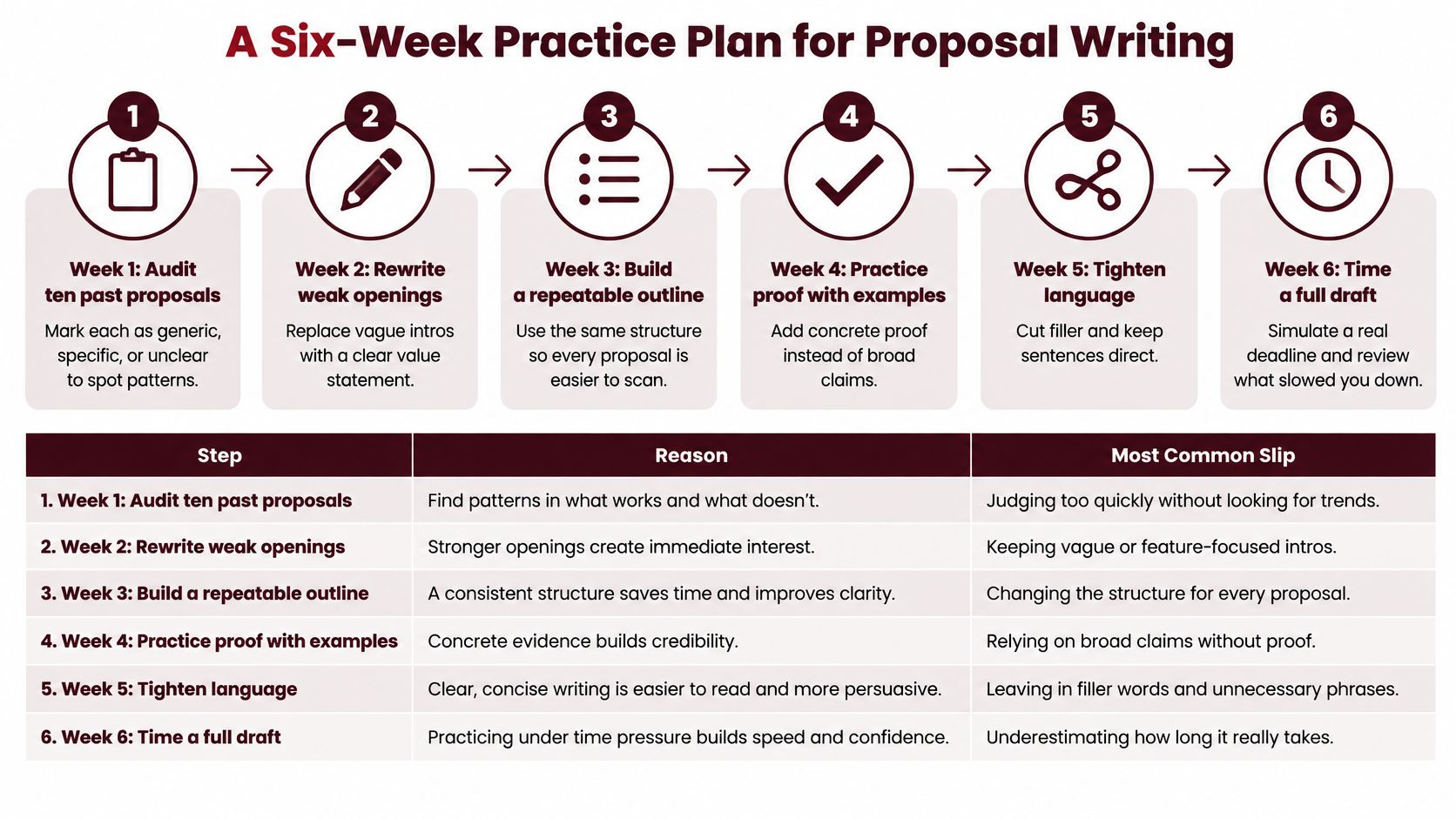
- Week 1, audit ten past proposals. Tag each draft generic, specific, or question-led, then note whether it got a reply. You're looking for patterns between style and response. The common slip is judging drafts by how polished they sound rather than by what they promise the client. A smooth paragraph that promises nothing is still a weak bid.
- Week 2, rewrite ten openers. Take ten job posts you could bid on and write a two-sentence opener for each that names the client's goal in your own words. Do not restate the job title. "You need a Shopify developer" says nothing. "You need checkout fixed before your spring sale so paid traffic stops leaking" shows you read the post.
- Week 3, build a proof library. Write three entries, one per service you sell. Each entry needs the problem, your method, the tools you used, and a measurable result. The slip is listing a credential with no outcome attached. Certifications don't persuade unless the client sees what changed because of your work.
- Week 4, write five full proposals. Keep each draft at 300 to 400 words, with a timeline and one specific question. Padding past that range to sound thorough is the usual mistake. Extra length usually repeats your profile instead of answering the post.
- Week 5, price one scoped project in phases. Follow Upwork's freelancer guide, which breaks website work into planning, design, development, review, and testing, estimates time for each phase including revisions, then adds the phase amounts together. Omitting revision time is the classic slip, and it gradually eats your margin later.
- Week 6, send ten proposals and log replies. Record which drafts earned responses, then rewrite the weakest section of your best-performing draft. Do not change several things at once, or you won't know what worked. I'd keep the winning opener fixed and improve one proof point at a time.
Why This Order Works
You diagnose before you draft, and you build proof before you write full bids. Reversing that order produces fluent proposals with nothing solid inside them. By week six, every exercise feeds a live submission, so practice stops feeling separate from paid work.
Feedback Techniques That Sharpen Each Draft
Review every draft twice, with two separate passes. The compliance pass checks every requirement in the posting, each screening question, length limits, and the submission deadline. It ends with a simple yes or no on whether anything is missing. If the answer is no, fix that before touching style.
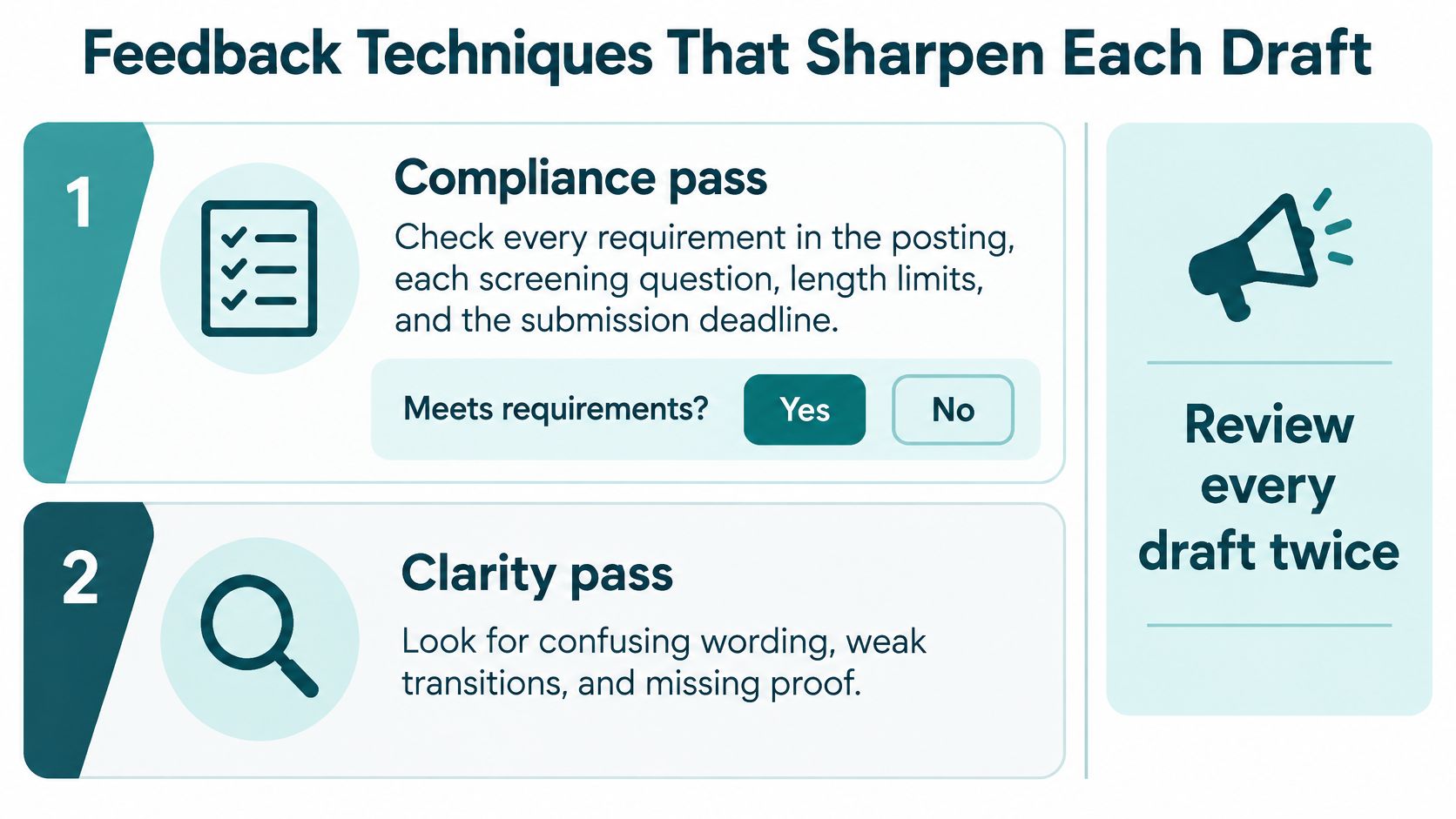
The persuasion pass asks different questions. Is relevance obvious within the first two lines? Does each proof point carry a result? Could the client act on your next step in under a minute? Mixing these passes slows both down, because you end up polishing sentences that a missing screening answer already disqualified.
Three Tests Worth Running Weekly
The two-line test. Read only your opening two lines to a colleague who hasn't seen the job post. Ask them to restate the client's problem in one sentence. If they can't, your opener describes you instead of the client's situation. Rewrite until a cold reader gets it right the first time.
The replace test. Go sentence by sentence and ask whether each one could be sent unchanged to a completely different client. Any sentence that passes is generic, so rewrite it with a detail from this post, a named tool, a timeline, or a result. This single test removes most template smell.
The peer swap. Exchange drafts with a partner who is bidding on similar work. Score each draft one to five on relevance, proof, clarity, timing, and next step. Structured scoring works better than open-ended opinions, and Fluidwave's guide to peer feedback shows how to phrase comments so they're specific enough to act on. Agree in advance that scores below three require a rewrite, not a debate.
A draft nobody else has read carries blind spots you can't catch yourself, because you already know what you meant.
Keep a feedback log. Record each draft version, the scores it earned, and whether it received a reply. After a few weeks, you'll see which changes correlate with responses. Without that log, you're guessing which feedback mattered.
End each review by naming one change to make before your next bid. A single named fix, applied consistently, compounds faster than a long list you never finish.
Templates and Structure That Stay Specific
A good template fixes structure and frees the details. Use the same six-block skeleton every time, because you write faster and clients scan familiar shapes easily. Here's a writer working through a draft by hand before it goes anywhere near a send button.

Upwork's sample proposal guidance places a complete proposal at about 300 to 400 words, covering who you are and how you help, the client's main challenge, a high-level approach, relevant examples, a timeframe or milestones, and an easy next step. That word budget forces each block to stay tight.
The Six Blocks in Order
- Introduction: One or two lines on who you help and how. Skip your life story.
- The client's challenge: Restate the problem in your own words, not copied from the posting. Rephrasing proves understanding in a way quotation never does.
- Approach: A high-level method in three or four steps, naming tools where relevant.
- Proof: One or two directly relevant examples. Say you moved a Shopify store to a headless front end before a seasonal sale. State what changed afterwards, such as load time or completed checkouts, so the example earns its space.
- Timeframe: Milestones with dates or durations, plus how drafts and revisions will be handled.
- Next step: One easy action, such as a short call through Upwork Messages.
Add a pricing block that shows the phases of work, estimated hours per phase including revisions, and a buffer for unexpected issues, desired profit, and project risk. Clients trust a visible calculation more than a lone total. If you want starting points for agency work, these agency proposal templates show how the same blocks adapt across services.
This walkthrough shows the blocks assembled into a finished bid, which makes the pacing easier to judge than a written description alone.
Keep three variants by project type, for design, development, and marketing. When adapting one, swap only the proof, the timeline, and the question. Do not rebuild the structure for every client, because constant reinvention slows you down and introduces gaps.
Apply one final test. If you can't name the client's problem in the first sentence of block two, the template has become generic.
Using AI Without Losing Your Judgment
Split the work before you open any tool. Editing tasks can be delegated, including proofreading, checking a draft against posting requirements, translating a passage, and generating clarifying questions. Strategic tasks stay with you, including the scope you'll commit to, your positioning, the risks you name, the prices you quote, and delivery promises. That split is the whole discipline.

A 2025 survey of Polish researchers found nearly 60% had not used generative AI when preparing proposals, and respondents were comfortable with proofreading and compliance checks but skeptical of AI producing the project concept or methodology. Their caution translates well to client work. Excessive reliance weakens the critical thinking a proposal is meant to demonstrate.
A Human in the Loop Sequence
Extract the client's requirements yourself first. Then ask the tool for questions the client hasn't answered, draft two or three options, and verify every factual claim against your own records. Rewrite the opening in your own voice. If you're comparing options, this roundup of the best AI tools for proposal writing helps separate drafting aids from full automation.
Watch for two warning signs. Claims with no proof attached mean the tool invented confidence. Sentences that could appear in any freelancer's bid mean your positioning has vanished. The same scrutiny applies to generated visuals in a pitch deck, where even watermark rewriting with Simple Unmark is just cleanup, never a substitute for checking that an image supports your claim.
For transparency, keep one rule. If a client asks how a proposal was prepared, answer and explain which parts you wrote. I'd rather lose a bid on honesty than win one I can't defend.
Confirm Your Progress Before You Bid Again
Track submitted, qualified, shortlisted, replied, and won proposals as separate counts. A single win-rate number hides weak qualification and slow follow-up, two problems with completely different fixes. If replies are healthy but shortlists aren't, your writing works and your targeting doesn't.
Record reply rate by opener version. Change one opening line per batch of ten bids and compare the two versions, which keeps the test small enough to run during client work. This is exactly how structured testing pays off. Earlybird ran A/B tests across five proposal variations for Vitalii to find which ones worked, instead of guessing. For the metrics behind that kind of analysis, this guide to Upwork data analytics lays out what to measure.
Three Readiness Checks
- Reply rate holds across at least ten proposals, not just one lucky batch.
- Compliance pass finds nothing missing before submission.
- Peer scores reach four or above on relevance and next step.
"Now I just open my calendar and close. Earlybird finds the jobs, sends the proposals, and books the calls, I haven't sent a manual bid since June." (Ben)
Once those checks hold and volume, not quality, is your bottleneck, automation becomes worth considering, provided each bid still answers the specific problem in the post. Earlybird AI is one option at that stage, since it customizes proposals for each job, so review its drafts against your own checklist before they go out.
Close with one action this week. Pick the practice exercise that addresses your weakest measured number and finish it before your next bid.
When your drafts pass your own compliance and persuasion checks but you can't keep up with volume, Earlybird AI finds matching Upwork jobs, sends customized proposals in your voice, and follows up until calls are booked. Visit the site to see how that loop runs on your own account and put your sharpened proposal writing skills to work at scale.


