
← Back To Blog
Your Guide to SEO for Clients: From Pitch to Profit

SEO clients aren't typically lost because they can't do keyword research. They are lost because delivery is messy, expectations are vague, and nobody built a system that survives more than a few accounts at once.
That usually shows up the same way. One client is waiting on a report. Another still hasn't shared Search Console access. A third wants to know why rankings moved but calls didn't. You spend the week doing real work, but the business still feels reactive. That's the difference between doing SEO tasks and running seo for clients as a service business.
Clients still need SEO badly enough to justify building a proper operation around it. Organic search drives about 33% of overall website traffic across major sectors, SEO is responsible for 34% of all qualified leads, and one B2B analysis reports an average organic search conversion rate of 5.0% according to G2's SEO statistics roundup. That is why agencies can sell SEO as a serious acquisition channel. But those results don't come from hustle alone. They come from process.
Building Your SEO Client Management System
If you're handling seo for clients from a task list, you'll hit a ceiling fast. Every account starts to feel custom, every request feels urgent, and your margins get eaten by context switching.
A workable client management system has four parts. Sales qualification, onboarding, delivery, and reporting. Most small agencies obsess over delivery and improvise the rest. That's backwards. Profit usually leaks before the work even starts.
Standardize the work before you scale it
A client system doesn't mean every campaign is identical. It means every campaign moves through the same checkpoints.
Use a fixed operating structure like this:
- Qualification first: Decide who you serve, what problems you solve, and what a bad-fit client looks like.
- Onboarding with deadlines: Access requests, kickoff, tracking setup, baseline audit, and roadmap sign-off should happen in a defined order.
- Delivery in cycles: Run technical fixes, content production, local optimization, and authority work on a recurring cadence.
- Reporting tied to outcomes: Show what changed, what shipped, what it means for leads, and what happens next.
That system protects three things at once. Client trust, team focus, and gross margin.
Practical rule: If a task happens for nearly every client, it should live in a template, checklist, SOP, or dashboard.
Stop selling labor and start managing outcomes
Clients don't buy title tags. They buy pipeline, booked calls, better lead flow, and less dependence on paid channels. That's why your internal workflow should map SEO work to business outcomes from day one.
For most agencies, the shift is this. Stop asking, "What SEO tasks do we need to do?" Start asking, "What operating model lets us deliver and explain those tasks consistently?"
A few examples of what that looks like in practice:
- One kickoff template: The same agenda for every new account.
- One reporting framework: Customized metrics, but a stable report structure.
- One production rhythm: Clear deadlines for audits, briefs, implementation, review, and client approvals.
- One owner per account: Even if specialists execute the work, one person owns clarity.
Without that, growth creates chaos. With it, adding clients becomes operational, not emotional.
Build for retention from the first week
Retention starts before the first ranking gain. It starts when the client can tell you have control of the process.
That means being plainspoken about trade-offs. Some sites need technical cleanup before content. Some local businesses need Google Business Profile work and review strategy before they need a publishing calendar. Some companies want national content authority, but their current site can't convert branded traffic.
Clients usually accept complexity if the process is clear. They resist when the work feels random.
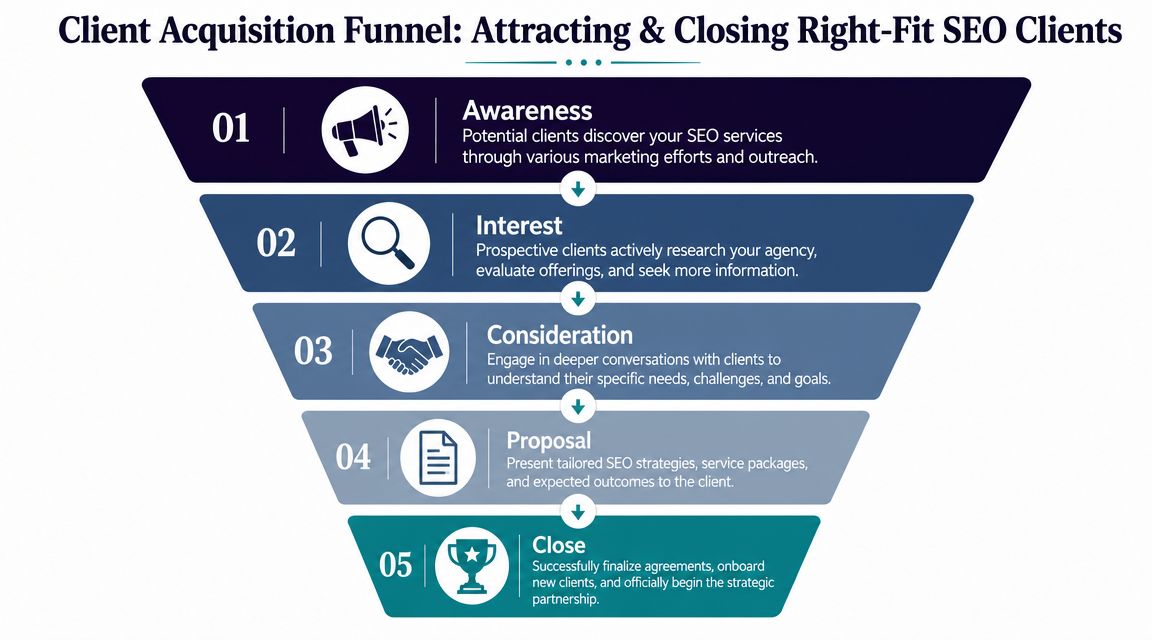
Winning and Scoping the Right SEO Work
A packed pipeline can still produce a weak agency. If the wrong clients keep getting through, sales grows and profitability shrinks.
The best agencies don't try to win every SEO project. They build a position in a narrow set of markets where SEO matters, weak competitors are common, and fulfillment can be repeated without reinventing the service each time. As noted in Synup's analysis of profitable local SEO industries, strong niches often share three traits: high value per customer, low digital maturity, and ongoing SEO needs. That's not just a prospecting advantage. It's a delivery advantage.
Pick a market you can learn deeply
Generalist agencies often confuse variety with safety. In practice, too much variety makes scoping harder and results less predictable.
A niche gives you an edge:
- Faster diagnosis: You start recognizing the same technical and conversion problems.
- Stronger proposals: You can speak to the business model, not just SEO tasks.
- Cleaner fulfillment: SOPs, briefs, landing page structures, and reporting become reusable.
- Better referrals: Clients refer peers in the same market when your positioning is clear.
Good niche candidates are usually service businesses that rely on search intent and trust. Lawyers, dentists, remodelers, plumbers, med spas, and similar categories often fit because the path from search to inquiry is direct.
If you're still building the pipeline, this guide on how to get SEO clients is a useful companion to the sales side.
Run discovery calls like an operator
Most bad SEO deals are obvious on the discovery call. The agency just ignores the warning signs.
Don't structure the call around what you'll do. Structure it around what has to be true for the engagement to work. Ask questions that expose business reality:
- Revenue model: How does the business make money, and which service lines matter most?
- Lead handling: What happens after a form fill or phone call?
- Geography: Are they local, regional, or national?
- Sales cycle: Do they close quickly or nurture over time?
- Internal resources: Who can approve content, implement changes, and provide subject matter input?
- Past experience: Have they worked with SEO providers before, and what disappointed them?
Those answers affect scope more than the keyword list does.
A discovery call should reduce uncertainty, not increase enthusiasm.
Price around responsibility, not output
Retainers work when the need is ongoing and the business benefits from monthly iteration. Projects work when the site needs one contained phase, such as an audit, migration support, or local presence cleanup.
What doesn't work is vague hybrid pricing where the client thinks they're buying growth and you think you're selling a bundle of tasks.
In proposals, define:
- The business problem
- The operating constraints
- The plan for the first phase
- What the client must provide
- How success will be judged
That last point matters most. If your proposal sells "four blogs, title tag updates, and backlinks," you've framed yourself as a vendor. If it sells better local demand capture, stronger service-page coverage, and improved conversion tracking, you've framed yourself as a partner.
Scope aggressively at the start
Scope creep usually starts with kindness. You agree to "just take a look" at a redesign, a paid landing page, or a second location rollout. Soon the account is carrying unpaid strategy.
Avoid that by defining boundaries early:
- Included: Core SEO strategy, implementation guidance, reporting, agreed production items.
- Conditional: Developer coordination, CRO recommendations, tracking audits beyond the initial setup.
- Excluded unless added: Full web copy rewrites, redesign management, paid media, sales enablement assets.
A clear scope doesn't make you rigid. It makes you dependable.
The First 30 Days Client Onboarding and Strategy
The first month decides whether the client feels calm or uneasy. It doesn't matter how strong your SEO is if onboarding feels sloppy. Clients read that as a preview of the whole engagement.
Good onboarding does more than collect passwords. It creates shared definitions, baseline data, and a sequence of decisions that turns a signed deal into a managed account.
Start with business goals and measurement
One of the clearest pieces of agency guidance is that SEO workflow should begin with business-goal alignment and measurement design, not keywords alone. Justia's guidance for agencies recommends defining what success means first, then setting up conversion tracking in tools like Google Analytics and Google Search Console so performance can be judged against business outcomes. It also recommends tailoring reporting to the client's revenue model and using achievable targets, such as a 10 to 20% increase in organic visitors over six months.
That changes the kickoff meeting completely. You're no longer discussing rankings in the abstract. You're identifying which actions matter. Form submissions, calls, booked consultations, location-level inquiries, or qualified lead volume.
Use the kickoff to answer five questions:
- What counts as a win?
- Which services or categories matter most?
- Which locations matter most?
- Which conversions can we track?
- Who signs off on implementation?
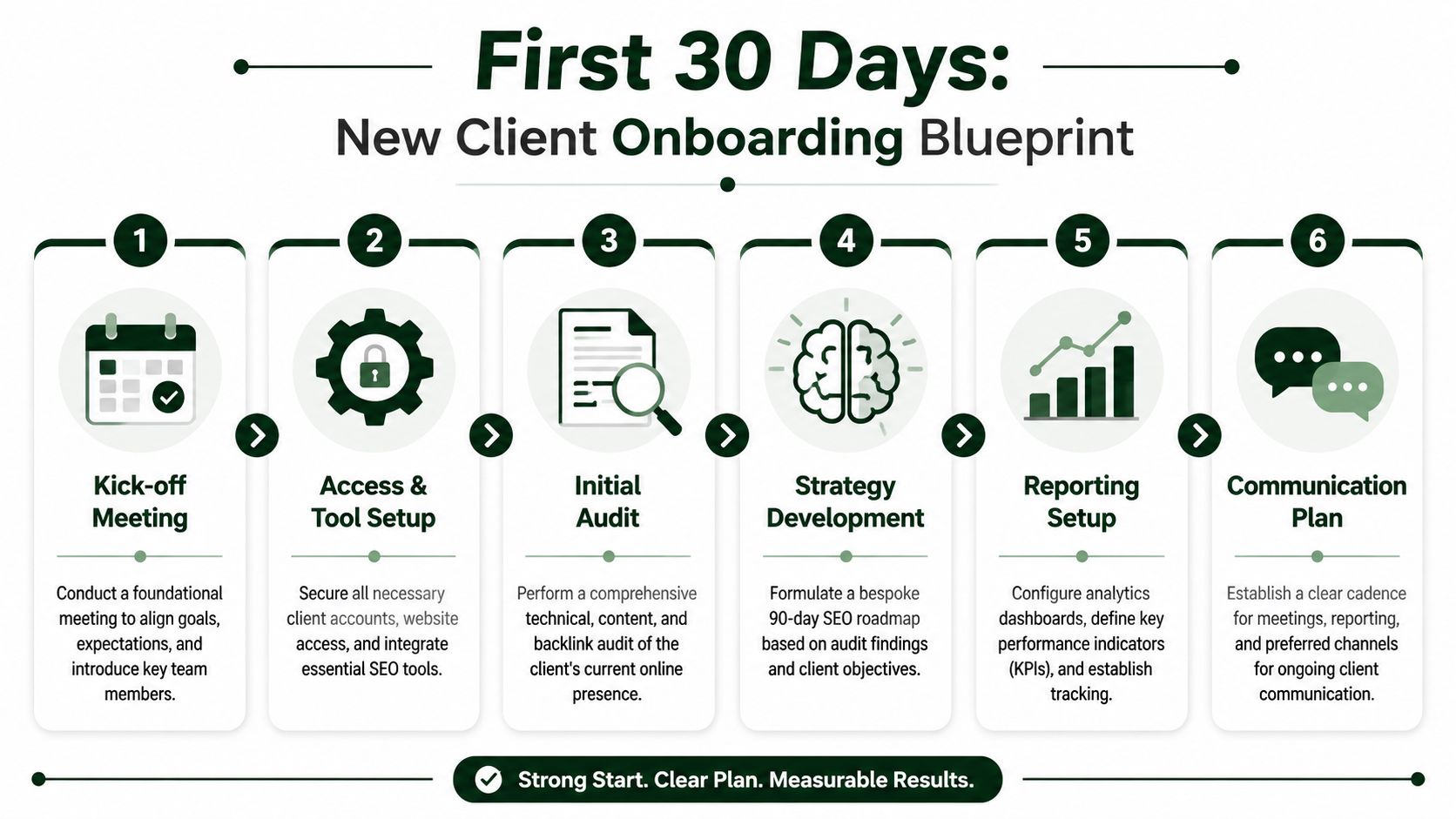
Use a 30-day onboarding sequence
The first month should feel structured on both sides. Here's a practical sequence.
Days 1 to 5
Secure access to Google Analytics, Google Search Console, Google Business Profile if relevant, CMS, call tracking tools, and any prior reporting. Confirm points of contact and response times.
Days 6 to 10
Run baseline audits. Look at technical health, existing content, location pages, service pages, internal linking, indexation patterns, and branded versus non-branded visibility. Pull screenshots and benchmarks now so future reporting has context.
Days 11 to 20
Develop the initial strategy. Prioritize issues by business impact, not by how impressive they sound. A broken conversion path matters more than an elegant but low-priority schema enhancement.
Days 21 to 30
Present the roadmap, confirm reporting cadence, assign responsibilities, and get written approval on priorities.
The first 30 days should end with fewer assumptions than the client had when they signed.
Build the roadmap around decisions
A weak onboarding process dumps audit findings into a slide deck. A strong one turns findings into decisions.
For example:
- If technical barriers are blocking crawlability or core templates, fix those before scaling content.
- If service pages are thin or duplicated, rebuild commercial pages before chasing informational traffic.
- If local visibility is the lever, prioritize profile optimization, location landing pages, reviews, and conversion attribution.
- If subject matter expertise is hard to extract, build a lighter content process with interviews and approvals.
This is also where communication standards get set. Decide how often you'll meet, what happens in email versus Slack, how urgent requests are handled, and who owns implementation on the client side. Most account friction is operational, not strategic.
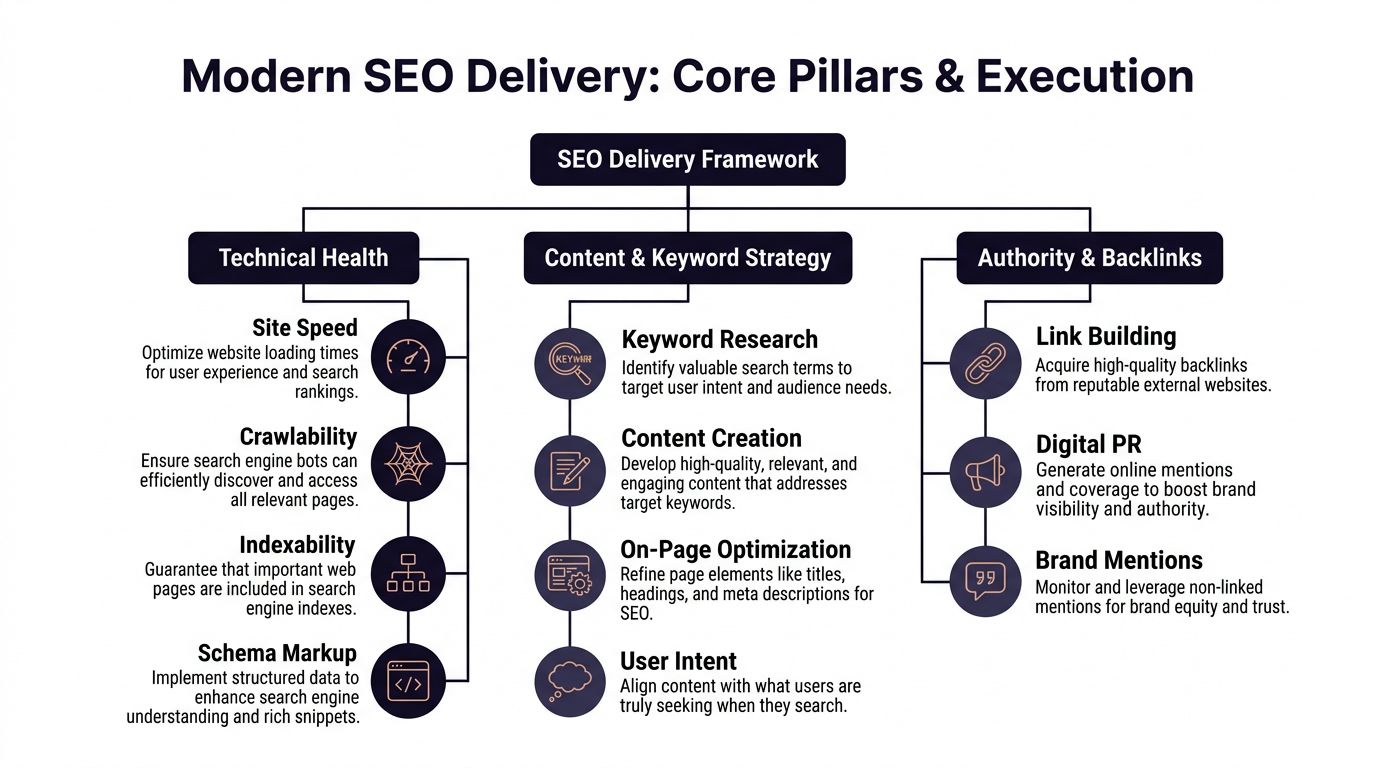
Executing a Modern SEO Delivery Framework
Ongoing SEO work gets easier to manage when clients can see the operating logic behind it. Most don't need a deep lecture on technical SEO. They need to understand why you're spending time in one area instead of another and how the work connects to lead generation.
The modern search environment makes that even more important. Google processes roughly 8.5 billion searches per day, 58 to 60% of Google searches are reported as zero-click, the top organic result still captures an average 27.6% CTR, and AI Overviews can reduce clicks to websites by 34.5% according to SEO Sherpa's search statistics roundup. For seo for clients, that means ranking alone isn't enough. You need pages that are crawlable, intent-matched, and compelling enough to earn the click when a click is still available.
Technical work should remove business bottlenecks
Technical SEO often gets oversold in client meetings and under-prioritized in execution. The right way to frame it is simple. Technical work removes constraints that stop search engines and users from reaching valuable pages.
That usually includes:
- Crawl and index issues: Important pages need to be discoverable and indexable.
- Template problems: Weak title structures, broken canonicals, poor internal links, or duplicate page patterns can suppress entire sections of a site.
- Speed and UX barriers: If high-intent pages are slow or confusing, traffic quality won't matter much.
- Structured data opportunities: Use schema where it improves clarity and supports SERP presentation.
Clients understand this better when you tie each issue to a business asset. Not "we're fixing crawl depth." Instead, "we're making sure your service pages and location pages can be consistently found and interpreted."
Content should cover intent, not just keywords
A lot of agencies still produce content as if the job is to publish more URLs. That usually creates thin blogs, weak service pages, and scattered authority.
A better content engine has three layers:
- Money pages
Service pages, location pages, and commercial pages tied to buying intent. - Supporting content
Articles that answer questions, objections, comparisons, and use cases. - Conversion support
Internal links, proof elements, calls to action, FAQs, and page structure that help users move.
If your team needs systems around execution, this roundup of SEO software for agencies can help you choose tooling for audits, workflows, and reporting. Agencies also use tools like Google Search Console, Google Analytics, Ahrefs, Semrush, Screaming Frog, Looker Studio, Asana, and content brief templates to keep delivery organized. For client acquisition workflows outside delivery, some agencies also use platforms such as Earlybird AI to automate parts of Upwork outreach and proposal handling.
Better content strategy usually means fewer pages with stronger intent coverage, not more pages with thinner coverage.
Authority work needs discipline
Link building is still useful, but many agencies turn it into busywork. Clients don't benefit from vague monthly promises about "off-page SEO." They benefit from authority work tied to real pages and real goals.
Keep this part disciplined:
- Map links and mentions to specific priority pages.
- Coordinate digital PR, local citations, partner links, and unlinked brand mention opportunities based on the client's market.
- Report authority work in plain terms. What was acquired, what page it supports, and why that matters.
The delivery framework only works when the client can follow the logic. Technical health supports visibility. Content captures intent. Authority strengthens credibility. Each month should show movement inside that system, even before big ranking changes arrive.
Mastering Client Communication and Reporting
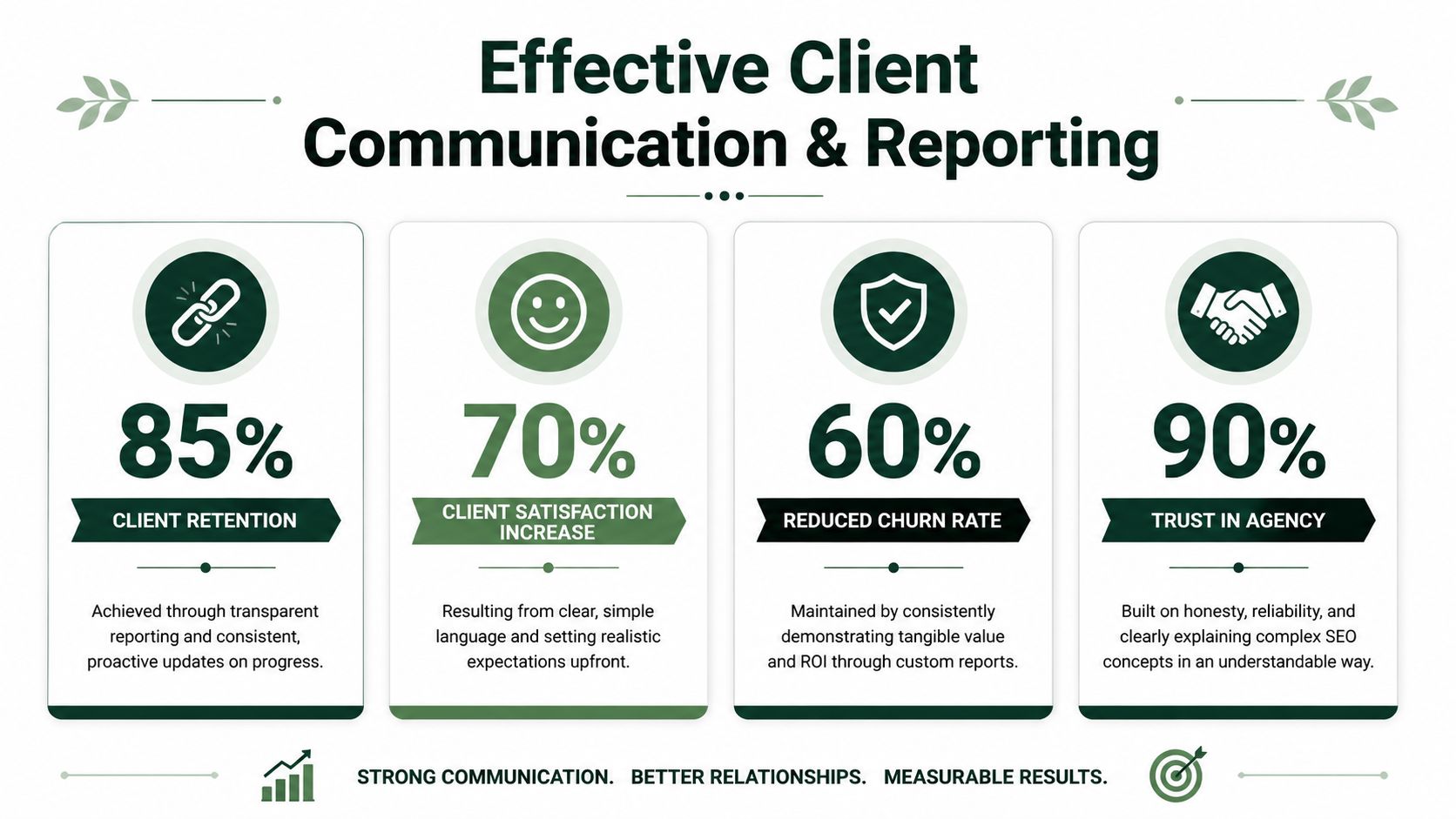
Most client anxiety isn't caused by bad intent. It's caused by silence, vague reporting, and metrics that don't explain the business result.
That matters because one article notes that as many as 90% of SEO services fail to meet client expectations, and the same piece argues that the fix is realistic goals and client-specific KPIs tied to measurable actions such as form submissions, phone calls, and booked consultations in Raibec's discussion of SEO expectation failures. The core mistake is familiar. Agencies report rankings and traffic while the client is asking about lead quality and ROI.
Here's a visual summary of what strong communication aims to support.
Build reports for decision-makers
A monthly report should help an owner, operator, or marketing lead answer three questions fast:
- What changed?
- Why did it change?
- What are we doing next?
That means the report needs structure. A practical format looks like this:
- Executive summary: Major wins, setbacks, and current priorities in plain English.
- Business KPI section: Calls, forms, booked consultations, qualified leads, or other tracked actions.
- Search performance section: Organic traffic trends, landing page movement, and visibility changes.
- Work completed: Technical fixes, pages published, profile updates, links earned, and implementation progress.
- Insights and next actions: What the data suggests and what you'll do with that information.
Avoid reports that read like exports from an SEO platform. A client does not need forty charts. They need interpretation.
For agencies evaluating systems, this guide to SEO reporting software for agencies is useful if you're comparing dashboards, automation, and client-facing presentation options.
Set a communication cadence clients can trust
A steady rhythm prevents panic. It also keeps small issues from becoming strategic doubts.
Use a cadence like this:
- Weekly update: Short written note with completed work, in-progress items, blockers, and next steps.
- Monthly review call: Walk through performance, decisions, and priorities.
- Quarterly strategy review: Revisit goals, service mix, seasonal shifts, and broader opportunities.
You can support the process with walkthroughs like the one below.
Be honest when the data is mixed
Some months won't look clean. A client may gain visibility but not conversions yet. A location page rollout may take time to settle. A technical fix may remove noise before it creates upside.
Say that plainly. Good reporting doesn't spin. It explains.
If performance is flat, explain the cause, the current hypothesis, and the next test. Clients usually stay patient when they can see the reasoning.
That honesty matters more than polished charts. It tells the client you are managing the account, not decorating it.
Avoiding Pitfalls and Scaling Your SEO Services
The biggest mistake in seo for clients is thinking scale comes from doing more of the same. It doesn't. Scale comes from deciding what kind of work you won't take, what requests won't be included, and which client models don't fit your operating system.
A common failure point is treating every client like a generic website owner. That's especially expensive with service businesses. Aligned SEO's guide for service providers notes that 46% of all internet searches have local intent, yet many SEO engagements still judge success mostly through traffic and rankings instead of lead quality, Maps visibility, and conversion tracking tied to calls, forms, or booked appointments. If you miss local intent, you can produce a report that looks healthy while the client feels no business impact.
The expensive mistakes agencies repeat
A few patterns cause most avoidable churn:
- Bad-fit sales: You accept clients with weak budgets, no implementation support, or unrealistic time expectations.
- Scope drift: Small unpaid requests pile up until margin disappears.
- Wrong KPI model: You report visibility while the client cares about booked work.
- Generic fulfillment: The same playbook gets pushed onto local service businesses, multi-location brands, and national publishers.
- No escalation rule: Problems linger because nobody owns hard conversations.
The fix isn't a smarter dashboard alone. It's stronger operating discipline.
Know when to hold, upsell, or exit
Not every account should be saved. Some should be expanded. Some should be reduced. Some should be fired.
Upsell when the client has traction, trusts the process, and has clear adjacent needs such as location expansion, stronger content production, or conversion path improvement. Hold steady when the foundation is still being built. Exit when the client won't implement, constantly rewrites scope, or wants guarantees that no honest SEO provider should give.
Document those thresholds. Once your team has rules, client decisions stop feeling personal.
A scalable SEO business is usually less glamorous than people expect. It's careful scoping, clean onboarding, disciplined delivery, useful reporting, and firm boundaries. That's what lets an agency handle more accounts without lowering quality or burning out the team.
If you're growing an agency and need a steadier flow of qualified opportunities, Earlybird AI helps automate Upwork outreach by searching for relevant projects, drafting personalized proposals, replying to client messages, and supporting multi-user workflows for teams. For agencies selling seo for clients, that can reduce time spent on manual prospecting and create a more consistent top of funnel while you focus on delivery and retention.