
← Back To Blog
How to Land Upwork Enterprise Clients and Scale Fast
You've probably seen the pattern: a strong Upwork proposal earns a reply, then the conversation stalls when someone mentions procurement, legal review, security documentation, or an internal hiring committee. The problem usually isn't your writing. Upwork Enterprise clients buy through a process, and independent professionals who treat that process like a standard hourly sale lose momentum before the decision-maker enters the conversation.
Enterprise pitching works better as a system. You need the right profile signals, a proposal that addresses business risk, a follow-up cadence that adds value, automation with human review, and clear compliance guardrails. Upwork's Enterprise materials describe clients ranging from fast-growing startups to global companies, including more than a third of the Fortune 500 according to Upwork's Enterprise client guidance. That audience expects evidence, structure, and predictable communication.
What Makes Upwork Enterprise Clients Different
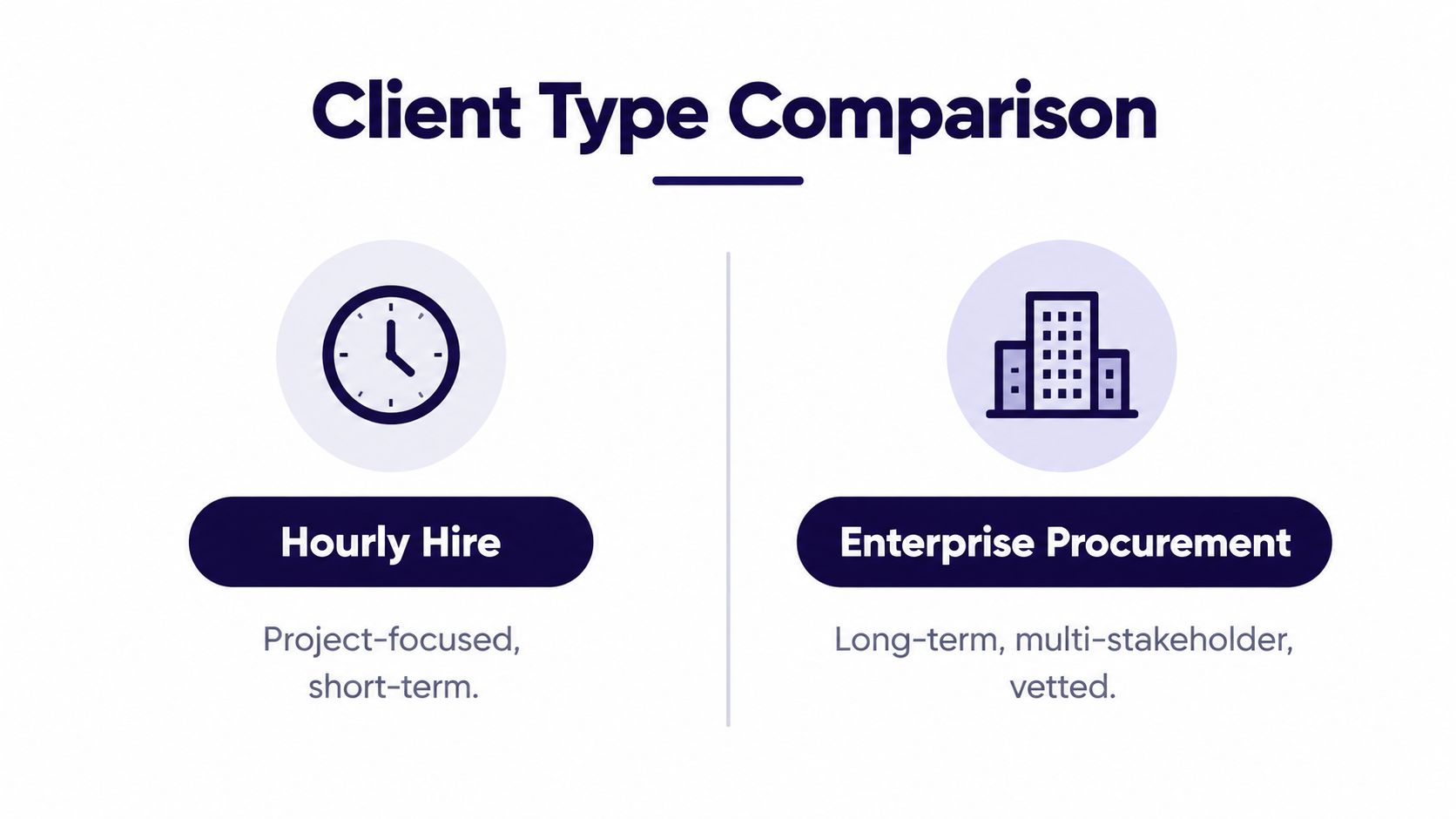
An enterprise opportunity can start with one hiring manager and end with procurement, legal, finance, and security reviewing the same vendor. The buyer is paying for an outcome, a controlled delivery process, and reduced vendor risk, so hourly availability alone rarely carries the sale.
Expect a longer evaluation cycle and more people in the interview loop. An NDA, insurance certificate, security questionnaire, or vendor form may arrive before the scope is fully settled. Work involving sensitive systems can also bring questions about data handling or SOC 2 documentation. A persuasive proposal opens the conversation, but it must give each reviewer enough evidence to continue it.
Read the behavioral signals
Enterprise opportunities often reveal themselves through the buying process, not a label:
- Several reviewers: The person posting the job may influence the decision without owning final approval.
- Formal documentation: An NDA, insurance certificate, security questionnaire, or vendor form can appear early.
- Outcome language: The post focuses on implementation, reliability, reporting, or business impact rather than isolated tasks.
- Contract changes: Upwork notes that upgrading membership during an active engagement can automatically replace an existing contract with a new Enterprise contract in its guidance for working with Enterprise clients.
Confirm the transition before agreeing to it. A contract conversion can affect billing, scope, and message history, and the original agreement may not continue unchanged.
Practitioner rule: Treat Enterprise opportunities as process-driven sales. Keep pre-contract communication inside Upwork Messages, document scope carefully, and prepare for formal stakeholder review.
Build the rest of the funnel around that behavior. Your profile should present credible vendor evidence. Your proposal should connect the work to the buyer's outcome and risks. Follow-ups should create a specific reason to respond. Automation can organize research and reminders, but human review must stop generic or non-compliant messages before they are sent. Winning Upwork Enterprise clients is a process design problem, not a copywriting problem.
Size and Shape of Upwork's Enterprise Market
A seller deciding where to spend prospecting time should treat Upwork Enterprise as a distinct commercial channel. Upwork reported $107.2 million in Enterprise revenue for full-year 2024, up 4% year over year, with Enterprise representing about 14% of total revenue during that period according to Upwork's full-year 2024 results. Q4 Enterprise revenue reached $27.8 million, showing that the segment is a meaningful part of the business rather than a small premium layer.
Upwork describes Enterprise clients as ranging from small boutiques to multinational companies, including over a third of the Fortune 500. These clients receive subscription-based access to additional services and benefits as described by Upwork. For sellers, that changes the evidence required. A profile or proposal must give more than one hiring manager a reason to support the decision internally.
Enterprise demand often centers on work with operational consequences. SaaS teams may need systems implementation or product support. Financial-services and healthcare organizations may emphasize documentation and controlled access. Global consultancies may use Upwork to extend delivery capacity while keeping a structured vendor process. These opportunities can involve different commercial terms, so confirm milestones, approvals, stakeholders, and reporting requirements before quoting.
Enterprise buyer signals in Upwork job posts
SignalWhat to Look ForWhy It MattersCompany scaleDepartments, regions, internal teams, or distributed operationsMore stakeholders may influence approvalInternal toolingCRM, data warehouse, ticketing, identity, or reporting systemsIntegration work carries higher delivery riskProcurement languageVendor onboarding, NDA, security review, MSA, or purchase order referencesThe buyer is evaluating operational readinessHiring historyRepeat hires, agency programs, or related rolesThe account may have broader talent needsCommercial structureFixed milestones, retained support, or ongoing workThe opportunity may support deeper revenue
Use filters for client hiring history, country, and contract characteristics, then inspect each listing manually. Look for language about departments, systems, approvals, and vendor requirements. Automation can collect and rank listings, but a human should verify the buying context before a proposal is drafted.
Enterprise posts may be less visible than general marketplace work, yet a qualified specialist can find opportunities with greater commercial value. Let that evidence shape your portfolio depth, minimum engagement, and proposal positioning. A small task may still be worth pursuing, but only if it provides a credible path to recurring or broader work.
Building a Profile That Attracts Enterprise Buyers
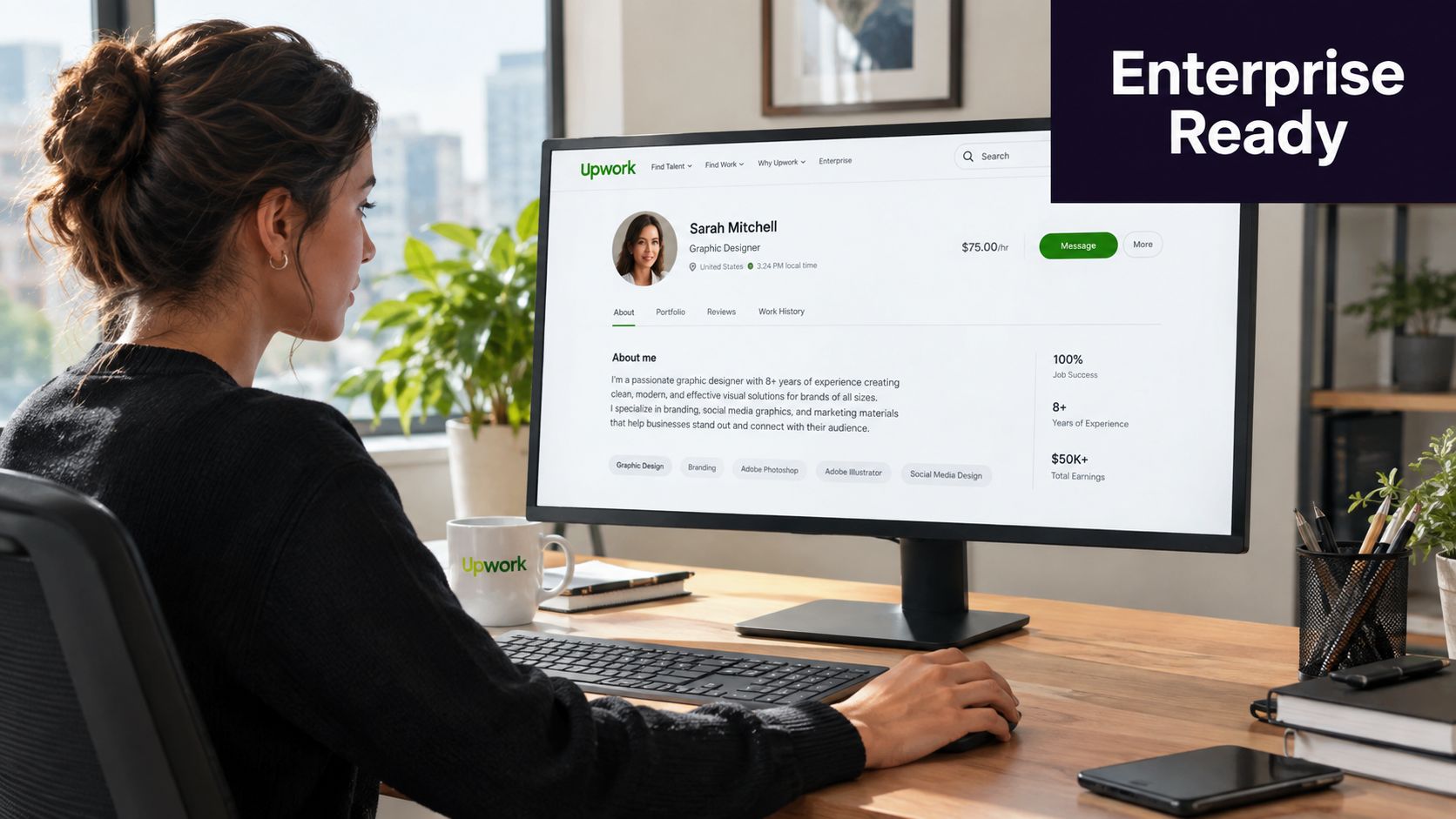
Enterprise buyers scan a profile for role clarity before they study your skill list. “Full-Stack Marketer VA” describes activity. “Revenue Operations Agency for B2B SaaS” describes a commercial function and gives a stakeholder an easier reason to keep reading.
Rewrite the title so it connects your service to a business outcome. Then structure the overview in three beats:
- Category expertise: Name the market, function, or systems you understand.
- Proof: Include a genuine result with its source or context where one exists. Don't manufacture a metric to make the profile look stronger.
- Enterprise process: Explain how you handle discovery, access, documentation, milestones, approvals, and handoff.
A profile that says you “build dashboards” is weaker than one that explains how you align metrics with finance and revenue teams, document definitions, and deliver a reviewable reporting system. The second version gives procurement and the functional buyer language they can reuse internally.
Turn the portfolio into internal proof
Your first three portfolio items should read like compact case studies. For each one, name the client industry, business problem, intervention, and verified result. If the result is confidential, describe the impact qualitatively and explain the measurement method without revealing restricted information.
A useful structure looks like this:
- Industry: Identify the environment the buyer recognizes.
- Problem: State the operational or commercial constraint.
- Intervention: Show what you changed and how you worked with stakeholders.
- Result: Use a real, defensible metric or a precise qualitative outcome.
Raise your minimum hourly or project threshold only when your delivery model supports it. A higher minimum can filter price-sensitive buyers and signal a vendor tier, but it won't compensate for weak evidence or vague scope. Add specialized profile qualifications, agency capabilities, and an enterprise services section so the page reads like a vendor landing page rather than a freelancer resume.
During week one, ship the title rewrite, overview rewrite, portfolio restructuring, specialization updates, and a short section covering security, communication, approvals, and handoff. Use this Upwork profile optimization guide as a practical checklist, then have someone outside your service line read the finished profile. If they can't explain the business outcome you deliver, the positioning still needs work.
Reading Enterprise Job Posts and Writing Proposals That Win
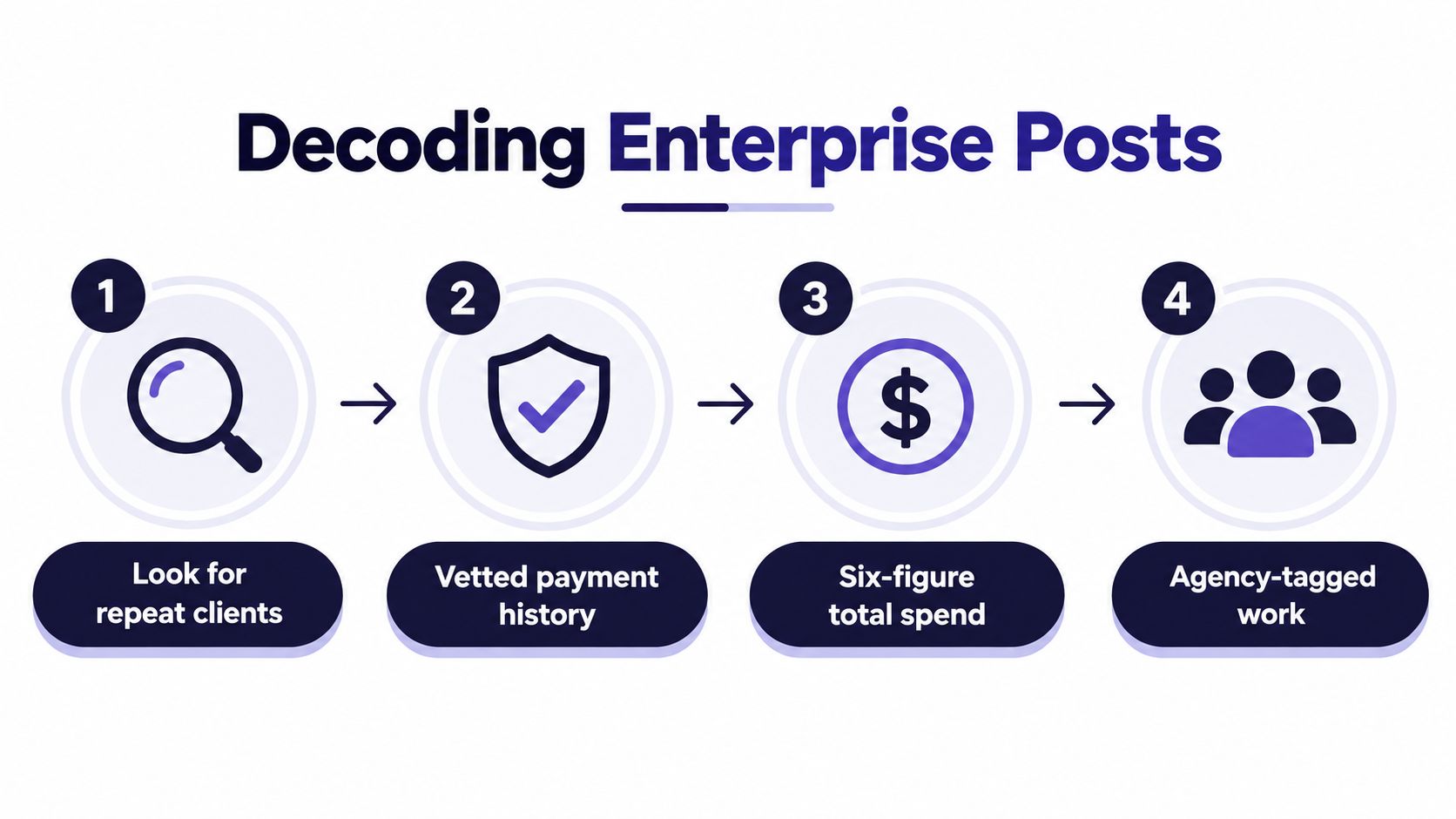
Enterprise job posts often reveal procurement signals in plain sight. Look for repeat client hiring, established payment history, large historical spend, agency-tagged listings, internal-team references, compliance language, and NDA requirements. None of these signals guarantees a good engagement, but together they tell you to slow down and map the decision process before writing the cover letter.
Identify three likely roles:
- Hiring manager: Owns the business problem and defines success.
- Technical or functional reviewer: Tests whether your approach can work inside the existing stack.
- Procurement or legal gatekeeper: Checks commercial terms, risk, documentation, and contract readiness.
Then write the opening around the named outcome, not the deliverable. If the client asks for a CRM migration, don't begin with “I have experience with CRM migrations.” Begin with the result the migration must protect, such as reliable data transfer, adoption, reporting continuity, or a controlled cutover, but only when the post supports that interpretation.
A proposal structure that reduces uncertainty
The first three lines should prove that you read the listing. After that, address one risk specific to the client's stack or timeline, propose a milestone structure, and finish with one low-friction next step.
For example, a strong proposal might say that you'd first confirm data ownership and reporting dependencies, then run a scoped audit, then deliver a documented implementation with stakeholder review. It doesn't promise an outcome you can't control. It shows the buyer how you'll make the work governable.
Submit early when you can do so without sacrificing relevance. The requested operating target is the first ten minutes after a post goes live, because credible early responses can enter the shortlist before the client's attention fragments. Speed only helps when the first sentence could exist for that listing and no other one. Remove generic claims, name a detail from the post, and ask one question that advances qualification.
Following Up Until the Conversation Starts
A proposal can be relevant and still disappear under competing messages. One agency operator I've worked with had a technically strong submission receive no response because every follow-up repeated the same claim, “happy to answer any questions.” The conversation changed only after the next message identified a dependency in the client's implementation timeline and offered a narrower first milestone.
The cadence looked like this:
- Day zero: Submit the proposal, then send a short LinkedIn connection request that references one public detail from the post. Don't move negotiation or contracting off Upwork.
- Day three: Share a value add, not a nudge. Offer one sentence about a likely stack or workflow issue, followed by a relevant case study link.
- Day seven: Reframe around milestones. Ask whether the timeline has shifted and offer a tighter initial scope if the full engagement has become harder to approve.
- Day fourteen: Close the loop politely. Invite a response if priorities return, or ask whether there's an appropriate referral inside the organization.
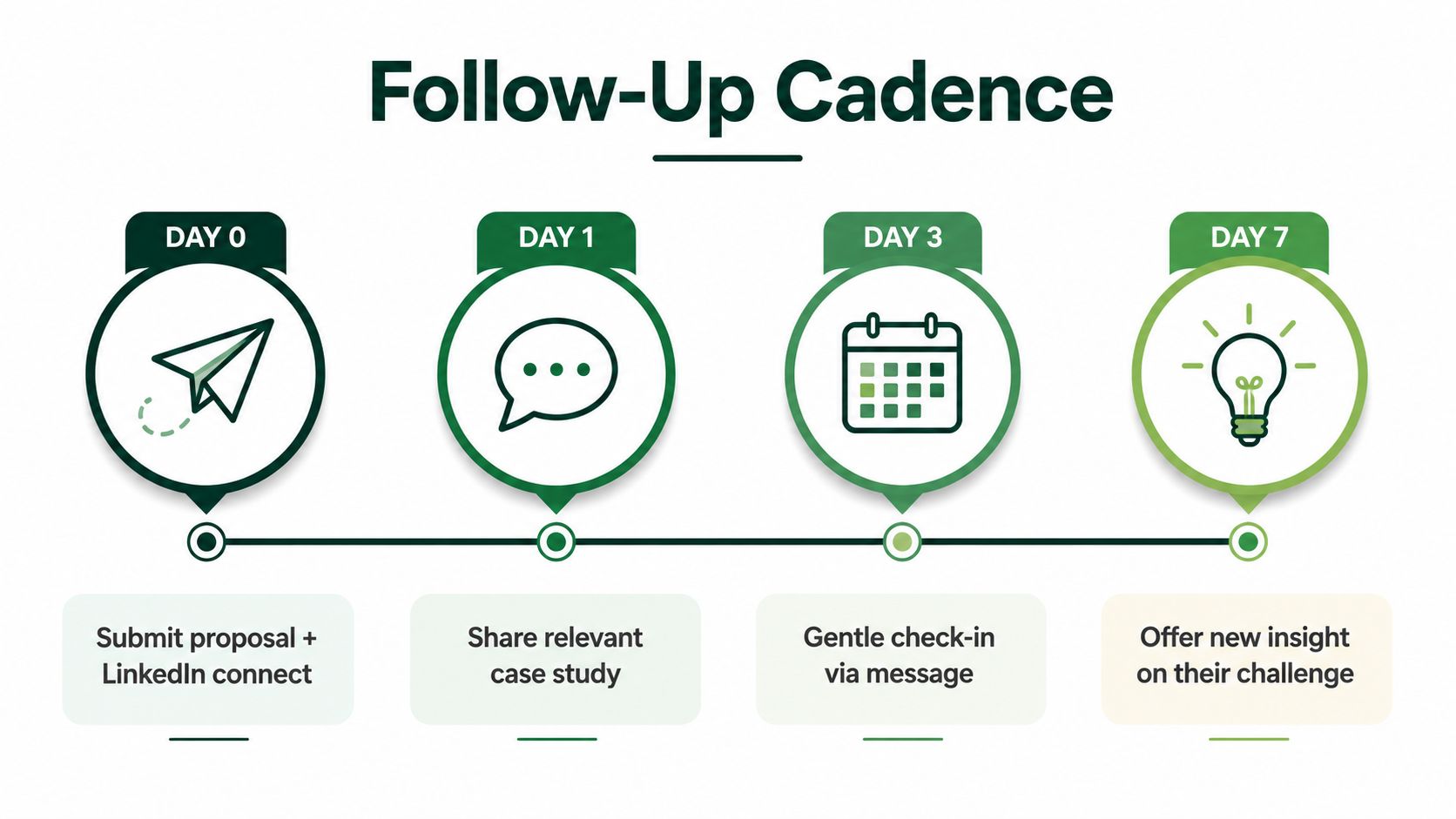
The sequence changes when the buyer opens the proposal, replies, hires someone else, or gives a hard no. An open without a reply may justify a new proof point. A reply deserves a direct answer rather than another scheduled message. If the client chooses another provider, exit with respect and protect the relationship. A hard no ends the cadence.
Rules that keep the sequence useful
Never send the same message twice. Every touchpoint should introduce a new asset, observation, decision aid, or scope option. Keep a record of what the client has seen so the automation layer doesn't recycle language and make the outreach feel careless.
The objective isn't to maximize touches. It's to create a reason for the buyer to answer. One useful observation can outperform several reminders, especially when enterprise stakeholders are coordinating internally and need a concrete question to forward.
Scaling Outreach With Automation Without Breaking Compliance
Automation works best when it handles repetition without pretending to be the relationship owner. Divide the funnel into research, proposal, and follow-up, then assign each zone a clear human checkpoint.
Funnel ZoneAutomation OwnsHuman OwnsCompliance GuardrailResearchSurface new listings, detect enterprise signals, and match jobs to portfolio evidenceDecide whether the opportunity is commercially and technically suitableReview source data before acting on a matchProposalAssemble relevant proof and draft a first passEdit every line for accuracy, tone, scope, and client specificityNever send an unreviewed draft or misleading claimFollow-upQueue timing, track assets, and flag repliesChoose the next useful message and handle objectionsKeep negotiation and contracting on Upwork
A tool such as Earlybird AI can search for jobs, draft personalized proposals, reply to leads, and support follow-up workflows on an Upwork account. Use it as a research and drafting layer, not as permission to remove judgment. The human review gate should sit immediately before every send, particularly when a listing includes confidential information, security requirements, or ambiguous authority.
Your analytics should separate client segments rather than blend every opportunity together. Track proposal volume, reply rate, interview rate, hire rate, and cost per interview by service, buyer type, and qualification level. The point isn't to chase a vanity reply rate. It's to identify whether enterprise-signal jobs produce better conversations, stronger scope, or more efficient use of Connects.
Build a weekly learning loop
Once a week, read every reply. Tag objections such as budget, timing, vendor approval, technical fit, availability, or security documentation. Feed those patterns into your prompt library and profile language, then remove boilerplate that repeatedly fails.
Stay conservative with volume caps and platform rules. Don't scrape or contact people in ways that violate Upwork's policies, don't send identical messages at scale, and don't spend Connects on jobs that your qualification system would reject. If your team needs human prospecting capacity beyond automation, compare the workflow with a specialized option such as Hire SDR, while keeping Upwork-specific communication controls explicit. For the automation layer, this guide to sales outreach automation provides additional workflow context.
Your 30-Day Plan to Land Your First Enterprise Client
A month is enough to install the operating system, not enough to guarantee a signed deal. Use the period to create evidence, remove bottlenecks, and measure each stage without confusing activity with revenue.
Week one focuses on diagnosis
Audit the profile, proposal history, portfolio, specialization tags, and current qualification rules. Benchmark your reply rate, then map 30 target Enterprise job posts and label the signals that made each one worth reviewing. Configure filters for verified payment methods, $10K+ budgets, and recurring engagements, as specified in your targeting model. Keep a written reason for every target so you can compare judgment against results.
Week two produces the sales assets
Rewrite the headline and overview for a business outcome. Rebuild the first portfolio items as mini case studies, update specialization tags, and create two proposal templates. Add five boilerplate blocks for common situations such as discovery, implementation risk, stakeholder review, security documentation, and ongoing support.
The templates should provide structure, not replace research. Leave deliberate spaces for the client's outcome, stack, timeline, and likely reviewer. If a block could be pasted into any listing without editing, it's too generic.
Week three tests qualified outbound
Send 10 qualified proposals daily only when the quality bar remains intact. Log every follow-up in a shared sheet, including the asset sent, the client response, the stage, and the next action. Run a mid-cycle review and cut any source, service, or message pattern that produces activity without useful conversations.
Week four converts and systemizes
Schedule calls with warm leads, prepare answers for stakeholder objections, and negotiate MSA terms only through the appropriate process. Document what happened from job discovery through proposal, follow-up, review, and contract preparation. A documented workflow makes the next Enterprise opportunity faster to qualify without forcing the team to repeat every manual step.
Use three checkpoints: reply rate by day fourteen, a booked call by day twenty-one, and a signed contract by day thirty. If a checkpoint misses, diagnose the stage instead of increasing volume blindly. Weak replies point to targeting or proposal relevance. No booked calls may indicate qualification or follow-up problems. No signed contract can reflect scope, procurement, or stakeholder alignment rather than lead volume.
Earlybird AI helps teams automate Upwork job discovery, personalized proposal drafting, lead replies, and follow-up while keeping human review in the workflow. Visit Earlybird AI to see how its filters, analytics, and multi-user workflows can support a more consistent path to Upwork Enterprise clients.