← Back To Blog
Upwork How It Works: Your Guide to Freelance Success in 2026
If you're new to Upwork, it’s easy to feel a bit lost. Think of it less like a job board and more like a massive, virtual city. Businesses set up shop in different districts (like "Web Development" or "Content Marketing") and post opportunities. Your job, as a skilled freelancer, is to navigate this city, find the right clients, and convince them you’re the one for the job.
It all boils down to a repeatable process: building a profile that stands out, hunting down the best projects, writing proposals that actually get read, delivering fantastic work, and, of course, getting paid.
How The Upwork Ecosystem Really Works
So, how does Upwork actually manage to connect millions of freelancers with clients all over the world? At its core, the platform is a sophisticated middleman. It provides the infrastructure—the communication tools, project management dashboards, and payment protection—that allows freelancers and clients to work together safely.
Once you understand the mechanics behind the curtain, you can stop feeling like just another applicant in a sea of faces and start operating like a sought-after professional. This entire journey, from first signing up to building a successful freelance business, follows a predictable path.
This flowchart breaks down the five key stages every top freelancer has mastered.
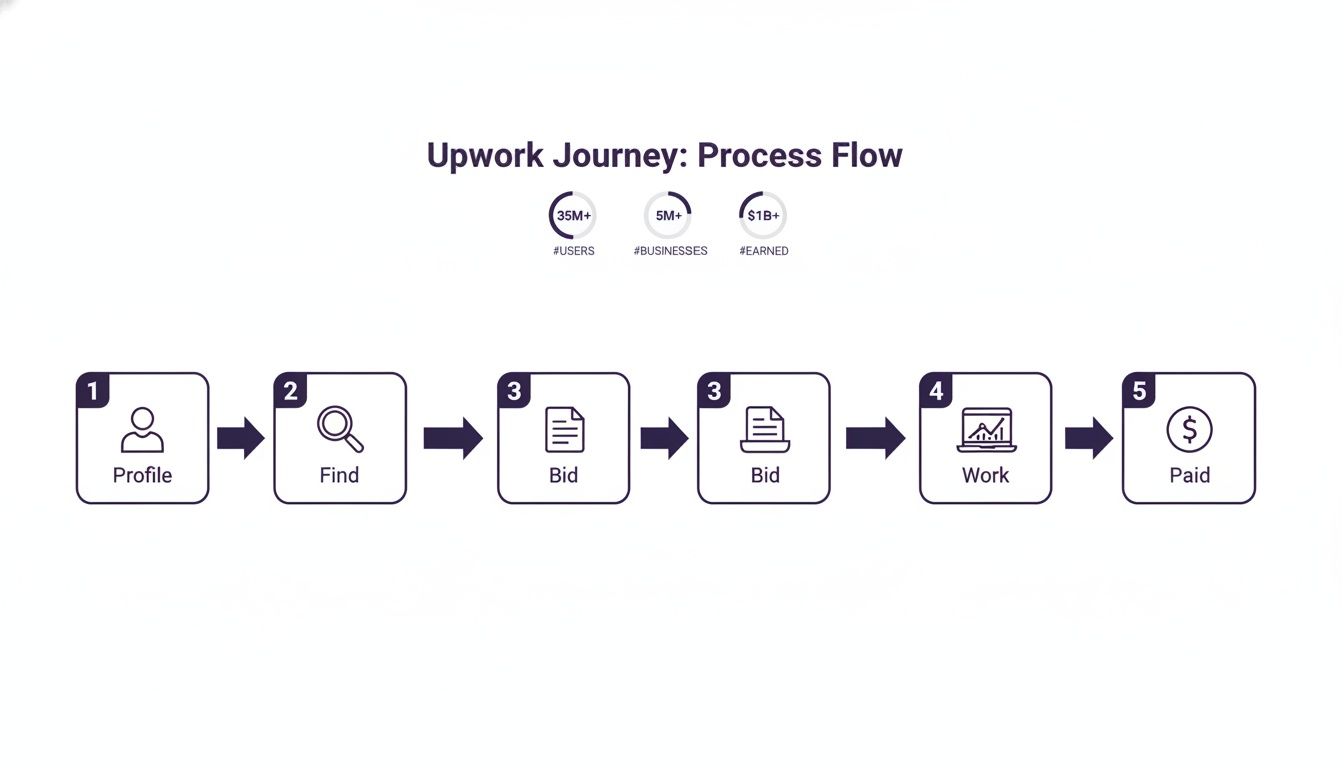
As you can see, winning on Upwork isn't about one magic trick. It's about getting a sequence of steps right, starting long before you ever hit "submit proposal."
The Five Core Stages of Upwork Success
Every single project you land will follow the same basic lifecycle. Getting good at each of these stages is what separates the freelancers who struggle from gig to gig from those who build a thriving, sustainable business.
Profile Creation: This is your digital storefront. A sharp, niche-focused profile with a compelling bio and a polished portfolio isn't just a formality—it’s your primary tool for attracting great clients.
Job Discovery: Next, you go hunting. The Upwork job feed is your window into available projects. Learning to use filters and search terms effectively is a skill in itself, helping you zero in on jobs that fit your expertise and pay what you're worth.
Bidding and Proposals: This is your sales pitch. You spend Connects, the platform's internal currency, to submit proposals. A great proposal goes beyond just listing your skills; it shows the client you understand their problem and are the perfect person to solve it.
Working and Collaboration: Once you're hired, the work begins. You'll use Upwork's built-in messaging and milestone features to communicate with your client, track progress, and submit deliverables for their approval.
Payment and Feedback: After the project is complete, you get paid through Upwork's escrow system. You and the client then leave feedback for each other. This public review becomes a crucial part of your reputation, making it easier to win the next project.
The entire Upwork model is built on creating a trusted environment where businesses can confidently hire talent. It acts as an intermediary, handling contracts and payments so both parties can focus on the work itself.
A Marketplace Built on Trust and Scale
Upwork didn't become the world's largest freelance marketplace by accident. Its sheer scale is a fundamental part of how it operates.
By 2025, this model was supporting 794,000 active clients who collectively spent over $4 billion on freelance talent annually. With a staggering 61.25% market share, Upwork is the undisputed leader in the freelance economy. This is a world where skilled professionals are no longer tied to a single employer, and platforms like Upwork make that freedom possible. You can discover more insights about Upwork’s market dominance and user statistics here.
Building A Profile That Wins Clients

Let's get one thing straight: your Upwork profile isn't a digital resume you set and forget. It’s your always-on, 24/7 salesperson, constantly working for you in a marketplace where clients make snap judgments. I’ve seen countless talented freelancers fail, not from a lack of skill, but because their profiles were practically invisible, filled with generic fluff like "reliable" and "detail-oriented" that just fades into the noise.
To really succeed, you have to change your thinking from "job applicant" to "expert consultant." A great profile doesn’t just list your skills; it sells the client a solution to their problem. This means being strategic about every single detail, from your title all the way down to your portfolio. It’s all about showing your expertise, not just telling people about it.
Craft A Magnetic Title And Overview
A potential client’s first impression of you comes down to two things: your professional title and the first couple of sentences of your overview. This is your most valuable real estate on the platform, so you have to make it count. A lazy title like "Freelance Writer" is a huge missed opportunity. A powerful one, like "B2B SaaS Content Writer for Lead Generation," instantly grabs the attention of a specific client with a very specific need.
Your overview should work the same way. Ditch the classic opening, "I am a passionate graphic designer with five years of experience." Instead, lead with the value you bring. Try something like, "I help early-stage startups build unforgettable brand identities that attract their first 1,000 customers." That client-focused approach immediately tells them what you can do for them.
Think of your profile as the direct answer to a client's unspoken question: "Can this person solve my problem without creating new ones?" Every word should build their confidence that the answer is a resounding 'yes.'
Define Your Niche And Weave In Keywords
On a platform with millions of freelancers, being a jack-of-all-trades is the fastest path to getting lost in the crowd. You need to pick a profitable niche. So, instead of offering something broad like "web development," you could specialize in "Custom WordPress Development for E-commerce Stores." That kind of focus makes you far more visible to the exact clients you want to work with.
Once you’ve locked in your niche, it's time to get strategic with keywords. Put yourself in the client's shoes—what terms would they actually type into the search bar to find someone like you?
- Skill-based keywords: "React.js developer," "SEO content strategy," "Figma UI/UX design"
- Industry-based keywords: "Fintech marketing," "healthcare copywriting," "real estate video editing"
- Outcome-based keywords: "Conversion rate optimization," "sales funnel expert," "brand awareness"
Work these keywords into your title, overview, and skills section in a way that feels natural. This is a crucial piece of how Upwork works for discovery; you're essentially telling the platform's algorithm exactly which clients to send your way.
Build Trust With Visuals And Reputation Metrics
Trust is the real currency on Upwork. A professional headshot and a thoughtfully curated portfolio aren't optional—they're essential. Your photo needs to be clear, professional, and approachable. A grainy selfie or, worse, a company logo, just screams amateur. And your portfolio is your proof. It needs to feature your best work, complete with short descriptions explaining the project's goal and your role in its success. For a deep dive, check out our guide on how to build a powerful Upwork portfolio.
Beyond what you control directly, Upwork gives clients several key metrics to gauge your reputation, and they lean on these heavily.
- Job Success Score (JSS): This is a percentage from 0 to 100 that reflects how happy your past clients were. A score of 90% or higher is the gold standard for top-tier freelancers.
- Top Rated Badge: Earning this badge shows you have a JSS of 90%+, consistent earnings, and a complete profile. It’s a powerful stamp of approval that signals quality and reliability to clients.
- Expert-Vetted Badge: This is the highest honor on the platform, reserved for the top 1% of talent. Getting here involves a tough screening process by industry experts, but it makes you a magnet for premium, high-paying clients.
All these pieces work together, turning your profile from a simple listing into a powerful client-attraction machine. This is how you stop competing on price and start winning work based on your proven expertise.
Mastering The Art Of The Winning Proposal

Finding a steady stream of jobs on Upwork is one thing. Actually winning them is a completely different ballgame. This is where so many talented freelancers stumble, treating the platform like a lottery. They burn through their Connects—Upwork’s currency for sending proposals—by flinging generic, copy-paste bids into the void and wondering why they never hear back.
If you want to succeed, you have to make a fundamental shift in your thinking. Stop being just another applicant in a long list. Start being the obvious solution to a client's problem.
A winning proposal isn't a long-winded resume. It's a direct, surgical response to a client's specific pain point. Your only goal in the first two sentences is to prove you've actually read and understood their post. This is your moment to break away from the pack of freelancers who all sound exactly the same.
Stop Wasting Connects And Start Winning Bids
Think of your Connects as a valuable, limited resource, not an infinite pile of lottery tickets. Every proposal you send is an investment of your time and your credits. The key is to stop carpet-bombing every job that looks remotely interesting and start being ruthlessly selective.
Before you write a single word, put on your detective hat and dissect the job post. Look past the surface-level technical requirements and hunt for clues about the real business problem. Is the client trying to boost sales? Generate more qualified leads? Free up their time? The better you understand their true goal, the more powerfully you can position yourself as the person who can achieve it.
Your proposal's number one job is to convince a client that hiring you is the lowest-risk, highest-reward decision they can make. It's less about your skills and more about their peace of mind.
Grasping this is central to understanding how Upwork works. The platform is an economic engine built on a simple workflow: clients post problems (jobs), and freelancers propose solutions. And that engine is humming, with platform revenue hitting $193.8 million in Q3 2024, a 10% year-over-year jump. With the number of active clients growing by 57.59% to 855,000 between 2019 and 2024, the opportunities are massive, but so is the competition. You can find more Upwork statistics and trends on Famewall.io.
The Anatomy Of A Hyper-Personalized Proposal
Sending a generic proposal is the kiss of death on Upwork. Clients can spot a template a mile away, and it instantly tells them you couldn't be bothered to understand their unique needs. A hyper-personalized proposal, on the other hand, makes the client feel seen and heard.
Here’s a simple but powerful structure to follow:
- The Hook (First 2 Sentences): Start by directly addressing their problem or project goal. You could even ask a smart, clarifying question that proves you've read the description with a critical eye.
- The Solution (The Body): Briefly outline how you would approach their project. Don't give away the entire farm, but provide enough detail to show you have a credible plan. More importantly, connect your specific skills and past experience directly to their needs.
- The Proof (Social Proof & Portfolio): Mention one or two highly relevant projects you've completed and, if possible, the results you delivered. Point them to specific examples in your portfolio that mirror their project.
- The Call to Action (The Close): End with a clear, confident next step. Ditch the weak "I look forward to hearing from you." Instead, try something proactive: "I have a couple of initial ideas for the landing page copy. Are you available for a brief 15-minute chat this week to discuss them?"
This framework turns your proposal from a passive application into an active consultation. For an even deeper dive, check out our complete guide on submitting a winning proposal on Upwork.
From Interview To Contract: The Final Steps
If you land an interview, it means your proposal did its job. Congratulations! Now it's time to close the deal. This is your chance to build real rapport and solidify your position as the expert they need.
Whether you're chatting via message or on a video call, make a conscious effort to listen more than you talk. Ask insightful questions that dig deeper into their challenges. The more a client talks, the more ammunition you have to frame yourself as the perfect solution. As you listen, echo their challenges back to them in your own words to confirm you're on the same page.
Finally, be ready to talk about budget and timelines with confidence. When you've spent the entire process clearly demonstrating your value and expertise, clients are far less likely to haggle over your rates. By following this system, you move beyond just applying for jobs and start building a repeatable process for winning high-quality work on demand.
Navigating Contracts, Payments, And Platform Fees

Let’s talk about the best part: getting paid. While it's the goal of every project, Upwork's financial side can feel a little intimidating at first. The key is to see the platform for what it is—a trusted middleman that makes sure you get paid for the work you do.
Once you get a handle on how contracts, payments, and fees work, you can focus on your clients with total peace of mind. It’s all built to create a secure environment where trust isn't an issue.
Hourly vs. Fixed-Price Contracts
Every job on Upwork is structured in one of two ways. Figuring out which one is right for you is fundamental to managing your projects and your income.
Hourly Contracts: This is exactly what it sounds like—you get paid for the time you put in. To make it work, you'll use Upwork's Desktop App to track your hours. It logs your time in 10-minute blocks, takes occasional screenshots, and notes your activity. This creates a clear, verifiable timesheet that protects both you and the client from any disputes.
Fixed-Price Contracts: These projects have a single, agreed-upon price. The real magic here is milestones. Before you even start, the client funds the first milestone into an escrow account. When you deliver the work for that milestone and they approve it, the funds are released to you. Simple as that.
A lot of freelancers gravitate toward fixed-price work because you get paid as soon as a milestone is cleared, and you have more freedom in how you structure your workday. Hourly is steady, but you have to wait for the weekly billing cycle to complete before funds are available.
Understanding Upwork Service Fees
Upwork isn't a charity, so they take a cut of your earnings. Think of it as the price for using their platform to find clients, process payments, and offer dispute resolution. The good news is, the fee structure is designed to reward you for building long-term relationships.
It’s a sliding scale based on your total billings with a specific client:
- 20% on the first $500 you earn from a client.
- 10% on your earnings between $500.01 and $10,000.
- 5% on all earnings that go beyond the $10,000 mark.
This tiered system is a core part of the Upwork model. It directly incentivizes you to find great clients and stick with them. The longer the relationship, the more money you take home.
If you want to really dig into the numbers, we've got a full breakdown on how much Upwork takes from freelancers and how to plan for it.
Payment Protection and Withdrawing Your Money
One of the biggest reasons to use Upwork is its Payment Protection program. For hourly jobs, as long as you're using the Desktop App properly, your payment for logged hours is guaranteed. For fixed-price gigs, the escrow system means the money is already secured before you write a single line of code or design a single graphic.
This financial security is what allows the platform to handle an incredible amount of money. In 2023 alone, Upwork's Gross Services Volume (GSV) was $4.1 billion. Top freelancers have earned over $1.5 million each, which shows you what's possible when payments are reliable. You can discover more insights about freelancer earnings on Upwork.com.
Once your earnings clear the security waiting period, getting your hands on your money is straightforward. You can choose from a few withdrawal methods:
- Direct to U.S. Bank (ACH)
- U.S. Dollar Wire Transfer
- Direct to Local Bank
- PayPal
Each option comes with its own fees and processing times, so it's a good idea to check which one makes the most sense for you. Mastering these financial mechanics is how you turn freelancing into a stable, professional business.
Advanced Strategies to Scale Your Upwork Business
Moving from a successful freelancer to a real business owner on Upwork demands a completely different playbook. Once you've gotten the hang of landing great solo projects, the next chapter is all about scaling your operation. This means looking beyond what you alone can earn and building a system that makes money even when you’re not the one at the keyboard.
This is where you start thinking like an agency owner. It’s a shift toward building a team, creating a repeatable process for finding clients, and using hard data to make smarter business decisions. The aim is to build a predictable growth engine on the world’s biggest freelance platform.
Building Your Agency on Upwork
The first step toward scaling is a tough one: admitting you can't do it all yourself. Setting up an Upwork Agency account is the practical way forward. It allows you to bring on team members, take on more projects, and serve more clients than you ever could alone.
An agency profile lets you add other freelancers under your company's banner. Each member has their own profile, but they can bid on jobs and work on projects for the agency. This is perfect for managing a team of specialists. Imagine a marketing agency with separate experts for SEO, PPC, and social media—all working together on a single, comprehensive client project.
To pull this off, you have to be consistent. Your agency needs a unified voice and a standard way of writing proposals. Every proposal sent by any team member should instantly communicate your agency's brand and quality. This gives clients a seamless experience, no matter who they first talk to.
Managing Multiple Accounts and Maintaining Brand Consistency
As you grow, you might have several team members applying for jobs at the same time. Without a solid system, things can get chaotic fast. The real challenge is making sure every proposal is personalized and top-notch while still sounding like it came from the same company.
This is why you need to create a "proposal playbook." Think of it as your agency's bible for outreach. It should include things like:
- Core Value Propositions: A few clear, powerful sentences explaining what problems you solve and for who.
- Case Study Snippets: Ready-to-use summaries of your best work and results that can be easily tweaked for a new client.
- Question Templates: A bank of smart questions for different project types that show you've really read the job post and are thinking deeply about the client's needs.
- Brand Voice Guidelines: Simple rules on tone and style so everyone on the team sounds professional and aligned.
The whole point is to systematize your outreach so your agency speaks with one, confident voice. This builds brand recognition and trust, which makes it much easier to close bigger deals at higher rates.
This centralized playbook is your quality control. It ensures your hard-earned reputation stays strong with every single client interaction and helps you build a process that delivers results time and time again.
Leveraging Real-Time Analytics for Growth
You can't fix what you don't measure. Scaling effectively means you have to stop relying on gut feelings and start making decisions based on data. The top agencies on Upwork are absolutely obsessive about tracking their key performance indicators (KPIs).
Watching these numbers in real-time gives you a crystal-clear map of your sales funnel, showing you exactly where you're succeeding and where you're getting stuck. The most important KPIs to keep an eye on are:
- Proposal Win Rate: What percentage of your proposals actually lead to an interview or a contract? If this number is low, it might mean your proposals aren't hitting the mark or you're targeting the wrong jobs.
- Client Response Time: How long does it take for clients to reply to your first message? If you’re hearing crickets, your opening lines might not be grabbing their attention.
- Interview-to-Contract Ratio: Of all the interviews you're landing, how many turn into paid work? If you're getting plenty of calls but no contracts, it’s time to work on your sales pitch and interview skills.
Tracking these metrics lets you run small experiments to see what actually moves the needle. You could A/B test different opening lines in your proposals or try different follow-up strategies and see how it affects your win rate. This analytical mindset is what separates the hobbyists from the professional agencies.
Using Automation Safely to Systematize Outreach
The biggest grind in growing on Upwork is the endless, repetitive task of finding new jobs and writing proposals. This is where automation, when used smartly, can give you a serious edge. We’re not talking about spamming generic, copy-pasted bids; we’re talking about building an intelligent system that does the heavy lifting for you.
Think of it like having an "always-on" sales assistant. Tools like Earlybird AI are built to work safely with Upwork’s platform, connecting securely to your account. The AI then gets to work, finding perfect-fit jobs based on your skills and past projects.
The system can then generate a highly personalized first draft of a proposal, often just minutes after a job is posted. This gives you a huge speed advantage, since clients almost always pay the most attention to the first few applicants. By automating the hunt for jobs and the initial drafting, you and your team can pour your energy into the things that really matter—personalizing that final proposal, hopping on calls with clients, and delivering amazing work. This is how you scale outreach without sacrificing quality or risking your account.
Common Questions About Working on Upwork
Diving into Upwork for the first time? You've probably got a few questions. Let's walk through some of the most common ones that pop up for new freelancers, so you can get started with a clear head.
How Long Does It Take to Get Your First Job on Upwork?
This is the big one, isn't it? The honest answer is that it can take anywhere from a few days to a few weeks. How fast you land that first gig really comes down to the quality of your profile, the demand for your skills, and how you write your proposals. A polished, complete profile paired with well-crafted proposals can make all the difference.
The trick is to focus on quality over quantity. You're far better off sending a handful of truly personalized proposals each day than spamming dozens of copy-pasted ones. Speed also plays a huge role. Clients tend to look at the first few applicants most closely, so getting your proposal in quickly gives you a real leg up.
Are Upwork's Fees Worth It for a New Freelancer?
For most freelancers just starting out, the answer is a resounding yes. Think about what it takes to launch a business from scratch. Upwork's fees are an investment that covers the heavy lifting—it drops a steady stream of potential clients right in your lap, handles all the payment processing, and provides standardized contracts and a system for resolving disputes.
View the initial 10% fee (which applies after your first $500 with a client) as your all-in-one cost for marketing, admin, and payment security. It frees you up to focus entirely on your craft. Plus, the platform rewards long-term relationships. Once you bill over $10,000 with the same client, that fee drops to just 5%, putting more money directly in your pocket.
Can You Really Make a Full-Time Living on Upwork?
Absolutely. Thousands upon thousands of freelancers use Upwork as their main source of income. The top earners on the platform have brought in millions in lifetime earnings. Getting to that level, however, means treating your freelance work like a real business, not a side hustle.
It’s about consistently delivering great work on schedule, communicating like a professional, and building a repeatable system for finding and winning projects. Success isn't handed to you, but Upwork provides a clear and proven path to a sustainable—and often very profitable—full-time career if you're dedicated and strategic.
Success on Upwork is not about luck; it's about shifting your mindset from a job applicant to a business owner. You're not just trading hours for dollars—you're providing expert solutions and building a reputation that attracts high-value clients.
Is Using Automation for Proposals Safe on Upwork?
Yes, as long as you're smart about it. Upwork’s rules are there to stop spammy, low-effort bots that just flood clients with junk proposals. But compliant, intelligent AI tools work in a completely different way and are perfectly safe.
These tools don’t just scrape job posts and blast out generic messages. Instead, they use authorized, secure methods to help you draft high-quality, personalized proposals that reflect your skills and the client's needs. Think of this kind of automation as a powerful assistant—it helps you work faster and more efficiently without ever putting your account in jeopardy.
Want to land more Upwork jobs without spending all day searching and writing proposals? Earlybird AI acts as your always-on sales team, finding perfect-fit jobs and drafting personalized proposals in minutes. Scale your outreach, win more projects, and focus on what you do best by visiting https://myearlybird.ai to learn more.