← Back To Blog
Upwork Profile Description: Attract High-Value Clients
Your Upwork profile is probably saying too much about you and not enough about the client.
That's the trap. A freelancer sits down to improve their Upwork profile description, opens a blank page, and starts listing experience, tools, industries, and personality traits. The result looks polished. It also sounds like everyone else. Clients skim it, feel no urgency, and move on.
A strong Upwork profile description doesn't work like a resume. It works like a sales page with restraint. It answers the quiet questions running through a client's head: Do you understand my problem? Have you solved this before? Are you easy to trust? Should I invite you or keep scrolling?
That shift changes everything. Once you stop writing for yourself and start writing for the buyer, your title gets sharper, your opening gets clearer, and your proof becomes easier to organize. The best profiles don't try to impress everybody. They make the right client feel understood fast.
The Unskippable First Step Defining Your Target Client
Most profile rewrites fail before the first sentence. The problem isn't wording. The problem is that the freelancer hasn't decided who the profile is for.
If your Upwork profile description tries to attract startups, agencies, local businesses, SaaS companies, ecommerce brands, founders, and enterprise teams at the same time, it won't feel specific to any of them. Clients notice that immediately. General language reads like uncertainty.
Pick the buyer before you write the bio
Start with a simple filter. Define your target client using three variables:
- Industry
- Company stage or size
- Project type
That means “B2B SaaS companies needing SEO content” is better than “businesses that need writing.” “Shopify brands needing landing page design” is better than “graphic design services.” “Agencies needing white-label Google Ads help” is better than “digital marketing.”
The point isn't to shrink your opportunities. The point is to become easy to understand.
Practical rule: Clients don't hire the profile that sounds most talented. They hire the one that feels most relevant to their problem.
Build a working client persona
You don't need a fancy worksheet. You need answers to a few blunt questions:
- What are they trying to achieve? More leads, cleaner code, faster delivery, stronger branding, better conversion copy.
- What are they worried about? Missed deadlines, sloppy communication, weak strategy, endless revisions, hiring the wrong person.
- What language do they use? A founder and a marketing manager rarely describe the same problem the same way.
- What kind of freelancer do they want? Specialist, operator, strategist, implementer, or someone who can own the entire function.
When you know that, your profile stops sounding like self-description and starts sounding like alignment.
A useful way to sharpen this is to review your positioning the same way you'd review market fit. This guide on mastering competitive positioning is useful because it forces a hard question: why should a client pick you instead of someone who looks similar on paper?
Think like the scanning client
Clients on Upwork don't read profiles like hiring managers reading a CV. They scan for fit signals.
They want quick answers to questions like these:
- Do you handle my exact kind of work?
- Have you done this enough to reduce my risk?
- Will I have to manage you closely?
- Can you communicate clearly?
Your Upwork profile description should answer those questions before they're asked. That's why niche beats breadth in most cases.
If your background is broad, don't dump all of it into the profile. Choose the part of your experience that supports the client you want now. A profile is a positioning tool, not a life story.
Crafting a Magnetic Headline and Powerful Opening
Your title and first lines carry more weight than the rest of the profile. If they're weak, the body never gets a chance.
Upwork says your title should be 10 words or less and your overview should be concise, client-focused, and easy to scan. It also warns against putting contact information in the overview because that violates the Terms of Service, as explained in Upwork's guidance on profile titles and overviews.
Write a title that says what you solve
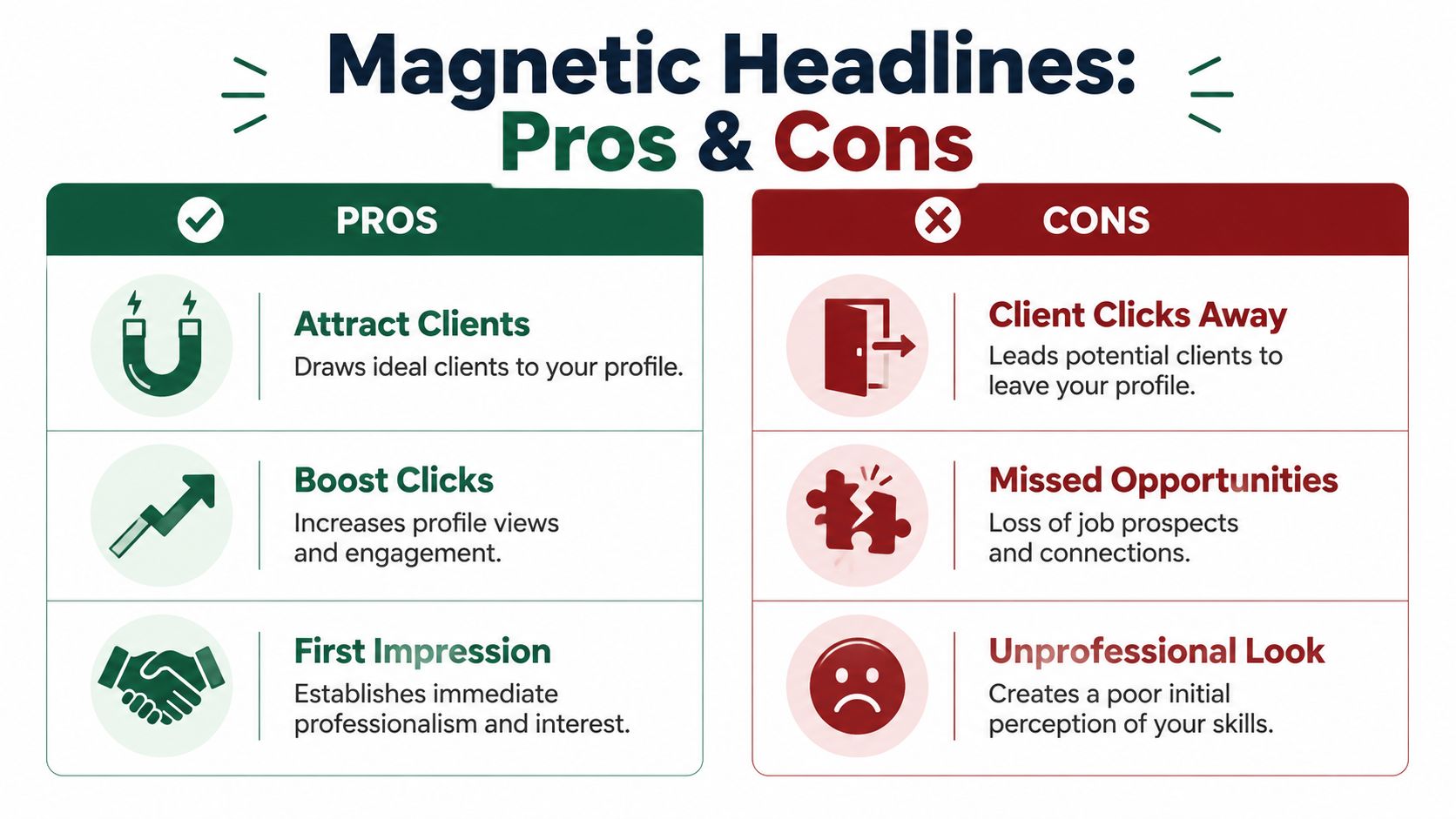
A bad headline is usually either too vague or too self-focused.
Before:
- Hardworking Freelancer
- Expert Digital Professional
- Full-Stack Developer and Creative Thinker
- Experienced Writer With Many Skills
After:
- B2B SaaS Copywriter for Landing Pages and Emails
- Shopify Designer for Conversion-Focused Storefronts
- Google Ads Specialist for Lead Generation Campaigns
- WordPress Developer for Fast Marketing Sites
The second group works because it gives the client a fast yes or no. That's useful. Clarity gets clicks.
Here's the visual difference in plain terms:
Open with the client's problem, not your greeting
Most freelancers waste the first lines on “Hi, I'm...” or “Welcome to my profile.” That space is too valuable for pleasantries.
Start with the problem you solve and the outcome you help create.
Better opening examples:
- You need landing page copy that sounds credible, matches buyer intent, and gives your traffic a better chance of converting.
- If your Shopify store looks polished but still feels hard to use, I help fix the friction that costs sales.
- I help agencies deliver clean, reliable WordPress builds without the communication drag that slows client work.
That kind of opening tells the client, “You're in the right place.”
A quick video breakdown can help if you want to study how strong hooks create momentum:
Use the first lines as a filter
The goal isn't to attract everyone. It's to attract the right clients and gently repel poor fits.
A strong opening should make a good client feel relief and a bad-fit client feel less interested.
That's a win. If you do branding for funded startups, say that. If you only take technical SEO work, say that. If you focus on long-term retainers, say that too. A profile that filters well usually converts better than one that sounds universally available.
Building Your Core Message with Value and Proof
Once the click happens, trust becomes the job.
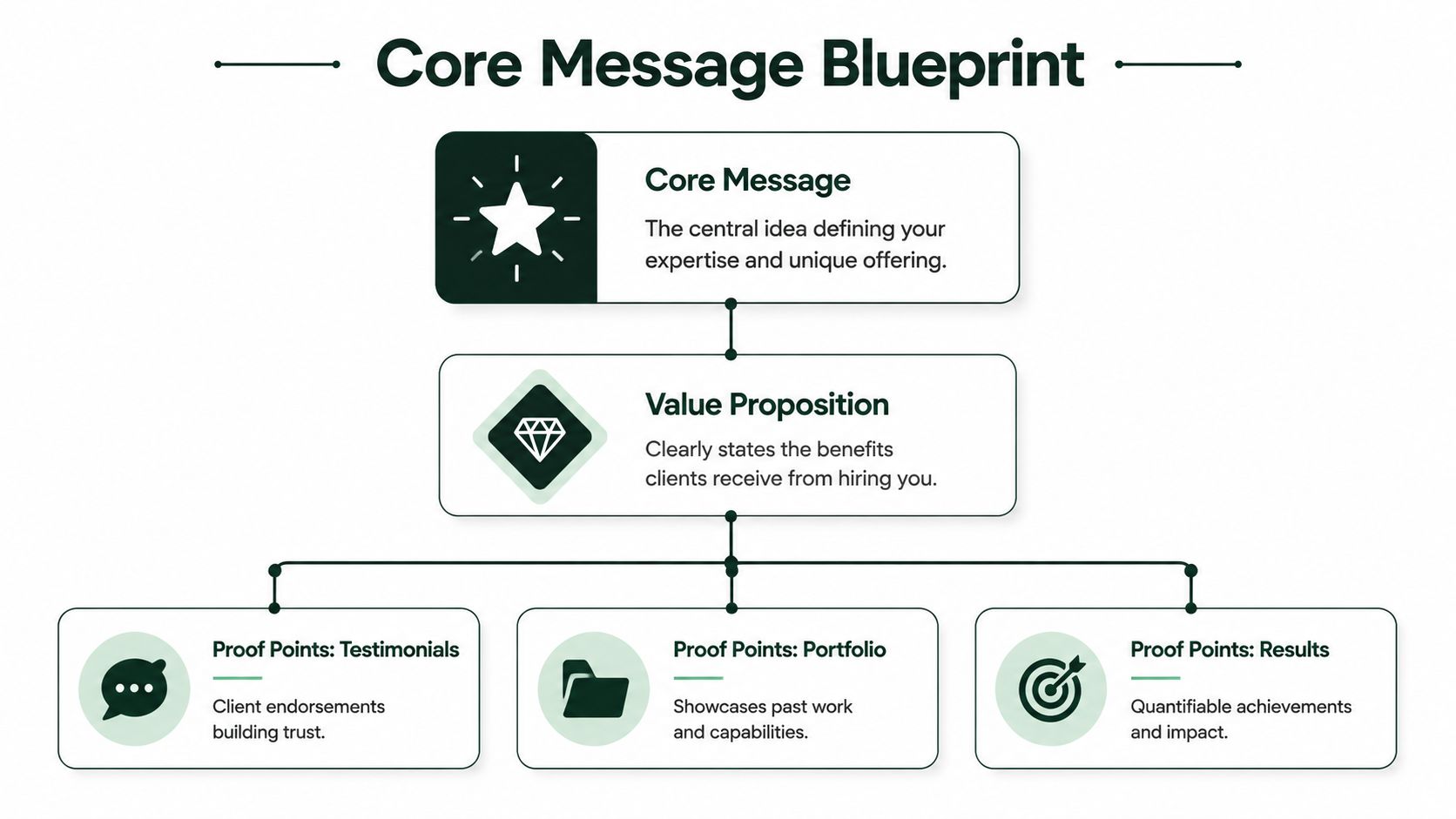
Most Upwork profile descriptions usually falter here. The freelancer lists skills, software, and years of experience, but never ties those details to business value. Clients don't hire a list. They hire a believable path from problem to outcome.
Use this sequence for the body
The body of your profile should move in this order:
- What you do
- Who you do it for
- What changes after hiring you
- Why the client should believe you
That's the skeleton. Everything else supports it.
A weak version sounds like this: “I'm a dedicated professional skilled in SEO, content writing, research, communication, and project management.”
A stronger version sounds like this: “I write B2B SEO content for software companies that need subject-matter credibility, clean structure, and drafts that don't require heavy rewrites.”
The second version connects skill to use case.
Turn claims into proof
Upwork's own profile advice says strong descriptions are built around specific proof points such as relevant employment history, certifications, identity verification, testimonials, and a clear hourly rate, as outlined in Upwork's profile examples guidance.
That matters because clients are scanning for credibility signals, not motivational language.
Use proof like this:
- Relevant background: Mention past roles only if they support your current niche.
- Certifications: Include them when they strengthen trust or category fit.
- Testimonials: Pull in short, concrete phrases from client feedback when available.
- Portfolio: Refer to examples that match the kind of project you want more of.
- Rate clarity: Don't make the client guess where you're positioned.
If you're tightening your samples too, this guide on building a stronger portfolio in Upwork is worth reviewing alongside your profile rewrite.
Make the profile easy to scan
Clients don't want to dig through dense paragraphs. Break your message into useful chunks.
A practical structure looks like this:
- Opening value statement: One short paragraph that names the client, problem, and service.
- Scope snapshot: A bullet list of the work you handle.
- Proof section: A short paragraph with credibility signals.
- Process tone: A few lines that show how you communicate and work.
For example:
- Services I handle: Landing pages, email sequences, website copy, product messaging
- Best fit clients: SaaS teams, agencies, and founders who need clear positioning
- Working style: Clear communication, defined scope, and fast feedback loops
Don't oversell what you can't prove
Discipline is particularly important. If you can't support a claim, soften it.
Bad:
- Best in the industry
- Guaranteed results
- World-class expert
- Master of every platform
Better:
- Focused on conversion-focused ecommerce copy
- Experienced with client-facing agency delivery
- Comfortable translating technical topics into plain language
Credibility rule: Specific beats impressive. A grounded claim with proof is stronger than a grand claim with nothing behind it.
The strongest Upwork profile description feels calm. It doesn't push. It demonstrates.
Using Keywords and Calls to Action to Drive Engagement
A client opens your profile from search, scans the first few lines, and asks two quiet questions right away. Am I in the right place? If I message this person, will the process be easy?
Your keywords answer the first question. Your call to action answers the second.
Use the words your buyer would type
Clients rarely search for vague talent. They search for the job in front of them. “Shopify product page designer.” “SaaS email copywriter.” “Google Ads for local services.” Your profile should mirror that language so the right clients recognize themselves in it within seconds.
Upwork gives freelancers multiple places to signal fit, including skills and specialized profiles. Use that structure with intent. A general profile can cover your main offer. Specialized profiles let you match different client searches without turning one description into a crowded mess.
Place keywords where they help a skimming client and where search can pick them up:
- Title: lead with your main service and niche
- Opening lines: name the client type, problem, and outcome
- Body copy: include related terms tied to real deliverables
- Skills section: fill relevant slots with focused service keywords
- Specialized profiles: tailor each one to a distinct buying scenario
The filter is simple. If your ideal client would type it into Upwork, say it. If only freelancers use the term, cut it.
For example, a Shopify freelancer might use Shopify designer, ecommerce UX, product page optimization, theme customization, and conversion-focused storefront design. A B2B writer might use SaaS content, case studies, landing pages, thought leadership, and email sequences. Those phrases do more than help search visibility. They reassure the client that you already live in their category.
Write calls to action that lower effort
Weak CTAs create extra decisions. Strong CTAs make the first step obvious.
“Feel free to reach out” sounds polite, but it pushes the work back to the client. They still have to figure out what to send, how specific to be, and whether you are a fit for their kind of project.
A better CTA gives the client a small, clear instruction:
- If you need SaaS landing page copy, send an invite with your product, audience, and current page.
- If you want Shopify design support, include your store URL and the pages hurting conversion.
- If your agency needs white-label SEO help, send the deliverables, timeline, and reporting expectations.
This works because it answers an unspoken concern. Clients want a freelancer who can lead the conversation, not wait to be managed.
Refine with tools, but keep your judgment
Profile writing is part search positioning and part sales psychology. Tools can help you review both faster. This guide on Upwork profile optimization is useful if you want a clearer process for tightening keyword fit and message clarity. Earlybird AI also includes profile optimization tools alongside proposal and reply automation for Upwork workflows.
Still, the profile itself has to reflect good judgment. The goal is not to squeeze in more terms. The goal is to make the right client think, “This freelancer understands my problem, and contacting them looks easy.”
That is what gets the invite.
Common Upwork Profile Mistakes and How to Fix Them
Most weak profiles don't fail because of one huge error. They fail because of small trust leaks stacked together.
A vague headline. A generic opening. Too much autobiography. Not enough proof. Mixed services. Inflated claims. Clients read that combination as risk.
Mistake one making the profile about you
Before:
“I am a passionate freelancer with extensive experience and a commitment to excellence.”
After:
“I help law firms publish clear, search-focused content that reads like it was written by someone who understands legal buyers.”
The fix is simple. Lead with the client's need, not your self-image.
Mistake two trying to sell too many services
Before:
“I do web design, SEO, branding, content writing, paid ads, and social media management.”
After:
“I help local service businesses improve lead flow through conversion-focused websites and local SEO.”
Breadth often looks like uncertainty. Clients want a specialist for the problem in front of them.
Mistake three using empty adjectives
Words like reliable, hardworking, detail-oriented, and results-driven aren't harmful. They're just weak without context.
Replace adjectives with evidence:
Instead of: Detail-oriented
Use: Clean file handoff, organized communication, and clear revision notes
Instead of: Strategic
Use: Messaging built around audience, offer, and conversion goal
Clients trust behavior they can picture.
Mistake four keeping irrelevant history in the spotlight
Many freelancers have non-linear backgrounds. That's normal. The mistake is treating every past role as equally important.
Guidance for freelancers with partially irrelevant backgrounds consistently points toward omitting or reframing unrelated history and focusing on a niche, as discussed in this breakdown of common Upwork profile mistakes.
That means:
- Keep it if it supports your current offer: A former in-house marketer becoming a freelance copywriter should use that.
- Reframe it if it adds domain expertise: A former nurse writing healthcare content should absolutely mention it.
- Cut it if it confuses the buyer: Old jobs that don't strengthen your current positioning should stay out of the spotlight.
Mistake five sounding desperate
This one is subtle. It shows up in lines like:
- I'm available 24/7
- I can do anything you need
- I'll work for low rates to build relationships
That language lowers trust. High-value clients don't want desperation. They want steadiness.
Better language sounds like this:
- Clear on scope and communication
- Focused on specific project types
- Comfortable working with defined timelines and priorities
A good Upwork profile description doesn't beg to be chosen. It makes a calm case.
Testing Optimizing and Leveraging Specialized Profiles
A profile can look polished and still attract the wrong buyers.
That happens when freelancers write for themselves instead of for the client scanning five profiles in two minutes. The fix is simple. Test your profile like a sales page. Watch what kind of work it pulls in, then tighten the message until the right clients feel understood fast.
Review what your incoming signals actually mean
Start with client quality, not vanity metrics.
Profile views matter less than the pattern behind them. If cheap one-off jobs keep showing up in your inbox, your positioning is casting too wide a net. If clients invite you for work you do not want, your title or skill tags are pointing at the wrong problem. If interviews start but stall, clients may like the profile and then hit friction when your proposals, samples, or pricing suggest a different offer.
Those are useful signals.
Look at the last 10 to 20 invites or conversations and ask:
- Which service did the client think I offered?
- What budget level kept appearing?
- Did the project match the kind of work I want more of?
- What phrase in my profile likely created that expectation?
This is the shift many freelancers miss. You are not testing copy in the abstract. You are testing whether your profile answers the buyer's unspoken question: "Is this person a fit for my exact problem?"
Use specialized profiles with intent
Specialized profiles work best when each one maps to a different buying trigger.
Upwork gives freelancers a general profile plus specialized profiles, and that creates a practical advantage if you serve related niches with different client motivations. A SaaS founder hiring for landing page copy is not thinking the same way as a Shopify brand owner hiring for retention emails. Both may need a copywriter. They do not respond to the same framing, proof, or vocabulary.
Your general profile can establish your broader category. Your specialized profiles should close the relevance gap.
Examples:
- General profile: Conversion copywriter
- Specialized profile one: SaaS landing page copywriter
- Specialized profile two: Ecommerce email copywriter
Or:
- General profile: WordPress developer
- Specialized profile one: B2B marketing site developer
- Specialized profile two: WooCommerce support developer
That structure changes how clients read you. In a broad category, you look interchangeable. In a specialized profile, you look closer to pre-qualified.
Test one variable at a time
Freelancers often rewrite everything at once, then have no idea what improved results.
Change one high-impact element, let it run, then judge the quality of invites. Good variables to test include your headline, the first two lines, your lead sample, your specialty focus, or the first proof point in your overview. Keep the rest stable long enough to spot a pattern.
A simple testing rhythm works well:
- Pick one element to change
- Run it until you have enough new views, invites, or conversations to judge quality
- Keep the version that attracts better-fit buyers
- Remove the version that brings confusion, low budgets, or off-target work
Let your market shape the profile you show
My own rule was blunt. If a service did not lead to strong invites, I stopped giving it prime real estate.
That can feel risky, especially if you are multi-skilled. But stronger positioning often means hiding services you can do in order to win more of the work you most want. Clients trust specialists because specialists reduce decision fatigue. They can picture the outcome faster, and that makes the invite easier to send.
The best profiles keep evolving as your target market, rates, and offer sharpen. Treat the profile as a working asset, not a finished bio.
Conclusion From Profile to Partner
A sharp Upwork profile description does more than summarize your background. It pre-sells trust.
When your title is clear, your opening speaks to the buyer, your body connects value to proof, and your closing tells the client what to do next, your profile starts doing its real job. It doesn't just exist on the platform. It helps qualify leads, shape expectations, and start better conversations.
That's the key shift. You stop looking like another applicant and start looking like a specialist who understands the work and the client behind it.
The strongest profiles aren't louder. They're more precise. They answer the client's unspoken questions early, reduce uncertainty, and make the invite feel like the obvious next move.
If you want help turning profile views into more consistent conversations, Earlybird AI supports Upwork teams with proposal automation, reply workflows, analytics, and profile optimization tools so your outreach and positioning work together instead of living in separate systems.