
← Back To Blog
What Is a Creative Agency: Services & Partner Guide
A founder hires a designer for a logo, a copywriter for the homepage, and a freelancer for paid ads. A month later, the pieces are finished, but they do not feel like parts of the same business. The logo looks polished, the website sounds generic, and the ads promise something the landing page never quite delivers.
That gap is a common point of confusion.
A creative agency exists to close it. At its best, an agency works like a specialist chef in a busy kitchen. Instead of handing you separate ingredients, it combines strategy, design, content, and technology into work that fits together and serves a clear business goal.
That is the simplest answer to what a creative agency is. It is not just a source of creative output. It is an operating system for turning business intent into brand assets, campaigns, and customer experiences people can understand and respond to.
If you are reading this, you are probably in one of two positions. You have a solid product or service, but the brand feels fuzzy, inconsistent, or forgettable. Or you are a freelancer, marketer, or operator trying to understand how agencies function so you can hire one, work with one, or build a better alternative.
That distinction matters because strong agencies do more than make things look better. They create alignment across the parts of the business customers can see. Messaging, visual identity, campaign ideas, production timelines, and launch execution need to support the same story. Without that coordination, even good individual pieces can pull in different directions.
This article focuses on that coordination layer. The value of a creative agency is not only what it makes. It is how the agency thinks, how it organizes talent, and how it helps a business make better creative decisions, especially when an in-house team is stretched thin or a patchwork of freelancers is no longer enough.
The Problem Solvers of Branding
A common scenario looks like this. A company has a product customers like, a sales team pushing for growth, and a founder who can explain the offer brilliantly in a meeting. Then a buyer lands on the website and leaves unsure what the company does, why it is different, or whether it feels credible.
That gap is a branding problem, but not in the shallow sense of needing a prettier logo. It is a translation problem. The business knows what it means. The market does not.
Creative agencies are brought in to close that gap. They sit between business intent and public perception, then turn scattered ideas, internal opinions, and half-finished assets into a clear system people can recognize and trust.
A good agency works like a diagnostic team before it works like a production team. It looks at the symptoms. Mixed messaging, dated visuals, weak campaigns, inconsistent content, poor handoff from ads to landing pages. Then it traces those symptoms back to the cause. In many cases, the visible issue is creative inconsistency, but the underlying issue is lack of strategic alignment.
Why businesses bring agencies in
Companies usually hire an agency at a moment of friction. Growth has outpaced the brand. A launch is too important to improvise. An internal team has talent, but no shared framework for deciding what the brand should say and how it should show up.
The pattern is familiar:
- The business has traction: Demand is growing, leadership wants to push harder, or a market opening has appeared.
- The brand presentation falls behind: The website, pitch deck, ads, and social presence no longer reflect the quality of the business.
- The team is too close to the problem: Every stakeholder has input, but no one is turning that input into a coherent set of decisions.
- Execution is split across specialists: One freelancer writes copy, another designs pages, another edits video, and no one owns the full customer experience.
That last point matters more than many clients expect.
A patchwork team can produce good individual parts, but branding is judged as a whole. If the ad promises speed, the landing page sounds formal, the sales deck tells a different story, and the onboarding emails use another tone entirely, customers feel the mismatch even if they cannot name it. An agency is often hired to create consistency, but its deeper job is to create coherence.
As noted earlier, this category continues to grow, which fits the way modern companies compete. Product quality still matters, of course. So do clarity, trust, distinctiveness, and the ability to present the same message consistently across channels. Agencies help build those qualities on purpose instead of leaving them to chance.
The simple definition that helps
The plain-English version is this. A creative agency helps a business decide how it should be understood, then turns that decision into brand assets, campaigns, and experiences people can respond to.
Sometimes that means a rebrand. Sometimes it means campaign concepts, a new website, video, or a content system. The format changes based on the problem. The function stays the same. The agency addresses communication and branding problems that a busy internal team, or a loose group of freelancers, often struggles to solve in a coordinated way.
What a Creative Agency Actually Does
The easiest way to understand a creative agency is to compare it to a professional kitchen.
A single freelancer is like one skilled cook. They may be excellent at one thing. A landing page. A logo. A short-form video. A paid ad concept. But a creative agency is the full kitchen. There's someone shaping the menu, someone leading the line, someone plating the final dish, and someone making sure every course arrives in the right order.

That coordination is the point. Upwork's explanation of creative agencies describes a creative agency as a multidisciplinary delivery system that combines strategy, design, content, and technology to turn business goals into market-facing assets and campaigns. That's a much better definition than “they make creative stuff,” because it shows how the value is created.
The four parts working together
Most agencies operate across four connected layers.
- Strategy: This is the thinking layer. It covers positioning, audience, message hierarchy, brand angle, campaign direction, and priorities.
- Design: This is the visual system. It includes identity, layouts, motion, user experience, and the look and feel of the brand.
- Content: This is what the audience reads, watches, hears, or clicks. Copywriting, videos, social content, ad variations, scripts, and editorial assets all sit here.
- Technology: This is how the work gets deployed. Websites, landing pages, CMS builds, design systems, integrations, analytics setup, and platform-specific production belong here.
When those layers are separated across too many vendors, businesses feel the drag. Copy doesn't fit the design. Designers wait on strategy. Developers interpret things differently. Reporting gets bolted on at the end.
An agency reduces that fragmentation by putting specialists under one brief.
What that looks like in practice
Say a software company needs to reposition itself for a new market. A creative agency might start by clarifying the message, then build a refreshed identity, rewrite the homepage, redesign the website, create launch visuals, produce ad creative, and package sales collateral so the whole go-to-market motion feels coherent.
Or take a consumer brand preparing for a campaign. The agency might develop the campaign concept, create the visual direction, write the scripts, design the ad units, coordinate video production, and prepare channel-specific assets for social and paid media.
Practical rule: If your challenge involves both deciding what to say and producing how it appears, you're usually in agency territory.
That's also why agencies can feel easier to work with than managing a loose network of independent specialists. You aren't just buying tasks. You're buying orchestration.
Why clients get confused
People often ask, “Couldn't I just hire freelancers instead?” Sometimes yes.
If your need is narrow and well-defined, a specialist freelancer can be the smarter move. But if the problem spans message, identity, production, and rollout, an agency often gives you a more joined-up result. The difference isn't just talent. It's workflow.
A freelancer can make a dish. An agency can run dinner service.
The Different Flavors of Creative Agencies
Not every creative agency does the same job. That's where buyers get tripped up. They hire a firm expecting brand strategy when the firm is really a production shop, or they expect campaign execution from a team that mainly does identity work.
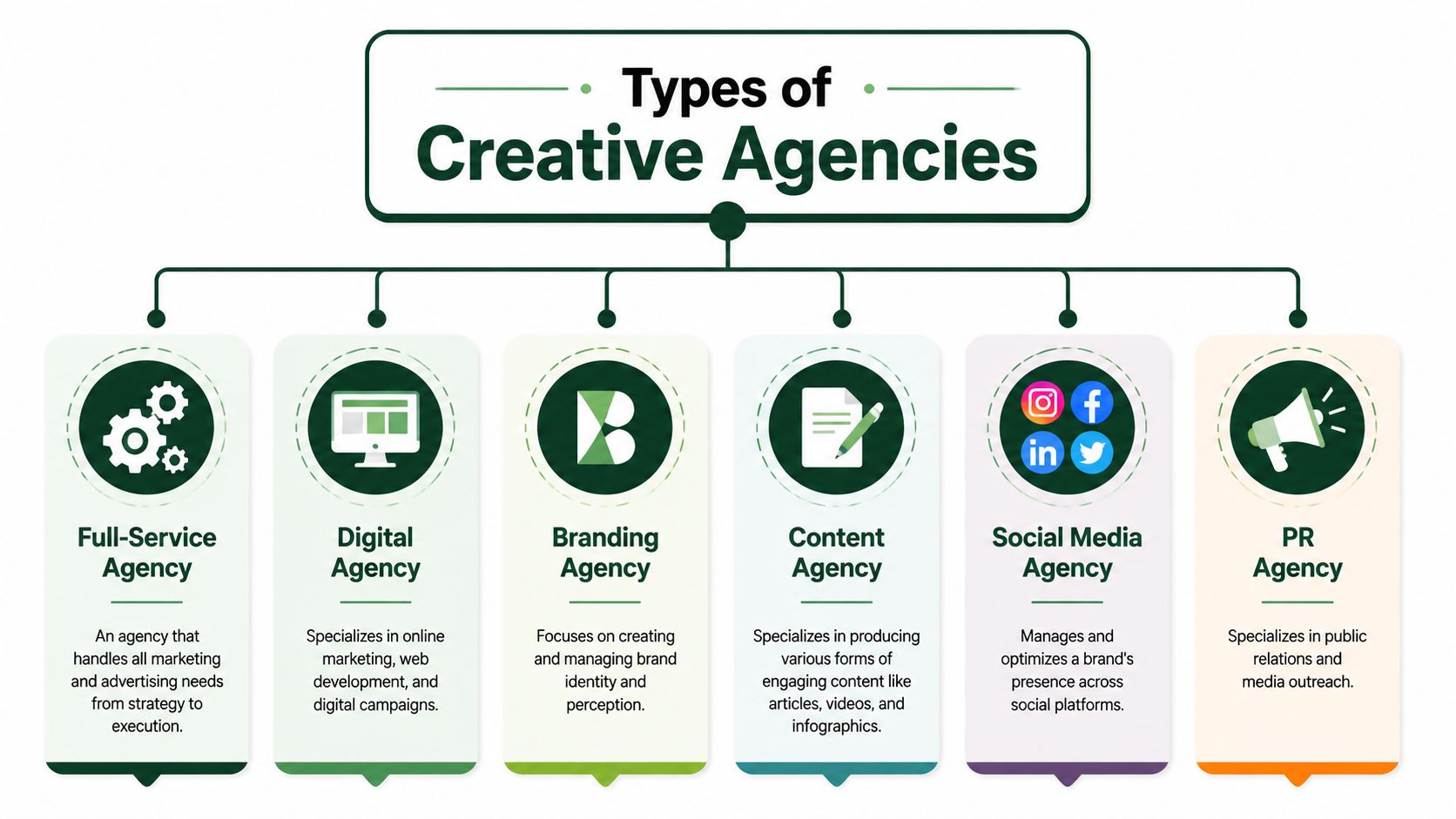
The cleanest distinction is scope. Wrapbook's overview of creative agencies notes that some agencies are full-service, while others specialize in narrower areas such as ad creative, UX/UI, branding, or video. That specialization changes how they work and what they're best at.
Full-service agencies
These agencies try to cover the full chain from strategy through execution. They may handle brand work, campaigns, design, websites, content, and media-facing creative.
You'd hire one when your business needs coordination more than point expertise. Rebrand plus new site plus launch assets is a classic full-service assignment.
If you want a better sense of how this type of firm is structured commercially, this breakdown of the agency business model is useful.
Branding agencies
A branding agency focuses on identity and positioning. That usually means naming, messaging, visual identity, tone of voice, brand guidelines, and the systems that shape how a business presents itself.
Hire them when the company has outgrown its current identity, merged with another business, entered a new market, or realized that people don't understand what makes it different.
This is less about campaign volume and more about foundation.
Digital agencies
Digital agencies live closer to channels and platforms. They may handle web design, web development, landing pages, digital campaigns, email creative, and online user experience.
They're a fit when your biggest issue is digital execution. Maybe the brand is acceptable, but the website underperforms, the funnel feels clunky, or campaign assets aren't adapting well across channels.
Advertising agencies
An advertising agency usually centers on campaign ideas and promotion. Think concept development, creative direction for ads, scripts, campaign visuals, and the creative assets that support launch and distribution.
You'd bring one in when you need attention fast. Product launches, seasonal pushes, category entries, and major awareness campaigns often land here.
Content agencies
Content agencies focus on output that educates, entertains, or nurtures. That can include articles, video, social content, scripts, graphics, newsletters, and editorial systems.
Hire them when your brand knows what it wants to say but lacks the team and process to say it consistently.
Specialized agencies often move faster within their lane. Full-service agencies are stronger when consistency across many touchpoints matters more than narrow channel optimization.
Social media and PR agencies
Some firms focus almost entirely on social platforms, community presence, creators, or public relations. Others blend those capabilities with broader creative work.
These are useful when your challenge is audience attention in public spaces. If reputation, media narratives, or daily channel presence matters more than a full identity overhaul, a focused team can be a better match than a broad one.
The Strategic Benefits of Partnering with an Agency
Hiring a creative agency isn't just a way to get more hands. It's a way to change the quality of thinking around the work.
Internal teams usually carry history, politics, assumptions, and bandwidth limits. They know the business thoroughly, which is valuable. But that familiarity can make obvious problems feel normal. Agencies walk in without that blindness. They ask the annoying questions that insiders often stop asking.

Outside perspective without inside chaos
Consider a company that keeps rewriting its homepage every quarter. The marketing lead thinks the problem is copy. Sales thinks it's lead quality. The founder thinks the market just doesn't “get it.”
An agency often diagnoses that differently. The issue may be weak positioning, an unclear offer structure, or a mismatch between the audience and the promise. Instead of patching surfaces, the agency reframes the problem.
That outside perspective is hard to build internally because staff members are often maintaining the system while standing inside it.
Access to a whole team at once
One of the least understood benefits of an agency is role stacking. You don't just get one person. You get a strategist, creative lead, designers, writers, production support, and often developers or channel specialists, depending on the brief.
That matters when work crosses disciplines. A freelancer might be excellent but still need direction from the client. An agency is more likely to generate that direction itself.
- For a growing business: You can access senior thinking without building a full internal department.
- For a lean team: You can launch larger initiatives without stretching your staff into jobs they don't own.
- For complex projects: You can keep message, design, and rollout connected instead of improvising the handoff.
Speed and decision quality
Agencies also compress decisions. Because they've run similar workflows across many clients, they can move from ambiguity to options faster than teams starting from scratch.
That doesn't mean “faster” in a reckless sense. It means fewer wandering meetings, fewer disconnected revisions, and a clearer path from brief to launch.
The real value of an agency often shows up in the decisions you no longer have to make alone.
There's another benefit that clients notice later. Agencies can scale with demand. A business may not need a permanent in-house video producer, brand strategist, UX designer, and campaign copywriter. It may need them intensely for a quarter. Agency partnerships match that reality better than many hiring plans do.
How Agencies Work and What They Cost
To many clients, agencies look mysterious from the outside. You have a kickoff call, a few decks appear, designs show up, revisions happen, then invoices arrive in a format you're not fully sure how to compare.
The black box becomes easier to understand once you see the operating rhythm.
A typical agency workflow
Most creative agencies move through five stages, even if they use different labels.
- Discovery The agency gathers business context. This includes goals, audience, constraints, competitors, existing assets, and the underlying reason the project exists. Good discovery isn't a formality. It prevents expensive misunderstanding later.
- Strategy and direction
Here the team defines the approach. That might be a messaging framework, creative platform, site architecture, campaign concept, or brand territory. This stage answers, “What are we making, for whom, and why this way?” - Creative development
Designers, writers, and other specialists turn the direction into actual work. You start seeing concepts, copy routes, wireframes, moodboards, scripts, or production-ready assets. - Production and implementation
The selected direction gets built, adapted, finalized, and prepared for use. Depending on scope, this may include web development, motion, ad variations, content packaging, or launch support. - Review and reporting
The project closes the loop. The agency gathers feedback, refines assets, and reports on what shipped or what happened after launch.
The people you'll usually meet
Titles vary, but the functions are predictable.
- Account manager or client lead: Keeps communication moving, manages scope, timelines, and approvals.
- Strategist: Defines the logic behind the work.
- Creative director: Guards the quality and coherence of the output.
- Designers and writers: Build the visible work.
- Developers or production specialists: Handle implementation where needed.
If you understand those roles, meetings start to make more sense. You'll also know who to ask when something feels off.
The main pricing models
Agencies usually charge in one of three ways.
Retainer
A retainer is an ongoing monthly agreement. It's best for businesses that need continuous support, recurring campaigns, regular content, or a steady creative partner.
The upside is continuity. The downside is that vague priorities can eat time quickly if the scope isn't defined well.
Project-based fee
This is common for rebrands, websites, campaign builds, and fixed deliverables. You agree on a scope, timeline, and fee for a defined piece of work.
This model is easiest to budget for. It gets messy when the brief keeps changing midstream.
Hourly or time-based billing
Some agencies bill by hours or time blocks, especially for consulting, advisory work, overflow support, or undefined scopes.
This can be fair for exploratory work, but clients need transparency. Otherwise every conversation starts to feel like a meter is running.
If you want a clearer look at how agencies turn those models into revenue structures, this guide on how marketing agencies make money maps the logic well.
Ask two questions before discussing price: what exactly is included, and what would count as a change in scope?
Those two questions prevent a surprising amount of friction.
How to Choose the Right Creative Partner
Most buyers over-index on portfolio aesthetics. They pick the agency with the prettiest work, then discover too late that the team can't manage process, challenge assumptions, or connect creative choices to business goals.
A better hiring approach is to act like an investigator.

Read the portfolio like evidence
A strong portfolio should answer more than “Does this look good?”
Look for signs of thinking:
- Problem clarity: Does the agency explain the business challenge, or only show polished visuals?
- Decision logic: Can you tell why they chose that direction?
- Range with consistency: Does the work adapt to different clients without feeling random?
- Execution depth: Do they stop at concept mockups, or can they carry work into real deployment?
Visual taste matters. But taste without reasoning can be expensive.
Compare fit, not just fame
Rankings can offer context, but they shouldn't make the decision for you. For example, My Codeless Website's marketing agency statistics page notes that in 2024 the world's most creative advertising agencies included Publicis Conseil with 1006.1 points, Le Pub with 759.7 points, and VML with 710.8 points. That tells you creative excellence can be measured and recognized. It doesn't tell you who's right for your specific brief.
A smaller team with sharper relevance to your problem may outperform a famous name that treats your account like a side assignment.
Don't ask only, “Are they impressive?” Ask, “Are they built for the kind of problem I actually have?”
Here's a useful way to hear practitioners discuss agency selection and collaboration in more practical terms:
Questions worth asking before you sign
Some questions sound basic, but they reveal a lot.
- Who will do the work? The pitch team isn't always the delivery team.
- How do you handle feedback? Good agencies have a clear revision process.
- What do you need from us to succeed? Mature teams know client-side inputs matter.
- What happens when priorities shift? Their answer will show how they handle scope and stress.
- Have you solved this type of problem before? Not same industry only. Same problem type.
If you're hiring through a platform environment like Upwork, there's an extra layer. Review not just the agency profile but the operating discipline behind it. How quickly do they respond? How clearly do they scope? How organized is their proposal? Agencies that win work consistently on marketplaces usually have a structured sales workflow. Some teams use CRMs, shared templates, and internal review systems. Others use tools such as Earlybird AI to automate proposal drafting and client replies on Upwork while keeping outreach organized.
The agency you hire doesn't need flashy process language. It needs dependable habits.
Getting the Most from Your Agency Relationship
A lot of agency relationships fail for ordinary reasons. The brief was fuzzy. Feedback arrived late. The client changed direction without saying so. The agency assumed too much. Nobody clarified who owned decisions.
The fix is rarely glamorous. It's operational.
Give the team a brief they can actually use
A useful brief doesn't have to be long. It has to be clear. State the business goal, the audience, the offer, the constraints, the deadline, and what success would look like in plain language.
Bad brief: “We want something bold.”
Better brief: “We need a landing page and ad creative for a new service aimed at operations leaders, and the current issue is that prospects don't understand the difference between this offer and our core package.”
That kind of specificity helps agencies think.
Treat feedback like direction, not taste
“Can you make it pop?” wastes everyone's time. Good feedback identifies the problem in the work.
Try comments like these instead:
- Message issue: “This headline sounds polished, but it doesn't say who it's for.”
- Design issue: “The hierarchy makes the supporting proof harder to find than the claim.”
- Conversion issue: “The call to action asks for too much too early.”
The best client feedback points to the gap between the goal and the work, not just a personal preference.
Build a shared operating cadence
This matters even more on remote and platform-based engagements.
Use one place for feedback. Decide who approves what. Set review windows. Clarify whether messages in Slack, Upwork, or email count as final decisions. If you're managing multiple freelancers or agency collaborators, tools for workflow visibility can help. Teams that need more structure around task flow, approvals, and delivery often use advertising agency software to keep projects from becoming a thread-by-thread scramble.
For new freelancers, there's a lesson here too. Clients stay when the process feels steady. Not flashy. Steady. That means clear updates, documented decisions, and enough consistency that nobody has to guess what happens next.
If your agency or freelance team wins work on Upwork, Earlybird AI helps automate parts of the client acquisition side, including proposal writing, client messaging, and follow-up workflows. It's designed for teams that want a more structured outbound process on Upwork while staying focused on delivery.