
← Back To Blog
Advertising Agency Profit Margin: 2026 Guide to Boost Yours

You can be fully booked, hit your deadlines, keep Slack buzzing all day, and still end the month wondering why the bank balance feels thin. That’s the trap a lot of agency owners fall into. Activity looks healthy. Revenue looks respectable. But the business is running on effort, not economics.
I see this most often in small and midsize shops that grew by saying yes to everything. They take on mixed-scope retainers, one-off projects, rush work, extra revisions, and “quick favors” for legacy clients. The team stays busy. The owner stays buried. Profit stays unpredictable.
An advertising agency profit margin gives you the clearest answer to what’s happening. It tells you whether the work you sell is leaving enough behind after delivery costs and overhead. It also forces a harder question. Are you building an agency that gets more profitable as it grows, or one that just gets more complicated?
That question matters more in the current market. The U.S. advertising agencies industry is projected to reach $88.7 billion in revenue in 2026 after a 4.7% CAGR over the past five years, while skills shortages in AI and analytics are pressuring margins, according to IBISWorld’s advertising agencies industry outlook. The same source notes that 97% of agencies raised rates in 2025. In other words, growth is there, but so is pressure. You can’t assume revenue growth will rescue a weak operating model.
From Busy to Profitable The Agency Owner's Dilemma
It’s Monday at 9:12 a.m. A client wants revisions on last week’s campaign. A strategist is blocked waiting for feedback. Two proposals still need to go out. The owner is handling all three, while also checking Upwork, replying to leads, and trying to keep the team billable. The agency looks full. The margin usually is not.

I see the same pattern in agencies stuck between survival mode and scale. Work is coming in, but pricing changes from deal to deal. Scope expands after kickoff. Senior people spend too many hours fixing work that should have been handled lower in the org chart. Then the founder absorbs the overflow at night and calls it commitment, when it is really margin erosion.
What busy agencies misread
The core mistake is simple. Owners track activity and assume activity equals health.
It doesn’t.
A packed pipeline, a busy Slack, and a booked-out team can hide weak economics for months. If client work takes more hours than expected, if retainers were sold too cheaply, or if the founder is still the primary sales engine, profit gets squeezed from three sides at once: delivery labor, overhead, and acquisition cost.
Client acquisition is the overlooked one. Many owners treat sales time as free because they are not cutting themselves a separate invoice for it. It is not free. If you spend ten founder hours a week chasing leads, writing custom proposals, and following up manually, that is a real cost. It pulls senior attention away from delivery, hiring, and account growth.
This is why automated client acquisition matters more than many agency owners realize. On platforms like Upwork, a structured system for prospecting, filtering, proposal generation, follow-up, and handoff can reduce non-billable sales time without starving the pipeline. That does two things that directly affect profit margin. It lowers acquisition cost per client, and it gives the owner back hours that can be used to improve pricing, tighten scope, or lead higher-value work.
Practical rule: If sales only works when the founder is personally watching Upwork, writing every proposal, and jumping on every intro call, the agency has a margin problem, not just a sales process problem.
Cost cutting helps, but it is rarely enough. You can trim software, renegotiate contractors, and delay hires. If the agency still wins business through a messy, founder-dependent process, profit stays fragile. Better margins usually come from better economics upstream: tighter offers, cleaner scoping, stronger pricing, and a repeatable way to bring in the right clients without burning senior time.
Why this matters in 2026
The pressure on agencies is operational, not theoretical. Clients still expect speed, specialist talent costs are still real, and delivery has become harder to standardize as service mixes expand. Agencies with disciplined systems have room to protect margin. Agencies running on improvisation usually feel busy and underpaid at the same time.
That split shows up early. One shop adds revenue but also adds chaos, extra revisions, founder bottlenecks, and expensive acquisition effort. Another shop adds revenue through tighter packages, controlled fulfillment, and automated outbound on channels like Upwork that produce opportunities without eating the owner’s week.
The second agency is not just working harder. It has built a model that keeps more of what it earns.
Calculating Your Advertising Agency Profit Margin
Agency owners often skip this part because finance language feels more intimidating than it is. It’s simpler than generally perceived. You need two numbers that answer two different questions.
The first is gross profit margin. The second is net profit margin.
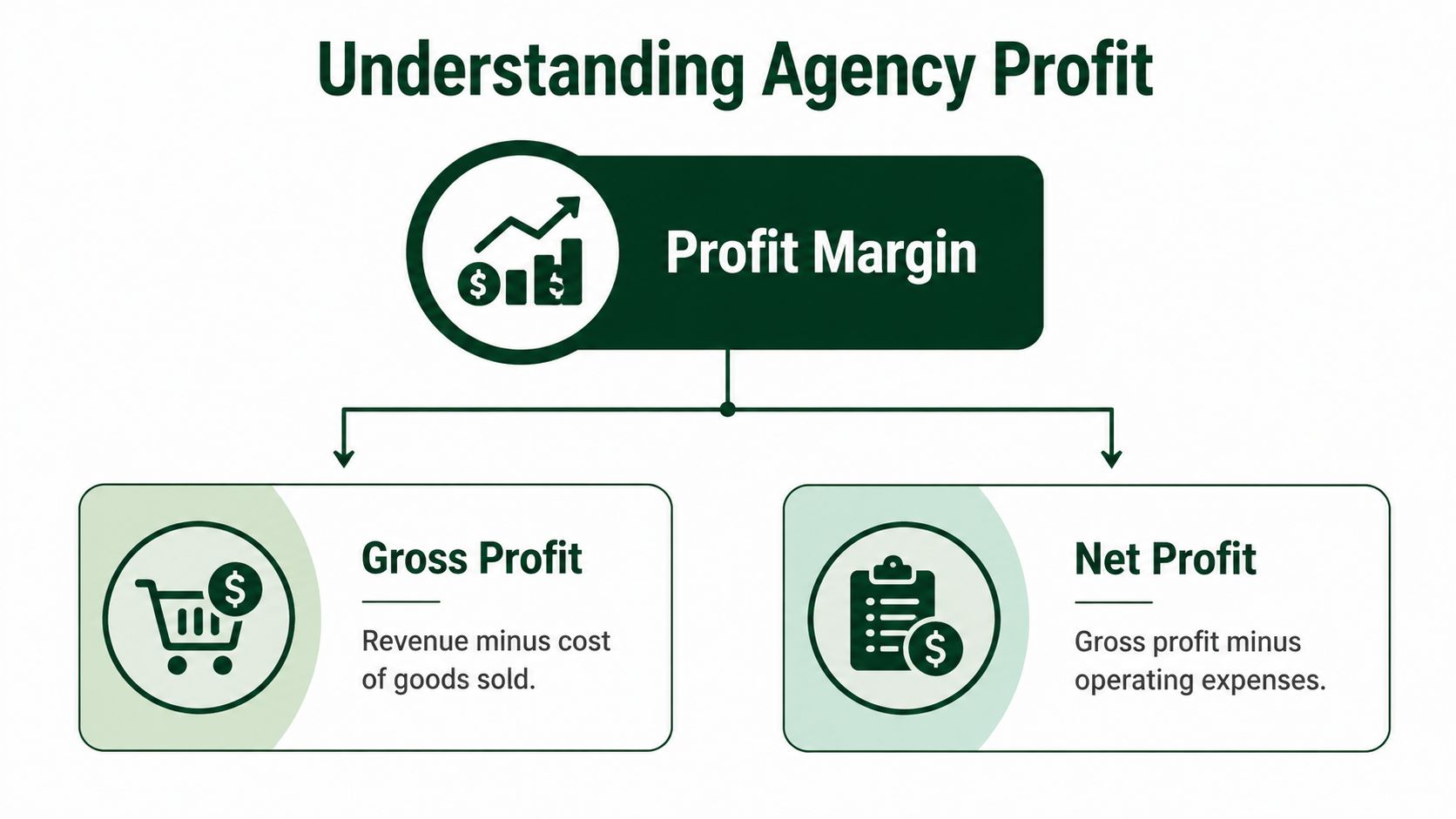
Gross margin shows delivery health
Gross profit margin tells you how profitable the work is before the rest of the business costs are considered.
For an agency, that usually means:
- Revenue: What the client paid you for your service
- Direct costs: The labor and delivery costs tied to fulfilling that work
The formula is straightforward:
- Gross profit = Revenue minus direct costs
- Gross profit margin = Gross profit divided by revenue
If you want an analogy, think of a bakery. Revenue is the price of the cakes sold. Direct costs are the flour, butter, and baker labor needed to make them. Gross margin tells the owner whether the product itself is priced properly.
For an agency, direct costs usually include delivery labor, specialist contractor hours, and any project-specific fulfillment costs you need to serve the client.
Net margin shows business health
Net profit margin goes one layer deeper. It tells you what remains after both delivery costs and operating costs are paid.
That includes things like:
- Salaries for non-billable roles
- Rent or coworking
- Software subscriptions
- Admin and finance costs
- Sales and marketing expenses
- Founder salary, if you pay one through the business
The formula:
- Net profit = Revenue minus all expenses
- Net profit margin = Net profit divided by revenue
Gross margin asks, “Is the work profitable to deliver?” Net margin asks, “Is the agency profitable to run?”
A lot of owners have decent gross margins and weak net margins. That usually means the service is viable, but overhead, sales effort, or poor capacity planning is draining the business.
A simple worked example
Take a fictional agency with monthly revenue from client services.
Start with this sequence:
- Add up service revenue
- Subtract direct delivery costs
- That gives gross profit
- Subtract operating expenses
- That gives net profit
- Divide each profit number by revenue to get each margin
Use your own bookkeeping categories. The key is consistency. Don’t hide delivery labor inside admin costs. Don’t mix pass-through client spend with agency revenue if it doesn’t belong to you operationally. Keep the categories clean so the result means something.
Here’s the practical version of how to do it inside your agency each month:
- Pull one profit and loss view: Use one accounting source of truth, not a spreadsheet patched together from memory.
- Separate direct from indirect costs: If a cost exists because a client project exists, it’s probably direct.
- Review by service line: Paid media may have one margin profile, creative production another, strategy retainers another.
- Check trend, not just one month: A single project can distort one reporting period.
Mistakes that distort the number
Agency owners usually get the math right and the categorization wrong.
Common mistakes include:
- Counting founder labor as free: If you’re doing billable or sales work, that time has value.
- Ignoring contractor creep: Contractors can turn a profitable service into a marginal one if scopes aren’t tight.
- Mixing pass-through spend into revenue: That inflates the denominator and makes margins look healthier than they are.
- Looking only at annual totals: You need enough frequency to spot operational drift before it becomes a structural problem.
If you calculate both gross and net profit margin every month, you stop guessing. You can see whether the leak is in pricing, delivery, overhead, or acquisition.
How Your Agency's Profitability Stacks Up
Once you know your number, the next question is obvious. Is it good, weak, or fixable? Benchmarks help, but only if you use them correctly. The point isn’t to compare your shop to the largest firms in the market. The point is to understand what your current structure can reasonably support, and what changes separate one margin band from another.
In 2025, 8-figure agencies with annual revenue above $10 million achieved 25-32% margins, while 7-figure agencies in the $1 million to $10 million range landed at 18-22%, according to the Agency Growth Benchmark Study summary from Predictable Profits. That gap matters because it shows profitability isn’t just about charging more. Scale changes the model.
Margin ranges tell a story about structure
The same benchmark summary shows a wider spread across the market. 38% of agencies operate at 0-20% margins, while 23.4% reach 40-60%. Those aren’t minor differences. They point to two very different kinds of businesses.
One agency in that lower band might still be promising. It may be early, underpriced, or carrying uneven client load while it finds a niche. Another may be stuck there because every client is custom, every proposal is reinvented, and every sale depends on the founder.
At the higher end, agencies usually share some structural traits. They tend to standardize more of their delivery, command stronger pricing power, and protect team time better.
Client count and team size change margin potential
The Predictable Profits benchmark also notes that agencies with 20+ clients and 50+ employees are significantly more likely to operate in the 20-60% margin range. That doesn’t mean every agency should rush to add headcount. It means larger agencies often gain efficiencies that smaller agencies haven’t built yet.
Those efficiencies usually come from things like:
- Better retention systems: A stable client base makes planning easier
- More repeatable offers: Teams deliver familiar work faster
- Cleaner role specialization: Sales, account management, and delivery aren’t all handled by the same person
- Higher-value engagements: Larger project values give more room for management, QA, and profit
If you want a practical companion to this discussion, this breakdown of how marketing agencies make money is useful because it forces you to examine whether your revenue model supports healthy margin in the first place.
How to use benchmarks without fooling yourself
Benchmarks are useful when they sharpen your decisions. They become dangerous when they feed ego.
A few ways to use them well:
- Compare by stage, not fantasy: If you’re a 7-figure agency, compare yourself to 7-figure peers first.
- Look for operational clues: Higher-margin agencies aren’t just “better.” They often have tighter scope, stronger retention, and more disciplined sales.
- Set the next target band: Don’t jump straight to the highest range. Focus on moving into the next healthier bracket.
- Examine your model objectively: If your margin is low, ask whether the issue is pricing, staffing, client quality, or acquisition friction.
Agencies rarely improve margin through one dramatic move. They improve it by removing the repeatable causes of waste and underpricing.
The benchmark gap between busy agencies and stronger agencies isn’t mysterious. It usually comes down to a handful of controllable drivers.
The Four Key Drivers That Control Your Profit Margin
Profit margin looks like a finance outcome, but inside an agency it’s mostly an operating outcome. Four drivers usually decide whether your margin holds up or gets squeezed: pricing, labor efficiency, overhead discipline, and client mix.

Pricing model and scope control
A weak pricing model forces your team to work harder just to stay even. If you sell heavily customized work on vague scopes, margin slips fast because the client keeps buying certainty while you keep absorbing ambiguity.
Hourly billing is the usual culprit. It can be useful early on because it’s simple. But it caps upside and punishes efficiency. When your team gets faster, you don’t earn more. You bill fewer hours.
Pricing gets stronger when scope is clear and the offer is easier to package. Fixed-fee projects, retainers with firm boundaries, and value-based pricing in the right contexts all tend to support healthier economics because they separate price from every hour consumed.
Labor cost and utilization
Labor is where many agencies win or lose. Digital ad agencies often achieve 20-40% net profit margins, compared with 10-15% for traditional agencies, by maintaining utilization over 70% and an Average Billable Rate of $150-250 per hour, according to Admove’s agency profit margin analysis.
Those numbers matter because they connect abstract profitability to daily operating behavior. If the team spends too much time in internal meetings, proposal rewrites, unclear revisions, or reactive account work, your utilization falls. If your ABR is too low for the skill level required to deliver the work, revenue can’t support the team.
The same source notes that a 5% drop in utilization can erode gross margin from 50% to 40%. That’s not a bookkeeping issue. It’s a scoping, scheduling, and management issue.
Overhead creep
Some agencies don’t have a pricing problem or a delivery problem. They have an overhead problem.
It starts innocently. A few extra tools. More management layers. A premium office. Duplicate software. Admin work no one audits. A sales process that consumes too much owner and senior staff time. None of these costs look fatal on their own. Together they gradually compress net margin.
The hardest part is that overhead often grows faster than discipline. Revenue rises, so spending rises with it, but systems don’t improve enough to justify the added expense.
Look closely at any recurring cost that doesn’t directly improve delivery quality, retention, or client acquisition efficiency. Some overhead is necessary. A lot of it is inherited habit.
Client mix and account quality
Not all revenue is equally profitable. Two clients paying similar fees can produce very different margins.
One client gives fast approvals, stays inside scope, and buys work that fits your process. Another asks for constant revisions, fragments communication across channels, and drags senior people into low-value discussions. Revenue may look similar. Margin won’t.
A weak client mix usually includes some combination of:
- Underscoped legacy accounts
- Low-ticket projects that require senior attention
- Clients outside your core niche
- Accounts with slow decisions and chaotic feedback
- Engagements won mainly because you were cheapest
The best client is not the one who says yes fastest. It’s the one whose work fits your delivery model, pricing model, and team structure.
When owners audit margin by client, they often find that a small group of accounts creates most of the stress and very little of the profit. That’s useful because it means the path to a stronger advertising agency profit margin is usually narrower than it first appears.
Actionable Strategies to Increase Your Agency Profitability
A lot of margin advice stops at “cut costs.” That’s incomplete. Cost discipline matters, but most agencies don’t build a stronger business by shaving expenses alone. They improve margin when they tighten delivery, price work correctly, and reduce the drag created by inefficient client acquisition.

Raise price through structure, not bravado
Most underpricing doesn’t come from weak confidence. It comes from weak packaging.
If your offer is custom every time, buyers compare you on effort and hours. If your offer is defined, scoped, and attached to a clear business outcome, buyers compare you on fit and credibility. That shift gives you room to price more intelligently.
A practical way to start:
- Productize one service line: Turn your most repeatable offer into a clear deliverable set with boundaries.
- Write exclusions into every proposal: Margin protection starts before kickoff.
- Separate revisions from expansion work: Don’t let added work hide inside client friendliness.
- Review clients that haven’t been repriced: Longstanding accounts often carry the oldest assumptions.
This isn’t about becoming rigid. It’s about charging in a way that reflects the cost and complexity of delivery.
Manage labor with capacity planning
If utilization is weak, don’t fix it by pushing everyone harder. Fix it by making work more schedulable.
Start by identifying where billable hours are getting lost. It’s often not laziness. It’s fragmentation. Teams lose time when projects are poorly scoped, handoffs are messy, and account managers pull specialists into preventable discussions.
Strong agencies do a few things well here:
- Match team level to task level: Senior people shouldn’t handle repeatable production if it can be delegated safely.
- Use contractors for variable demand: Flexible talent works best for spikes, narrow expertise, and overflow.
- Protect maker time: Meetings destroy margin when they interrupt delivery blocks.
- Audit estimate accuracy: If estimated hours and actual hours rarely match, the issue is in scoping or process design.
For agencies evaluating systems that support more efficient operations, this guide to advertising agency software is a useful lens for separating essential tools from stack clutter.
Cut overhead by removing drag
The best overhead cuts usually come from simplification, not austerity. You don’t need the cheapest stack. You need a stack that earns its keep.
Review overhead through three filters:
- Does this help us win clients?
- Does this help us deliver better or faster?
- Does this reduce founder dependency?
If a tool, role, or process doesn’t clearly support one of those outcomes, question it. Agencies often discover they’re paying for duplicate reporting tools, excess admin complexity, or software bought for edge cases that rarely occur.
Field note: The cleanest cost reduction is the one your team barely notices because it removes friction instead of capability.
Improve client mix deliberately
A better client mix increases margin faster than broad cost-cutting. That’s because bad-fit clients don’t just consume time. They distort staffing, proposals, scheduling, and morale.
To improve mix, make decisions at the top of the funnel:
- Define disqualifiers: If a prospect needs highly custom work outside your core offer, be willing to pass.
- Track margin by client type: You want to know which niche, service line, and deal structure performs best.
- Replace low-fit revenue gradually: Don’t fire half your book in one month. Build toward a cleaner roster.
- Use your proposals to filter: Clear scope and process language will repel some bad-fit buyers, which is useful.
Many agencies wait too long to become selective because they think selectivity is a luxury. It isn’t. It’s one of the main mechanisms that protects margin.
Treat client acquisition as a margin lever
Many owners miss the bigger opportunity. They focus on delivery efficiency but ignore how expensive and inconsistent their sales process is.
If the founder spends too much time searching for leads, writing proposals manually, replying late, or chasing follow-ups inconsistently, the agency is carrying hidden acquisition cost. That cost doesn’t always appear as payroll. It often appears as lost senior time, slower pipeline velocity, and erratic deal flow.
On platforms like Upwork, speed and consistency matter. Agencies that respond quickly, personalize well, and maintain regular follow-up often create a better pipeline than agencies that rely on bursts of manual effort whenever work gets quiet. That matters for margin because unstable acquisition creates unstable staffing. When the pipeline is inconsistent, owners overhire, underhire, discount, or accept poor-fit work just to smooth revenue.
A more automated acquisition system can improve margin in several ways:
- Lower sales overhead: Less founder and senior team time spent on repetitive outreach
- Faster response times: Better positioning on fresh opportunities
- More consistent proposal volume: Reduced feast-or-famine pipeline behavior
- Cleaner qualification: More focus on projects that match your ideal offer
- Better follow-up discipline: Less leakage after the first message
This short video gives a useful example of how agencies are thinking about automation in their workflows:
The key point is simple. If you only try to boost profit margin by squeezing delivery costs, you’ll eventually hit a ceiling. But if you improve both delivery economics and acquisition efficiency, margin becomes easier to scale.
Putting It Into Practice With Examples and KPIs
The fastest way to make this useful is to stop treating margin improvement like a finance project. It’s an operating rhythm. You need a few clear actions, then a short list of indicators that tell you whether those actions are working.
Consider a midsize agency that offers paid media management, landing page support, and creative testing. The owner notices a pattern. Revenue is decent, the team is occupied, but too much senior time goes into proposals, custom scopes, and accounts that don’t fit the agency’s strongest process.
A realistic margin improvement path
The first move isn’t dramatic. The agency narrows its offer. Instead of leading with “full-service growth support,” it leads with a more defined engagement. That makes proposals easier to scope and easier for buyers to understand.
The second move is operational. The owner reviews clients by actual effort, not just monthly fee. A few accounts that looked fine on paper turn out to be expensive because they require excessive meetings, extra revisions, and senior troubleshooting. New sales efforts start favoring cleaner-fit projects, especially on marketplaces where service packaging and fast response can be a real advantage.
The third move is in pricing. The agency stops quoting loosely and adds explicit boundaries around deliverables, revisions, and channels. That doesn’t eliminate all client friction, but it does reduce the amount of unpaid expansion work hidden inside “normal service.”
Margin usually improves before revenue does, because the first gains come from clarity, not scale.
The KPIs worth tracking every month
Most agencies track too much and act on too little. Keep the dashboard tight.
- Net profit margin: The clearest bottom-line measure of whether the agency model is working
- Gross profit margin: Useful for spotting delivery issues before they become full-company problems
- Utilization rate: A practical read on whether paid team capacity is turning into billable value
- Average Billable Rate: A direct check on whether your pricing and staffing match the work
- Proposal-to-call conversion: Shows whether your positioning and qualification are strong
- Client acquisition cost: Helps you see whether winning new business is becoming more efficient or more expensive
- Average onboarding effort by client type: Good for spotting which deals create hidden drag early
- Revenue concentration by top clients: Important for resilience, not just profitability
What to look for in the numbers
Don’t read any KPI in isolation.
If utilization is rising but net margin isn’t, overhead or pricing may still be weak. If proposal volume is high but conversion is poor, the issue may be targeting or offer clarity. If gross margin looks solid but the owner is exhausted, founder labor may be carrying too much of the load without being properly accounted for.
The point of KPI tracking isn’t to admire reporting. It’s to catch cause and effect early. A stronger advertising agency profit margin comes from repeated operational decisions that the numbers make visible.
Building a More Profitable and Resilient Agency
A profitable agency doesn’t happen by accident. It’s designed. Owners who treat margin as an output of pricing, staffing, process, and acquisition make better decisions than owners who look at profit only after expenses have already piled up.
That’s the key shift. You stop asking, “Where did the money go?” and start asking, “Which part of the model made this month more or less profitable?” That question gives you something useful to act on.
What resilient agencies do differently
The stronger shops usually share a few habits:
- They know their numbers monthly
- They protect scope before delivery starts
- They align labor to the value of the work
- They trim overhead that adds complexity without return
- They qualify harder so bad-fit clients don’t enter the system
- They build acquisition processes that don’t depend entirely on founder energy
That last point matters more than many owners realize. A resilient agency doesn’t just deliver efficiently. It also brings in opportunities through a process that’s consistent, selective, and less labor-intensive than manual hustle. If you want to reduce wasted internal effort more broadly, this guide on how to automate repetitive tasks is a practical next step.
The practical takeaway
You don’t need a giant agency to run a disciplined one. You need clear margins, clear offers, and clear operating rules. Once those are in place, profitability becomes something you can influence directly instead of something you hope appears after a busy quarter.
The owners who build durable agencies treat profit like architecture. They choose the inputs. They reinforce the weak points. They remove what doesn’t support the structure.
That’s how you move from busy to profitable. And that’s how you build an agency that can handle 2026 and beyond without becoming heavier, slower, and less rewarding to run.
If you want to improve profit by reducing the hidden cost of manual prospecting, Earlybird AI is built for agencies using Upwork as a growth channel. It helps automate project discovery, proposal writing, follow-up, and inbox response so your team can spend less time on repetitive sales work and more time on high-value client conversations.