
← Back To Blog
B2C Lead Gen: Your Complete Guide for 2026
B2C companies average 196.5 new leads per month, while B2B companies average 27. B2C landing pages also convert at nearly 10% view to submission, which is higher than B2B’s rate. Those benchmark numbers from Databox’s lead generation statistics should change how service businesses think about growth.
Most freelancers and agencies still approach client acquisition like slow, custom B2B selling. They research too long, write every outreach message from scratch, and add friction where they should remove it. That works when deal volume is low and every opportunity is large. It breaks when you’re competing in crowded digital channels or bidding platforms where buyers compare multiple options fast.
That’s where b2c lead gen becomes useful, even if you don’t sell consumer products.
The lesson isn’t “act like an e-commerce brand.” The lesson is to borrow the mechanics that make B2C effective: wider top-of-funnel reach, lower-friction capture, tighter follow-up, and faster movement from first click to first conversation. On freelance platforms, that means fewer manual steps, clearer offers, sharper qualification, and response systems that don’t wait for you to be at your desk.
Agencies that understand this stop treating lead gen like a handcrafted ritual. They start treating it like an operational system.
Why B2C Lead Gen Is Your New Secret Weapon
The biggest mistake agencies make with b2c lead gen is assuming it only applies to brands selling shoes, subscriptions, or skincare. It doesn’t. It applies anywhere buyers move quickly, attention is fragmented, and a slower competitor loses before the conversation starts.
Freelance marketplaces fit that description perfectly. Buyers post a project, compare multiple providers, skim for credibility, and make early judgments fast. That behavior looks a lot closer to consumer decision-making than traditional enterprise procurement. If your process adds friction, you won’t just convert less. You’ll get ignored.
The mindset shift that matters
B2B lead generation often resembles spearfishing. You target a small set of accounts, personalize heavily, and accept a longer cycle.
B2C is more like fishing with a large net. You still care about quality, but you build systems for volume, speed, and ease. You make it simple for the right prospect to raise a hand, and you follow up before attention fades.
For freelancers and agencies, that changes how you think about prospecting:
- Wider reach: Don’t rely on one acquisition source.
- Lower friction: Reduce the number of steps between interest and reply.
- Fast response: Follow up while intent is still high.
- Simple offers: Make your value easy to understand in seconds.
Practical rule: If a prospect has to work to understand what you do, your funnel is too complicated.
This is why b2c lead gen has become a strong operating model for service sellers. It doesn’t replace expertise or positioning. It gives those strengths a delivery system that matches how modern buyers behave.
The B2C Lead Generation Engine Explained
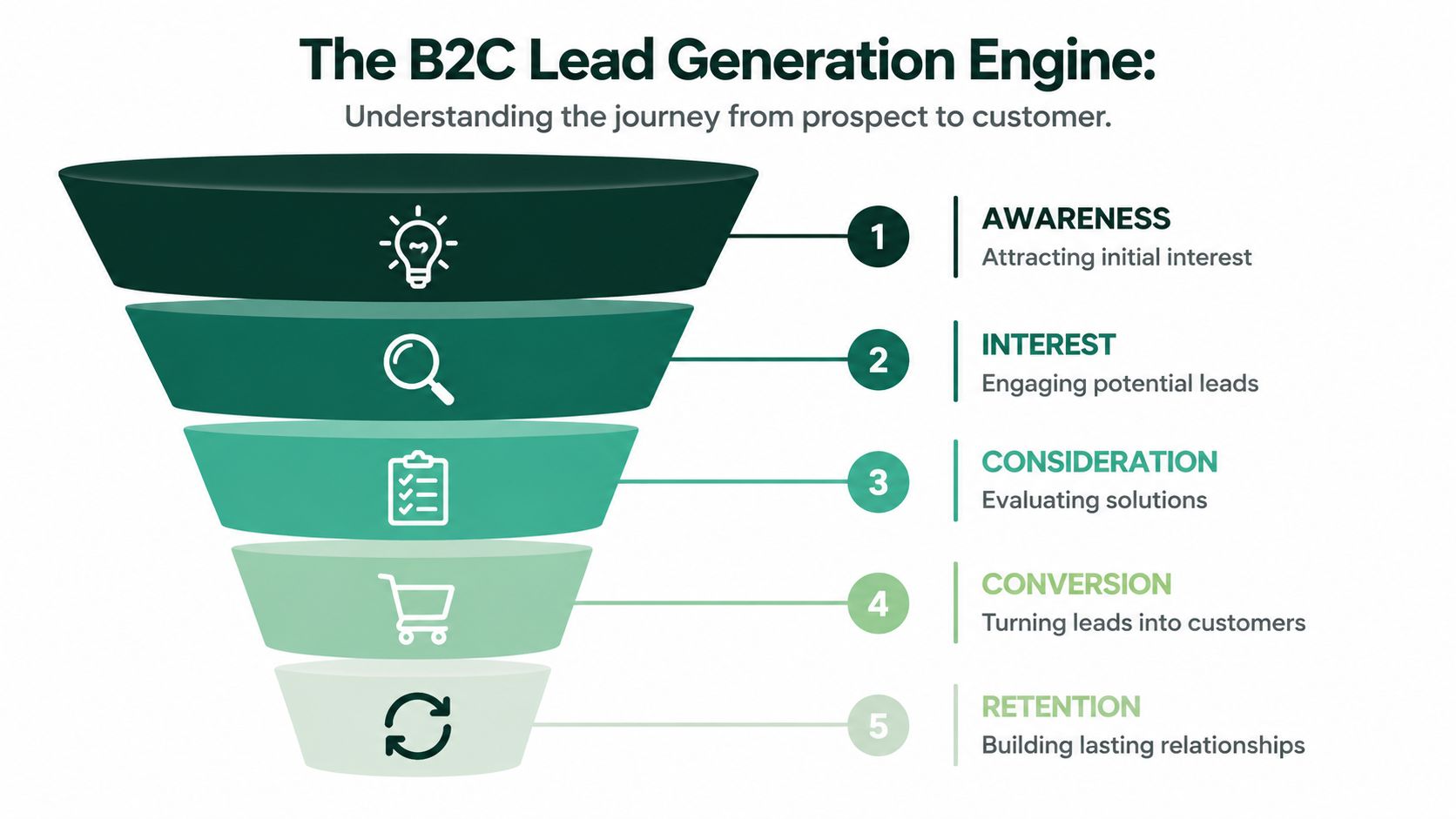
B2C works because it removes hesitation at each step. Instead of asking for major commitment up front, it creates a smooth path from awareness to action.
The easiest way to understand it is through the net-versus-spear contrast. B2B typically starts with precise targeting and deep relationship-building before any real buying intent appears. B2C starts by attracting a broader pool, then uses messaging, capture points, and nurture systems to separate casual interest from real intent.
Attract
This is the attention layer. A prospect discovers you through content, paid ads, search, referrals, social posts, or marketplace visibility.
For an agency, “attract” might be a niche landing page, a strong Upwork profile, short educational content on LinkedIn, or a lead magnet tied to a specific service problem. The core job is simple: get the right people to notice you without making them decode your offer.
Capture
Once someone is interested, you need a low-friction handoff.
That could be a lead form, a calendar link, a platform message reply, or a short qualification form. The key is to ask for only what you need at that moment. If you demand too much too early, prospects leave.
Nurture
Most leads aren’t ready the instant they engage. They need reminders, reassurance, proof, and timing.
Email sequences, retargeting, saved replies, CRM notes, and follow-up workflows perform the heavy lifting. A lot of freelancers skip this entirely. They send one message, get no reply, and move on. B2C systems assume interest fades unless you actively maintain it.
The follow-up is often the real funnel. The first touch only earns the right to continue the conversation.
Convert
Conversion is the moment of commitment. On a marketplace, that might be a reply, discovery call, or contract start. In an agency funnel, it might be a booked audit or paid pilot.
Strong conversion mechanics are usually plain, not flashy. Clear offer. Relevant proof. Direct next step. Minimal delay.
Keep the loop alive
The infographic includes retention for a reason. Good b2c lead gen doesn’t end at the first sale. It creates conditions for repeat work, referrals, upsells, and stronger targeting over time. Agencies that document why clients bought, what they valued, and what objections appeared build better acquisition systems with each cycle.
Building Your Lead Funnel Across Key Channels
B2C teams win by reducing delay between interest and action. Freelancers on Upwork and similar platforms need the same discipline, but applied to a faster, noisier environment where buyers compare five providers in ten minutes and move on.
You do not need to be everywhere. You need a channel mix that matches buyer intent, routes leads into one follow-up system, and keeps response time low.
Paid channels that reduce friction
Paid acquisition works best when the path from click to reply is short. Analysts at Databox, in their B2C lead generation strategy breakdown, found that Facebook Lead Ads can lower cost per lead by 40% to 60% compared to standard display campaigns because pre-filled forms remove extra steps and move lead data into follow-up systems quickly.
That lesson carries well beyond Facebook.
For agencies, native lead forms, short landing pages, and marketplace profile CTAs all serve the same purpose. They cut hesitation. On freelance platforms, the equivalent is a proposal that answers the client’s core concern fast and gives them one easy next action, usually a reply, a shortlist request, or a scoped call.
A practical setup looks like this:
- Use native capture when possible: Platform forms, lead ads, and short booking flows usually outperform pages with too many choices.
- Qualify with restraint: Ask only the questions that affect routing, pricing, or fit.
- Send every lead into one system: CRM, inbox, and task creation should update the moment a form is submitted or a marketplace reply arrives.
- Retarget partial intent: Clicked, viewed, or opened but did not book is still a useful audience.
The trade-off is quality control. Lower friction usually increases volume, but it can also pull in weaker leads. The fix is not adding six more form fields. The fix is better routing and faster follow-up.
Organic channels that build demand over time
Organic acquisition takes longer to mature, but it gives agencies and freelancers a stable pipeline that is less exposed to ad costs or platform swings.
The mistake is publishing broad educational content that attracts curiosity instead of buying intent. A freelancer selling conversion copy does not need another general post on marketing trends. That freelancer needs pages and articles that help a buyer decide whether to hire now, what the process looks like, how long the work takes, and what results are realistic.
Organic content also does more than rank. It gives sales assets to reuse in proposals, DMs, email nurture, and client follow-up. One well-built case study can support search, improve reply rates on Upwork, and shorten sales calls because it answers common objections before the prospect asks.
Useful content types include:
- Problem pages: Content built around a costly issue the buyer already wants fixed
- Service comparison pages: Clear explanations of when your offer fits and when it does not
- Proof assets: Before-and-after examples, mini case studies, process breakdowns
- Opt-in assets: Checklists, templates, audits, or calculators tied to a real buying decision
Direction matters here. Every asset should point toward a next action, not just educate and stop.
Email rescues delayed intent
Email still does a large share of the conversion work because many leads are interested before they are ready. Agencies feel this after webinar signups, quote requests, and paid lead form submissions. Freelancers feel it after profile views, proposal opens, and replies that go quiet.
What works is segmentation, timing, and relevance. A lead who asked about landing page redesign needs a different sequence than someone comparing retainers. A buyer who clicked pricing needs a different follow-up than one who downloaded a checklist.
Useful email sequences usually do four things well:
- Match the entry point: Follow up based on the ad, page, offer, or platform conversation that started the interaction
- Use behavior signals: Opens, clicks, page views, and prior replies should change the next message
- Keep the copy tight: Short emails with one action usually outperform longer, generic updates
- Reduce one objection at a time: Price, trust, timing, process, and scope should be handled across the sequence, not dumped into one email
If you want practical examples, review these lead generation email patterns for service businesses.
On freelance platforms, this same principle applies inside the platform inbox. Saved replies help with speed, but canned responses without context get ignored. Intelligent automation should draft follow-ups, tag lead intent, and trigger reminders. It should not make every prospect sound identical.
The best follow-up matches the question the buyer is already trying to answer.
Partnerships that borrow trust and shorten the sales cycle
Partnerships often send better leads than cold traffic because the referral carries context from the start. In B2C brands, that role is often filled by creators, affiliates, and community partners. In freelance and agency work, the equivalents are developers, designers, media buyers, consultants, and niche operators who serve the same client at a different stage.
Good partnerships share three characteristics:
- The audience overlaps: Both sides serve the same buyer profile
- The trust is real: The recommendation has weight because the partner has done good work or built credibility
- The handoff is clear: Both sides know who qualifies, how the intro happens, and what details get passed over
For example, an Upwork SEO freelancer can build a quiet but reliable channel through Shopify developers who regularly spot indexing or content issues they do not fix themselves. A branding consultant can refer paid media work to a specialist who understands launch timelines and creative testing. Those arrangements scale because the fit is clear before the introduction happens.
Partnerships need process. Shared intake notes, a simple referral form, and automatic reminders keep introductions from dying in someone’s inbox. Without that structure, even strong partner channels become inconsistent.
Measuring Success Beyond Lead Volume
A full pipeline can still be a bad pipeline.
That’s the uncomfortable truth in b2c lead gen. Volume is useful, but volume without qualification creates busywork, inflated ad spend, and sales teams that distrust marketing. One of the clearest gaps in B2C guidance is that most advice focuses on generating attention, not deciding which leads deserve attention first. G2’s lead generation statistics summary points to this blind spot directly, noting that lead qualification in B2C remains underdefined even though poor lead quality hurts pipeline and spend.
Don’t stop at top-line metrics
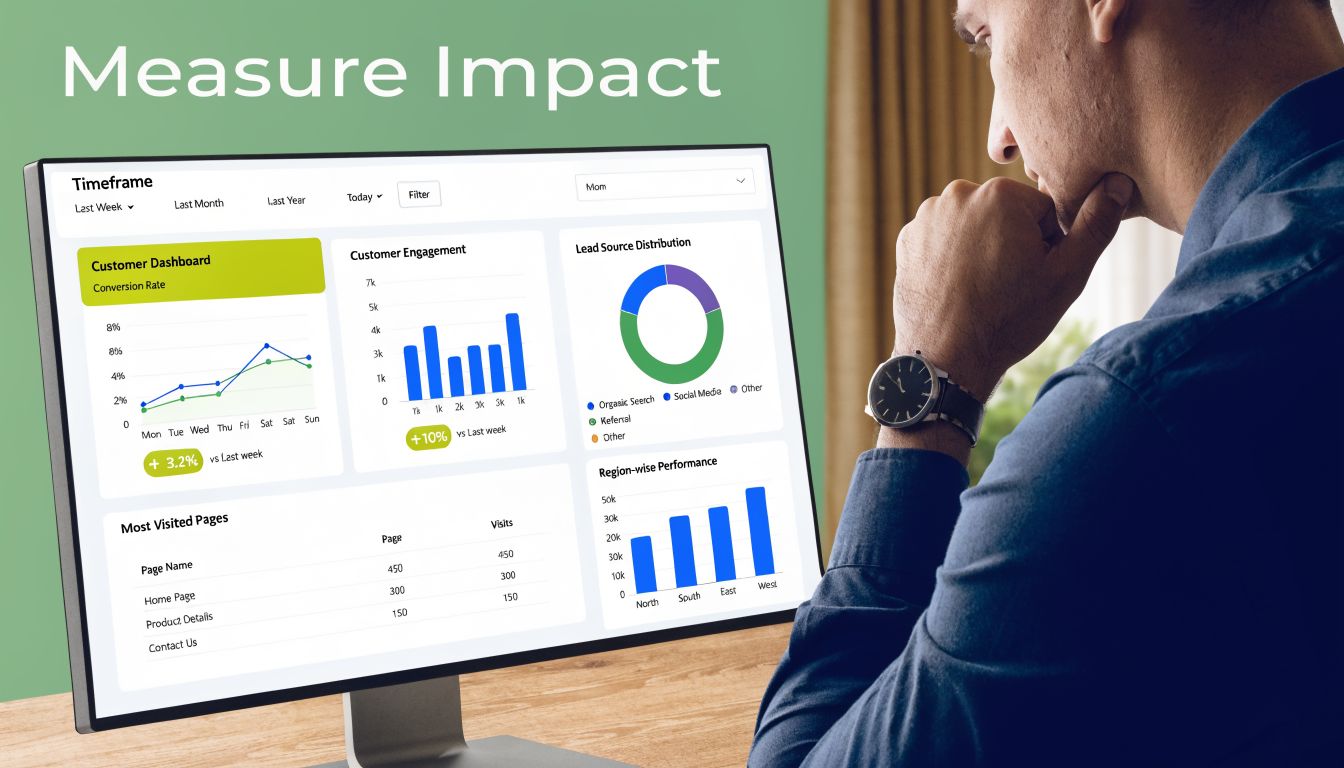
Teams typically track submissions, booked calls, and close rate. That’s a start, but it won’t tell you where quality breaks down.
A more useful measurement stack for agencies includes:
- Source quality: Which channels produce leads that reply and progress
- Lead-to-call rate: Which captured leads become real conversations
- Call-to-client rate: Which offers and segments close most often
- Sales velocity: How quickly qualified leads move from first touch to decision
- Disqualification reasons: Why bad-fit leads entered the funnel in the first place
If you don’t track disqualification, you keep buying the same bad traffic and calling it growth.
A simple qualification model for agencies
You don’t need a complicated scoring model to improve lead quality. Start with operational filters your team can apply consistently.
Use three buckets:
Fit
Can you help this lead?
Check service match, industry alignment, project type, and minimum engagement logic. If your agency serves funded SaaS companies and the inquiry is a one-off brochure site with unclear goals, that’s not a scoring debate. It’s a fit issue.
Intent
Has the lead shown real buying behavior?
Intent signals include specific problem statements, timeline urgency, pricing requests, repeat engagement, or direct replies. Vague interest without action belongs in nurture, not immediate sales effort.
Readiness
Can they move now?
Budget, internal approval, stakeholder access, and implementation timing matter. A high-fit lead with low readiness shouldn’t be discarded, but it shouldn’t receive the same immediate attention as a high-fit lead that can start soon.
Operator’s lens: Qualification isn’t about rejecting people. It’s about routing them correctly.
For teams that want a more formal process, this guide on how to qualify sales leads is a useful companion.
Define your MQL in plain language
A lot of agencies overcomplicate “marketing qualified lead.” Keep it simple. An MQL is a lead that matches your service scope, shows credible intent, and has a realistic path to engagement.
That definition should be written down. If one team member treats every inquiry as gold and another ignores anything without a budget field, your reporting won’t mean much.
Actionable Workflows for Agencies and Freelancers
Companies that win in B2C usually respond faster, ask for less upfront, and run more volume through a tighter system. Agencies and freelancers can use the same operating logic, especially on channels where buyers skim, compare, and move on within minutes.
What changes is the setting, not the mechanics. A service business still needs relevance and trust. But in high-velocity environments such as Upwork, lead generation works better when the path from attention to reply is short, the message is easy to act on, and follow-up happens without relying on memory.
Solo freelancer with a lean setup
A solo operator rarely has a traffic problem first. The usual problem is friction.
Start with one offer tied to one buyer pain point, then give that buyer one easy next step. That could be a short intake form, a booking link, or a marketplace profile built around a narrow outcome. Broad positioning creates extra decisions for the prospect and extra work for the seller.
A practical solo workflow looks like this:
- Publish one focused offer: “Email automation for Shopify stores” converts better than “done-for-you marketing.”
- Use one primary acquisition channel: Pick the place where your buyers already ask questions or compare providers.
- Keep capture simple: Ask for contact details, business type, and the core problem. Save the rest for the call.
- Send a short follow-up sequence: Share one proof point, one process explanation, and one clear invitation to continue.
- Tag outcomes from the start: Interested, later, bad fit, and referral are enough for an early system.
That setup protects attention, which is the freelancer’s scarcest resource. It also gives you enough structure to see patterns before you add tools.
Small agency ready for paid acquisition
Paid acquisition works after the offer is clear and the handoff process is stable. If the team still debates who should respond, what to send, or how to route inquiries, paid spend just increases the mess.
A simple agency workflow often includes a paid social campaign, a native lead form, CRM routing, and immediate nurture. The point is speed. If someone raises a hand, the system should acknowledge, sort, and progress that lead the same day.
Use a workflow like this:
- Run one offer per campaign: Buyers respond better to a specific promise than a bundle of unrelated services.
- Use native forms where speed matters: Fewer steps usually means more completed submissions.
- Route by service line or account owner: Keep ownership clear from the first touch.
- Trigger follow-up immediately: Email, task creation, and reminders should fire as soon as the lead enters the system.
- Review lead quality weekly: Look at what entered the pipeline, what stalled, and which source keeps sending poor-fit inquiries.
For teams building that system, a practical guide to AI for sales prospecting can help reduce manual triage without making outreach feel templated.
Freelance platforms as B2C lead environments
Mainstream B2C advice proves surprisingly useful for freelancers in this scenario.
Upwork and similar platforms reward speed, message clarity, and low-friction response. Buyers post a need, scan several options, and shortlist fast. The underlying service may be complex, but the buying behavior often looks closer to B2C than traditional agency sales.
That means the workflow should prioritize fast pattern recognition and controlled personalization.
- Filter hard before you write: Skip weak-fit jobs, vague scopes, and low-probability budgets.
- Build modular proposal blocks: Keep reusable components for opening, proof, delivery approach, and CTA.
- Personalize the high-value lines only: Focus on the prospect’s problem, the likely risk, and the immediate next step.
- Follow up on strong-fit opportunities: A second message often matters when the client is reviewing several similar proposals.
- Track reply patterns: Note which hooks earn responses, which project types close faster, and which objections repeat.
There is a trade-off here. More personalization can improve reply rates, but slower response often costs you visibility on freelance platforms. Strong operators solve that by standardizing everything except the few lines the buyer notices.
A freelancer who identifies fit fast, sends a relevant proposal quickly, and follows up on schedule is using B2C lead generation principles in a market that rewards them.
Scaling Outreach with Intelligent Automation
At some point, manual effort becomes the bottleneck. Not strategy. Not offer quality. Not positioning. Just throughput.
That’s where intelligent automation starts to matter in b2c lead gen. Not because every process should be automated, but because high-velocity environments punish delay. If your system relies on someone checking notifications, rewriting similar messages, and remembering to follow up later, speed drops first and consistency drops right after.
Automation does more than save time
A lot of teams justify automation on labor savings alone. That’s too narrow.
The better case is operational quality. Automation helps teams search continuously, standardize qualification logic, trigger fast responses, personalize from structured inputs, and keep leads moving after first contact. In other words, it helps you execute the B2C model with fewer dropped balls.
For agencies and marketplace sellers, useful automation usually shows up in five places:
- Lead discovery: Monitoring relevant opportunities without manual refreshing
- Initial drafting: Building first-pass outreach from templates and lead data
- Routing: Assigning leads by service line, account owner, or priority
- Follow-up: Sending reminders and nudges when humans would forget
- Analytics: Showing which inputs produce replies, calls, and wins
Speed matters, even when the benchmark data is incomplete
There’s an important nuance here. Speed is widely treated as an advantage in competitive bidding and lead response, but there’s still a gap in published B2C research on the exact relationship between response time and win rates. That gap is highlighted in Scaling With Systems’ discussion of B2C lead generation tips, which notes that the literature doesn’t establish hard best-practice benchmarks for response speed in these contexts.
That doesn’t mean speed is irrelevant. It means teams should stop pretending generic industry research has already answered the question.
The practical move is to build your own benchmark. Track reply rate, meeting rate, and close quality against your response patterns. If your agency replies faster on one segment and consistently books more calls there, that becomes your operating truth.
A useful companion for this is a broader look at AI for sales prospecting in modern outreach systems.
After the systems are in place, training matters just as much as tooling.
Where teams over-automate
The risk isn’t automation itself. It’s automating the wrong layer.
Don’t automate positioning. Don’t automate offer clarity. Don’t automate qualification rules you haven’t defined. Automation performs best when the process is already sound and the machine is handling repetition, not replacing judgment.
Use humans for deciding who to target, what problems matter, and what proof is credible. Use automation for everything that slows those decisions down.
Putting Your B2C Lead Gen Plan Into Action
B2C lead gen works because it respects how modern buyers behave. They move quickly, compare options fast, and ignore unnecessary friction. Agencies and freelancers who adapt to that reality build stronger pipelines than those who rely on slow, handcrafted outreach alone.
The shift is straightforward. Capture interest with less friction. Nurture with relevance. Qualify with discipline. Respond fast enough that intent doesn’t cool off. Then use automation where consistency and speed matter more than manual effort.
Don’t try to rebuild your entire system this week.
Audit one part of your funnel instead. Find the step where prospects hesitate, disappear, or wait too long. Then remove that friction point. Sometimes the most effective growth move isn’t adding another channel. It’s making the next step easier.
Frequently Asked Questions About B2C Lead Gen
How do I handle low-quality leads without killing volume
Don’t solve this by shutting off top-of-funnel activity too early. Solve it by improving routing.
Create a simple qualification layer based on fit, intent, and readiness. Then separate leads into immediate sales follow-up, nurture, and disqualify. That keeps volume flowing while protecting your team’s time. If too many bad-fit leads are entering, tighten your offer language and targeting before you blame the channel.
Can I start b2c lead gen with almost no budget
Yes. Start with one niche offer, one capture path, and one follow-up sequence.
For most freelancers, that means:
- One clear service page or profile message: Make the value obvious fast.
- One content channel: Publish where your buyers already pay attention.
- One nurture path: Use email or platform follow-up to stay in touch.
- One tracking habit: Record why leads replied, ghosted, or converted.
A low-budget system can outperform an expensive messy one. Precision and consistency matter more than channel count.
Is b2c lead gen different for services than for products
Yes, but the mechanics still transfer.
Products often rely on broader demand capture and simpler purchase decisions. Services need more trust, more proof, and clearer expectations. That means your version of b2c lead gen should emphasize fast relevance, low-friction inquiry capture, and stronger nurture rather than trying to force instant purchase behavior.
For service businesses, the playbook is usually:
- Lead with the problem solved
- Show proof early
- Make the next step simple
- Follow up more than once
- Qualify before heavy sales effort
The businesses that win aren’t always the loudest. They’re usually the easiest to understand and the easiest to engage.
If you want to apply these ideas inside Upwork without building the whole system manually, Earlybird AI helps agencies and freelancers run faster, lower-friction outreach with personalized proposals, automated replies, follow-up workflows, and analytics built for high-velocity client acquisition.