← Back To Blog
Finding the Best Proposal Writing Software to Win More Deals
The right proposal writing software can do more than just clean up your workflow. It automates the grunt work, helps you personalize your outreach, and frees you up to focus on what actually makes you money: billable client work. In fact, the best tools can slash the time it takes to create a proposal by over 40%, letting you bid on more projects and land more clients without cutting corners.
Why Manual Proposal Writing Is a Losing Strategy

If you're a freelancer or run an agency, you know the feeling all too well: staring at another blank proposal document, about to start the tedious copy-paste-tweak cycle all over again. This old-school approach isn't just slow—it's a direct brake on your earning potential. Every hour you spend wrestling with a document is an hour you can't bill.
This is especially true on competitive platforms like Upwork, where the early bird gets the worm. The best projects often get flooded with bids in the first hour. If your process is bogged down, you've missed your shot before you even start, no matter how perfect you are for the job.
The Hidden Costs of the Manual Method
Time is the most obvious cost, but the real dangers are deeper. When you're rushing to get a proposal out the door, mistakes are bound to happen. Forgetting to swap out the last client's name, leaving in an irrelevant project detail, or even a simple typo can make you look sloppy and get your bid tossed in the trash.
This messiness only gets worse as you grow. The administrative weight of manual proposals quickly becomes too much to handle, forcing you into a tough spot: either turn down good leads or compromise the quality of your work to keep up.
Manual proposal creation isn't just inefficient—it's a high-risk activity that exposes your business to preventable errors, missed opportunities, and a hard cap on your growth potential.
It’s no surprise, then, that the proposal management software market is booming. Valued at USD 2.33 billion in 2022, it's expected to hit USD 5.81 billion by 2030. This explosion is driven by businesses, especially in competitive fields like IT and consulting, that simply can't afford to stick with outdated methods. Companies that make the switch are seeing real results, like 45% shorter proposal cycles and 38% higher accuracy. You can discover more insights about the proposal software market and its impact.
Moving Beyond the Blank Page
At the end of the day, sticking with manual proposal writing is a losing game in a world that values speed, accuracy, and a personal touch. It keeps you stuck in a reactive cycle, constantly chasing deadlines instead of thoughtfully growing your client list.
To break free, you need a tool that does more than just shuffle documents. You need a system that can:
- Automate all the repetitive, mind-numbing tasks.
- Make sure every single proposal speaks directly to the client's needs.
- Give you the data and analytics to actually improve your win rate.
Adopting the right software lets you shift your energy from tedious paperwork to high-value work like client strategy and execution. It’s the single most important step you can take to build a more efficient, profitable, and scalable business.
What to Look for in Proposal Writing Software
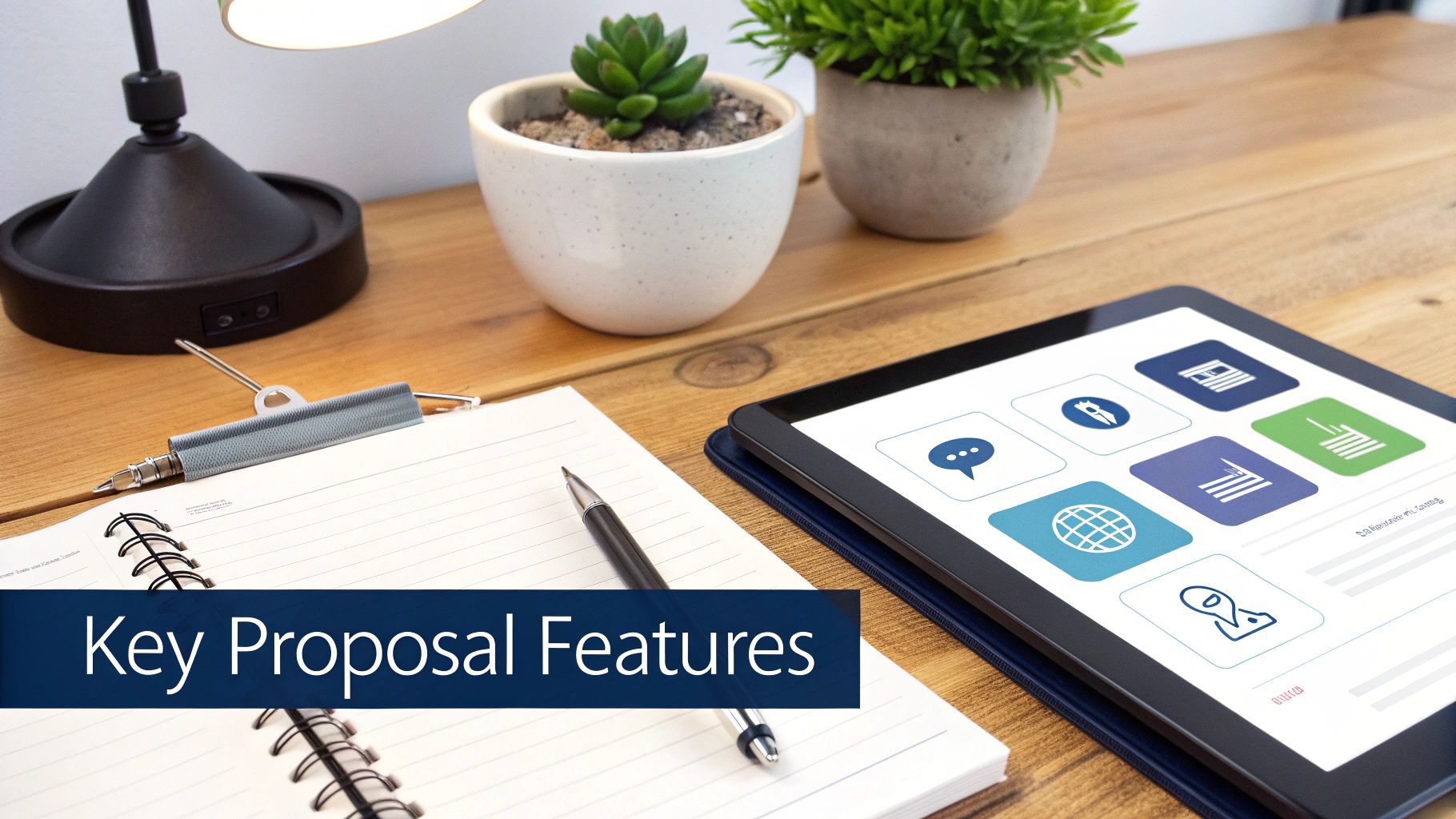
Choosing the right proposal software isn't about finding the one with the longest feature list. It's about finding a tool that solves real problems—the ones that are actually holding back your win rate and eating up your time. Before we jump into a head-to-head comparison, let's establish a clear framework for what really matters.
This framework is your filter. It helps you cut through the marketing hype and zero in on the capabilities that will actually move the needle for your business. A good evaluation boils down to four critical areas that separate a glorified document editor from a genuine business development engine.
AI-Powered Personalization and Content Generation
This is the biggest game-changer in proposal software today: the shift from stale templates to dynamic, AI-driven content. Clients can spot a generic, copy-pasted proposal from a mile away, and they almost always ignore it. Real personalization means the software can digest a job description and spit out a relevant proposal that speaks directly to the client's needs.
The best tools don't just fill in blanks; they learn from your past wins. Look for software that can absorb your unique voice, your go-to project examples, and your specific expertise, then weave that into its suggestions. The result is an authentic, compelling bid that feels custom-written, even if it only took you minutes to create.
A key differentiator here is moving beyond basic "mail-merge" personalization. The best AI acts like a strategy partner, suggesting fresh angles and framing your strengths in a way that resonates with each specific opportunity.
Robust Automation and Workflow Integration
Automation is what gives you your time back. A great tool should streamline the entire bidding process, from flagging relevant jobs to sending the final proposal and even handling the follow-ups. This is how you stop drowning in admin work and start focusing on the billable stuff.
Seamless integration is non-negotiable. Your proposal software absolutely has to play nice with the platforms you live in, especially marketplaces like Upwork or your CRM. This creates a single, connected workflow where information moves automatically, killing off manual data entry and the errors that come with it. For agencies, this synergy is everything; check out our guide on essential software for a digital marketing agency to see how these tools fit together.
Platform Safety and Compliance
Whenever you connect a third-party tool to your business accounts, security has to be front and center. This is especially true for platforms like Upwork, which have strict rules. The best proposal software is built from the ground up with compliance in mind, taking deliberate steps to protect your account's good standing.
Here are the safety features that really count:
- Human-like behavior: The software should operate in a way that mimics natural user activity to avoid tripping any automated security flags.
- Clean, regional IPs: Using dedicated and secure connections helps maintain a trustworthy digital footprint.
- No credential storage: A reputable tool will never store your sensitive login information, like your password, on its servers. Period.
Stick with providers who are transparent about their security protocols. It’s the only way to get peace of mind and protect your account for the long haul.
Insightful Analytics and Performance Tracking
You can't improve what you don't measure. One of the most critical functions of any modern proposal tool is to give you clear, actionable data on your outreach. Basic analytics might show you if a proposal was opened, but the really powerful platforms go much, much deeper.
Look for software that tracks the KPIs that matter: reply rates, win rates, and your average time-to-close. This data is gold. It shows you exactly which parts of your proposal are landing and which are falling flat. With that knowledge, you can double down on what works and fix what doesn’t, driving a much higher return on your efforts.
Alright, let's break down the top proposal tools. It's time to get past the marketing hype and look at what actually works, whether you're a one-person shop on Upwork or a growing agency.
The best tool isn't about having the longest feature list. It’s about how those features solve your specific problems and fit into your day-to-day workflow. This isn't a one-size-fits-all situation, so we're going to compare these platforms head-to-head to see where they really shine—and where they fall short.
Earlybird AI: The Upwork Automation Specialist
Earlybird AI isn't your typical proposal builder. It was built from the ground up for one specific job: winning projects on competitive freelance marketplaces like Upwork. Think of it less like a document editor and more like a dedicated sales engine that gets you in the door before anyone else.
Its real magic is in its intelligent automation. You connect Earlybird to your Upwork account, give it a simple thumbs-up or thumbs-down and a brief sentence on jobs it finds, and it quickly learns what you’re looking for. From there, it just runs, finding the best projects and writing highly personalized proposals using your voice.
- AI Personalization: The AI here is smart. It doesn't just slot a name into a template; it reads the job post, figures out what the client actually needs, and then highlights your most relevant skills and projects. The result is a proposal that feels like you wrote it yourself, which is exactly what you need to stand out.
- Automation Depth: This is where it leaves other tools in the dust. It can find a job and submit a proposal within 10 minutes of it being posted. It even handles initial client messages in under 5 minutes. On a platform like Upwork where the first few proposals get all the attention, that speed is a game-changer.
- Ideal User: This is a no-brainer for freelancers and agencies whose lifeblood is Upwork. If your main goal is to automate the most time-consuming part of your sales process on that platform, Earlybird is purpose-built for you.
For any business that relies on platforms like Upwork for growth, a specialized tool like Earlybird AI delivers a competitive advantage that general, all-in-one proposal platforms simply can’t offer.
PandaDoc: The All-in-One Document Workflow Hub
PandaDoc is a heavyweight in the document world, and it's earned that reputation. It’s a comprehensive platform that goes way beyond just proposals—it handles quotes, contracts, e-signatures, and more. It’s a favorite for established businesses that need a central command center for their sales documents.
Where Earlybird AI is a scalpel, PandaDoc is a Swiss Army knife. Its power lies in managing the entire document lifecycle for sales teams that are selling across multiple channels, not just a single marketplace.
The platform is loaded with features designed to be the single source of truth for sales documents. The content library is a huge plus, letting teams save and reuse approved proposal sections, which keeps branding consistent and numbers accurate.
PandaDoc’s analytics are also pretty sharp. You can see when a client opens your proposal, how long they spend on each section, and when they sign. That kind of intel is gold for timing your follow-ups. The catch? Its automation is built for internal workflows—getting approvals, routing documents—not for outbound prospecting on a platform.
- AI Personalization: PandaDoc uses AI to help you create documents faster from inside its editor, but it doesn't have the market-specific job analysis that makes a tool like Earlybird so effective for Upwork.
- Automation Depth: It's all about streamlining your internal processes. Think routing a contract to legal, not automatically finding and applying for new jobs.
- Ideal User: A great choice for mid-sized to large sales teams that need one robust system to manage a high volume of different sales documents and want deep integration with their CRM.
The proposal software space is definitely shifting toward specialization. We're seeing AI-driven personalization jump by 41% in adoption, while 67% of organizations still lean on template-based automation. Finding a tool that can cut your proposal cycle by 30%-45% is a huge win for any agency owner. You can learn more about proposal software market trends and see how the right integrations can improve accuracy by as much as 38%.
Proposify: The Design-Forward Proposal Creator
Proposify has carved out its own space by focusing on one thing: helping you create beautiful, professional-looking proposals that are impossible to ignore. If the look and feel of your documents are a critical part of your sales pitch, Proposify has one of the best and most intuitive design experiences out there.
It’s really made for sales teams who need to make a strong visual impression. With a drag-and-drop editor and a huge library of slick templates, you can crank out stunning proposals without needing to bring in a graphic designer.
Proposify’s value isn't in automated outreach like Earlybird or in all-in-one document management like PandaDoc. Its value is in the final artifact—the proposal itself. It’s brilliant for keeping brand standards locked down and gives you solid metrics on how clients are engaging with your documents.
It does integrate with the major CRMs to pull in contact and deal information, but its automation is mostly focused on the design and internal approval parts of the process.
- AI Personalization: Proposify is more about content management and design consistency. It’s not really playing in the advanced, AI-driven text generation space.
- Automation Depth: The platform is great at automating things like content reuse and branding but won't help you automate finding leads or sending that first proposal.
- Ideal User: A perfect match for creative agencies, marketing firms, and any sales team where a visually impressive proposal is half the battle.
At the end of the day, picking the best proposal writing software comes down to how your business actually operates. If you're all-in on a platform like Upwork, a specialist like Earlybird AI is in a league of its own. For managing complex sales documents across many channels, PandaDoc is a powerhouse. And if you win business with beautiful design, Proposify is the clear leader.
Choosing the Right Software for Your Business Model
Finding the right proposal writing software isn't about ticking off the most features on a list. It’s about finding the right features for how you actually run your business. A solo freelancer grinding on Upwork has a completely different set of needs than a growing agency with a dedicated sales team.
Making the right choice comes down to matching a tool's core strengths with your primary goals, whether that's lightning-fast submission or sophisticated workflow management. The wrong tool just creates friction and wastes time. An agency trying to use a freelancer-focused app will hit a wall with collaboration, and a freelancer paying for enterprise-level features is just burning cash.
For the Solo Freelancer on Upwork
When you’re a one-person shop, your time is your money. Every minute you spend on admin is a minute you aren't billing clients. Your whole game is about speed, efficiency, and getting a high-quality proposal in front of a potential client before everyone else does.
This means the best proposal writing software for you has to nail two things: smart automation and high-quality AI content generation. You need a system that finds the right jobs for you and then helps you write a compelling, personalized proposal with minimal effort.
Here's what to look for:
- Automated Job Sourcing: The software should be your eyes and ears, constantly scanning platforms like Upwork for gigs that fit your skills so you can stop scrolling.
- Rapid, AI-Powered Proposal Writing: The tool must be able to digest a job description and spit out a highly relevant, personalized proposal in minutes.
- Simplified Interface: You don't need a cockpit full of confusing dashboards. You need a clean, straightforward way to review, tweak, and send your bids.
For freelancers, the right tool acts like a personal sales assistant, working 24/7 so you can focus on what you do best—the actual client work.
For the Growing Agency with a Sales Team
The moment you start hiring, the game changes. Speed is still on the table, but now you’re juggling team collaboration, keeping your brand consistent, and tracking performance. Your proposal software has to grow with you and support these new demands.
An agency needs a tool with robust workflow management and deep analytics. You're not just sending one-off proposals anymore; you're managing a sales pipeline, making sure everyone on the team sounds like they work for the same company, and figuring out which strategies are actually closing deals.
This decision tree shows exactly how these priorities diverge.
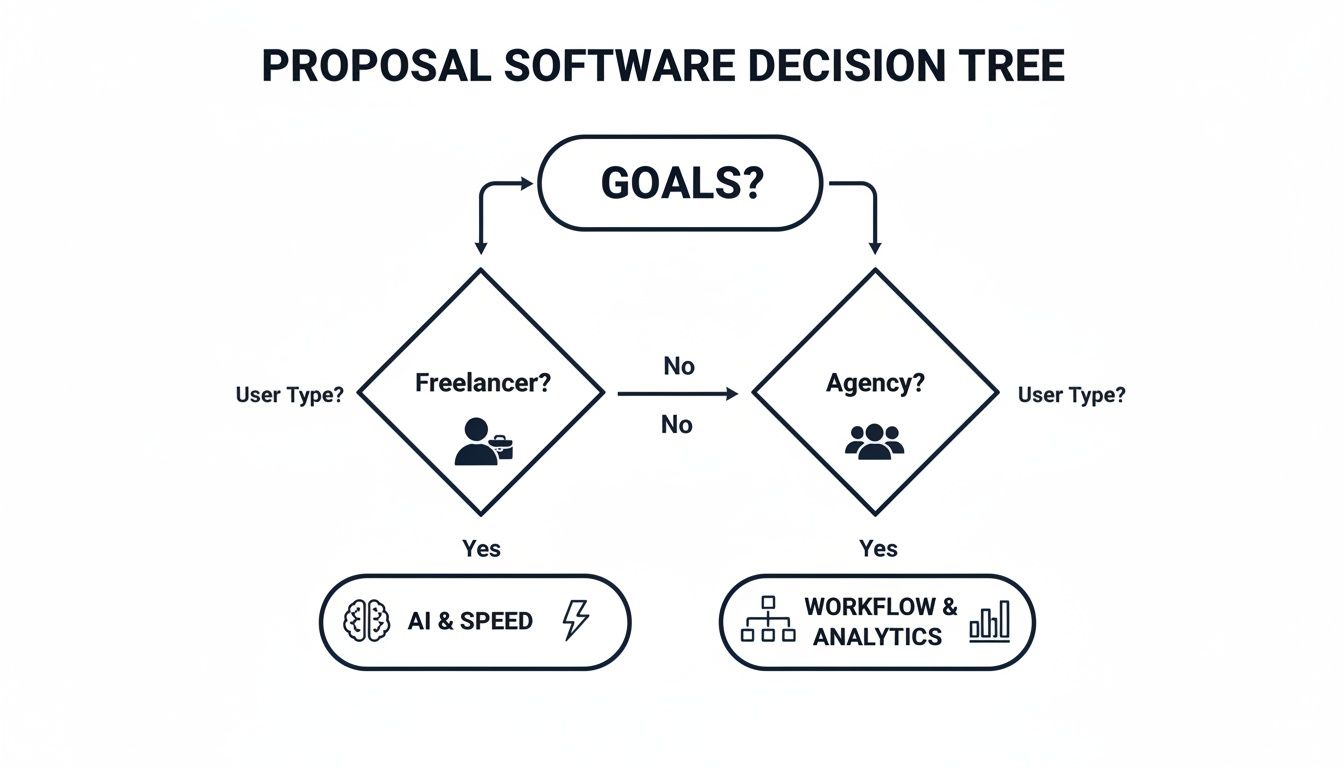
As the chart shows, both freelancers and agencies want to win more work, but the path to get there requires different features depending on your business's scale and complexity.
Choosing software is a strategic investment in your business model. Freelancers should invest in speed and AI leverage, while agencies must invest in systems that support scale, consistency, and data-driven decisions.
The market data backs this up. Small and mid-sized businesses, especially in IT and marketing, are adopting these tools faster than anyone. And it’s paying off: over 72% of enterprises using proposal tools report that their proposal cycles are now 30%-45% faster. At the same time, AI adoption for personalization has shot up 41%, leading to 38% greater accuracy in proposals—a game-changer for freelancers who need to scale. You can explore more data on the proposal software market to see these trends for yourself.
In the end, knowing your business model is the first and most important step. It turns a confusing feature comparison into a focused search for a tool that solves your biggest problems and plays to your strengths.
Getting the Most Out of Your New Proposal Software

Just buying a subscription to a top-tier proposal tool won't automatically fix your sales process. The real magic happens when you thoughtfully weave it into your daily operations. The goal is to make it more than just another piece of software; you want it to become a core part of how you generate revenue, starting from day one.
A sloppy rollout is a recipe for a wasted investment. To avoid this, you need a plan. It's not just about learning the features—it's about setting clear objectives, training the system to work for you, and syncing it with the tools you already rely on. This is how you build a smooth, efficient sales engine instead of letting another subscription gather dust.
Your Four-Step Implementation Checklist
Follow this checklist to turn your shiny new software into a workhorse for your business. Each step builds on the last, creating a solid foundation for real, measurable results.
- Set Clear, Measurable Goals: Before you touch a single setting, define what winning looks like. Do you want to increase proposal output by 50%? Or maybe you’re aiming to get your client reply rate above 15%? Setting specific numbers gives you a clear benchmark for success.
- Train the AI With Your Greatest Hits: An AI is only as good as what you teach it. You need to feed it your best work—the proposals that landed you those game-changing contracts. This trains the system on your unique style, voice, and the specific selling points that click with your target clients. Remember, providing feedback is an ongoing process that keeps the AI sharp.
- Integrate It Into Your Workflow: This tool should save you time, not create extra steps. Connect it directly with the platforms you live in, whether that’s a freelance marketplace like Upwork or your company's CRM. A solid integration means data flows automatically, cutting out tedious manual entry and giving you a single, unified view of your pipeline.
- Track Analytics and Keep Tweaking: Your work isn't finished once you're up and running. Get comfortable with the analytics dashboard. Are you hitting the goals you set in step one? Use the data to see what’s landing and what's falling flat. If one proposal template is outperforming others, lean into it. If you're consistently bidding on jobs that go nowhere, it’s time to rethink your targeting. For some great ideas, check out these powerful examples of job proposals that really work.
From Software Purchase to Business Asset
This methodical approach is what separates the people who see a small bump in efficiency from those who see a massive leap in growth. It’s a constant cycle of learning and refining. The most successful agencies and freelancers I know don't just use their proposal software—they treat it as a dynamic part of their sales strategy.
Successful implementation is an active process. By setti ng clear goals, training the AI, integrating workflows, and continuously analyzing performance, you transform a software subscription into a predictable and scalable revenue stream for your business.
Every proposal you send is a new data point. Every client reply is a lesson learned. Every insight from the analytics helps you sharpen your edge for next time. This feedback loop is what drives real improvement and ensures your investment pays for itself over and over, freeing you up to focus on what you do best: delivering amazing work for your clients.
Winning Proposals Are Automated, Not Just Written
If there's one thing to take away from all this, it's that moving past manual proposal writing isn't just about getting ahead anymore—it's about survival. The best tool for the job is always the one that fits your business like a glove and fixes your most glaring problems, whether you’re a one-person shop or a rapidly expanding agency.
In high-speed marketplaces like Upwork, speed and a personal touch make all the difference. Sticking to old-school methods means you're actively choosing to leave money on the table and stunt your own growth. Smart automation is how you build an outreach system that can actually scale.
What’s Around the Corner for Proposal Tools
These platforms are evolving fast. We're already seeing the beginnings of some seriously powerful features that will completely change how we close deals. Keep an eye on these trends:
- Predictive Analytics: Imagine AI scanning job posts and client histories to tell you which leads you have the highest chance of winning. This isn't science fiction; it's the next step in focusing your energy with laser-like precision.
- Smarter AI Integration: Soon, AI will manage even more of the sales process. Think initial discovery chats, scheduling, and follow-ups, all happening in the background to create a nearly autonomous prospecting engine. We dive deeper into how sales automation is changing the game in another one of our guides.
The future isn't just about automating tasks; it's about using systems that deliver strategic insights, turning your outreach from a guessing game into a data-driven science.
At the end of the day, success comes down to taking a hard, honest look at your current workflow. A tool built specifically for the job, like Earlybird AI, can completely overhaul your sales efforts and unlock consistent, predictable growth.
Frequently Asked Questions
Jumping into proposal automation naturally brings up some big questions. You're probably wondering about security, how much time you'll actually save, and whether an AI can truly capture your voice. These are the right questions to ask. Let's tackle them head-on so you can feel confident choosing the right tool.
Is It Safe to Use Proposal Software with Platforms like Upwork?
This is the most critical question, and the answer is yes—if you choose the right tool. Legitimate proposal software is built with platform compliance as a top priority. They work hard to protect your account by mimicking human behavior, using clean regional IPs to avoid flagging security systems, and never storing sensitive info like your password.
The key is to pick a provider that’s transparent about their safety measures. They should operate in a way that protects your account's good standing, not put it at risk.
How Much Time Can Proposal Automation Realistically Save?
The time savings can be massive. Most users report cutting their proposal writing time by 30-45%. If you’re an active freelancer or agency, that can easily add up to several hours back in your day, every single day.
Good automation software handles the entire grind for you—it finds the right jobs, writes a personalized proposal, and sends it off within minutes. This frees you up to focus on what actually makes you money: client work and growing your business.
The real win with automation isn't just about speed. It's about shifting your energy. When you cut out hours of tedious, repetitive work each week, you can move from low-value admin tasks to high-value activities that actually drive revenue.
Will AI-Generated Proposals Sound Authentic?
It's a fair concern. Nobody wants to sound like a robot. Thankfully, modern AI has moved way past generic, cookie-cutter templates. The best proposal software learns from your winning proposals and your unique writing style.
Look for systems with a feedback loop. This feature lets you constantly train the AI to better match your tone and highlight your specific skills. The end result is a highly personalized proposal that sounds like it came straight from you and genuinely connects with the client.
Ready to stop writing proposals and start winning them? Earlybird AI acts as your 24/7 sales team on Upwork, finding the perfect jobs and sending personalized proposals in minutes so you never miss an opportunity. See how our automation can transform your outreach and drive real growth.