
← Back To Blog
Business Plan for SEO Company: Winning Business Plan For

You're probably in one of two situations right now. You know SEO well enough to get results, but your agency still feels like a freelance hustle with a nicer logo. Or you're about to launch, staring at a blank document labeled business plan for SEO company, wondering how to turn audits, content briefs, and client calls into a real business.
Most agency plans fail because they read like a service list. They talk about rankings, traffic, and deliverables. They don't explain how the agency will make money, how clients will measure return, or how the founder will avoid becoming an underpaid operator inside their own company.
That's the mistake I'd fix first.
Beyond Traffic: Crafting Your Revenue-First SEO Plan
Most SEO business plans are weak because they worship traffic. Traffic is useful. Traffic alone doesn't pay payroll, fund hiring, or keep clients from churning. If your plan doesn't connect SEO work to leads, appointments, and closed revenue, you're not writing a business document. You're writing a fantasy.
The gap is bigger than most founders admit. Most SEO business plan guides neglect the critical angle of building a revenue-first SEO stack that directly ties organic traffic to booked appointments and sales, a failing evident given that 73% of small business owners report their SEO efforts fail to generate measurable revenue due to poor conversion tracking and lack of intent-based content (Small Business Expo on SEO marketing for small business).
Start with the only question that matters
When a prospect asks what your agency does, don't say “technical SEO, content, and link building.”
Say what the work is supposed to produce.
A revenue-first agency says things like:
- For local businesses: more calls, booked jobs, and map visibility
- For B2B firms: more qualified demos from commercial-intent pages
- For SaaS companies: more pipeline from comparison, solution, and use-case content
- For service businesses: more forms, calls, and consultation requests from search
That framing changes everything. It changes how you package services. It changes who you hire. It changes what you report every month.
Practical rule: If a deliverable can't be connected to pipeline, booked calls, or sales opportunity creation, it shouldn't sit at the center of your business plan.
A lot of founders need a model before they can write clearly. If you want one strong reference point, this blueprint for marketing agencies is useful because it pushes you to think like an operator, not just a technician.
Build your plan around business math, not channel jargon
Your business plan should answer five blunt questions:
- Who pays you?
- What exact outcome are they buying?
- How long does that outcome usually take?
- What delivery model protects your margin?
- How do you prove progress before final ROI lands?
That last point is where most agencies lose trust. Founders obsess over rank trackers but ignore conversion tracking, CRM visibility, and sales attribution. Then a client says, “We got more traffic, but did it produce anything?” and nobody has a clean answer.
That's why your plan should include a revenue model for clients and for your agency. If you need a simple breakdown of service economics, recurring revenue, and margin logic, this guide on how marketing agencies make money is worth reviewing before you finalize pricing.
What a revenue-first plan actually looks like
A strong business plan for an SEO company includes:
- Offer design tied to buyer intent
- Measurement tied to leads and sales activity
- Retention strategy tied to realistic timelines
- Pricing tied to business value, not task volume
- Niche positioning that makes referrals and outbound easier
Stop trying to impress people with how many tactics you know. Investors, partners, and serious clients care about one thing. They want to know whether your agency can repeatedly turn search demand into revenue.
That's the foundation. Everything else sits on top of it.
Defining Your Agency Identity and Core Mission
Most founders write this part like they're applying for a bank loan in 1998. They stuff it with generic lines about excellence, innovation, and customized solutions. None of that helps.
Your agency identity should be sharp enough that a prospect can decide in a few seconds whether you're relevant. If your positioning could belong to any other SEO shop, it's too broad.
Write the executive summary like a sales memo
Your executive summary should fit on one page. Shorter is usually better. It needs four parts.
- Who you serve: Be specific about the kind of company you want. Local home services. B2B SaaS. Multi-location healthcare. Law firms. Pick one if you're early.
- What problem you solve: Don't say “visibility.” Say “low lead volume from search,” “weak non-brand pipeline,” or “poor local map presence.”
- What you deliver: Keep this practical. Revenue-focused content, technical fixes, local SEO systems, reporting tied to sales outcomes.
- Why clients should trust your model: This can be your founder background, your niche experience, your reporting discipline, or your process.
Here's the simplest test. If someone deletes your agency name and swaps in another one, would the summary still work? If yes, rewrite it.
Define your mission with a filter, not a slogan
Your mission isn't wall art. It's a filter for decisions. It should help you say yes to the right clients and no to the wrong ones.
A useful mission statement does three jobs:
- It clarifies the market you want to own
- It defines the business outcome you care about
- It sets the operating standard for delivery
For example, a practical mission might focus on helping local service businesses turn search demand into booked jobs through high-intent pages, local visibility, and conversion tracking. That's concrete. Your team can act on it.
Agencies get in trouble when the mission is broad but the resources are thin. A focused mission creates better offers, cleaner marketing, and easier hiring.
Use client filters before you write the company description
Before you describe your agency, describe the clients you refuse to serve.
That sounds harsh, but it saves you. Early-stage agencies waste months on bad-fit accounts because they're afraid to narrow down. Then they end up doing random work for random industries with random expectations.
Use these filters:
- Budget fit: Can this client afford ongoing work without treating every invoice like a negotiation?
- Timeline fit: Will they stay long enough for SEO to work?
- Operational fit: Do they have someone who can approve content, implement changes, and respond on time?
- Goal fit: Do they care about revenue, or are they addicted to vanity metrics?
- Ethics fit: Will they push you toward spam, shortcuts, or bad reporting?
Draft the company description in plain English
Your company description should answer these prompts:
- What kind of SEO agency are you?
- Which market do you serve best?
- What makes your delivery model different?
- Why are you built to win in that segment?
Don't overthink it. A strong version might sound like this in structure: a niche SEO agency serving one market, focused on generating measurable business outcomes through local SEO, commercial content, technical execution, and reporting tied to leads and sales.
That's enough. You don't need corporate theater.
Packaging Your SEO Services for High Value and Clear ROI
Clients don't buy “SEO.” They buy a path from their current mess to a better commercial outcome. If your services are packaged like a random menu of tasks, you force the buyer to do the strategy work themselves. That kills deals.
Package your services around business stage and revenue objective.
Organic search generates 53% of all inbound leads for B2B marketers and contributes 44.6% of B2B revenue, while companies viewed as authoritative through SEO close deals with 89% larger average values (B2B SEO statistics from Omniscient Digital). That's exactly why your plan should present SEO as an investment tied to sales performance, not as a collection of technical chores.
Structure your offers in tiers

A simple three-tier model works because buyers understand it fast.
Foundational package
This is for smaller businesses, first-time SEO buyers, or accounts with weak basics.
Include services like:
- Keyword research: focused on commercial and local intent
- Technical audit: crawl issues, indexation, metadata, site structure
- Core page optimization: service pages, title tags, internal links
- Basic reporting: rankings, traffic trends, lead tracking setup
This package should create clarity and traction. It's not your forever offer. It's the clean starting point.
Growth package
Most agencies should aim for this position. It's usually the strongest balance between client results and agency margin.
Include a broader operating model:
- Content strategy: landing pages, comparison pages, blog support where relevant
- Link acquisition: quality over volume
- Local SEO: listings, location pages, map pack support where applicable
- Conversion-focused updates: stronger CTAs, forms, page structure
- Monthly strategy reviews: not just reports, decisions
Sell the outcome, then explain the components. Never do it in reverse.
Enterprise package
This is for bigger accounts with more stakeholders, more locations, or more complexity.
Typical additions include:
- Advanced analytics
- International or multi-location SEO
- Custom dashboards and reporting
- Cross-team collaboration with developers and internal marketers
- Content governance and workflow support
The point isn't to make this package sound fancy. The point is to show that complexity costs more because execution and coordination cost more.
Price for value, then protect your margin
If you price by hours alone, you train clients to compare you with cheaper labor. That's a losing game. Price around value bands and delivery scope, then check whether the underlying labor model still works.
Use a few pricing formats:
- Monthly retainers for ongoing SEO programs
- Project fees for audits, migrations, or setup work
- Hybrid deals where strategy is monthly and implementation is scoped separately
If you're building your stack, this roundup of best SEO tools for agencies is useful because tooling decisions affect delivery speed, reporting quality, and margin more than founders expect.
Tie every package to ROI language
Don't promise outcomes you can't control. Do connect every offer to business movement.
For example:
- Foundational means cleaner site structure and better visibility for high-intent terms
- Growth means more lead-generating pages and stronger authority
- Enterprise means scale, governance, and deeper reporting tied to revenue operations
That's how you make your services easier to buy. Clients don't want more SEO. They want a clearer path to return.
Analyzing the Market to Pinpoint Your Profitable Niche
The good news is that SEO is a real market with real demand. The bad news is that broad demand creates lazy agencies. If you tell yourself everyone is a potential client, your positioning gets mushy, your sales process slows down, and your margins get squeezed.
The global SEO agency services market was valued at $51.7 billion in 2023 and is projected to grow at a CAGR of 8.1% from 2023 to 2030. Only 5.5% of agencies exceed 70% gross margins (SEO services industry statistics from SEO Sandwitch). That combination tells you exactly what to do. Enter a growing market, then narrow aggressively enough to protect profitability.
Here's the market funnel I'd use.
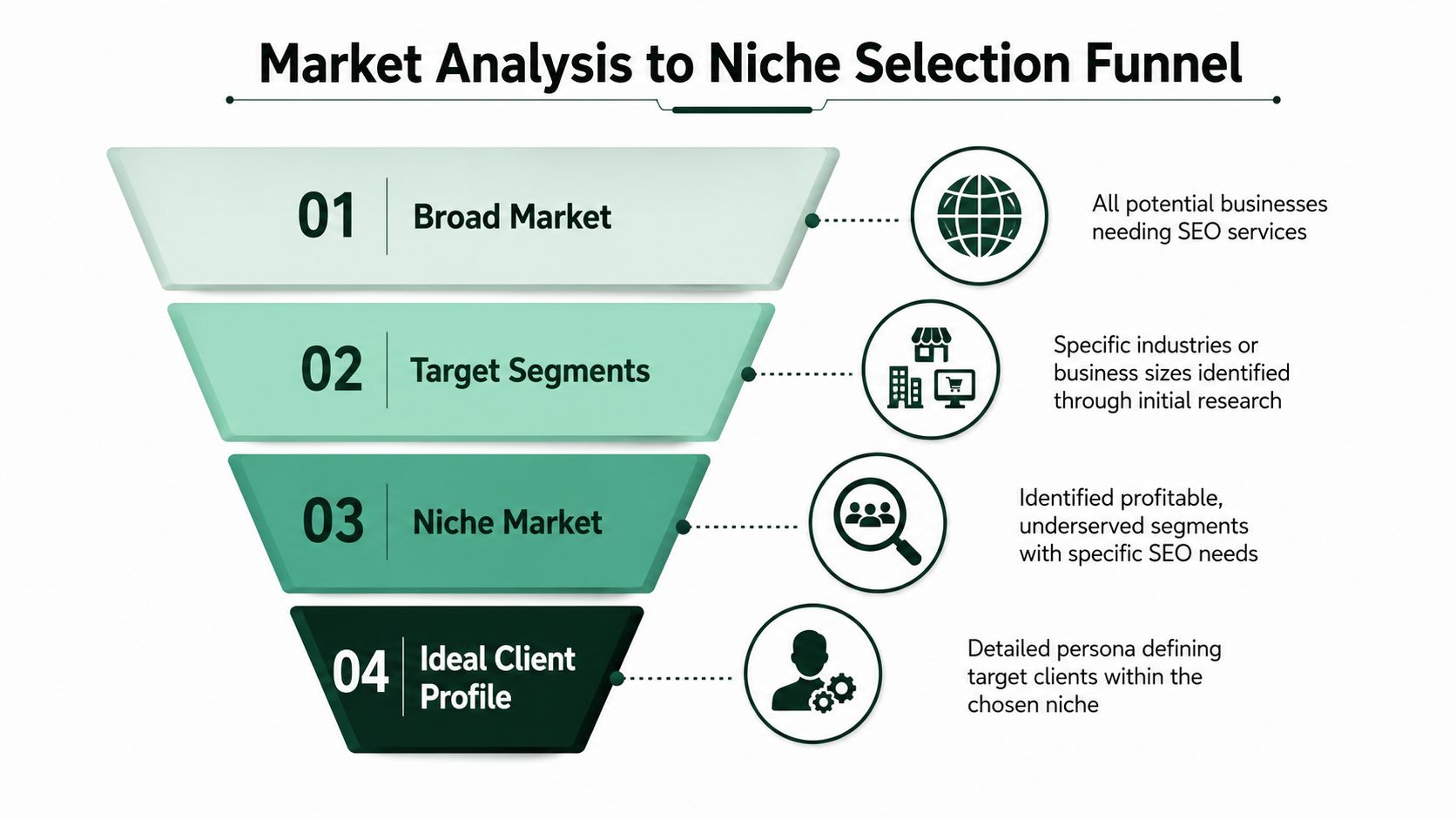
Start broad, then eliminate fast
Most founders choose a niche based on personal interest. That's not enough. You need a segment where buyers feel pain, can afford help, and can stay long enough for SEO to compound.
Use this decision lens:
- Clear buying intent: Do searchers in this market look for providers with commercial intent?
- Real margins on the client side: Can these businesses afford recurring SEO?
- Sales process complexity: Can you access the decision-maker without a six-layer procurement process?
- Implementation reality: Will the client approve content and make site changes?
A niche with lower ego and faster action often beats a glamorous niche with endless delays.
For a closer look at the path from broad agency idea to focused positioning, this article on starting an SEO agency is a practical companion.
Pick a niche you can explain in one sentence
Your niche should sound simple when you say it out loud.
Examples:
- SEO for home service companies in competitive local markets
- SEO for B2B SaaS brands with weak non-brand acquisition
- SEO for multi-location medical practices
- SEO for law firms that need higher-intent case inquiries
If the explanation takes three sentences, it's still fuzzy.
A short video can also help you think through positioning and niche selection from an operator's angle.
Use founder-market fit honestly
Don't ignore your own background. If you've spent years around contractors, legal, healthcare, or SaaS, that matters. It affects how fast you can write convincing copy, understand sales cycles, and build trust.
But founder familiarity shouldn't overrule economics. The ideal niche sits where three things overlap:
- You understand the buyer.
- The buyer has urgent search-driven problems.
- The buyer can support a healthy retainer.
Niche selection isn't branding fluff. It's margin strategy.
Avoid the generalist trap
Generalist agencies usually defend their breadth by calling it flexibility. In practice, it often means weak messaging and sloppy fulfillment. A narrower niche lets you build repeatable systems. The same templates, reporting logic, sales objections, and onboarding process can serve multiple clients.
That's how agencies get faster without getting chaotic. Your business plan should reflect that. Don't just name a niche. Explain why that niche creates better acquisition, stronger referrals, and cleaner operations.
Building Your Client Acquisition Engine
A business plan that doesn't explain where clients come from is useless. Hope isn't a channel. Referrals aren't a system. You need an acquisition engine that gives you short-term opportunities and long-term deal flow at the same time.
I'd split the engine into two lanes. Inbound builds authority. Outbound creates urgency.
Use inbound to make your agency easier to trust
Inbound content works best when it speaks to a niche, not the entire internet. If you serve local service businesses, publish content around local visibility, lead quality, and conversion gaps. If you serve B2B SaaS, publish around comparison pages, bottom-funnel content, and pipeline attribution.
Your inbound system should include:
- Pillar pages: strong service and industry pages
- Proof content: teardown posts, opinion pieces, process breakdowns
- Conversion assets: clear calls to action, lead forms, and booking paths
- Email capture or direct consult paths: make it easy to raise a hand
Most agency content fails because it tries to rank for broad informational terms that don't produce buyers. Write for prospects who are close to action.
Use outbound to control cash flow
Outbound matters because it creates conversations before your content engine matures. For many new agencies, freelance marketplaces are one of the fastest ways to validate offers and close early revenue.
Agencies that submit proposals to Upwork job postings within 10 minutes achieve reply rates between 8% and 24%, while a 2-to-4-hour response lag drops reply rates to 1% to 3%. Speed changes visibility because buyers review early proposals first.
That makes proposal timing an operational issue, not just a sales habit.
Build a simple acquisition workflow
Don't overengineer this. A practical client acquisition engine looks like this:
- Daily monitoring: watch for niche-fit opportunities
- Fast qualification: reject weak-fit jobs quickly
- Personalized proposals: mention the buyer's problem, not your life story
- Prompt follow-up: keep the conversation moving while interest is fresh
- Sales call structure: diagnose, frame the opportunity, recommend the package
If your outbound volume grows, you may also want support from an experienced SDR who can help manage qualification and follow-up without dragging the founder into every early exchange.
The first sales system doesn't need to be elegant. It needs to be repeatable.
Blend the channels instead of choosing one
Some founders act like they must choose between content and outbound. That's a false choice.
Inbound makes outbound stronger because prospects can check your site and see focused thinking. Outbound makes inbound more useful because sales conversations reveal the objections and pain points your content should address.
A healthy plan includes both. One channel builds trust at scale. The other creates cash flow now. That combination is what gets you from your first few clients to a business with actual momentum.
Projecting Financials and Tracking Key Performance Indicators
Most agency founders either avoid the numbers or romanticize them. Both are dangerous. Your financial section should be plain, disciplined, and slightly conservative. If you can't explain how the agency gets from startup costs to stable recurring revenue, the rest of the plan won't matter.
The biggest mistake is assuming clients will sign fast, stay forever, and never question timing. SEO doesn't work like that. You need a model that survives slower ramps and still protects your margin.
Set expectations around time-to-value
The 3–6 month wait for first ROI signals is the most uncomfortable but necessary fact to communicate to clients, and stronger retention tends to follow when that expectation is built into the business plan because growth accelerates in months 12–24 (SMB SEO benchmarks and ROI timing).
That single point should shape your contracts, onboarding, sales calls, and forecasts.
If you model revenue like every client becomes a glowing case study by month two, you'll make bad hiring decisions and panic when normal SEO timing shows up.
Build a lean financial model first
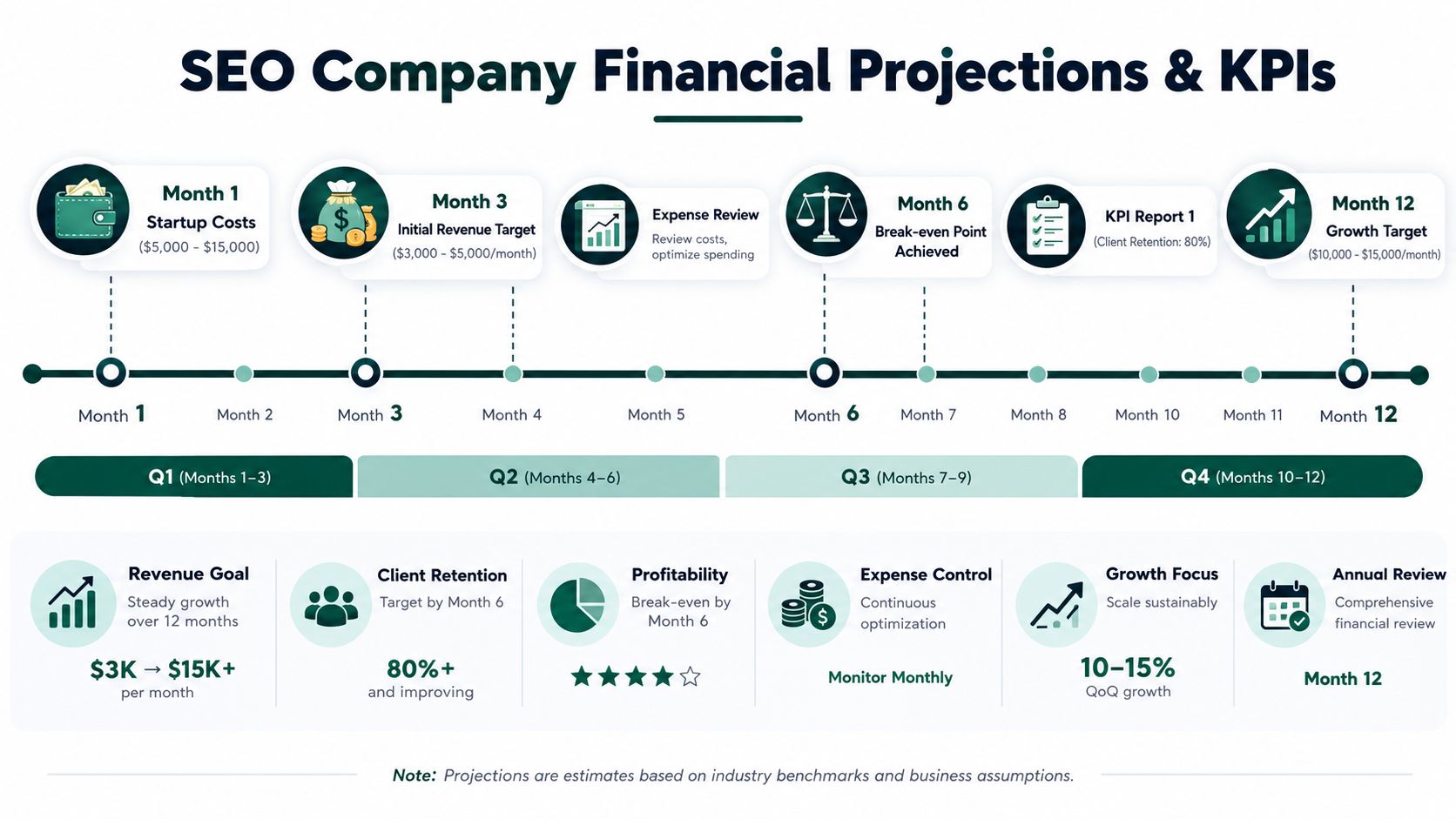
Your first model only needs a few categories:
- Startup costs: branding, site, software, legal setup, sales tools
- Monthly fixed costs: subscriptions, contractors, admin support
- Delivery costs per client: writing, technical help, links if part of your model
- Revenue by package: expected retainer mix and project revenue
- Cash buffer: enough room for slower closes and normal churn
Don't try to predict every detail. Focus on operational reality. Which services are high-margin? Which ones eat time? Which package is easiest to sell and deliver well?
Track the KPIs that reflect business health
A lot of agency dashboards are cluttered with metrics that impress nobody. Keep it tight.
The most useful KPIs are:
- Monthly recurring revenue: shows whether the company is becoming stable
- Gross margin: tells you whether your pricing and delivery model make sense
- Proposal-to-call rate: shows whether your sales messaging is working
- Close rate: reveals whether your offer matches the market
- Client retention: protects the economics of SEO delivery
- Time to onboarding completion: faster starts usually mean faster progress
- Lead-to-sale visibility for clients: this is the backbone of revenue-first reporting
If you need a better structure for presenting progress to clients without drowning them in vanity metrics, this guide to SEO agency reporting is a solid reference.
Build your forecast around three scenarios
I prefer a simple scenario model:
- Conservative case: slower deal flow, slower retention, tighter margins
- Expected case: normal close rates and stable delivery
- Aggressive case: stronger sales execution and better upsell performance
This forces you to think like an operator. If the conservative case breaks the business, the plan is fragile.
Clients don't leave only because results are weak. They also leave because you sold the wrong timeline.
Keep your financial section honest
Your business plan for an SEO company should show restraint. That's what makes it credible. State your service model, define your revenue assumptions, explain your retention strategy, and tie reporting to business outcomes.
That's enough. You don't need fake precision. You need a plan you can run.
If your growth plan depends on winning clients through Upwork, Earlybird AI is worth a close look. It helps agencies automate project discovery, proposal writing, and follow-up so you can respond faster, stay consistent, and spend more time on sales calls and delivery instead of manual bidding.