
← Back To Blog
Start a start seo agency: From Scratch to Scale

So, you're thinking about starting an SEO agency. The most important thing to get right from the beginning is this: you’re building a business, not just creating a more demanding freelance job for yourself. A successful launch really comes down to defining your value, getting the business structure right, and creating a reliable system to win and keep clients. This guide is that practical roadmap.
Your Roadmap to a Profitable SEO Agency

There’s never been a better time to jump in. Honestly. The market isn't just growing; it's practically begging for specialized experts who can deliver real, measurable results. Small and medium-sized businesses, in particular, know they need to show up online but usually don't have the people or knowledge to do it themselves. That gap in the market? That's your opportunity.
The numbers don't lie. The global SEO services market is on track to hit a massive $108.28 billion by 2026, which is a huge leap from $81.46 billion in 2024. The engine driving this growth is small to medium enterprises (SMEs). They're responsible for a whopping 58.40% of total billings because they’re outsourcing SEO to avoid the high cost of an in-house team. You can read more about the SEO market statistics and see exactly where your new agency fits.
Shifting From Freelancer to Business Owner
This guide is designed to help you make one crucial mental shift: from thinking like a solo freelancer to operating as a true business owner. A freelancer trades time for money. A business owner, on the other hand, builds systems that generate revenue. This journey means you have to be obsessed with scalability, efficiency, and profit from day one.
The goal is to build an agency that can run and grow without you being stuck in the weeds, doing every single task. It's about working on the business, not just in it.
The Pillars of a Successful SEO Agency
To get there, we're going to dig into the core pillars that hold up a thriving agency. Think of this as the blueprint for your entire operation. We'll cover:
- Defining Your Niche & Offerings: We’ll figure out how you can stand out in a crowded space by specializing and creating service packages that are easy to sell and even easier to deliver.
- Business Structure & Financials: This is the boring but essential stuff. We'll get the legal and financial setup right from the start so your agency is built on a rock-solid foundation.
- Mastering Service Delivery: I'll show you how to create standardized processes for everything—onboarding, execution, reporting—that keep clients happy and your workload manageable.
- Building a Client Acquisition Engine: We’ll dive into real, actionable strategies, including some slick automation, to create a predictable flow of new business without you having to manually chase down every lead.
By focusing on these areas, you're not just building a job for yourself. You're creating a valuable, scalable asset. This guide will give you the step-by-step plays to make it happen.
Laying Your Agency's Foundation
Before you even think about chasing down your first client, you've got to answer a tough question: who are you, and what do you actually sell? I’ve seen so many eager founders rush this part, and it’s like building a house without a blueprint. The strategic calls you make right now will dictate your agency's entire future—from the clients you attract to the prices you can command.
This is the bedrock. It's about shifting your mindset from a generalist "I do SEO" to a specialist who solves a specific problem for a specific kind of business. Honestly, that clarity is your single biggest advantage in a crowded market.
Define Your Niche and Target Client
Let's get one thing straight: you cannot be everything to everyone. Trying to serve any business that needs SEO is a surefire way to get lost in the noise. You have to specialize. This focus not only makes your marketing a thousand times easier, but it also lets you become a genuine expert, which means better results and, you guessed it, higher prices.
A profitable niche usually falls into one of these buckets:
- Industry-Specific: This is my personal favorite. You become the go-to SEO agency for a particular business type. Think e-commerce stores on Shopify, local contractors like plumbers and roofers, or even B2B SaaS companies.
- Service-Specific: You could also go deep on one high-value area of SEO. Maybe you become the master of technical SEO audits for massive websites or the absolute best at building authority through high-quality link building.
- Location-Specific: Especially when you're just starting out, zeroing in on local businesses in your city or region is a powerful way to build an initial client base and a solid reputation fast.
When you pick a niche, you stop competing with every other agency on the planet. You start playing a different game—one where your expertise gives you an almost unfair advantage.
Craft Your Core Service Packages
Okay, you know who you're serving. Now, what are you selling them? Vague, custom-quoted services are a nightmare. They create confusion for clients and operational chaos for you. The fix is to productize your services into clear packages.
I always recommend thinking in terms of "good, better, best" tiers. For an agency serving local contractors, it might look something like this:
- The Foundation Package: This covers the absolute essentials—Google Business Profile optimization, local keyword targeting, and basic on-page SEO.
- The Growth Package: Here you’d add things like content creation (maybe two blog posts a month), building local citations, and a bit more advanced link acquisition.
- The Market Leader Package: This is the all-in offering. It has everything in the Growth package, plus a bigger content budget, proactive reputation management, and more detailed monthly reporting.
Structuring your services this way makes it incredibly easy for clients to understand what they're buying. More importantly, it lets you build standardized workflows, making your delivery efficient and scalable. If you're looking for clients to pitch these new packages to, platforms like Upwork can be a goldmine. Our guide on how agencies can succeed on Upwork has some great strategies for getting noticed.
The real point of packaging is to turn your expertise into a tangible product. It completely changes the conversation from "how many hours will this take?" to "which of these solutions is right for my business?"
Establish Your Legal and Financial Structure
This is the part everyone wants to skip, but it’s non-negotiable if you want to build a real business. Getting your legal and financial house in order from day one protects you and sets you up for actual growth.
First, choose your business entity. For most new agency owners in the US, an LLC (Limited Liability Company) is the way to go. It separates your personal assets from your business debts, giving you critical protection without the headaches of an S-Corp.
Next, open a dedicated business bank account. I can't stress this enough: never, ever mix your personal and business finances. This simple step makes bookkeeping clean, profit tracking accurate, and tax season way less painful.
Finally, get comfortable with your key financial metrics. You can't make smart decisions if you don't know your numbers. At a minimum, you need to be tracking:
- Monthly Recurring Revenue (MRR): The predictable income from your client retainers. This is your agency's lifeblood.
- Customer Acquisition Cost (CAC): How much you spend in time and money to land a new client.
- Gross Profit Margin: Your revenue minus the direct costs of delivering your service (think contractor fees, software licenses, etc.).
With a sharp niche, clear packages, and a solid legal and financial foundation, you’re no longer just a freelancer. You're the owner of a legitimate agency, ready to grow.
Building a Reliable Client Acquisition Machine
An agency without a predictable stream of new clients isn't really a business—it's a recipe for constant stress. If you want to grow sustainably, you have to build a machine. That means creating a repeatable, reliable system that consistently brings in qualified leads. This isn't about fluffy advice like "network more." It's about putting specific, battle-tested strategies into action to keep your pipeline full.
You can forget the idea that you need a full-time salesperson from day one. With the right tools and smart workflows, you can automate the most grueling parts of outreach, letting you punch way above your weight class.
The whole process really starts with a solid foundation. Once you’ve nailed down your niche, packages, and legal setup, you have a launchpad for everything else.
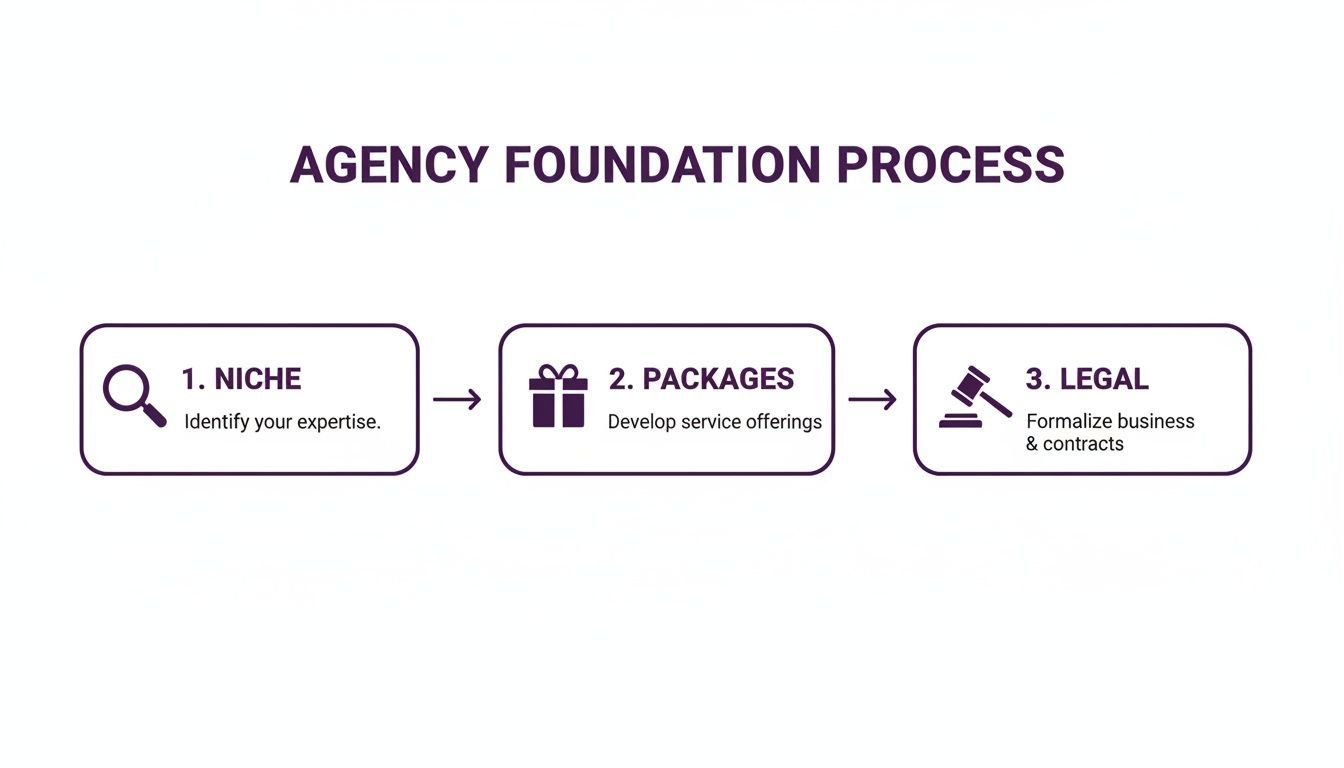
Getting this right first makes your client acquisition efforts targeted and efficient, so you’re attracting the right kind of prospects from the get-go.
Mastering Upwork with Smart Automation
Freelance platforms like Upwork can be a goldmine for new agencies, but they're also brutally competitive. Manually sifting through job posts and cranking out custom proposals is a full-time job in itself. The secret to winning here is moving with speed and personalizing at scale—and that’s where automation gives you an almost unfair advantage.
Certain tools can hook into your Upwork account, learn what your ideal client looks like, and then automatically hunt for and bid on relevant projects. Picture this: a perfect-fit project gets posted, and within minutes, a highly personalized proposal, modeled after your most successful bids, lands in the client's inbox.
This gives you a massive first-mover advantage. While other agencies are still reading the job description, you’re already in the conversation.
Developing a High-Converting Proposal Workflow
Your proposal isn't just a price tag; it's your #1 sales tool. A weak proposal gets ignored, no matter how good your SEO skills are. A strong one can close the deal without you ever needing to hop on a call.
Your workflow needs to be a system, not a last-minute scramble. Here’s a simple but incredibly effective structure:
- Hit Their Pain Point: Start by showing you get their problem. "I see you're a local plumbing company struggling to outrank competitors for 'emergency plumber in Dallas'" works a lot better than a generic "Hi, I'm an SEO expert."
- Present Your Solution (Briefly): Connect their problem to one of your packages. Skip the technical jargon. Just explain how your process will fix their issue and get them the outcome they want, whether that's more phone calls or more booked jobs.
- Show Relevant Proof: This is crucial. Drop in a mini case study or a link to a portfolio piece from a similar client. Social proof is your most powerful weapon.
- Give a Clear Call to Action: End with one simple next step. Don't say, "Let me know your thoughts." Instead, say, "Are you free for a quick 15-minute chat next week to walk through this? You can book a time directly on my calendar here."
This structured approach turns your proposals from hopeful long shots into compelling sales arguments. You can discover proven methods to get SEO clients and build a more robust acquisition strategy.
Diversifying Your Acquisition Channels
While a platform like Upwork is a fantastic place to start, a truly resilient agency never relies on a single source for leads. Once you've got some initial traction and cash flow, it's time to start building out other channels.
Building a client acquisition machine means you're never desperate. You have multiple streams of opportunities, giving you the power to choose the clients you want to work with, not just the ones you need to pay the bills.
Think about adding these powerful channels to your mix:
- Targeted Content Marketing: Don't just blog about "SEO tips." Get hyper-specific and write content that solves the exact problems of your niche. If you serve e-commerce stores, publish an in-depth guide on "Fixing Canonical URL Issues on Shopify." This brings in qualified leads who are already hunting for a solution.
- Strategic Networking: Forget stuffy chamber of commerce meetings. Join online communities—think Facebook Groups or Slack channels—where your ideal clients already are. Add real value to the conversation without pitching, and you'll naturally become the go-to expert when they need help.
- Building a Referral Pipeline: Your happiest clients are your best salespeople. Set up a simple, formal referral program. Offer a small commission or a discount on their next invoice for every new client they send your way. It's a low-cost, high-trust way to grow your business.
The demand is definitely there. The global SEO services market is expected to jump from $89.1 billion in 2024 to $143.9 billion by 2030, all driven by businesses who need expert help. A multi-channel strategy backed by smart automation is how a new agency can tap into this growth effectively. You can find more SEO industry statistics to see just how big the opportunity is.
Nailing Service Delivery and Keeping Clients for the Long Haul
Landing a new client feels great, but that's just the starting line. The real test—and where you build a sustainable agency—is in the follow-through. Keeping clients happy with incredible service and crystal-clear communication is what turns a one-off project into predictable, recurring revenue.
Let's be blunt: sloppy delivery and going dark on a client are the fastest ways to burn a bridge you just spent weeks building. The antidote is to create repeatable, efficient processes for every single step. This guarantees every client gets the same top-tier experience and saves you from reinventing the wheel every time a new contract is signed.
Design a Flawless Client Onboarding Experience
Onboarding is your client’s first real taste of what it’s like to work with you. A seamless, professional start sets the entire tone of the relationship. The goal is simple: get all the info you need, set clear expectations, and show them they’re in capable, organized hands.
A chaotic start plants an immediacy seed of doubt. On the other hand, a structured, buttoned-up process inspires confidence and instantly reassures them they made the right call. It’s your chance to look like a pro before you’ve even logged into their website.
Here’s what a solid onboarding checklist needs:
- Welcome Packet: A branded PDF that clearly lays out communication channels, who their point of contact is, and a roadmap for the first 30 days.
- Kickoff Call Agenda: Don't just wing it. Send a structured agenda beforehand covering goals, timelines, and how you'll measure success (the KPIs).
- Information Intake Form: Use a secure form to collect all the necessary credentials—website CMS access, Google Analytics, and Google Search Console logins are the bare minimum.
- Initial Questionnaire: Go deeper than just their website. Ask about their ideal customers, their top three competitors, and what they’ve tried in the past that didn't work.
This structured approach doesn't just impress clients; it gives your team everything they need to hit the ground running. No more frustrating email chains chasing down logins two weeks into the engagement.
Systematize Your SEO Work with SOPs
If you ever want to scale your agency beyond just you, you absolutely need Standard Operating Procedures (SOPs). These are your agency's recipes—detailed, step-by-step guides that explain exactly how to execute your core SEO services. SOPs are the secret to ensuring consistency and quality, no matter who on your team is doing the work.
Think of SOPs as your agency's playbook. They are living documents that let you delegate with confidence, train new hires in a fraction of the time, and maintain an ironclad standard of quality as you grow.
An SOP isn't just a to-do list; it's a quality control mechanism. It guarantees that whether it's you or your tenth employee doing a technical audit, the final product meets your agency's high standards.
Start by creating SOPs for the tasks you do over and over again:
- Technical SEO Audit: A comprehensive guide covering everything from checking site speed and mobile-friendliness with PageSpeed Insights to hunting down crawl errors and broken links.
- Keyword Research: A defined workflow for finding primary, secondary, and long-tail keywords based on client goals, search intent, and a deep dive into what competitors are ranking for.
- On-Page Optimization: A step-by-step checklist for perfectly optimizing title tags, meta descriptions, H1s, body content, and internal links for a target keyword.
- Content Brief Creation: A template for building detailed outlines for writers, including target keywords, recommended word count, topics to cover, and internal link opportunities.
With these systems locked in, you transition from a freelancer chasing tasks to an agency owner managing a well-oiled machine. This mindset shift is absolutely critical if you want to start an SEO agency that can scale.
Build Reports That Actually Mean Something to a Business Owner
Finally, reporting is how you prove your value. Clients couldn't care less about vanity metrics like a #7 ranking for a low-value keyword. They care about one thing: results that affect their bottom line. Your reports must connect the dots between your SEO work and real business outcomes.
Stop sending reports that are just a list of rankings. Instead, frame your results around the metrics a CEO actually cares about.
Focus on reporting:
- Leads Generated: Track contact form fills, website phone calls, and demo requests that came from organic search.
- Conversion Rate: Show the percentage of organic visitors who are taking a valuable action and becoming a lead or customer.
- Return on Investment (ROI): This is the holy grail. If you can tie revenue generated from organic search directly back to their monthly retainer, you've made yourself indispensable.
This simple shift changes the conversation from, "So, what did you do last month?" to "Look at the business we generated together." It solidifies your position as a true growth partner, making it a no-brainer for them to renew their contract, month after month.
Scaling Your Operations with People and Tech

If you really want to grow your business from a one-person show into a genuine agency, you have to accept a hard truth: you can't do it all yourself. Making that leap from freelancer to agency owner is all about scaling with smart hires and the right technology. It’s the only way to break the cycle of being overworked and under-leveraged.
This isn’t just about getting more work done. It’s about building an operational backbone that can actually support growth. You're creating systems that let you step back from the day-to-day grind and focus on steering the ship. Without this, your agency will hit a ceiling—and that ceiling will be you.
Knowing When to Make Your First Hire
The million-dollar question is always when to hire someone. Pull the trigger too early, and you could kill your cash flow. But wait too long, and you'll burn out, miss deadlines, and watch your quality of work nosedive. The signs are usually obvious if you know what to look for.
You're probably ready if you're consistently turning down good projects because you're at capacity. Another dead giveaway is when you realize you're spending more time on admin and low-value tasks than on client strategy or finding new business. If you feel like you're constantly putting out fires instead of planning ahead, it's time.
Your first hire doesn't have to be a full-time employee, either. In fact, bringing on specialized freelancers is the perfect first move for most new agencies. It’s a flexible way to add expertise without the heavy overhead.
- Virtual Assistants (VAs): A godsend for offloading admin work like scheduling meetings, basic client communication, and taming your inbox.
- Content Writers: Finding a solid writer in your niche can instantly boost your service quality and free up countless hours of your time.
- Technical SEO Specialists: For tricky site audits or complex migrations, bringing in a dedicated expert on a project basis is a no-brainer.
Choosing Your Core Technology Stack
As your team grows, so does the need for a central hub to manage projects, communication, and client work. A well-chosen tech stack is the engine that powers a modern SEO agency. This isn't about having the most tools; it’s about having the right tools that fit seamlessly into your workflow.
Your tech stack should be a force multiplier. It should automate repetitive work, provide clear insights, and make collaboration seamless, allowing a small team to deliver results that rival much larger agencies.
For a new agency, your essential stack really breaks down into a few key categories.
Project Management Software
This is your agency's central nervous system. It's where your SOPs live, where tasks get assigned, and where you track every moving part of a project. A good PM tool is what keeps things from falling through the cracks.
- Asana: Loved for its clean interface and ability to create repeatable task templates directly from your SOPs.
- ClickUp: Incredibly customizable and powerful. It’s a fantastic all-in-one solution for agencies that want to manage everything from tasks to client docs in one spot.
Core SEO Platforms
These all-in-one platforms are non-negotiable for serious SEO. They give you the data you need for everything from keyword research and rank tracking to deep competitive analysis and site audits.
- Semrush: A true Swiss Army knife with strong features for keyword research, competitor analysis, and content marketing.
- Ahrefs: Widely considered to have the best backlink data on the planet, making it indispensable for link building and competitive intel.
The SEO software market is exploding for a reason. It's projected to jump from $74.6 billion in 2024 to a staggering $154.6 billion by 2030. That kind of growth sends a clear message: a solid tech stack isn't optional anymore. You can read more about the agencies SEO services market report to get a sense of where things are heading.
Choosing the right platform is critical, and we've put together a guide on key software for a digital marketing agency that can help you weigh your options.
By combining the right people with the right technology, you create a foundation that can actually scale. This operational efficiency is what lets you take on more clients, deliver consistently great work, and finally build an agency that’s a valuable asset, not just a demanding job.
Common Questions About Starting an SEO Agency
Jumping into agency ownership always brings up a ton of questions. Forget the high-level strategy for a minute—it’s the practical, nitty-gritty decisions that can feel like the biggest roadblocks. Let’s tackle some of the most common ones I hear from new founders, covering everything from pricing and profits to landing those first crucial clients.
How Should I Price My SEO Services When I'm Just Starting Out?
Pricing is part art, part science, and a massive source of anxiety for pretty much every new agency owner. The absolute biggest mistake you can make is pricing based on your time.
Never, ever charge by the hour. It’s a broken model that actively punishes you for getting better at your job. The moment you build a system or find a shortcut that makes you more efficient, you start making less money. It makes no sense.
Instead, you need to build your pricing structure around value and outcomes. This means focusing entirely on monthly retainers or project-based fees, which completely shifts the conversation from your labor to the client's results.
For a new agency trying to get its footing, here are some realistic starting points:
- Local SEO Packages: For a small local business like a dentist's office or a plumbing company, a solid starting retainer is usually in the $1,500 - $2,500 per month range. This typically gets them the essentials: Google Business Profile management, local keyword targeting, and solid on-page optimization.
- National or E-commerce Campaigns: When you're up against broader competition and the goals are more complex, your starting point has to be higher. Retainers for these clients often begin at $3,000 - $5,000+ per month, simply because the scope and potential return on investment are so much bigger.
Remember, your price is a signal. It communicates your confidence and the value you bring to the table. Go ahead and research what other agencies in your niche are charging, but just use that as a benchmark, not a rulebook. Price based on the tangible business results you can drive, and you’ll start attracting clients who get it.
What's a Realistic Profit Margin for a New SEO Agency?
Your profit margin is the ultimate health score for your agency. It tells you if your pricing works, if your expenses are in check, and if your business can actually last. If you want to start an SEO agency that survives its first year, you have to track this from day one. It's non-negotiable.
In the very beginning, when you’re doing all the client work yourself, your margins are going to look amazing—think 60-70%, maybe even higher. Your only real costs are software and a few small administrative fees. This is the perfect time to build up a cash cushion.
For a growing SEO agency, a healthy and sustainable profit margin falls somewhere between 30% and 50%. This sweet spot gives you enough cash to reinvest in growth, hire top-tier talent, and still pay yourself well.
But as you scale, that super-high margin will naturally come down. Don't panic; this is a good thing! It means you're growing. When you start investing in people (whether contractors or full-time employees) and premium tools like Ahrefs or Semrush, your costs go up. The trick is to manage this growth intentionally. By keeping a close eye on your profit margins, you'll know exactly when it’s smart to hire, how to price a new service, or which expenses are actually worth it.
How Do I Get My First Three SEO Clients?
Getting those first few clients is, without a doubt, the hardest part. It feels like a classic catch-22: you need clients to build a portfolio, but you need a portfolio to land clients. The good news is that it’s less about having a long track record and more about smart, proactive effort.
To break through that initial wall, you need to focus on building trust and showing what you can do—fast. Forget about cold-calling hundreds of businesses. You need to be more targeted and strategic.
Here’s a simple, three-pronged attack to land those first clients:
- Tap Your Network: This is the lowest-hanging fruit you've got. Make a list of everyone you know—friends, family, old colleagues, your accountant, your barber—and tell them you've launched an SEO agency. Be specific about who you help. A warm referral is a thousand times more effective than a cold email.
- Be Strategic on Freelance Platforms: Sites like Upwork can be a goldmine for your first clients, but you have to be quick and smart. The goal is to stand out. Don't just send the same generic, copy-pasted bid to every job. Build a system that lets you spot the perfect projects and fire off a highly personalized, value-driven proposal within minutes of it being posted. Countless six-figure freelancers got their start this way.
- Give Value Away for Free: One of the best ways to get your foot in the door is to show, not tell. Offer a free, no-strings-attached SEO audit or a quick 15-minute strategy call to businesses you want to work with. Record a short Loom video walking them through 2-3 major opportunities on their website. This builds instant trust, proves you know your stuff, and makes the follow-up sales call a breeze.
Landing those first three clients is all about building momentum. Once they’re on board, your job is to deliver incredible results. That's what will generate the case studies and referrals you need to land clients four, five, and beyond.
Growing your agency is all about building a predictable client acquisition engine. Earlybird AI works like a 24/7 sales assistant on Upwork, automatically finding your ideal clients and sending personalized proposals in minutes. It's the smartest way to keep your pipeline full so you can focus on what you do best—delivering results. See how you can automate your outreach and win more clients at myearlybird.ai.