
← Back To Blog
Master Competitive Positioning for Freelance Success
You send proposals for hours, sometimes days. You rewrite the first line. You trim the scope. You tweak the pricing. Then the job closes, and nothing happens. No reply. No view. No interview. Just another submission sitting in a pile with dozens of others.
That's the part most freelancers and small agencies get wrong about platforms like Upwork. They think they have a proposal problem when their real problem is positioning. If your profile sounds interchangeable, your proposal gets judged like a commodity. Clients compare you on price, speed, and vague reassurance because you haven't given them anything sharper to compare.
I've seen this pattern constantly with freelancers who are good at the work but invisible in the sale. They say things like “I do web design,” “I help businesses grow,” or “I'm a full-service marketer.” None of that gives a buyer a reason to remember them, and it definitely doesn't give a buyer a reason to pay more.
Competitive positioning fixes that. Not in the abstract brand-strategy way people like to overcomplicate, but in the practical way that wins jobs. It helps you define who you serve, what problem you solve better than the next bidder, and how to say it in language that makes a client think, “This one gets it.”
On a crowded platform, that shift matters. You stop sounding like an available pair of hands and start sounding like the right specialist for a specific result.
Introduction From Invisible Bidder to In-Demand Expert
A lot of freelancers start the same way. They create a profile, list every skill they've ever sold, and begin bidding broadly. SEO, content, landing pages, email, social, website fixes, audits, strategy. The thinking is simple. More services should mean more opportunities.
In reality, broad positioning usually creates weaker proposals. When a client posts “Need SEO for B2B SaaS site,” the specialist who says “I help SaaS companies fix pipeline leaks caused by weak non-brand search intent” feels safer than the bidder who says “I'm an experienced digital marketer with expertise across multiple channels.”
Clients don't hire from your full capability set. They hire from the slice of your capability that matches the problem in front of them.
Practical rule: If your offer could fit almost any client, it won't feel tailored to the one reading it.
The shift from invisible bidder to in-demand expert starts when you stop trying to look flexible and start trying to look relevant. That doesn't mean narrowing so much that you starve your pipeline. It means choosing a lane that gives buyers a fast mental shortcut. Healthcare UX writer. Shopify retention email specialist. Paid search manager for local service businesses. Proposal strategist for agencies selling technical SEO.
That kind of specificity changes everything downstream:
- Your profile gets clearer because the headline speaks to one buyer.
- Your samples get stronger because they reinforce one category of problem.
- Your proposals get shorter because you don't have to explain yourself from scratch.
- Your pricing gets easier to defend because specialists are judged on fit, not just effort.
Most freelancers don't need more hustle. They need a sharper market position.
What Is Competitive Positioning Really
Competitive positioning is the choice you make about where you want to win and why a buyer should pick you over the alternatives. That last part matters. It's not just about what you do. It's about what you do relative to other options.

Think about a food court with ten burger stands. If you open the eleventh burger stand and say your food is fresh, tasty, and affordable, you're not positioned. You're present. If you open the only fast lunch spot built for office workers who need high-protein meals ready in minutes, now you've given people a reason to choose you.
That's how competitive positioning works on Upwork. The platform is full of capable people. Buyers don't just need capability. They need a reason to sort one capable option above another.
Positioning is about market context
This isn't just branding language. The U.S. Small Business Administration says a competitive analysis should identify competitors by product line or service, market segment, strengths and weaknesses, barriers to entry, and indirect competitors. That's why good positioning has to account for direct rivals and substitute offerings, not just your own message, as outlined in the SBA guide to market research and competitive analysis.
For freelancers, substitute offerings are everywhere:
- Other freelancers with similar skills
- Small agencies that package the same service
- In-house hires the client is considering instead
- DIY tools that reduce the need for expert help
- Doing nothing because the pain doesn't feel urgent enough
If you ignore those alternatives, your positioning gets lazy. You start describing your service in isolation, and clients never buy in isolation.
The platform will position you if you don't
This is the hard truth. If you don't define your position, the market will define it for you. On freelance platforms, the default label is usually some version of “generalist” or “cheap.”
That happens when your profile says too much without saying anything distinct. “Helping businesses grow” is forgettable. “I build conversion-focused landing pages for B2B SaaS demos” is memorable because it names the buyer, the asset, and the business goal.
Use this test on your own profile:
- Clear buyer test. Can a stranger tell who you serve in under ten seconds?
- Problem test. Can they identify the pain you solve without reading your whole overview?
- Comparison test. Can they explain why you're a better fit than the next five bidders?
If the answer is no, your issue isn't effort. It's position.
Key Frameworks to Define Your Market Position
You don't need a corporate strategy deck to build solid positioning. You need a few simple frameworks and the discipline to answer them accurately.
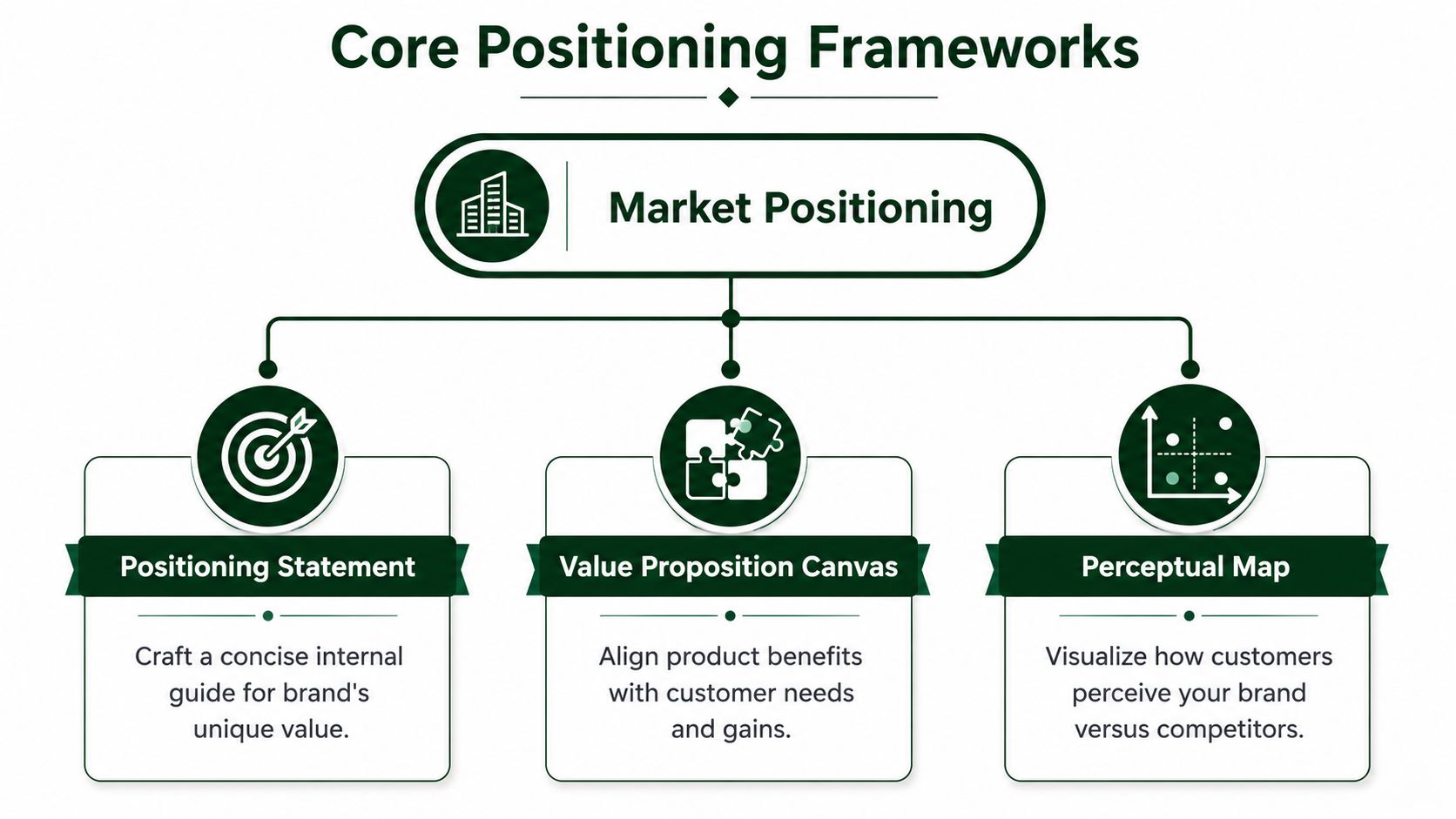
Positioning statement
A positioning statement is an internal tool. It keeps you from drifting into vague language every time you update your profile or send a proposal.
Use this template:
For [specific client type], I help solve [specific painful problem] by delivering [service or mechanism] so they can achieve [clear business outcome], unlike [common alternative], which usually falls short because [key weakness].
A few examples:
- For founder-led B2B SaaS companies, I fix underperforming landing pages by combining conversion copy and UX structure so paid traffic turns into demos, unlike generic copy support that improves wording but not page flow.
- For ecommerce brands with repeat-purchase potential, I build retention email systems that lift customer value after first purchase, unlike one-off campaign writing that doesn't create an ongoing revenue engine.
That's already stronger than most freelance profiles because it forces a choice.
Value proposition canvas
Most freelancers overcomplicate value propositions. Keep it practical. Focus on two parts only: client pains and your service as the pain reliever.
Write down the recurring pains your best-fit client feels before they hire someone like you:
- Revenue pain. Leads are weak, conversions are low, retention is unstable.
- Operational pain. Internal teams are stretched, projects stall, no one owns the outcome.
- Risk pain. They've hired before and got poor communication, missed deadlines, or shallow thinking.
- Complexity pain. They don't know what's broken, only that results aren't good enough.
Then match those pains to your method. Not your features. Your method.
A client doesn't care that you “offer SEO audits, competitor reviews, and strategy workshops.” They care that you can diagnose why organic traffic isn't turning into pipeline and give their team a clear fix order.
The strongest position sits in the overlap where the buyer cares deeply, you perform strongly, and competitors are weak there, as described in Shopify's breakdown of competitive positioning.
Perceptual map
This one is simple and useful. Draw two axes on paper. For freelancers, a useful version is:
- X-axis: low specialization to high specialization
- Y-axis: low strategic involvement to high strategic involvement
Now place yourself and the freelancers or agencies you keep running into on those axes.
You'll often see a pattern quickly. Many providers cluster in one zone, usually broad execution with limited strategic depth. That's your clue. If you can credibly move into a clearer niche, or frame your service around business diagnosis rather than just delivery, you create separation.
Another version is price versus specificity. Another is speed versus customization. Use whatever reflects how clients compare options.
If you want a concrete example of turning SEO capability into a clearer client-facing offer, study how targeted lead generation content sharpens the service angle in this piece on getting SEO leads.
Keep the exercise small and honest
You can complete all three frameworks in an afternoon. The point isn't to sound clever. The point is to remove ambiguity.
Use these questions as a final check:
- What kind of client do I want more of?
- What painful problem do they already know they have?
- What do they compare me against?
- Where am I clearly stronger than the average alternative?
- Can I explain that in one sentence without fluff?
If you can, your positioning is getting usable.
How to Craft Your Competitive Position in 5 Steps
Good positioning isn't discovered by writing prettier profile copy. It's built by looking at the market, making choices, and pressure-testing those choices before you scale them.
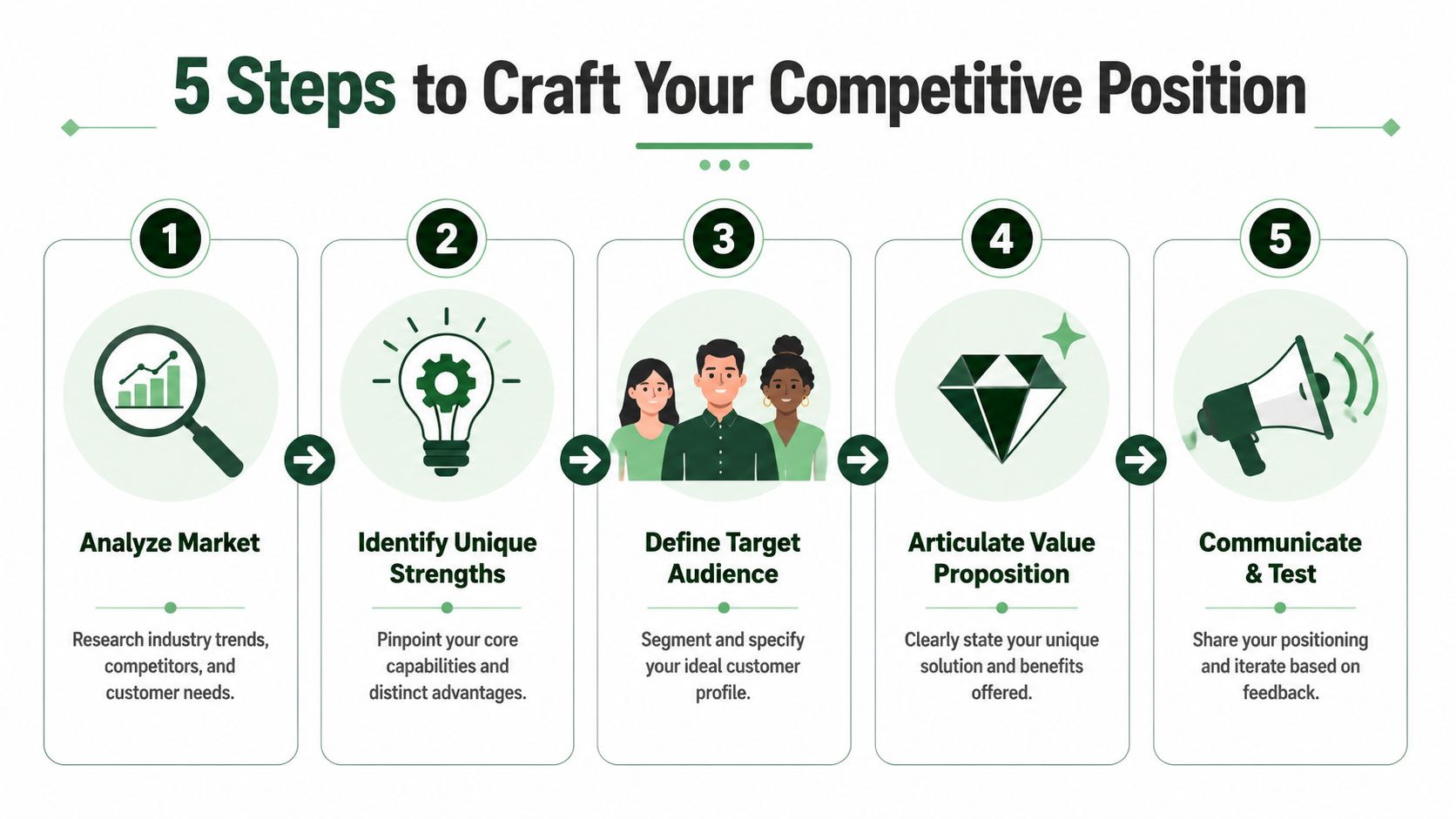
Start with this process.
1. Analyze your actual competitive set
Most freelancers analyze the obvious competitors and stop there. That's too shallow. A solid positioning exercise maps direct rivals, secondary options, and the “do nothing” alternative. Some frameworks suggest a thorough analysis often identifies 10+ competitors, which is a good reminder that buyers consider a wider set of options than most sellers assume, as discussed in this full-set positioning framework.
For an Upwork seller, your real alternatives might include:
- Direct rivals who offer the same service in the same niche
- Secondary providers who solve the problem differently
- Internal alternatives like the client's existing team
- Automation or software tools that promise to replace the service
- Delay because the buyer decides the issue can wait
Create a short scoring sheet. Rate each alternative on factors like specialization, proof, responsiveness, clarity of offer, and price framing. Don't obsess over precision. You're looking for patterns.
What usually works is identifying where competitors sound the same. What doesn't work is trying to beat everyone at everything.
2. Define your highest-value client
Freelancers often say they'll work with startups, agencies, ecommerce brands, coaches, SaaS companies, and local businesses. That isn't a target market. That's a refusal to choose.
Pick the clients that create the best combination of fit, budget, urgency, and repeatability. The goal isn't to describe who can technically buy from you. It's to define who should.
Ask:
- Who hires fastest?
- Who understands the problem without education?
- Who values the outcome more than the hours?
- Who tends to bring repeat work or retainers?
- Whose language do I already understand?
A freelancer who specializes in “email marketing” will struggle more than one who focuses on “lifecycle email for subscription ecommerce brands.” The second seller has a sharper buyer, a clearer pain set, and stronger proposal language.
3. Identify your real differentiator
Your differentiator is not “quality,” “great communication,” or “attention to detail.” Everyone claims those. Clients tune them out.
Your differentiator needs to be visible and relevant. It can come from your niche, your process, your background, your speed, your commercial understanding, or the way you package work.
Here are stronger differentiator types:
- Category experience. You know a client's market, not just the tactic.
- Problem specialization. You solve one costly issue repeatedly.
- Systemized process. You bring a method, not just labor.
- Decision support. You help the client choose what not to do.
- Execution plus strategy. You don't just deliver assets. You shape priorities.
A useful differentiator removes time, risk, or complexity for the buyer. If it doesn't do one of those, it's probably not strong enough.
4. Turn it into a core message
To make strategy usable, you need a short message you can place in your headline, overview, proposal opening, and follow-up replies.
A strong core message usually includes three parts:
- Who you help
- What problem you solve
- Why your approach is distinct
Examples:
- I help B2B SaaS teams turn weak landing pages into clearer demo paths by combining conversion copy with offer positioning.
- I help agencies sell technical SEO work by rewriting proposals, scopes, and client-facing messaging so complex services feel easier to buy.
- I build onboarding and retention email systems for subscription ecommerce brands that need more value from first-time customers.
Keep it compact. You're not writing a slogan. You're creating a repeatable sales sentence.
A short explainer can help if you want another angle on turning a service into a client-winning message:
5. Pressure-test before you commit
This step saves you from elegant nonsense.
Take your new position and challenge it with real-world questions:
- Can a buyer understand it quickly?
- Does it point to a painful enough problem?
- Can I prove it with samples, process, or past work?
- Would a client pay more for this specificity?
- Does it still hold up when compared to substitutes?
Then test it live in small ways. Update your Upwork headline. Rewrite the first two lines of your proposal template. Adjust your profile overview. Narrow the kinds of jobs you pursue for a few weeks and watch the quality of conversations.
What works is iterative testing. What fails is trying to perfect positioning in a document while your market is giving you live feedback every day.
Bringing Your Positioning to Life on Upwork
A strong position only matters if the buyer can feel it fast. On Upwork, that usually means your profile headline, proposal opening, and project descriptions need to do much less talking and much more sorting.

Proposal opening lines before and after
Generic proposal opening:
Hi, I'm an experienced digital marketer and would love to help with your project. I have worked with many clients and can provide high-quality results within your timeline.
That opening says nothing useful. It could belong to almost anyone.
Positioned proposal opening:
You don't need more SEO activity. You need pages that match commercial intent and turn search visits into qualified leads. That's the kind of work I handle for B2B service firms when traffic exists but pipeline doesn't.
The second version does three things quickly. It names the primary problem, frames the service around the buyer's outcome, and signals a point of view.
Profile headline before and after
Weak headline:
- SEO Specialist | Content Writer | Web Designer | Social Media Manager
That headline tries to maximize reach and ends up reducing trust.
Sharper headline:
- SEO strategist for B2B service firms that need pipeline, not just traffic
Now the buyer can self-select. Some prospects will skip you. Good. The right ones will pay attention faster.
Project descriptions before and after
Weak project description:
- I helped a client with website copy, SEO improvements, and digital marketing strategy.
Stronger project description:
- Reworked service-page messaging and search intent targeting for a B2B firm whose traffic wasn't converting. Focused on offer clarity, page structure, and lead-path friction.
The better version gives context, diagnosis, and action. It sounds like a specialist handled a business problem, not a freelancer completed tasks.
Buyers on Upwork rarely reward the most complete explanation. They reward the clearest fit.
What to change on the platform this week
If your positioning work is done, these are the first places to apply it:
- Your title should name the buyer or problem, not your whole toolbox.
- Your first proposal sentence should diagnose, not introduce.
- Your overview should open with the business issue you solve.
- Your portfolio should group work by problem type, not by random chronology.
- Your saved proposals should have modular opening lines based on niche and pain point.
If you run an agency, the same rule applies at team level. Don't present as “full service” unless your account already has strong authority. Smaller agencies usually do better when they package one expensive problem clearly, then expand once trust is established.
For more practical guidance on how agencies package and sell themselves on the platform, this breakdown of agencies on Upwork is worth reviewing.
Automating Your Outreach with Consistent Positioning
Positioning falls apart when execution gets sloppy. You might have a sharp market position on paper, but if your first fifty outreach messages are inconsistent, generic, or late, clients won't experience that clarity.
That's one reason competitive intelligence became a standard discipline inside large firms. 90% of Fortune 500 companies use competitive intelligence to gain advantage, according to Evalueserve's competitive intelligence statistics. Freelancers don't need a corporate research department to borrow that discipline. They need a repeatable way to monitor fit, respond consistently, and keep message quality stable.
What automation should actually do
Good automation doesn't replace thinking. It operationalizes a position you've already defined.
That means your system should help you:
- Filter for fit so you stop chasing misaligned projects
- Reuse core messaging without sounding copied and pasted
- Respond quickly while the job is still fresh
- Keep tone consistent across proposals and replies
- Track patterns in what kinds of jobs and messages get traction
One option in this category is Earlybird AI for automated Upwork proposals, which is built to search for projects, craft personalized proposals, and handle replies based on the jobs you want to pursue. Used well, that kind of tool supports your positioning rather than flattening it.
The mistake is automating generic outreach. The better move is automating a well-defined sales message so your ideal client hears the same clear value proposition every time.
Conclusion Beyond Bidding to Building a Defensible Brand
Freelancers who struggle on Upwork often assume the answer is more bids, lower prices, or better proposal tricks. Those can help at the margins. They don't solve the core issue if the client still sees you as interchangeable.
Competitive positioning is the deeper fix. It forces you to choose a buyer, define the problem you solve, and present a reason you're the right option relative to competitors and substitutes. That choice shapes your profile, your samples, your proposals, and the kinds of projects you even bother pursuing.
The long-term payoff is bigger than one win. You stop building a profile that chases work and start building a business that attracts the right work. That's what gives you pricing power, faster trust, cleaner referrals, and a brand clients can remember.
Treat positioning as an ongoing discipline. Refine it as your market shifts, as your best clients evolve, and as you learn which messages consistently open conversations.
If you want help turning your positioning into faster, more consistent Upwork outreach, Earlybird AI gives freelancers and agencies a way to automate project discovery, proposal drafting, and client replies while keeping their core message aligned with the work they actually want to win.