
← Back To Blog
Cover Letter Proposals That Win on Upwork: A 2026 Guide
You open Upwork, spot a job that fits your agency almost perfectly, read the brief twice, and write a thoughtful proposal. You mention relevant work. You keep it professional. You hit submit.
Then nothing happens.
Most freelancers assume the silence means the client did not like their background. In practice, the failure usually happens earlier. The proposal arrived too late, looked too generic, or forced the client to work too hard to see the fit.
That is why cover letter proposals matter so much on Upwork. They are not a formality. They are your first filter, your positioning, and often your only chance to sound more useful than the next bidder.
The hard part is that Upwork punishes two extremes at once. Slow, handcrafted proposals miss the early window. Fast, copied proposals sound disposable. The approach that works is a hybrid one. Research enough to sound specific. Build a structure tight enough to repeat. Use automation where it removes delay, not where it removes judgment.
Why Your Upwork Proposals Are Getting Lost in the Crowd
The usual advice says to write better proposals. That sounds right, but it misses the actual problem.
Most losing proposals are not terrible. They are just late, vague, or forgettable.

The real issue is process
A freelancer can spend half an hour writing a careful pitch and still lose to someone who replied faster with a more specific opening. That feels unfair until you remember how clients behave on Upwork. They scan quickly. They shortlist fast. They often start replying before the full pile of proposals arrives.
Existing resources on cover letter proposals often miss the freelance platform angle, where speed is critical. Recent 2025 Upwork data shows freelancers can receive 50+ invitations weekly but convert less than 5% with generic proposals, while automation tools achieve double-digit reply rates of 10% to 20% by submitting personalized proposals within minutes, capitalizing on the 70% of clients who prioritize first responders (opengrants.io on proposal cover letters and the freelance platform angle).
That lines up with what many experienced Upwork sellers already know from the trenches. A proposal is not judged in a vacuum. It is judged in sequence, in context, against a pile of half-relevant bids.
Why good freelancers still get ignored
Three things usually cause the miss.
- The opener wastes the first line. “Hi, I’m interested in your project” says nothing the client cares about.
- The proposal leads with biography instead of diagnosis. Clients posted a problem, not a request for your life story.
- The timing is bad. A strong message sent too late often loses to a good-enough message sent early.
On Upwork, a proposal competes on two levels at once. First for attention, then for trust.
That is why I treat the proposal as a cover letter proposal, not a casual message. It needs the focus of a personalized cover letter and the speed of a sales response.
What changes when you think this way
You stop trying to sound impressive to everyone. You start trying to sound right for one client.
You also stop writing every proposal from scratch. Instead, you build a repeatable system for reading the post, spotting the likely pain point, selecting one relevant proof point, and turning that into a concise pitch quickly.
That shift matters more than another round of polishing your profile text. If your current process produces silence, the answer is rarely “work harder on each bid.” The answer is usually “fix the workflow behind the bid.”
The Foundation Winning Proposals Are Built On
The proposal itself is short. The thinking behind it should be sharp.
Most freelancers read the visible request and answer it directly. Stronger bidders read the post, the client’s behavior, and the gaps between the lines. That is where the useful material comes from.

Applications with personalized cover letters are 1.9 times more likely to secure an interview, and 87% of recruiters consider them a key factor in interview decisions. Recruiters also prioritize relevant experience at 27% and personality at 24%, which is why client-specific research matters before writing a single line.
Read the job post like a buyer brief
A job post gives you more than requirements. It gives you emotional signals.
Look for these clues:
- Urgency words. If the client says “asap,” “today,” or “urgent,” they may care as much about responsiveness as technical depth.
- Specific frustration. If they mention poor communication, missed deadlines, bad prior hires, or “please read fully,” they are telling you what they fear.
- Decision style. A detailed post usually comes from a client who wants structure. A short post may mean they need help clarifying scope.
A weak read says, “They need a Shopify developer.”
A strong read says, “They need a Shopify developer who can fix conversion issues without turning this into a long discovery process.”
Check the client history before you write
Upwork gives you context many freelancers ignore. Use it.
Review the client’s prior hiring behavior and ask:
- Do they hire often or post casually?
- Do they rehire freelancers?
- What complaints appear in past feedback, if any?
- Do they buy low-cost tasks or long-term outcomes?
- Do they seem decisive, or do they invite a lot and hire slowly?
This changes how you frame your proposal.
If the client has hired many freelancers, they do not need education about the platform. They need confidence that you can slot in cleanly. If they are new, they may need a lower-friction next step and more reassurance around process.
Good proposals answer the posted need. Great proposals answer the hidden concern.
Build a practical client profile
Before writing, summarize the opportunity in plain language. I keep it simple.
What they want
State the visible outcome in one sentence.
Example: redesign landing pages, recover ranking loss, build a custom plugin, clean up ad account structure.
What they probably care about
List the likely business concern.
Example: faster launch, fewer revisions, lower delivery risk, clearer communication, less hand-holding.
What could block the sale
Identify the objection you may need to neutralize.
Example: budget mismatch, doubt about niche experience, concern about time zone overlap, fear of agencies outsourcing everything.
Once you have those three notes, your proposal gets easier to write because it has a target.
Research enough, then stop
Freelancers often over-research and under-submit. The goal is not to become an unpaid consultant before the contract starts.
Use a fast research pass:
- Read the post once for the obvious need
- Read it again for pain signals
- Check client history
- Pick one matching example from your portfolio
- Write around that
If you cannot identify a strong fit after that, skip the job. Good bidding is not just writing better. It is selecting better.
Crafting Your Proposal The Unignorable Structure
Once the research is done, the writing should move fast. Strong cover letter proposals on Upwork are usually compact, direct, and built to survive a skim.
The easiest way to keep quality high is to use one structure every time, then customize the details inside it.
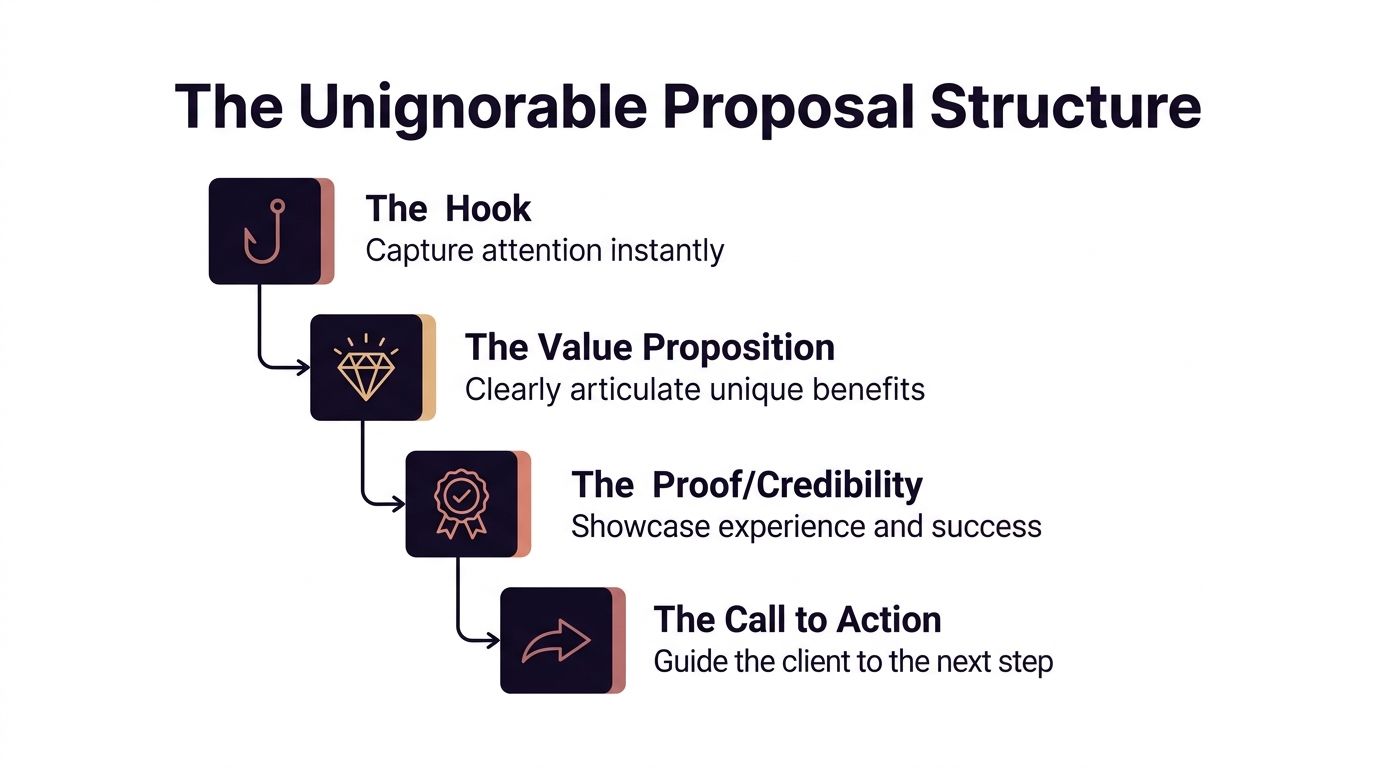
In RFP contexts, 73% of winning proposals contain personalized, buyer-pain-focused cover letters. A structure that starts with the client’s exact terminology, includes one relevant proof point, and maps your solution directly to the request can generate 2.3x more positive evaluator feedback (Arphie on proposal cover letter structure).
For a deeper breakdown of proposal formatting on freelancing platforms, this guide on format for a proposal letter is a useful companion.
The Hook
The first line decides whether the rest gets read.
Do not open with thanks, introductions, or generic enthusiasm. Open with recognition. Show the client you understand the exact job in front of you.
Hook formula
Start with the client’s problem, not your identity.
Weak:
Hi, I’m a full-stack developer with several years of experience and I’d love to help with your project.
Stronger:
You need a developer who can stabilize the existing Laravel app first, then add new features without creating more regressions.
That second line does two jobs. It proves you read the post, and it frames the work in the client’s language.
The Value Proposition
Now tell them how you think about solving the problem.
Many freelancers at this stage dump a service list. Do not do that. The client does not need “SEO, content, audits, backlinks, GA4, CRO, technical fixes” in one breath. They need a believable path from current pain to desired outcome.
What to say instead
- Tie your skill to their outcome
- Name your approach briefly
- Keep it concrete
Example for SEO:
I’d start by isolating whether the drop came from technical changes, indexation issues, or content cannibalization, then prioritize fixes that can affect the pages already closest to recovery.
Example for design:
If the goal is a cleaner SaaS homepage that converts better, I’d focus first on hierarchy, offer clarity, and visual proof points before touching secondary pages.
Example for paid ads:
I’d separate account cleanup from growth work so we do not scale inefficient campaigns before the tracking and structure are reliable.
The Proof
Use one proof point, not five.
A lot of freelancers sabotage themselves here by attaching everything they have ever done. The better move is one relevant example that feels close to the client’s current situation.
Proof works when it feels adjacent
Similar problem, similar stakes, similar deliverable.
Weak:
I’ve worked with many clients across various industries and always deliver high-quality work.
Stronger:
I recently helped a B2B service team rebuild underperforming landing pages after a rushed launch. The main fix was clarifying the offer and tightening the page flow, which is similar to what your brief suggests.
Notice what this does. It gives context without bloating the message. It also avoids sounding copied.
If you do have a metric that is already verified and relevant, use it carefully. If you do not, describe the result qualitatively. On Upwork, specificity matters more than bravado.
The Call to Action
Most proposals end lazily.
“Let me know if you want to discuss” is not offensive, but it creates no momentum. The client has to decide what happens next. Remove that friction.
Better calls to action are small, clear, and easy to say yes to.
Examples:
- For vague jobs
“If helpful, I can outline the likely scope and the fastest way to tackle phase one.” - For technical work
“Send the current stack details or repo summary and I can tell you where I’d start.” - For marketing work
“If you share the account history or current funnel, I can point out the first issues I’d audit.”
A full compact template
Here is a reliable structure:
You need [specific outcome tied to their brief].
From your post, the key issue looks like [pain point or constraint]. I’d approach it by [brief method connected to their goal].
I’ve handled similar work in [relevant niche or adjacent situation], especially where [matching challenge].
If you want, send [one low-friction asset or detail], and I can outline the best next step.
That is enough for many jobs.
Why this structure works on Upwork
It respects how clients read.
They do not read proposals like resumes. They scan for signs of fit, clarity, and low risk. This structure helps them answer four silent questions fast:
- Did this person read my post?
- Do they understand the real problem?
- Have they handled something similar?
- What happens if I reply?
If your cover letter proposal answers those four questions quickly, it becomes hard to ignore.
Proposal Templates for Different Job Types
Templates help when they reduce hesitation. They hurt when they flatten your voice.
The right way to use them is as scaffolding. Keep the skeleton. Rewrite the muscle every time.
If you want more examples to adapt, this collection of examples of job proposal formats is useful for building your own swipe file.
Web development template
This works well for builds, bug fixes, migrations, and app support.
You need someone who can [restate technical outcome] without slowing the project down with unnecessary back-and-forth.
From your brief, the main concern looks like [risk, deadline, messy handoff, unstable codebase]. My approach would be to first isolate [critical technical issue], then handle [next priority] so the work stays predictable.
I’ve worked on similar jobs where the primary challenge was not just coding the feature, but reducing delivery risk and keeping communication clear.
If you share the current stack or a short summary of what is already built, I can tell you the cleanest starting point.
Why it works: technical clients want confidence and order. This wording reduces perceived chaos.
SEO and marketing template
This works for audits, growth retainers, content strategy, paid media, and recovery projects.
Your post suggests the bigger issue is not just getting more traffic, but improving the quality of traffic and the path to conversion.
I’d start by checking whether the main bottleneck sits in acquisition, tracking, or page-level conversion. That prevents wasting time on channel tactics before the foundation is clear.
I’ve handled similar situations where the visible problem looked like weak performance, but the actual fix came from tightening the funnel and prioritizing the highest-impact pages first.
If you want, send the current goals and the channels already in play, and I can outline how I’d prioritize the first round of work.
Why it works: it sounds commercial, not just tactical. Clients buying marketing want business thinking.
Graphic design template
Design buyers usually respond to taste, clarity, and confidence. They do not want a long essay.
You need design that fits the brand and gives the client-facing material a more polished direction.
From the brief, I’d pay close attention to [brand consistency, hierarchy, readability, conversion intent, ad performance, presentation flow]. That is usually where good-looking design separates from useful design.
I’ve worked on projects where the challenge was turning rough direction into a clean system that still felt on-brand and easy to approve.
If you share the current assets or references you like and dislike, I can tell you how I’d approach the visual direction.
Why it works: it shows taste without sounding vague or overly artistic.
Content writing template
Content proposals fail when they sound like generic writing service ads.
You do not just need a writer. You need someone who can match the intent, structure the piece well, and make it sound like it belongs to your brand.
Based on your brief, I’d focus on [search intent, audience sophistication, product understanding, thought-leadership tone, conversion path], because that will determine whether the draft feels strategic or generic.
I’ve worked on similar assignments where the difference came from getting the angle right before drafting, not from adding more words.
If you send the target audience and an example of content you already like, I can suggest the right angle before we start.
Why it works: it positions writing as problem-solving, not typing.
A template should save time on structure. It should not save time on thinking.
Common Mistakes That Get Your Proposal Ignored
Most proposal problems are not dramatic. They are small habits that lower trust.
The cost is high. 83% of hiring managers prefer candidates who submit cover letters even when optional, and 81% of rejections stem from the cover letter alone. People who consistently submit well-crafted proposals see a 35.8% hire rate, compared with 21.2% for those who rarely submit them (Rothman Career Coach on cover letters in 2025).

Mistake one, opening with yourself
Clients care about themselves first. That is normal.
Instead of this:
Hi, my name is Alex and I’m an expert freelancer with years of experience.
Do this:
You need a cleaner handoff from strategy to execution, not just another person completing isolated tasks.
The second version enters the client’s world immediately.
Mistake two, writing a wall of text
A dense proposal feels expensive to read.
Instead of this:
Long paragraphs with every service, every credential, every software tool, and every past role.
Do this:
- Open fast with the exact problem
- Add one useful angle on how you would approach it
- Include one proof point
- End with one next step
Short does not mean shallow. It means edited.
Mistake three, attaching irrelevant proof
Freelancers often send portfolio items they are proud of, not items the client can map to the job.
Instead of this:
Sending your favorite branding project to a client hiring for landing page CRO.
Do this:
Send the work that solves the closest version of the problem, even if it is less glamorous.
Mistake four, answering screening questions lazily
Many freelancers treat the proposal seriously and the screening questions casually. Clients often notice the opposite. Screening answers can reveal whether you read carefully and can follow instructions.
A weak answer is broad and self-promotional. A strong answer is direct, job-specific, and concise.
Mistake five, submitting too slowly
This is the one many people resist because it feels less craft-driven. But timing matters.
If your system requires starting from a blank page every time, you will either submit fewer bids or lower your quality when you rush. Neither scales well.
The fix is not choosing between quality and quantity. The fix is building a process that protects both.
Scaling Your Outreach with Automation and Analytics
Once the manual process works, the next bottleneck appears fast. Volume.
A freelancer can write a handful of strong proposals a day manually. An agency managing several specialists, multiple niches, and different Upwork profiles runs into a different problem. Consistency slips. Follow-up slows down. Good jobs get missed because no one saw them quickly enough.
Where agencies usually break
The first issue is proposal fatigue. The second is coordination.
For agencies managing multiple Upwork accounts, proposal fatigue affects 60% of teams. The same source notes that feedback-loop AI training using simple thumbs-up or thumbs-down signals can produce a 15% higher invite response rate, while multi-user dashboards help agencies capture 3x their typical lead volume (Instrumentl on proposal workflow gaps and agency scaling).
Those numbers matter because they point to a workflow problem, not just a writing problem.
What automation should actually do
Bad automation removes thought. Useful automation removes delay.
The practical use case looks like this:
- Job filtering so weak-fit opportunities do not eat attention
- Draft generation based on your proven proposal structure
- Fast submission while the posting is still fresh
- Reply handling so good leads do not cool off
- Analytics so you can compare hooks, niches, and profile positioning over time
That is different from blasting generic bids. A strong system still needs your judgment. It just stops wasting it on repetitive steps.
One option in this category is automate Upwork proposals, which explains how automated workflows can support faster submission and message handling on the platform. In practice, tools such as Earlybird AI are built around this model. They learn preferred jobs from feedback, craft personalized proposals from your profile and prior context, and help agencies manage multi-user workflows without turning every bidder into a separate manual sales desk.
The trade-off to manage carefully
Automation introduces a real risk if you use it lazily. If every proposal sounds polished but emotionally flat, clients notice. If every profile submits the same style of message, patterns emerge.
That is why the safest and most effective setup is hybrid:
Use humans for
- Offer design
- Portfolio selection
- Positioning decisions
- Reviewing edge-case opportunities
- Refining the message after client replies
Use systems for
- Monitoring new jobs
- Producing first drafts
- Applying consistent structure
- Speeding up submission
- Tracking response patterns
The point is not to remove the freelancer from the sales process. The point is to stop spending human energy on mechanical repetition.
Analytics changes how you improve
Without data, most freelancers change their proposal style based on mood.
With analytics, you can start spotting patterns. Certain hooks work better for redesign jobs than for retainers. Certain portfolio pieces trigger more replies in one niche than another. One profile positioning angle attracts more serious clients, while another attracts price shoppers.
That feedback loop matters more than writing theatrically. Over time, your best-performing cover letter proposals stop being random acts of inspiration. They become a system.
Frequently Asked Questions About Upwork Proposals
How do I write a proposal when the job description is vague
Do not guess too hard. Name the likely problem, then show how you would clarify it.
A good line is: “The brief is broad, so I’d start by tightening the scope around the first deliverable and the main success criteria.” That shows initiative without pretending you know details you do not have.
Will using AI get my Upwork account banned
Using tools is not the same as using them recklessly. The risk comes from low-quality automation, repetitive patterns, and behavior that looks unnatural. The safer approach is to use AI to speed up research, drafting, and organization while keeping the message aligned with the actual job and your actual experience.
How should I follow up without being annoying
Keep follow-up useful, not needy.
A weak follow-up asks whether they saw your message. A better follow-up adds a small insight, clarifies your approach, or offers a next step tied to the brief. If you have nothing useful to add, do not send filler.
Should fixed-price and hourly proposals sound different
Yes. Fixed-price proposals should reduce scope ambiguity. Hourly proposals should reduce execution uncertainty.
For fixed-price jobs, emphasize boundaries, milestones, and what is included first. For hourly work, emphasize decision-making, responsiveness, and how you work through evolving tasks without wasting time.
How long should Upwork cover letter proposals be
Short enough to skim, specific enough to feel written for the client. Most losing proposals are too broad, not too brief. If the first few lines do not prove fit, extra paragraphs rarely save you.
If your agency already knows how to deliver but struggles to keep proposal quality high at scale, Earlybird AI is worth evaluating. It fits the hybrid approach outlined above by helping teams find jobs faster, draft personalized Upwork proposals, manage replies, and support multi-user workflows without turning outreach into a full-time manual process.