← Back To Blog
How to Create an Agency in 2026 A Modern Playbook

Thinking about starting your own agency? Let’s be honest—being great at your craft isn't enough anymore. If you want to build a business that actually grows (and doesn't burn you out), you need a smart, scalable system for winning clients from the very beginning.
This guide is the blueprint I wish I had, built on modern strategies that actually get results.
Your Modern Blueprint for Building an Agency

The old way of starting an agency is broken. The typical path—being a talented freelancer who just starts hiring help—almost always leads to the same place: exhaustion, inconsistent cash flow, and a business that falls apart the second you take a day off.
The new model is completely different. It's about building a true agency machine from day one. That means creating repeatable processes for everything you do, from finding your next client to delivering incredible work. It’s about being strategic instead of just putting out fires.
The Shift from Freelancer to Agency Owner
Making the leap to a real agency starts with a mental shift. You have to stop thinking like you're selling your time and start thinking like you're building an asset. This guide will walk you through that entire process, step by step, so you can build a resilient and profitable business.
We're going to cover all the essentials you need to build a company that lasts:
- Finding Your Niche: How to get crystal clear on your positioning so you can attract better, higher-paying clients.
- Legal & Financial Setup: The boring but non-negotiable stuff that protects your business and keeps the money flowing correctly.
- Service Packaging: How to structure your offers to be irresistible to clients and profitable for you to deliver.
- Building Your Team: Knowing exactly when to hire and who to bring on board to fuel your growth.
The real difference between a struggling freelancer and a successful agency owner comes down to one thing: systems. One runs on chaos and manual effort; the other runs on predictable, repeatable processes.
A Focus on Automated Growth
Let's face it, one of the biggest headaches for any new agency is getting a steady stream of clients. Grinding it out with manual outreach is a massive time-suck that rarely pays off.
That’s why this blueprint focuses heavily on smart automation. I'm going to show you exactly how to turn a platform like Upwork from a freelance rat race into a powerful, automated lead-generation engine. Imagine waking up to qualified leads and meetings already booked on your calendar—without you lifting a finger to send proposals.
Consider this your starting point for building that machine. It’s for anyone who wants to escape the feast-or-famine cycle and finally build a business with predictable revenue and scalable operations. Let's get to work and build your agency the right way.
Right, let's get your agency's foundation poured. Everyone gets excited about landing that first big client, but the agencies that actually last are the ones that do the boring work upfront.
Skipping this part is like building a house on sand. It might look fine for a little while, but it’s guaranteed to collapse when the first storm hits. Getting your legal, financial, and strategic ducks in a row isn't just busywork—it’s what will save you from chaos and headaches down the line.
The first, most critical decision? Deciding who you are and who you serve. Trying to be a jack-of-all-trades is the fastest path to being a master of none, and you'll end up competing with everyone on price. That's a race to the bottom you don't want to run.
Finding Your Profitable Niche
Your niche is your identity. It's your agency's North Star. It dictates who you help, what you do for them, and why they should pick you out of a lineup of a hundred other generalist agencies. A sharp, well-defined niche doesn't just attract your dream clients; it actively repels the ones who would have been a nightmare to work with anyway.
Think about it. If you run a sustainable fashion brand, are you going to hire a generic "digital marketing agency"? Or are you going to choose the one that only works with e-commerce stores in the ethical and sustainable space? It’s a no-brainer. The specialist gets their world, speaks their language, and already knows the pitfalls to avoid.
To find your sweet spot, look at it from a few different angles:
- Industry-Specific: Do you have a background or deep-seated interest in a specific field, like SaaS, local home services, or healthcare?
- Service-Specific: Are you an absolute wizard at one particular thing? Maybe it's Google Ads for B2B tech or creating short-form video content that actually converts.
- Audience-Specific: Can you zero in on a certain type of customer? Think venture-backed startups, family-owned restaurants, or authors and personal brands.
The goal isn't to limit your potential; it's to concentrate your power. A tight niche makes your marketing sharper, your sales calls easier, and your service delivery a well-oiled machine because you're solving the same core problems over and over.
Handling the Legal and Financial Essentials
Once you know who you're going to be, it's time to make it official. I know, this is the part that makes most creatives' eyes glaze over, but trust me, it's non-negotiable for protecting yourself and looking like a professional.
Most people start with two main options: a Sole Proprietorship or an LLC.
A Sole Proprietorship is the default—if you start doing business, you're automatically one. It's simple, with no paperwork needed. The huge downside? There's zero legal separation between you and the business. If your agency gets sued, your personal assets—your house, your car, your savings—are on the line.
An LLC (Limited Liability Company) fixes that by creating a separate legal entity. It acts as a firewall between your business liabilities and your personal life. Yes, it costs a little bit to file and involves some paperwork, but that small investment is worth a fortune in peace of mind. For nearly everyone starting an agency, forming an LLC is the smartest move you can make.
Next up: contracts. My rule is simple: no signed contract, no work. Ever. A good contract isn't about distrust; it’s about creating crystal-clear expectations for both sides. At a minimum, it must spell out:
- The exact scope of work and all deliverables.
- Payment terms: how much, when it's due, and what happens if it's late.
- The project timeline and any important milestones.
- Who owns the final work and how either party can terminate the agreement.
My very first client contract was a clunky one-page document I cobbled together. I felt awkward sending it, but it became my savior when the client started asking for "just one more quick thing" for the fifth time. That taught me a powerful lesson: clear contracts don't create friction; they prevent it and lead to better client relationships.
Finally, get your money right from day one. Open a dedicated business bank account. Do not mix your personal and business finances—it creates a nightmare for bookkeeping, taxes, and actually knowing if you're profitable. Then, sign up for a simple billing tool to automate your invoicing and payment follow-ups. Getting paid on time shouldn't depend on you sending awkward reminder emails. These simple financial habits are what separate a real business from an expensive hobby.
Designing and Pricing Your Core Agency Services
The way you package and price your services is the real engine of your agency. It’s what separates a glorified freelance gig—where you’re perpetually stuck trading hours for dollars—from a legitimate, scalable business with predictable income. Getting this right is all about moving past hourly rates to create offers that clients actually understand and are excited to invest in.
Your goal is to stop selling your time and start selling outcomes. Your value isn't measured by the hours you log in a spreadsheet; it's measured in the problems you solve and the results you deliver. This shift in mindset is the foundation of a truly profitable service menu.
Moving Beyond Hourly Billing
Hourly billing feels safe when you're starting out, but it quickly turns into a trap. It actually punishes you for being good at your job—the faster and more efficient you become, the less you earn for the same project. It also forces your clients to obsess over the cost per hour instead of the value you're creating, which almost always leads to micromanagement and scope creep.
Let's look at three much better models that tie your pricing directly to the value you provide.
Project-Based Fees: You charge one flat fee for a project with a clear beginning and end. This works perfectly for one-off needs like a website redesign or developing a core brand strategy. The secret here is having an ironclad scope of work document to prevent those "can you just add..." requests.
Monthly Retainers: This is the gold standard for predictable cash flow. The client pays a recurring monthly fee for ongoing access to your team and services. It’s ideal for work that never really "ends," like SEO, content creation, or social media management, and helps build lasting partnerships.
Productized Services: Here, you turn a specific service into a fixed-price, off-the-shelf product. Think of it as bottling your expertise. It makes the sales process incredibly simple and ensures your deliverables are consistent every single time.
A project fee pays for a defined task. A retainer pays for an ongoing partnership and results. A productized service pays for a pre-packaged solution to a very specific problem. Pick the model that makes the most sense for the service you're offering.
Building Your Service Tiers
One of the most effective ways to present your services is with tiered packages. This is a classic for a reason—it works. By offering a few clear options, often labeled something like "Starter," "Growth," and "Scale," you make the buying decision much easier for the client.
For instance, a new email marketing agency could structure its retainers like this. If you happen to be interested in this niche, you can check out our comprehensive guide on how to start an email marketing agency.
Example Marketing Agency Tiers:
Foundation Package ($1,500/mo): This is the entry-level option that covers the essentials. It might include weekly email campaigns, managing a list of up to 5,000 subscribers, and basic performance reports. It’s the perfect fit for clients who are just getting their feet wet with email marketing.
Growth Package ($3,500/mo): This is your sweet spot—the one you want most clients to choose. It builds on the Foundation package by adding automated welcome sequences, lead nurturing funnels, and A/B testing to optimize performance. This tier is for businesses that are serious about using email to drive revenue.
Scale Package ($6,000+/mo): The premium, all-in offering. Here, you could add advanced segmentation, SMS marketing integration, and a dedicated monthly strategy call. This is built for larger clients who want a true growth partner to help them maximize customer lifetime value.
This tiered approach does three powerful things at once. It anchors your value, makes your mid-tier package look like the best possible deal (a psychological trick called "price anchoring"), and gives you a built-in upsell path as your clients grow. You’re not just selling a service; you’re showing them a clear journey to success.
The Modern Agency Client Acquisition Playbook
If you think building an agency means endless cold calls and hoping for referrals, it's time for a major rethink. Relying on manual outreach is a surefire way to burn out. To truly scale, you need a predictable, automated system that brings clients to you.
I'm talking about turning a platform like Upwork from a crowded freelancer marketplace into your own private lead generation engine. This isn't about out-bidding everyone; it's about being smarter and faster to win the high-value jobs.
Optimizing Your Agency Profile for Credibility
Before you can flip any switches on automation, you have to get your foundation right. On Upwork, your agency profile is your digital storefront. A half-baked profile says "amateur," but a polished, specialized one immediately positions you as an expert.
Think of your profile as a dedicated landing page designed to convert. It needs to zero in on your niche and speak directly to your ideal client's biggest headaches.
- Nail your tagline. Ditch generic labels like "Full-Service Digital Marketing Agency." Get specific. Something like, "We Build Automated Lead Funnels for B2B SaaS Companies" instantly tells the right people they're in the right place.
- Show, don't just tell, with case studies. Don't just list past clients. Craft compelling stories that detail the client's initial problem, the solution you implemented, and—most importantly—the measurable results. Use real numbers.
- Flesh out your team profiles. Showcase the experts behind the curtain. Make sure every team member's profile is complete, professional, and highlights their unique skills. This adds serious depth and credibility to your agency.
A strong profile isn't just about looking good. It builds immediate trust and pre-sells prospects before you've even sent a single message. It's the bedrock of your entire acquisition strategy.
The Automation Game-Changer
Here's where you gain a massive, almost unfair, advantage. The real key to winning on Upwork isn't about working harder—it’s about using smart automation to work faster.
Manually hunting for jobs and writing proposals from scratch is a losing game. By the time you find a great fit and craft a thoughtful response, you're already buried under dozens of other applicants. Automation flips this entire dynamic on its head.
This is where a tool like Earlybird AI becomes the heart of your client acquisition machine. You set it up once to act like your own dedicated Sales Development Rep (SDR) that never sleeps. It scans Upwork 24/7 for projects that perfectly match your pre-defined criteria.
When a perfect-fit job gets posted, Earlybird doesn't just send you a notification—it takes action. Within minutes, it uses your refined templates to generate a hyper-personalized proposal and sends it automatically. You consistently show up as one of the very first applicants a client sees. Speed is everything.
The system can even handle the initial back-and-forth, answering common questions and guiding the conversation toward a discovery call. Of course, this is just one piece of the puzzle. To round out your skills, it's worth getting familiar with other tactics, like crafting powerful lead generation emails.
This frees you up to focus on what actually matters: talking to warm, qualified leads and closing deals. You’re no longer stuck in the prospecting grind. This consistent flow of new leads is what allows you to offer different pricing structures, whether that's project-based work, retainers, or productized services.
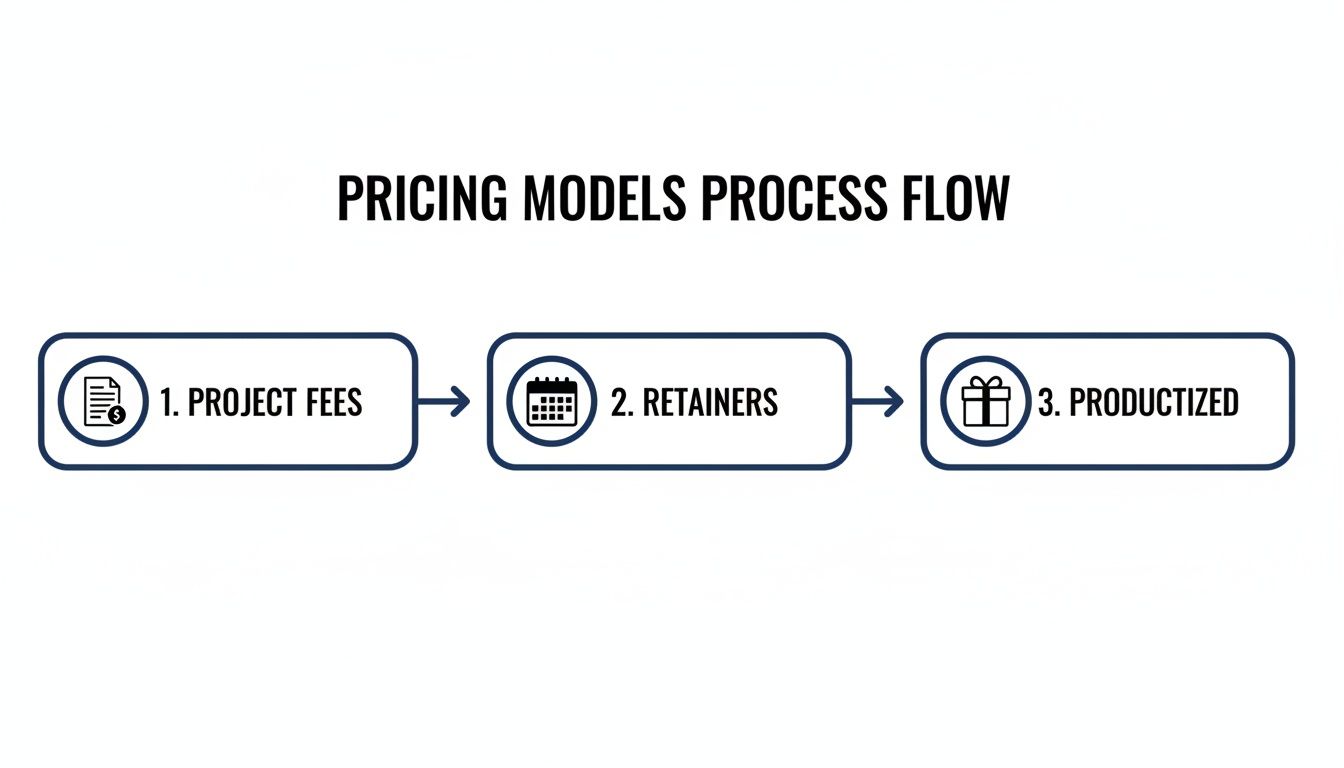
As you can see, a reliable pipeline is what fuels the entire business model, allowing you to build a mix of revenue streams.
Replacing Your SDR with AI
There's a reason the sales automation market is exploding. Projections show it rocketing from $12.5 billion in 2026 to a staggering $22.7 billion by 2033. Automated software is already dominating, making up over 72% of the market because it flat-out works. You can learn more about this trend in this detailed report.
When you use Earlybird AI to automate your Upwork proposals and initial client chats, you're tapping directly into this powerful shift. You’re essentially replacing the need for a human SDR to do the tedious, top-of-funnel work.
The results speak for themselves. Agencies that adopt this system see double-digit reply rates and dramatically shorter sales cycles. You’re not just saving time—you’re building a scalable, predictable client acquisition machine that fuels your growth month after month.
Building Repeatable Systems for Team and Client Management
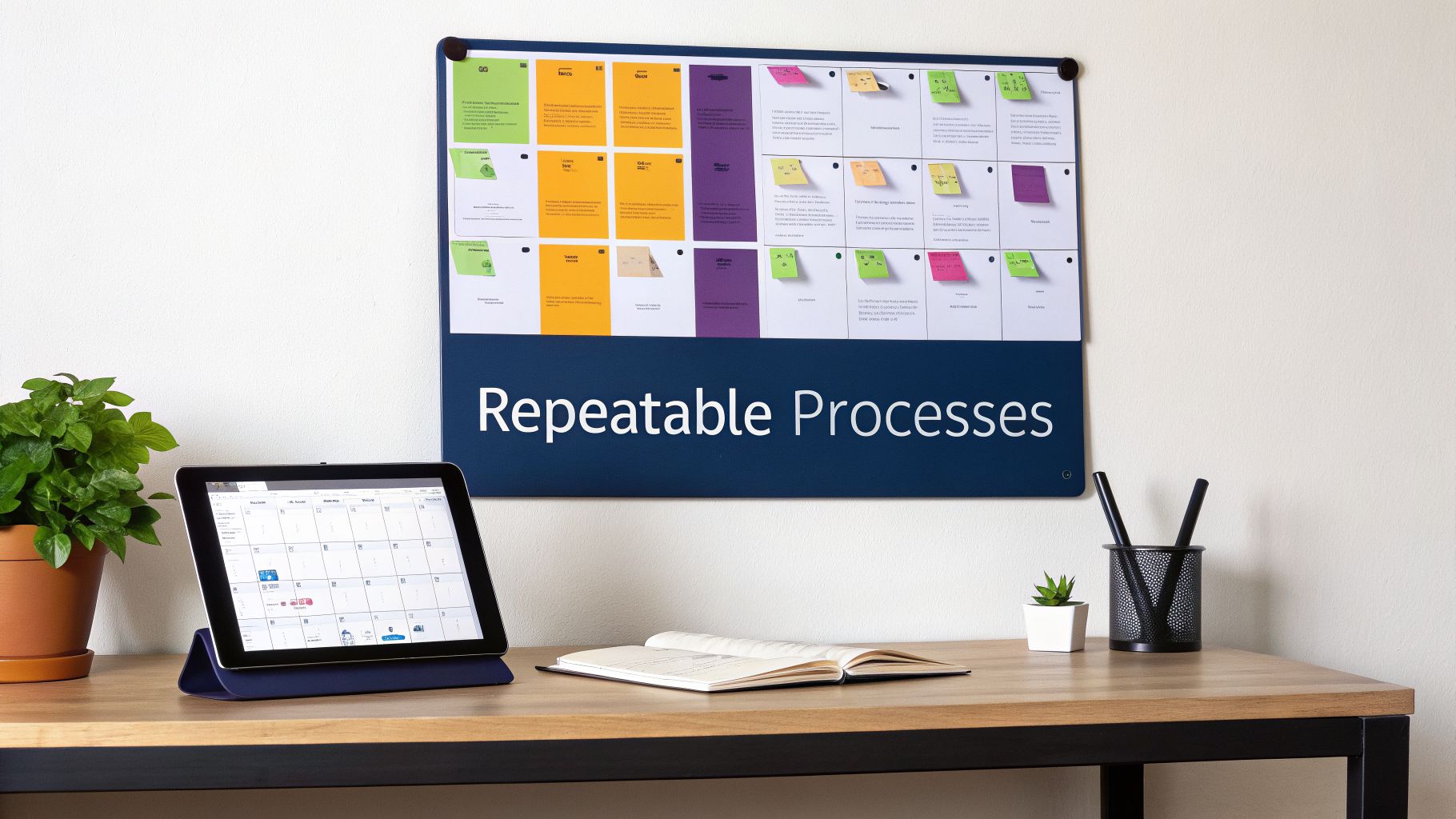
Once you start landing more clients, you’ll hit a wall. Fast. There are only so many hours in the day, and you can’t keep doing everything yourself forever. To grow beyond a one-person show, you have to shift your mindset from being a doer to being a builder—a builder of systems.
Solid processes are what turn a fragile solo operation into a resilient, scalable agency. They’re your guarantee that every client gets the same top-notch experience and that your team can run smoothly, whether you’re in the weeds with them or not. This is where you bottle up your secret sauce and make it repeatable.
Creating Your Agency's Core SOPs
Standard Operating Procedures (SOPs) are the absolute backbone of an agency that’s built to last. Forget stuffy, bureaucratic manuals; think of them as living guides that capture your agency's unique way of getting things done. They kill the guesswork and give your team the confidence to deliver consistently.
You don't need to document everything at once. Just start with the most critical, repetitive tasks in your business. Simple checklists and templates in a shared space like Google Docs or Notion are perfect.
I’d recommend focusing on these three areas first:
- Client Onboarding: What happens the second a client signs? Map out every single step, from the welcome email and kickoff call agenda to getting them set up in your project management tool.
- Project Delivery: Take each of your services and break it down into a clear, step-by-step process. For a "Foundation" marketing package, that might mean a checklist for the initial audit, another for content creation, and a template for weekly reports.
- Communication Protocols: Set clear rules of engagement for how your team talks to clients and each other. This means setting expectations for email response times and defining the exact purpose of a weekly check-in call.
The goal of an SOP isn't to micromanage; it's to provide clarity. It frees up your mental energy from answering the same questions over and over, letting you focus on strategy instead of day-to-day firefighting.
A dead-simple way to build these is to just record your screen while you do a task. Talk through each step as you go. That video becomes the perfect source material for a written checklist your first hire can follow.
Leveraging Automation in Your Workflows
As you start documenting your processes, you'll immediately spot administrative tasks that are begging to be automated. This is a non-negotiable step when you create an agency built for modern efficiency. Seriously, launching an agency in 2026 without leaning on AI is a huge mistake.
Companies that are already using AI automation are seeing an average ROI of 171%. It’s no surprise the AI Agents market is projected to explode from $7.84 billion in 2025 to $52.62 billion by 2030. When you apply this to lead generation on a platform like Upwork, you can cut costs by 30%, boost leads by 80%, and see conversions jump by 77%. You can dig into these impressive AI automation findings to see the full picture.
Knowing When to Make Your First Hire
Deciding to hire someone is one of the most gut-wrenching moments for any new agency owner. The truth is, the right time is when you consistently feel the pain of being the bottleneck.
Are you turning down good projects because you just don't have the time? Is the quality of your work starting to slip because you're stretched too thin? Those aren't just growing pains; they're giant, flashing signs telling you it's time to hire.
And please, don't just hire another you. Your first hire should fill a specific gap and, most importantly, free you up to do the one thing only you can do: grow the business.
Your first hire will almost always be one of two people:
- A Specialist: This is someone who takes over the core "doing" of the service. If you're a design agency, you hire another designer. They execute the work, which frees you up for sales calls, client strategy, and management.
- A Project Manager: This person is the organizational glue for the whole agency. They handle client communication, manage timelines, and make sure the trains run on time, pulling you out of the administrative chaos.
For most founders, hiring a specialist first is the way to go. It directly increases your capacity to take on more billable work, and that cash flow is what will fund all your future growth. The project manager usually comes next, once you have a few specialists and the logistics start getting too messy to handle alone. This methodical approach is key to creating an agency that can scale without breaking.
Scaling Your Agency with Data and Smart Automation
Sustainable growth doesn't happen by accident—it’s engineered. If you want to scale past six figures, you have to make a crucial shift: stop working in your business and start working on it. This final piece of the puzzle is all about using data to make smart decisions, supercharged by automation.
Forget relying on gut feelings. Real growth is driven by numbers. It's time to get obsessed with the metrics that actually move the needle. When you start analyzing this data, you’ll quickly spot your most profitable services and ideal client types, which tells you exactly where to double down.
This is how you build a predictable growth engine instead of just crossing your fingers each month.
The Key Metrics That Drive Growth
You don’t need a massive, complicated dashboard filled with vanity metrics. To build an agency that scales, you just need to keep a close eye on the vital signs of your business's health.
These are the non-negotiables:
- Client Acquisition Cost (CAC): How much do you spend in time and money to land one new client? This number is a gut check on the efficiency of your sales and marketing efforts.
- Customer Lifetime Value (LTV): What’s the total revenue you can realistically expect from a single client over your entire relationship? This is the ultimate measure of client satisfaction and retention.
- Profit Margin Per Client: Don't just look at the top-line revenue. You need to know the actual profit you make from each client after factoring in all costs, especially your team's time.
The magic really happens when you achieve a healthy LTV to CAC ratio. A strong agency should aim for at least a 3:1 ratio. This means for every dollar you spend acquiring a client, you’re generating at least three dollars in lifetime value.
Analyzing these numbers will reveal some powerful truths. You might discover that your highest-paying client is actually your least profitable because they're so demanding. Or maybe you'll find a smaller, "productized" service has a fantastic profit margin and is incredibly easy to sell. These insights are pure gold.
Expanding Automation Beyond Lead Generation
Automation isn't just a tool for finding leads; it’s your key to creating operational excellence across the entire agency. As you gear up for growth, start looking for repetitive tasks you can automate in other areas, like client reporting or internal project management. You'll find a ton of great options in our roundup of software for digital marketing agency operations.
The expanding use of AI in sales prospecting is a perfect example of this trend. A staggering 81% of sales teams are already using or experimenting with AI. What’s more, teams that adopt it are 1.3x more likely to see revenue growth. The market for AI-powered SDRs—which is precisely what a tool like Earlybird AI delivers for finding and messaging clients—is projected to hit $15 billion by 2030. You can see just how deep this trend runs in this report on the state of AI in sales prospecting.
By combining real-time analytics with smart, strategic automation, you’re building a system that fuels predictable growth. This data-backed approach is what finally frees you up to step into the role of a true CEO.
Common Questions on the Agency Path
As you map out your agency's future, a few big questions always seem to pop up. Let's tackle them head-on with some straight-to-the-point advice drawn from real-world experience.
How Much Cash Do I Really Need to Start an Agency?
Starting a service-based agency can be surprisingly lean. The biggest initial costs are usually just the administrative basics: filing for an LLC, grabbing a professional domain name and web hosting, and a few essential software subscriptions for things like project management.
Honestly, you can get the essentials locked in for under $1,000. The most valuable thing you'll invest at the start isn't money—it's your time building out your processes and landing those first few critical clients.
Is a Physical Office Necessary to Start?
Absolutely not. A fully remote agency isn't just a possibility anymore; it’s often a huge strategic advantage, especially in the beginning. Running your business remotely keeps your overhead costs practically non-existent.
Forget about rent. Your energy is much better spent on building a rock-solid digital foundation. A well-organized project management system and clear remote communication policies are infinitely more valuable than a physical office. Plus, it opens up a global talent pool.
When Is the Right Time to Make My First Hire?
You'll know it's time when you become the bottleneck. That feeling of "pain" is very real—it's when you're consistently turning down good projects or getting that sinking feeling that quality is about to slip because you're stretched too thin.
Don't wait until you're completely drowning. Your first hire is a strategic move, not a desperate one. This person should take over the core delivery work, which frees you up to focus on the things only you can do: sales, high-level client strategy, and actually growing the business.
Can I Actually Land High-Quality Clients on Upwork?
Yes, without a doubt. But you have to approach Upwork differently. The platform is full of high-value clients, but they aren't looking for the cheapest freelancer. They're looking for expert partners.
The key is to position yourself as a premium agency from day one. This means a polished profile, compelling case studies that prove your value, and a system for sending out highly personalized proposals fast. When you do this, you attract clients who want to solve major business challenges, not just get a small task done.
Tired of the manual grind for leads? It’s time to build a client acquisition machine that works for you. Earlybird AI acts as your 24/7 sales team for Upwork, finding your ideal jobs and sending hyper-personalized proposals in minutes. See how other agencies are winning better clients with way less effort.