← Back To Blog
Creating upwork account: Get high-value clients

Diving into a platform like Upwork can feel like a big commitment, but getting your account set up is more than just busywork. It’s your first real step toward connecting with a global pool of clients who are actively looking for—and paying for—your specific skills.
Why Bother with an Upwork Account in 2026?
Before you even think about hitting that "Sign Up" button, let’s be clear about what Upwork is and what it isn't. This isn't just another job board you scroll through endlessly. It's a dynamic marketplace where quality talent in development, marketing, design, and writing is always in high demand. For a freelancer or a small agency ready to grow, an Upwork profile is a direct pipeline to that demand.
Freelancing has completely transformed over the last decade. It's no longer a side hustle for most; it’s a full-fledged career path for millions who value their autonomy. Setting up an Upwork account in 2026 means you’re plugging directly into this modern workforce.
The Opportunity Is Huge—Here's the Proof
This isn't just a trend; the numbers are staggering. The freelance economy is booming. Recent industry reports show that over 28% of skilled knowledge workers worldwide now identify as freelancers. We're talking about a massive, skilled segment of the global workforce.
Even more impressive, these professionals collectively earned an incredible $1.5 trillion USD back in 2024. That figure alone shows the sheer potential for building a serious income here. If you want to dig into the numbers yourself, Upwork regularly publishes its own freelancing research.
This isn't about finding another one-off gig. It’s about plugging into a global talent economy where your expertise is a premium commodity. A well-built profile puts you in front of clients who are ready to hire and invest in quality.
This Is About Career Building, Not Just Gig Hunting
Treat your Upwork account as a powerful new client acquisition channel—one where you can build a solid reputation, show off your best work, and attract long-term partners. The platform is built to reward freelancers who deliver high-quality, reliable work, which allows the best to charge higher rates and land more consistent projects over time.
When you invest in building your presence, you're really working toward a few key outcomes:
- Landing High-Value Projects: You can move past the small, quick jobs and start connecting with clients who have substantial budgets and long-term needs.
- Building a Global Reputation: Your job history and client reviews act as powerful social proof, making it easier to attract even better opportunities down the line.
- Earning a Significant Income: With the right approach, your freelance business can easily become your primary—and most profitable—source of revenue.
Let's walk through how to create your account in a way that sets you up for exactly that kind of success.
Alright, let's get you set up on Upwork. The first thing you'll do is make a decision that shapes your entire journey on the platform: choosing between an individual freelancer account and an agency account.
This isn't just a box to check. Think of it as the foundation for your freelance business. An individual account is for the solo flyer. It’s built around you—your skills, your reputation, your personal brand. Every dollar you earn and every review you get is tied directly to your name.
An agency account is your move if you're building a team. It lets you create a main agency profile and then link individual freelancer profiles for your team members. This is the right path if you plan on having multiple people working on projects or want to build a business brand that’s bigger than just one person.
The basic flow on Upwork is pretty simple: you bring the expertise, connect with clients, and get paid.
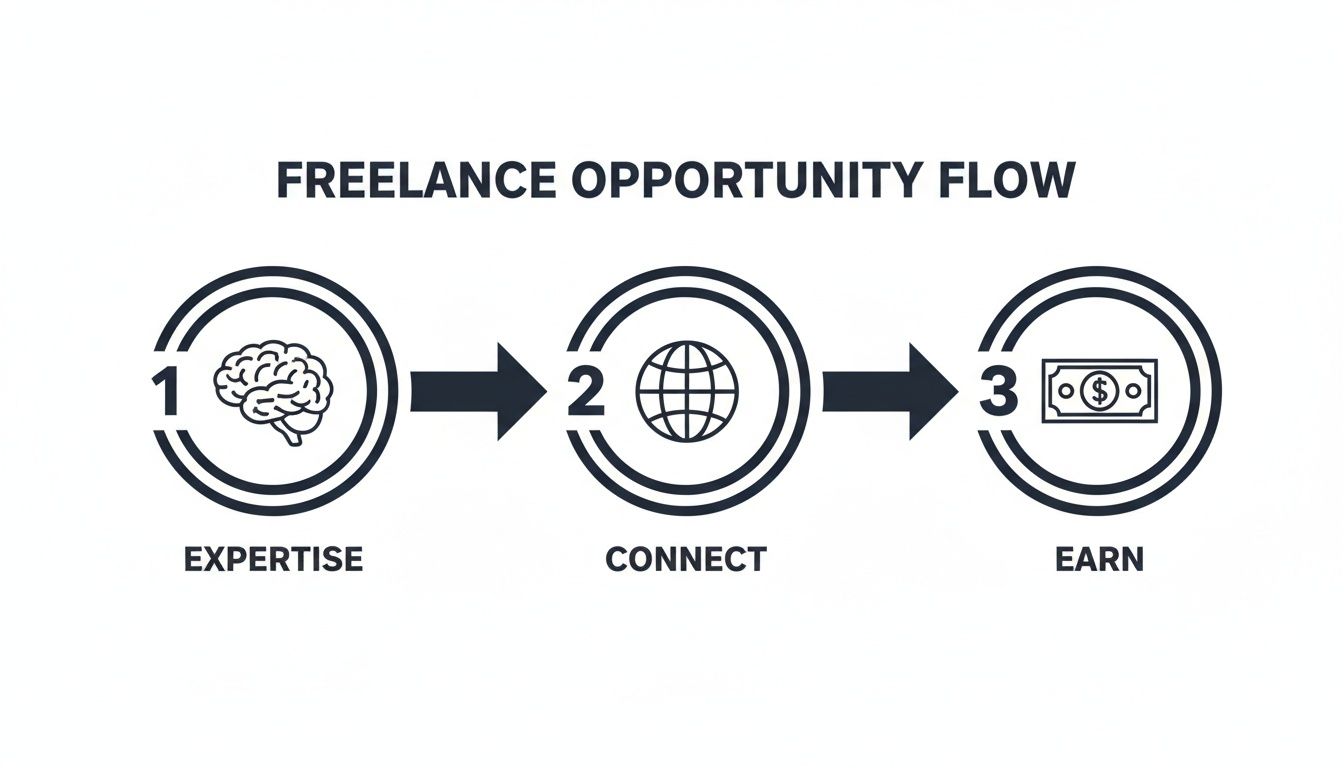
While that sounds easy, it’s the details in between those steps that really determine your success.
Getting Your Core Identity Right
Once you've picked your account type, it’s time for the signup basics, starting with your email. This seems small, but it's your first impression. Use a professional email address. Something like firstname.lastname@gmail.com works just fine, but an old handle from your high school days instantly lowers your credibility.
Next up is your username, which becomes part of your public profile URL. Your best bet is to use your real name or your business name. Make it clean and professional. Most importantly, use your real, full name for your profile. Clients are hiring a person, and seeing a real name goes a long way in building that initial trust.
Finally, you’ll set a password and security question. Don't rush this. Your Upwork account is where your business lives and where your money flows, so securing it with a strong, unique password is a must.
Choosing to use your real name is one of the easiest ways to build trust from day one. Anonymity can feel safe, but on a platform built on professional relationships, transparency is what helps you connect with high-quality clients.
Verification and Building Trust
After you hit submit, Upwork will fire off a verification link to your email. Clicking it confirms the email is yours and officially activates your account. This is just the first of several trust and safety checks you'll go through. They're all there to help keep the platform secure for everyone.
Think of these early steps not as chores, but as the first strategic moves you're making. A professional email, a clear username, and using your real name are small things that add up to a strong first impression. They signal to potential clients that you’re a serious professional ready to do great work.
Making Your Profile Actually Win You Work
Getting your Upwork account approved is just the first step. Now the real work begins. Think of your profile not as a resume, but as a finely-tuned marketing machine designed to attract high-quality clients. You’re stepping onto a very crowded field, so a generic profile simply won’t cut it.

This field is only getting more competitive. More clients are spending serious money on the platform, creating both massive opportunities and fierce competition for top talent.
Your Title Is Your First Impression
Your professional title is the single most important line of text on your profile. It’s the first thing a client sees, and it needs to do more than just state your job. A title like "Web Developer" is a missed opportunity. It tells them what you are, but it doesn't tell them what you can do for them.
A much better approach is to be specific and focus on the results you deliver.
- Generic: "Marketing Specialist"
- Expert: "SaaS Marketing Strategist | Driving User Acquisition & Reducing Churn"
See the difference? The expert title instantly communicates value, speaks to specific business challenges, and promises a solution. It grabs the attention of the right clients while telling the wrong ones to keep scrolling.
Write an Overview That Sells, Not Just Describes
Stop thinking of your profile overview as a summary of your career. It’s your sales pitch. So many freelancers make the mistake of just listing their past job duties. Honestly, clients don’t care about your duties; they care about their problems and whether you can solve them.
Your overview shouldn’t be a story about you. It should be a story about your client, with you positioned as the guide who helps them reach their desired outcome.
Hook them from the very first sentence by speaking directly to a pain point they're experiencing. Show them you understand their world before you even start talking about yourself.
A winning structure looks something like this:
- Hook them with their problem: "Struggling to turn website traffic into paying customers?"
- Present your unique solution: "I help e-commerce brands optimize their checkout process to recover abandoned carts and increase conversion rates by up to 20%."
- Offer some proof: Casually mention impressive results, well-known brands you've worked with (if you have permission!), or your specific process.
- Give them a clear next step: "Send me a message to discuss how we can boost your store's revenue."
Build a Portfolio That Tells a Compelling Story
Your portfolio is where you prove you can walk the walk. This is your most powerful tool for building trust. Don't just upload a few random screenshots of finished projects. Top-tier clients want to see your brain at work—they're buying your thought process, not just a pretty picture.
For every piece you add, frame it as a case study. Explain the client's problem, walk them through the steps you took to solve it, and—most importantly—show the tangible results.
Here’s a simple way to structure each portfolio item:
- The Challenge: Briefly explain what the client was trying to achieve or the obstacle they faced.
- My Approach: Detail your specific strategy and the process you followed.
- The Result: Showcase the outcome with hard numbers. Think "Increased user engagement by 40%" or "Reduced page load time from 5s to 1.5s."
A portfolio built this way does the selling for you. If you want to dive deeper, we have a complete guide on creating a stellar portfolio for Upwork that will really set you apart from the competition.
Navigating Agency Account Creation and Management
So, you're thinking about growing beyond just your own two hands on Upwork? Stepping up from a solo freelancer to running an agency is a huge leap, but it's how you scale your impact and take on those bigger, more complex projects that are impossible to tackle alone.
The first thing to know is that you don't just create an "agency account" from scratch. You'll need to have your own individual freelancer profile first. That personal profile essentially becomes the owner of the agency, giving you the administrative keys to the kingdom. This is actually a great setup, as it lets you keep your personal reputation intact while building a new brand for your team.
Building Your Agency's Identity
Think of your agency profile as your team's digital storefront. It's not just a list of services; it's your chance to tell a compelling story about the specific problems you solve. A vague profile that says "we do web development" gets lost in the noise.
Your agency overview needs to be sharp and specific.
- What are you known for? Pinpoint your niche. Are you the go-to team for building Shopify apps for CPG brands? Or maybe you’re a group of writers specializing in long-form content for the B2B tech space? Specificity wins contracts.
- Who is on your team? Introduce your crew and show how their skills complement each other. Clients are hiring a team, and they want to see the combined firepower.
- Where's the proof? Your portfolio is everything. It shouldn't be a random dump of past work. Curate it to feature your absolute best projects and frame them as case studies that show tangible results.
This isn't just a side hustle; it's a massive business opportunity. The demand is there. Upwork's client base has exploded, with significant growth in recent years chasing billions in annual client spending. You can dig into the numbers yourself and explore the data on Upwork's user growth and market resilience.
An agency account fundamentally changes your role. You stop being a freelancer looking for a gig and become a business owner pursuing contracts. Your mindset shifts from your own skills to your team's collective ability to deliver.
Managing Your Team and Permissions
Once your agency profile is live, it’s time to build your roster. You can invite other freelancers to join your agency, and their individual profiles will be linked to it. This is a powerful feature because clients can see both your agency's brand and the specific expert they’ll be working with directly.
Upwork gives you solid control over your team. You can set different permissions and roles for each member:
- Agency Managers: These are your trusted lieutenants. They can submit proposals, manage contracts, and handle client communications.
- Agency Members: These team members can be assigned to contracts, but they can't manage the business side of things.
Getting this structure right is what allows you to scale without chaos. To get a really detailed walkthrough of the process, our guide on setting up and managing an Upwork agency account breaks down all the operational details. A well-managed agency presents a polished, professional front that gives clients the confidence to sign bigger checks.
Finalizing Your Account for Payments and Security

You’ve built a stellar profile, and now it’s time to handle the money side of things. This part might feel like administrative busywork, but getting it right is what turns your freelance hustle into a real business. After all, landing a great project is only half the battle—you also need a smooth, reliable way to get paid.
First up, you need to tell Upwork where to send your earnings. Head into your settings and connect a payment method. You'll find a few options, and the best one really depends on where you live and your banking preferences.
- Direct to Local Bank: This is often the simplest and most cost-effective way to get your money.
- PayPal: A great option for its speed and universal acceptance, but keep an eye on the fees, which can sometimes be a bit higher than a direct bank transfer.
- Wire Transfer: Generally best for very large withdrawals. It usually has a flat fee, so it isn’t very economical for smaller, more frequent payments.
- Payoneer: Another popular choice for international freelancers, giving you the flexibility of a prepaid card or bank transfers.
Take a minute to compare the fees associated with each one. A small percentage difference might not look like much, but it can easily add up to hundreds of dollars over a year of consistent work.
Securing Your Account and Income
Once your payment method is set, the next critical step is locking down your account. Think of your Upwork profile as a valuable business asset—because it is. It deserves serious protection.
The first thing you should do is enable two-factor authentication (2FA). Don't put this off. It's a simple, one-time setup that adds a massive layer of security and can prevent a world of headaches if someone ever tries to gain unauthorized access.
You'll also need to get your tax information sorted. This is a non-negotiable step required by Upwork before you can withdraw any funds.
For U.S.-based freelancers, you’ll need to fill out a W-9 form. If you're based outside the U.S., you'll complete the W-8BEN form. This is important because it certifies your status as an international freelancer and can help you avoid having U.S. taxes unnecessarily withheld from your earnings.
Getting these forms filled out correctly from day one is key to preventing future payment delays. It also shows Upwork that you're operating as a legitimate professional. For a deeper dive into withdrawal schedules and managing fees, check out our guide on how to get paid on Upwork.
Finally, a quick but important piece of advice: read Upwork’s Terms of Service. A common and easily avoidable mistake is trying to communicate or take payments outside the platform. This is a fast track to getting your account suspended. Play by the rules, and you'll build a solid foundation for a long and successful career on the platform.
Common Questions About Creating Your Upwork Account
When you're first getting started on Upwork, a few questions always seem to pop up. Getting these sorted out from day one will save you a world of trouble and set you on a much clearer path.
The first big question is usually about what kind of account to open. Should you go for an individual profile or an agency? An individual account is all about you—it’s your name, your reputation, and your Job Success Score on the line. This is the right choice for most solo freelancers building a personal brand.
An agency account is built for teams. It lets you create a distinct company brand, bring on other freelancers as team members, and go after bigger, more complex projects together. You’ll still need your own individual profile to start one, but the agency itself becomes its own separate entity on the platform.
How Long Does Profile Approval Take?
You’ve poured your effort into crafting the perfect profile, hit submit, and now… you wait. The profile approval time can be a little nerve-wracking because it really does vary. Some freelancers get the green light in just 24 hours, but for others, it can take several days.
So, what's the difference? It usually comes down to a few things:
- How complete is your profile? A profile that’s filled out to the brim with a professional photo, a well-written overview, and solid portfolio pieces tends to get reviewed faster.
- Are your skills in demand? Upwork manages the supply of freelancers on the platform. If you have hot, in-demand skills, you're more likely to be fast-tracked. If your niche is already crowded, it might take a bit longer.
- Is your verification complete? Make sure you’ve jumped through all the hoops for identity verification. It’s a crucial step that shows Upwork you’re a real, legitimate professional.
The single best thing you can do is make sure your profile is 100% complete before you submit it. Don't just list skills—use your overview and portfolio to prove you're an expert in a specific, valuable niche.
Can I Have More Than One Upwork Account?
This one is critical, and the answer is an absolute no. Upwork's Terms of Service are crystal clear: one person, one account. Trying to open multiple individual accounts is one of the quickest ways to get a permanent ban.
There's a good reason for this strict rule—it protects the integrity of the marketplace and prevents people from gaming the system. Upwork’s trust and safety team is always on the lookout for duplicate accounts, so it's not worth the risk. If you want to manage different services or teams, the agency account is the proper way to do it, not a second profile.
Ready to land more clients on Upwork without spending hours sending proposals? Earlybird AI acts as your automated sales team, finding your ideal jobs and crafting personalized proposals in minutes. Our system mimics human behavior to keep your account safe while placing you first in the client's inbox. Discover how our members are doubling their reply rates and winning more work at https://myearlybird.ai.