
← Back To Blog
Unlocking Growth with an Upwork Agency Account
If you've ever felt like you've hit a ceiling as a solo freelancer on Upwork, you're not alone. An Upwork agency account is your way of breaking through it. It’s the official mechanism for a freelancer to build a team, pool together different skills, and start bidding on much larger projects as a unified business.
Essentially, it turns your one-person show into a business that can actually scale. You can bring on other freelancers, hand off work, and grow your income well beyond what you could ever manage by yourself.
Why an Upwork Agency Account Changes the Game
Making the jump from a solo profile to an agency account is a major move. It's the moment you stop being just a skilled individual and start running a coordinated business. Most top freelancers hit an income cap because there are only so many hours in a day. An agency is the most direct way to shatter that limit.
By bringing talent together, you can confidently go after complex projects that are impossible for one person to handle. Think about it: a client needs a full website overhaul—that means design, backend development, copywriting, and SEO. As a solo act, you might only be able to tackle one of those pieces. But as an agency, you can show up with a complete team ready to handle the entire project. Big clients love that one-stop-shop approach.
Overcoming Solo Freelancer Limitations
Every freelancer who finds success eventually runs into the same roadblocks. An agency account is designed to solve these exact problems.
- Limited Capacity and Burnout: As a one-person show, you have to say "no" to good projects all the time. With an agency, you can delegate work to your team, take on more clients, and avoid burning yourself out.
- Skill Gaps: Let's be honest, nobody is an expert in everything. An agency lets you bring in specialists when a project needs a skill you don't have. This opens up a much wider range of jobs you can realistically bid on.
- Inconsistent Workload: The infamous "feast or famine" cycle is a huge source of stress. With a team managing multiple projects at once, you can build a far more stable and predictable cash flow for your business.
This isn't just about making more money; it's about building a sustainable business on the platform. For a closer look at the platform's dynamics, check out our guide on working with Upwork.
A key advantage is the ability to build a brand that’s bigger than yourself. Clients begin to trust the agency's reputation for quality and reliability, not just the skills of one person. This brand equity becomes a powerful asset for long-term growth.
Making Your Agency Profile a Client Magnet
Think of your Upwork agency profile as your digital storefront. It’s the very first thing a potential client sees, so it needs to do more than just list what you do. It has to sell. A killer profile builds immediate trust and answers the one question every client has: “Why is this the right team for me?”
This isn't just about filling in boxes on a form. It's about building a brand story that clicks with the exact clients you want to work with. Every single piece, from your agency name right down to your overview, has to scream professionalism and expertise.
Naming and Branding Your Agency
Your agency’s name is ground zero for your brand. It needs to be memorable and professional, and if it can hint at what you do, even better. Steer clear of generic names that just fade into the noise. You want something that’s easy for clients to spell, say, and remember.
Once you’ve got a name, the logo is your next big move. It doesn’t have to be a masterpiece, but it absolutely must look professional. A clean, well-designed logo sends a clear signal: you're a serious operation.
- Agency Name: Pick something that reflects your niche. A name like "Data-Driven Commerce" immediately tells a client you're focused on e-commerce results.
- Logo Design: Go for a simple design that still looks sharp as a tiny icon. Remember, that logo is going everywhere—your profile, your proposals, your messages.
- Tagline: Nail down a short, punchy tagline that sums up what you deliver. Think something like, "Building E-commerce Giants, One Campaign at a Time."
Writing an Agency Overview That Actually Converts
Your overview is your elevator pitch, plain and simple. This is your chance to stop listing skills and start telling a story about the real problems you solve for clients. The biggest mistake agencies make here? They talk all about themselves. Flip the script and focus on the client's world—their pain points and what they want to achieve.
Kick it off with a strong hook that grabs their attention, clearly stating who you help and how you do it. Weave in keywords that match your services so your upwork agency account actually shows up when clients are searching. Use bullet points to break up the text and highlight your key services or the results you get; it makes the whole thing much easier to scan and absorb.
Your overview needs to paint the big picture. Talk about your team's combined brainpower, the complex projects you’re built to tackle, and the concrete results you deliver. It's about showcasing your collective strength, not just a bunch of individual résumés.
Specialize to Win the Best Clients
Here’s a pro tip that can change the game: create specialized profiles for each of your main services. If your agency does both web development and content marketing, a single, one-size-fits-all profile will feel watered down. Specialized profiles let you speak directly to each type of client, tailoring your message, portfolio, and skills just for them.
This approach instantly positions you as an expert. A client searching for a top-tier SEO agency will almost always choose the profile that’s laser-focused on SEO case studies and results, not one that also dabbles in mobile app development.
This move toward specialization is why agencies are crushing it on the platform. The number of active clients has rocketed from 540,000 in 2019 to over 794,000 recently. Gross Services Volume has also shot up, now topping $4 billion annually, and a huge chunk of that is going to agencies that win complex, high-value projects. If you're curious about the numbers, you can dive deeper into Upwork platform trends in this detailed statistical analysis.
Building and Managing Your Freelance Team
At its core, an Upwork agency is all about teamwork. Your success isn't just about your own talent; it’s about how well you can find, organize, and lead a group of skilled freelancers. This goes way beyond just sending out a few invites. You need a solid strategy for defining roles, setting permissions, and building a team that clients see as a single, professional unit.
The way you structure your team will define how your agency operates day-to-day. Getting a handle on the different roles and membership types is the first real step to building an agency that can actually grow.
This diagram breaks down the basic elements of your agency profile—the public face your team will be working under.
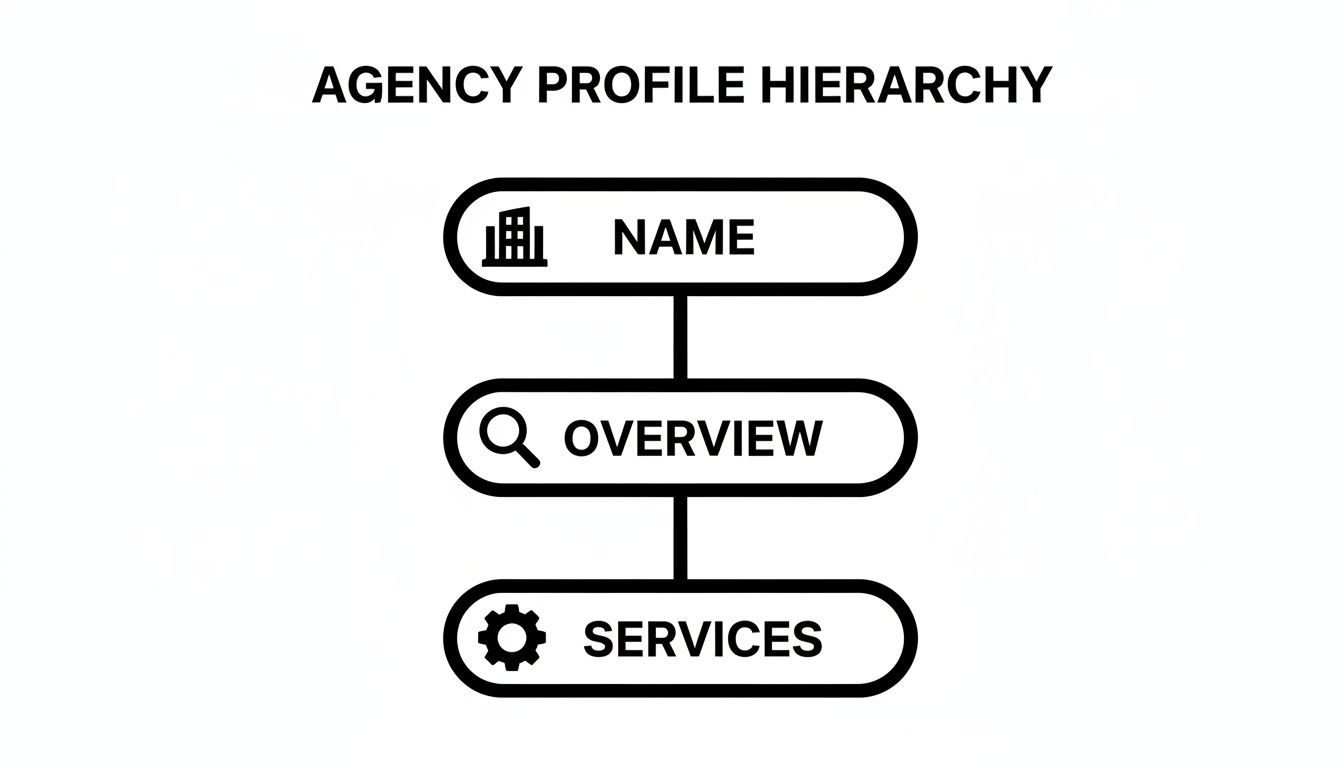
Think of these elements—your name, overview, and services—as the foundation of your brand. Every proposal and message sent by your team reinforces this identity.
Defining Key Agency Roles
Inside your Upwork agency account, you can assign roles that come with different levels of access. Nailing these assignments from the start is a game-changer for keeping things secure and running smoothly.
- Agency Manager (Owner): That’s you. You have the keys to the kingdom—complete control over finances, the agency profile, and who comes and goes. The buck stops here.
- Business Manager: This is your trusted right-hand person. They can submit proposals, handle contracts, and talk to clients, but they cannot touch the money or mess with core agency settings. It's the perfect role for a project manager or your top salesperson.
I always tell people to think of the Business Manager role as the safest way to scale. You empower your best people to bring in work and manage projects without ever giving them access to your financial backend.
Exclusive vs. Non-Exclusive Team Members
When you bring a freelancer onto your team, you have to decide what kind of member they'll be. This choice affects both them and your agency in some pretty big ways.
Exclusive members are all in. They can only work on Upwork projects through your agency. Their personal profile gets linked to the agency, and every hour they log is under your banner. This is fantastic for building a committed core team.
Non-exclusive members, on the other hand, have more freedom. They can keep their solo careers going and even work with other agencies. This flexibility is a huge draw, making it much easier to attract top talent who aren't ready to commit to just one team.
Assembling and Managing Your Roster
Finding the right freelancers is an art form. I always look for people with a proven track record, stellar client reviews, and skills that fill a gap in our current lineup. A diverse team means you can confidently bid on a much wider range of projects.
Once they’re on board, it’s all about communication. For a closer look at managing those client conversations, our guide on using an Upwork CRM tool is a great resource.
Set up clear workflows for everything—how you talk, how proposals get written, and how projects are handed off. This prevents chaos and ensures that every client gets the same professional experience, no matter who they’re talking to. Agencies are perfectly built to tap into the booming gig economy. In 2023, 38% of the US workforce—that's a massive 64 million people—did some form of freelance work. With a talent pool that big, agencies that know how to manage teams effectively are in a prime position to succeed, a trend you can read more about in this report on the rise of high-earning freelancers.
Winning More Jobs with a Smarter Workflow

Running a top-tier Upwork agency isn't just about having talented people on your team. It's about building a machine—a reliable system that consistently lands high-quality projects. If your strategy is just scrolling through the job feed hoping to get lucky, you're setting yourself up for missed opportunities and burnout.
To really get ahead, you have to be proactive, not reactive. The whole point is to build a workflow that lets you spend less time hunting for jobs and more time talking to clients who are a perfect match for your agency.
Setting Up Custom Job Feeds and Filters
Let's be honest, the main Upwork job feed is a firehose of noise. Your first job is to cut through it with laser-focused searches. For any serious agency, using advanced filters isn't optional; it's essential.
Forget generic searches. You need to build custom feeds that screen for the exact criteria that signal a great client.
- Payment Verification: This is basic, but non-negotiable. Only look at jobs from clients with a verified payment method. It’s a simple click that saves a lot of headaches.
- Client History: I always filter for clients with a proven track record. Someone who has already spent over $10k on Upwork is usually far more serious and professional than a brand-new account with no history.
- Keyword Modifiers: Get good at using boolean search. Instead of just "SEO," try something like
"SEO" AND "e-commerce" -entry. This finds you e-commerce SEO gigs while filtering out the low-paying, entry-level noise.
Once you have a search that works, save it. Create a few of these custom feeds and check them daily. This one habit can transform your lead generation from chaos into a curated list of ideal opportunities.
Developing Winning Proposal Templates
Sending a generic, copy-pasted proposal is the fastest way to get your application archived. But writing every single one from scratch is a huge waste of time. The sweet spot is a hybrid approach: a master template that's 80% solid framework and 20% genuine personalization.
Your template should cover the basics: your agency's value proposition, a quick intro, and a clear call to action. The real work—and what gets you hired—happens in the personalized bits. This is where you speak directly to the client's problem, using their own words from the job post, and explain exactly how your team is the right one to solve it.
If you want to get this process dialed in, our guide on how to automate Upwork proposals walks you through how to do it without sounding like a robot.
Pro Tip: The secret to a great proposal is showing you actually read the job description. Mention a specific detail from their post in your first two sentences. This immediately puts you ahead of the 90% of applicants who just send a generic block of text.
Using Automation Responsibly
On Upwork, speed is a massive advantage. The first few high-quality proposals to land in a client's inbox almost always get the most attention. This is where smart automation, when used correctly, can completely change your win rate.
Tools like Earlybird AI can monitor your custom job feeds and draft personalized proposals from your templates, often within minutes of a relevant job being posted. This gives you an incredible "speed-to-lead" advantage, getting your agency in front of clients before your competitors have even logged on.
This isn't some futuristic idea; it's happening now. A recent Upwork industry report found that 78% of organizations are already using AI in some capacity. If you're not, you're falling behind.
Ultimately, a winning workflow is a combination of targeted filtering, efficient proposal writing, and responsible automation. This system frees you and your team up to do what really matters: closing deals and delivering amazing work.
Advanced Strategies to Scale Your Agency
Alright, you've got the basics down. Your agency is set up, projects are coming in, and the team is busy. Now, it's time to shift gears from just running the agency to truly scaling it. This is where you move beyond the daily grind of project management and start building a real business asset.
The goal here is to create systems that build value far beyond the hours your team bills. We're talking about building a rock-solid brand reputation on the platform, digging into your performance data, and turning those one-off gigs into long-term, high-value client relationships.
Build a Powerhouse Portfolio
Think of your agency portfolio as your number one sales machine, not just a scrapbook of past jobs. Stop just tossing every finished project in there. A great portfolio tells a story about what your team can accomplish together.
Make a point to showcase a wide variety of case studies from across your whole team. Got a killer e-commerce designer and a backend developer who specializes in SaaS? Feature both. This shows potential clients that you have the depth to tackle complex projects that no single freelancer could handle.
When you write up a portfolio piece, frame it around the business outcome. Don't just list what one person did. Talk about the client's challenge, how your agency solved it, and the real-world results you delivered. That's what lands the big fish.
Actively Manage Client Feedback
On Upwork, your reputation is gold, and that reputation is built on client feedback. Don't be passive about this. You need a system for encouraging and managing reviews to keep your agency's Job Success Score (JSS) sky-high.
Make it part of your project close-out process to politely ask for a review every single time. Did a client seem thrilled with the final delivery? That's the perfect moment to send a quick note and ask them to share their experience. A proactive approach here is the difference between a good JSS and a great one that attracts premium clients.
Use Reporting to Steer the Ship
Upwork’s reporting dashboard is more than just a bunch of numbers; it's your agency's command center. If you're not using it, you're flying blind. This is how you make decisions based on cold, hard data instead of just gut feelings.
At a minimum, you should be tracking these metrics:
- Proposal Win Rate: Who on your team is best at closing? What can others learn from them?
- Team Member Earnings: This helps you identify your star players and manage your overall capacity.
- Client Spend: Who are your biggest accounts? These are your prime candidates for upselling.
By keeping a close eye on this data, you can spot what's working and pour fuel on it. You can also catch small problems before they spiral into big ones.
Upsell Services to Existing Clients
Looking for more revenue? The easiest place to find it is with the clients who already know and trust you. You've already done the hard part of proving your value. Now it's time to look for opportunities to deepen the relationship.
Let’s say you just finished building a slick new website for a client. Don't just say goodbye. Pitch them an ongoing SEO or content marketing retainer to help them actually get traffic to that new site.
This is how you turn a one-and-done project into a recurring revenue stream. It dramatically increases the lifetime value of that client and gives your agency the predictable income it needs to grow confidently.
Got Questions About Your Upwork Agency Account?
Running an agency on Upwork brings up a lot of questions, especially when you're just getting started. It's easy to get tangled up in the details of team structures, payments, and the platform's rules. Let's clear up some of the most common things agency owners ask.
Can One Freelancer Join Multiple Agencies?
Yes, they absolutely can, but with one important catch: they can only be a non-exclusive member of your team if they're also part of another. This setup gives them the freedom to take on their own solo gigs or work with other agencies.
A freelancer can only be an exclusive member of a single agency. When you bring someone on as an exclusive member, their individual profile essentially merges with the agency's. All of their work on Upwork has to run through you.
This distinction is critical for your team-building strategy. Exclusive members are your core, go-to people. Non-exclusive members are fantastic for bringing in specialized skills for a particular project without a long-term commitment.
How Do Payments and Fees Actually Work?
This is a big one. When a client pays, the money doesn't go to the individual freelancer who did the work. Instead, all payments land in the agency's central financial account.
From there, it's the Agency Manager's job to withdraw the funds and pay the team according to whatever internal agreement you have in place. Upwork's service fees are deducted from the agency's total contract earnings, not from each freelancer. Make sure you have a clear, documented payment process from the very beginning to keep everyone happy and avoid any misunderstandings.
What's the Difference Between an Agency Manager and a Business Manager?
Think of the Agency Manager as the owner or the person with the keys to the kingdom. They have full control over the account—finances, profile edits, team roles, and all contracts.
A Business Manager, on the other hand, is a role you can delegate to a trusted team member. It gives them the power to submit proposals, talk to clients, and manage projects. But crucially, they can't touch any of the financial settings or change core agency details. It's a safe way to hand off sales and operational tasks without giving up full control.
Does the Agency Get Free Connects Every Month?
Unfortunately, no. Unlike individual freelancer accounts, agency accounts don't receive a monthly batch of free Connects.
The agency works from a shared pool of Connects that you have to purchase. Anyone on the team with permission to bid on jobs can dip into this pool. This means you need a solid strategy for how those Connects are used, ensuring they're spent on jobs that are a great fit and have a real chance of landing.
Ready to scale your agency without the endless grind of searching for jobs and writing proposals? Earlybird AI acts as your automated sales team, finding ideal clients and sending personalized proposals in minutes. Discover how Earlybird AI can help you win more projects.