← Back To Blog
Freelance Conversion Rate Optimization: The Practical Guide
The median website conversion rate is only 2.35% across industries, while top landing pages can reach 11.5%+. That gap is the story behind freelance conversion rate optimization, because it shows how much room there is between a decent profile and a system that consistently turns attention into clients. The freelancers who win more work aren't just better writers, they're better operators.
Why Freelance Conversion Optimization Is Different
Freelancers live inside a much tighter funnel than most website owners. On Upwork and similar marketplaces, a single profile impression can decide whether a prospect opens your proposal at all, which means the usual “send more and hope” approach breaks down fast.
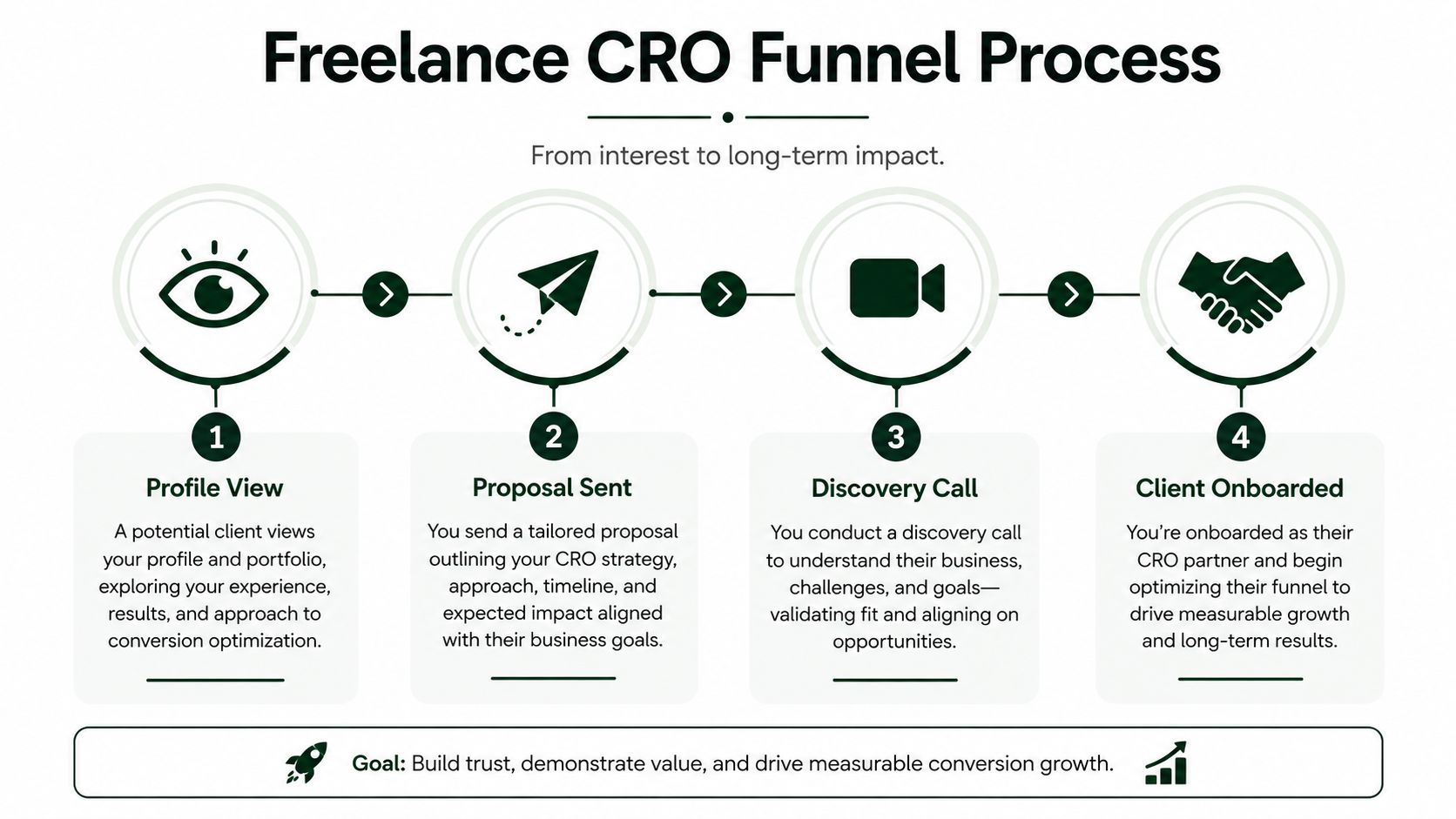
That's why the benchmark gap matters. If average websites sit around 2.35% to 2.9% and the top 10% convert 3-5x better than average, the same logic applies to freelance acquisition, just with different touchpoints and higher variance in intent. A freelancer who treats profile views, proposals, replies, and discovery calls as one measurable funnel has a real advantage over someone guessing at what sounds persuasive.
Practical rule: if you can't name the step where leads disappear, you don't have a conversion problem yet, you have a measurement problem.
Most freelancers still treat conversion as a volume game. They optimize for speed, send generic pitches, and assume the market will reward persistence. In practice, the client who compares three similar proposals is often choosing the one that makes the problem feel understood, the process feel low-risk, and the next step feel easy.
A good starting point is to think like a CRO consultant, not a bidder. If you want a clear refresher on the mechanics of page-level conversion thinking, this guide on boost website sales today is useful because it keeps the focus on friction, clarity, and proof, not cosmetic redesigns.
The strongest freelance operators also understand that their “landing page” is not a single page. It's the profile, the opening line, the proposal, the follow-up, and the handoff into a call. Each part either moves the lead forward or leaks it.
What Freelance CRO Is and How the Process Works
Freelance conversion rate optimization is the disciplined practice of measuring and improving every stage of your client-acquisition funnel, from profile view to signed contract. It uses the same logic as agency CRO, but the objects of optimization are marketplace presence, proposal quality, response timing, and follow-up cadence.
A serious engagement starts with instrumentation. Before any test goes live, define the event taxonomy, the data-layer schema, the baseline metrics, and the success criteria, because weak tracking can blur the cause of a change and make the result useless for decisions. That measurement discipline is the difference between “I think this worked” and “I know what moved the funnel.”
The seven-step process in a freelance setting
Audit the baseline. Review your profile views, proposal reads, replies, interview invitations, and wins. If you skip this, every later change becomes a hunch.
Find the drop-off point. Maybe clients view your profile but don't message you. Maybe they reply to your proposal but vanish before a call. Each stage tells a different story.
Form a testable hypothesis. For example, a tighter headline might increase profile-to-proposal progression, or a shorter opening paragraph might improve reply rates.
Run a controlled experiment. Test two profile taglines or two opening proposal lines, not five changes at once. Keep the variable isolated so you can trust the result.
Measure the outcome. You're looking for movement at the exact stage you changed, not general activity.
Iterate on what wins. Keep the version that improves the funnel, then test the next bottleneck.
Repeat with a clean record. Strong freelance CRO compounds because every decision improves the next test.
Unbounce's benchmark set, built from 41,000 landing pages, 464 million pageviews, and 57 million conversions, reported a 6.6% median landing-page conversion rate, with SaaS at 3.8% and entertainment at 12.3%. The point for freelancers is simple, optimization is always relative to context, traffic quality, and the exact offer being sold.
Why context changes the target
A freelancer selling high-ticket strategy won't benchmark the same way as someone bidding on quick tactical work. A niche, a price point, and a traffic source all reshape what “good” looks like. The right habit is to measure your own funnel against your own baseline first, then compare it to industry context for sanity, not comfort.
That same mindset is why controlled experiments matter more than design opinions. A polished profile that doesn't get replies is still failing. A plain profile that gets better response rates is doing its job.
Skills and Tools Every Freelance CRO Practitioner Needs
Strong CRO work needs more than persuasive writing. You need enough statistical literacy to read test results without fooling yourself, enough UX judgment to spot friction, and enough technical fluency to instrument the funnel cleanly.

The core skill stack
A good freelancer needs to understand how people decide, hesitate, and abandon. That means knowing the basics of behavioral psychology, reading session replays without overreacting to one odd visitor, and recognizing when a page is asking for too much too soon.
The technical side matters just as much. If your tracking is messy, your tests are noisy, and your conclusions won't survive a client conversation. A measurement audit should define every tracked action before you optimize anything, because clean data beats clever guesses.
Practical rule: if the tracking is vague, the decision will be vague too.
Tools that actually help
Heat maps and session replay tools show where people pause or lose confidence. Analytics dashboards show whether those moments lead to drop-off. A/B testing platforms let you compare versions instead of arguing about them.
Some changes are obvious once the data is visible. A landing page with a single clear CTA converts 266% better than one with multiple competing CTAs, and video on landing pages increases conversions by an average of 86%, according to Searchlab's 2026 CRO statistics roundup. Those numbers don't mean every page needs video, they mean clarity and focus deserve to be tested before you chase fancier ideas.
Speed matters too. SQ Magazine reports that conversion rate declines by about 4.42% for each additional second of load time in the first 0 to 5 seconds, which is why slow pages can kill otherwise decent offers. On mobile, that friction often shows up as abandonment before the page even fully settles.
For freelancers who want to automate parts of the acquisition workflow, one operational option is best AI tools for freelancers, especially when you're trying to keep tracking, follow-up, and task management consistent across multiple leads. The key is to treat tools as instruments, not shortcuts.
Pricing and Packaging Your CRO Services
Pricing sends a signal before the first call. If you charge by the hour, clients often assume they're buying time. If you package around outcomes, they start evaluating the work the way CRO should be evaluated, by what changes in the funnel.
Project pricing works well for one-off audits. A retainer fits ongoing testing and iteration, where the value comes from accumulating insight over time. Performance-based pricing can work too, but only when both sides agree on the metric and the measurement method before the work begins.
What the buyer is really purchasing
Clients don't buy “optimization.” They buy fewer leaks, clearer offers, more booked calls, or a stronger proposal-to-reply path. Your package should describe the deliverable, the measurement method, and the expected business effect in plain language.
A good tiered structure usually makes sense:
- Audit tier: one funnel review, a prioritized findings list, and a testing roadmap.
- Optimization tier: audit plus implementation support and iterative testing.
- Advisory or retainer tier: ongoing analysis, test planning, and performance reviews.
The wrong move is promising unlimited revisions. That turns strategic work into open-ended labor, and clients who don't understand CRO will keep asking for more opinions instead of better tests. Scope boundaries protect both your time and your credibility.
I'd push harder toward outcome-based framing than hourly billing because it matches how clients think about risk. If your work improves the funnel, the value sits in the lift, not the time spent staring at a dashboard. If you need a portfolio-facing place to present that kind of outcome-led positioning, win clients with your portfolio is a useful reference for thinking about proof and presentation together.
How to talk about value
When a client says they just need “a quick look,” that usually means they haven't yet connected conversion work to revenue or lead quality. Your job is to connect the dots without overselling. Explain what you'll measure, what you'll change, and what the client should expect to learn even if a test doesn't win.
That framing makes you sound like an operator, not a commodity seller. It also makes retainers easier to justify because optimization is rarely a one-and-done problem.
Client-Winning Tactics for Upwork and Freelance Marketplaces
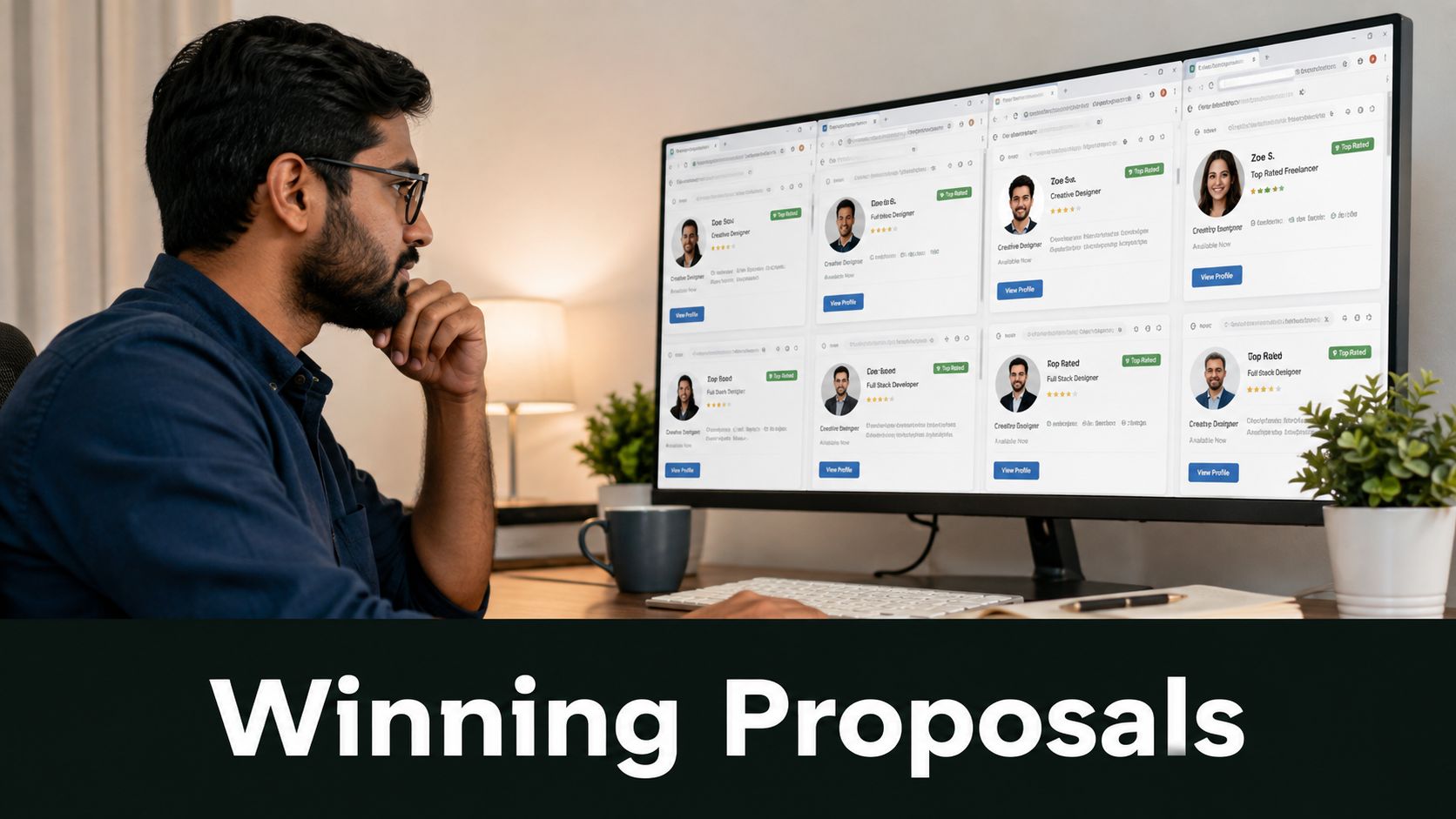
The freelancers who win on Upwork and similar marketplaces do more than reply quickly. They make every touchpoint easier to trust, easier to understand, and easier to act on. Speed matters, but speed without relevance and measurement just creates more busy work.
Instrument the funnel before you optimize it
Track profile impressions, proposal response rate, interview-to-contract ratio, and revenue per client acquired. Those numbers show whether the bottleneck sits in visibility, persuasion, qualification, or close quality.
Generic marketplace advice stops at “be personal” and “follow up.” That leaves too much to guesswork. You need to see which stage is weak so you can fix the right thing instead of working harder everywhere at once.
A practical proposal structure stays simple. Open with the client's problem in their language, connect one relevant proof point, then make the next step obvious. If the job post is vague, your response should reduce uncertainty rather than add more features to your pitch. For deeper reference on building credibility in marketplace settings, these actionable personal brand strategies can help.
What a strong proposal usually does
A strong opening line names the pain point or outcome. The middle shows that you have done comparable work or understand the constraint. The close asks for a low-friction next step, like a brief call or a clarifying question.
Many freelancers overcomplicate that flow. They write long intros, stack credentials, and bury the ask. Buyers do not need your full biography. They need confidence that you can solve their specific problem.
If you want a deeper reference for marketplace positioning, how to be successful on Upwork gives a useful operational lens for account health and client acquisition behavior. The point is not to copy someone else's pitch. It is to understand the mechanics of getting seen and trusted.
Follow-up without sounding needy
Follow-up works when it adds utility. Share a useful insight, clarify one part of the brief, or answer the question the client has not asked yet. Repeating “just checking in” does not move the conversation.
Automation can help if it does not make your outreach feel canned. An always-on system can keep timing tight, maintain reply consistency, and reduce the manual drag of repetitive follow-up. In that category, Earlybird AI is one option for Upwork users because it connects to an account, drafts personalized proposals, replies to client messages, and keeps follow-up moving toward a booked call.
Why the measurement gap matters
Many freelancers never learn whether their proposals are failing because of positioning, proof, or timing. That gap matters. If you instrument the funnel properly, you stop guessing which message worked and start seeing which stage needs attention.
A simple decision rule
- High views, low replies: your profile or opening pitch is weak.
- High replies, low calls: your qualification or offer framing needs work.
- High calls, low wins: your close, scope, or pricing is off.
That is the signal a serious freelancer should want. Outreach becomes a system instead of a hope.
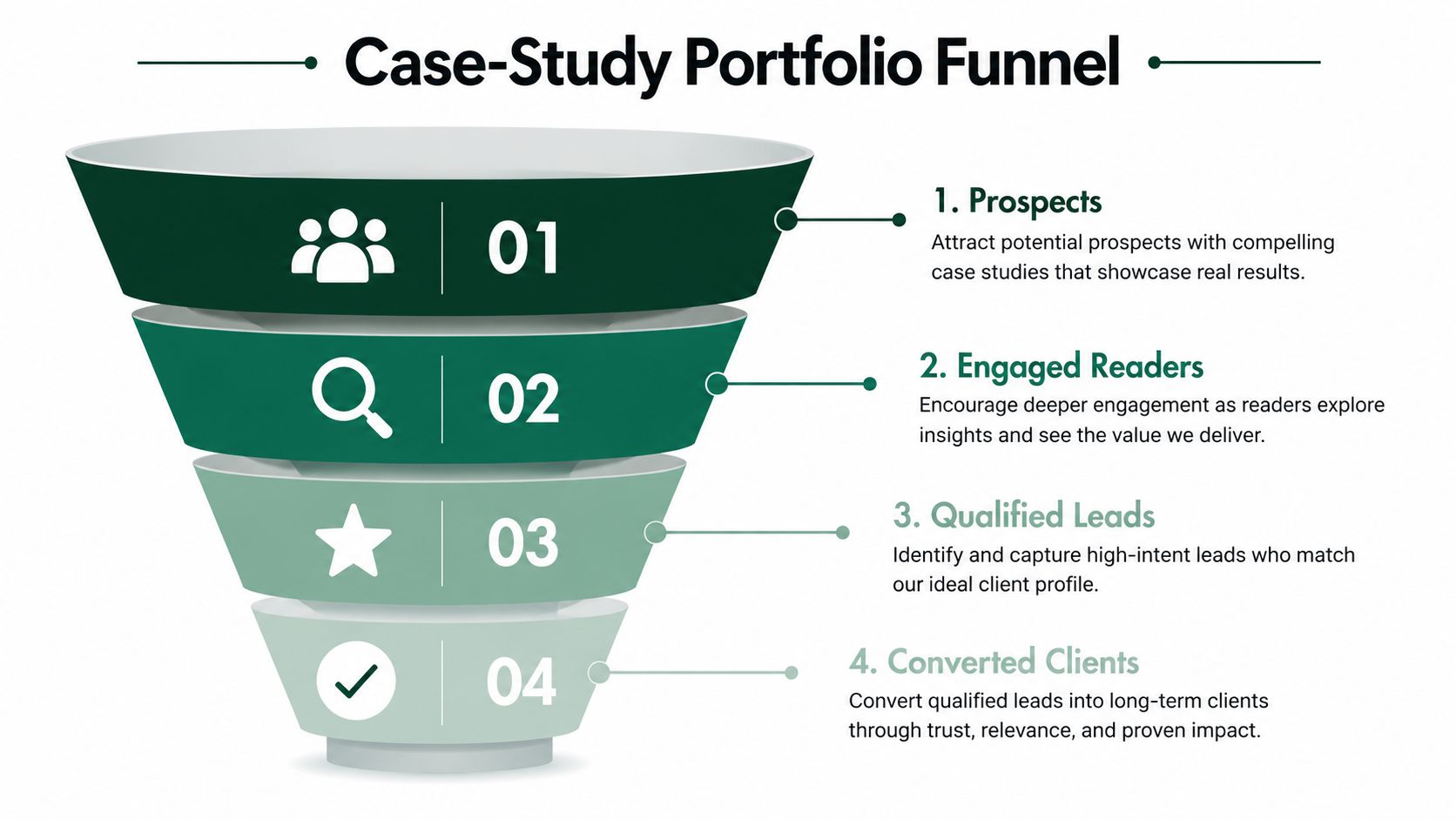
Building a Case-Study Portfolio That Converts Prospects
A good portfolio doesn't just show work, it shows decision-making. Prospects want proof that you can find friction, make a change, and explain the result in language that makes business sense.
Turn small wins into usable proof
Early in your career, the data may be thin. That doesn't mean you have nothing to show. It means you need to document the problem clearly, capture the change you made, and explain what improved in a way the client can verify.
The strongest case studies follow a simple narrative, problem, action, result. Avoid vanity stats that don't help someone decide whether to hire you. A prospect cares far more about whether you understand the conversion bottleneck than whether a post got likes.
Benchmark context helps here too. If the top 10% of websites convert 3-5x better than average and best landing pages can reach 11.5%+, then measurable improvement is not rare magic, it's the normal shape of good optimization. That supports the story you want your portfolio to tell, which is that small, focused changes can produce real movement.
What to capture every time
Before the project starts, save the baseline screenshots, the funnel state, and the problem statement. During the project, save test ideas, notes from calls, and the changes you shipped. Afterward, record what moved, what didn't, and what you'd test next.
This makes your portfolio easier to update later, and it keeps you from reconstructing details from memory when a client asks for proof. It also helps non-technical buyers trust your process because the work feels documented, not improvised.
Present results in decision-friendly language
Not every prospect understands analytics jargon. They do understand clearer positioning, fewer objections, and a funnel that leaks less. Write the case study so a marketing lead, founder, or agency owner can see the business value without decoding your process.
If you're building the portfolio from scratch, portfolio in Upwork is a good place to think about how presentation and proof work together inside a marketplace setting. A portfolio that converts usually has a point of view, not just a gallery of screenshots.
Keep the story tight, and keep the evidence visible. A long case study with unclear outcomes loses to a short one that makes the win easy to understand.
Your Next Steps for Implementing Freelance CRO
Start by finding your biggest drop-off point. If you don't know whether the leak is in profile views, proposal replies, or discovery calls, you're optimizing blind.
Pick one tracking tool and one hypothesis this week. Write down what you expect to change, what metric should move, and what result would prove the test was worth keeping. Then run the test cleanly instead of changing five things at once.
The gap between average and elite freelance performance isn't mystery, it's discipline. Freelancers who measure, test, and iterate build steadier pipelines than freelancers who rely on instinct and volume.
If you want an always-on way to manage Upwork outreach with more discipline, Earlybird AI connects proposal timing, replies, follow-up, and analytics in one workflow. It's built for freelancers and agencies that want to track the funnel more clearly and spend less time on repetitive outreach. Visit it if you're ready to turn your marketplace activity into a measurable client-acquisition system.