
← Back To Blog
How Do Retainer Fees Work for Freelancers and Agencies

You're staring at a contract that says $2,000 monthly retainer, and the client wants an answer today. Your hourly instinct says to ask, “How many hours does that cover?” but that's only part of the story. A retainer can be a deposit against future work, a fee for availability, or a prepaid block of services, and the difference changes how you invoice, what gets refunded, and how much risk you carry.
Freelancers usually get tripped up because the word retainer sounds simple while the mechanics are not. If you've only billed hourly, the model can feel backwards at first, because money often arrives before the work does. That upfront payment is exactly why retainers can stabilize cash flow, but only if the contract spells out what the money buys.
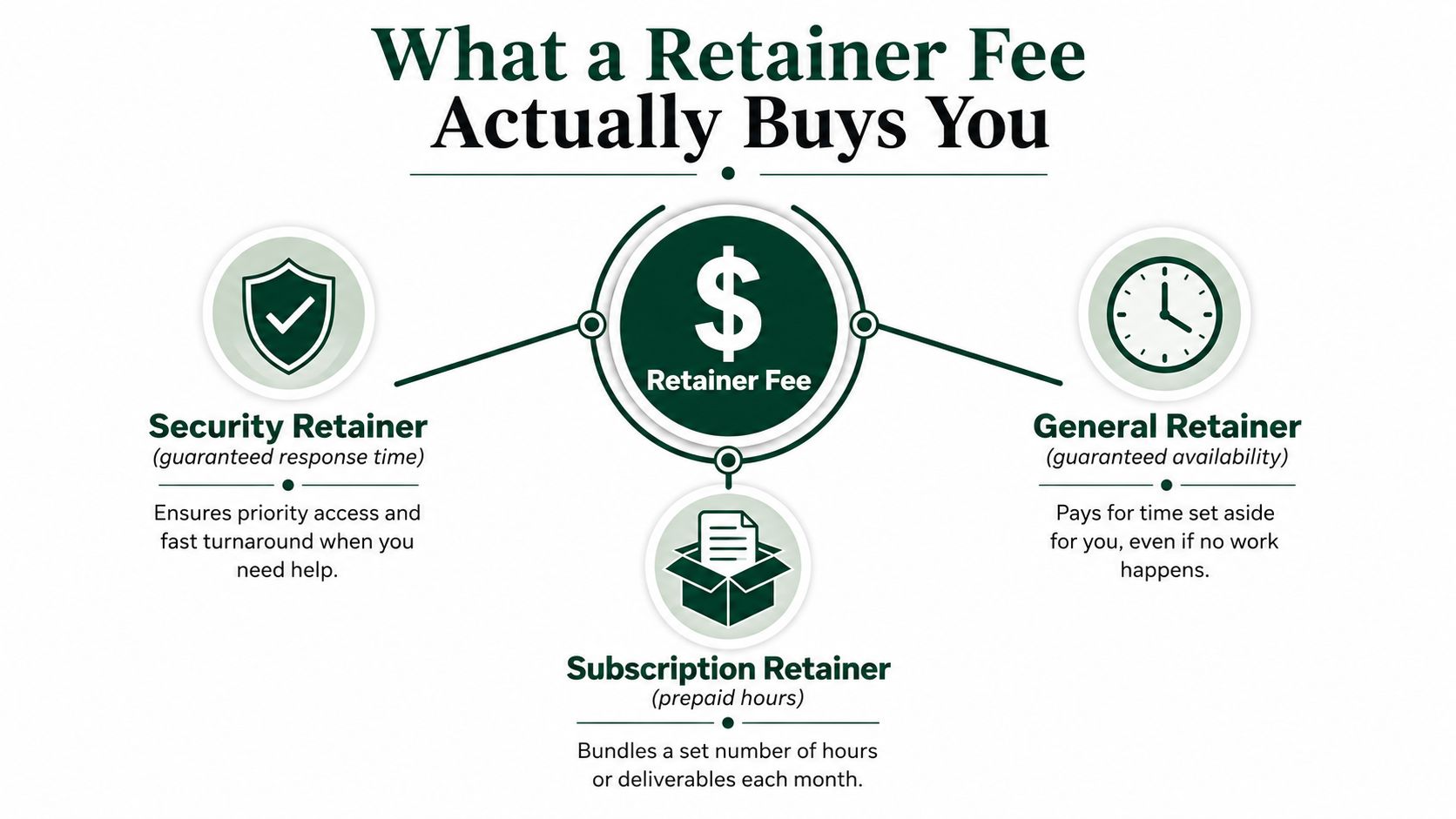
What a Retainer Fee Actually Buys You
A freelancer gets an email that says, “We'd like to move forward with a $2,000 monthly retainer.” The first question isn't how to spend the money. It's what that money purchases, because the answer changes whether you're holding a deposit, reserving time, or pre-selling work.
Two very different meanings hide under one label
In practice, a retainer fee often means an upfront payment that secures access to a professional's time, then gets drawn down as work is performed. In legal work, that money is commonly held in a client trust account and returned if it isn't fully earned, while in other professional-services settings it may reserve availability or cover a defined package of work. That's why a one-page agreement matters more than the label on the invoice, and why unused money may be refundable in one contract and not in another.
A simple way to read any retainer is to ask one question. Are you paying me to be ready, or paying me in advance for what you'll use?
If the money is a deposit against future work, you'll usually see language about hourly rates, billing against a balance, replenishment triggers, and refunds for anything unused. If the money is for availability, the client is paying to keep you on call, even during quiet periods. California's State Bar distinguishes these structures clearly, including a guarantee of availability, an on-call arrangement for limited services, and a down payment deducted as work happens.
Practical rule: if the agreement doesn't say what happens to unused funds, don't assume the client has no right to ask.
For agency owners, this distinction is more than legal fine print. Retainers have become a major recurring-revenue model, and one agency pricing analysis cited in 2025 found that retainers made up 44% of agency revenue, with project-based work around 50% and hourly billing 30% (Corporate Finance Institute). That's why agencies like the model, they're trying to turn one-off work into predictable cash flow. For a freelancer, the same logic applies, but only if you know which kind of retainer you've sold.
Earlybird AI can be useful here if you're comparing a recurring client pipeline to one-off project work, because its agency economics framing helps you think about steady revenue instead of isolated invoices.
The Three Retainer Models Most Contracts Use
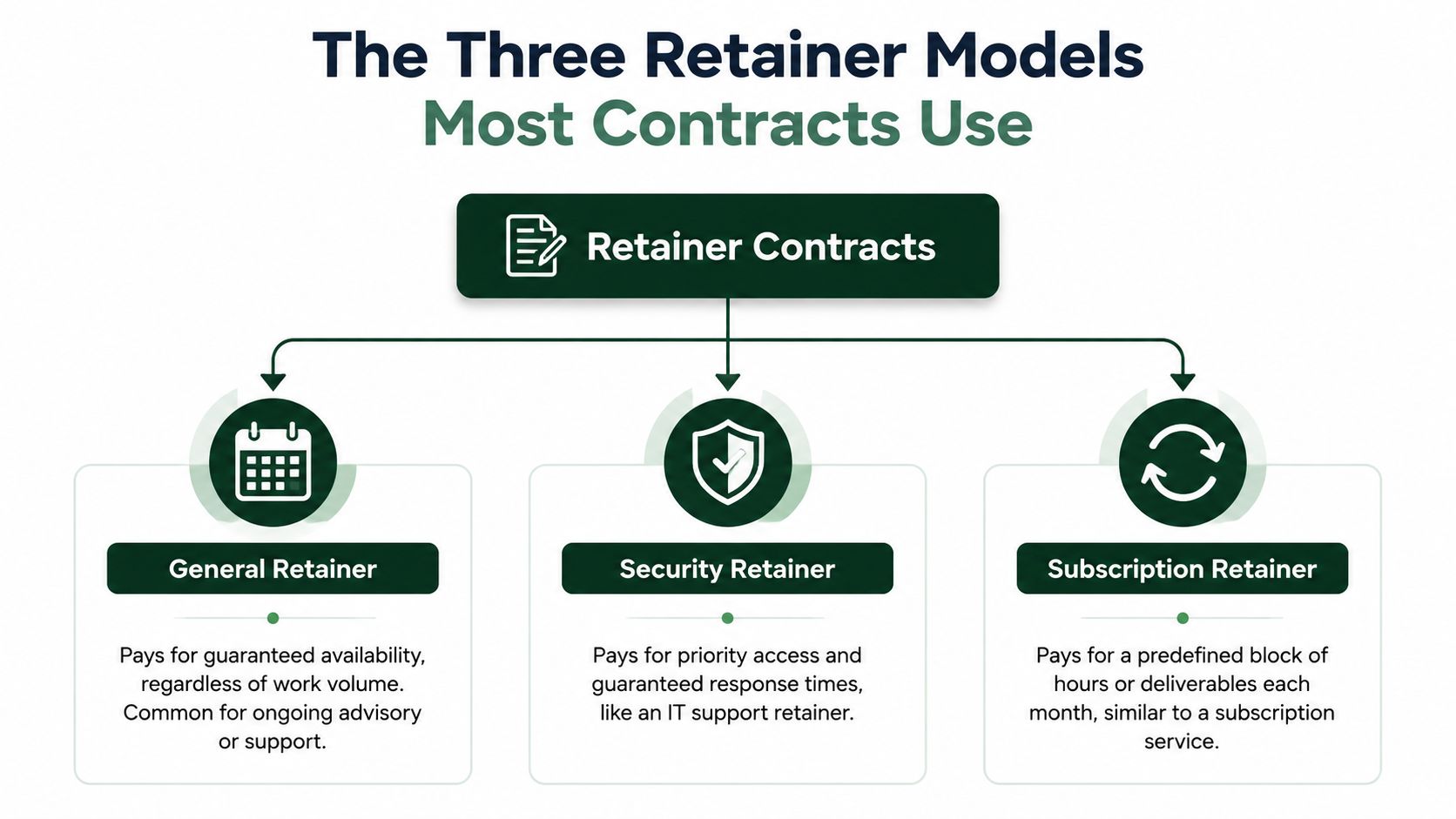
A client says they want a retainer, but that word can hide three different deals. One is about your availability. One is about prepaid work. One is closer to a fixed project fee with recurring paperwork. If you bill hourly now, the easiest way to sort them out is to ask one question first, what is the client really buying, access, a work bucket, or a defined outcome?
General, security, and special retainers
A general retainer pays for availability. The client is not buying a pile of hours or a list of deliverables. They are paying to know you will be ready when they need advice, quick reviews, or occasional support. That makes sense for ongoing counsel, background oversight, and situations where being reachable is the product.
A security retainer works like prepaid work credit. The client deposits money first, and you earn down that balance as you complete work. This is the structure many freelancers picture when they hear “retainer,” because the money sits up front and gets reduced by time logged or tasks finished.
A special retainer is narrower. It is usually tied to a specific matter, project, or defined scope, so it behaves more like a fixed-fee arrangement than a classic availability agreement. When the work can be described clearly before it starts, this model can keep both sides focused on the finish line instead of on hourly tracking.
Which one fits which client
Use a general retainer when the client mainly wants access to you and expects to call on you as needed. Use a security retainer when the workload will rise and fall, but the client still wants predictable access to your time. Use a special retainer when the deliverable is specific enough that both sides can point to the end state before the work begins.
The easiest test is practical. If the client needs you on call, think general. If they need prepaid work credits, think security. If they need one defined outcome, think special.
For freelancers on Upwork, this distinction matters because the platform usually pushes people toward hourly thinking, even when the work is really recurring. If the job is mostly access and quick response, price the retainer around the cost of being available, plus your margin, not around every minute you hope to capture. If the work is repeatable delivery, price the retainer from the cost of doing that work, then add your margin and any buffer for revisions, admin, or waiting time. That keeps you from underpricing a client who uses you like a standing resource but pays you like a one-off task.
Monthly retainers have also become a common operating model across service businesses, which is one reason agencies often prefer them over sporadic projects. The same source also reports lower client churn and longer client lifespan for retainer-based agencies than for project work, which helps explain why recurring agreements can feel safer for both sides. Shno retainer pricing statistics
How Retainer Payments Flow
A retainer is easier to follow once you watch the money move from one step to the next. The client pays, the funds sit in the agreed account or balance, you earn against that balance as work is completed, and the contract says whether the remaining money rolls forward, gets replenished, or is returned. Once you see the cycle in that order, the model stops feeling abstract.
The billing flow in plain English
With a security retainer, the client pays upfront and the balance stays in place until you earn it. You then invoice against logged hours or completed deliverables, and the invoice either reduces the balance or records what has been earned so the client can approve the transfer. If the agreement includes a replenishment rule, the client adds money when the balance reaches the agreed threshold.
A simple example makes the pattern clearer. If a client pays a $3,000 retainer and you work 7 hours at $300 per hour, the earned fee is $2,100, leaving $900 in the balance (YouTube example). That remaining balance can stay available for later work or be refunded if the engagement ends and the contract calls for a refund.
The important point is that the retainer is not the same thing as a deposit. A deposit usually sits there as a reserve tied to a transaction, while a retainer is tied to future work or access that you will earn against. For freelancers, that difference changes how you price the arrangement, because you are not just asking for money in advance, you are setting the rules for how that money gets consumed.
What to document while you work
Keep the record aligned with the contract language. If the agreement says hours are billed against the retainer, log hours as you go. If it says deliverables are the unit of measure, track completion dates, review cycles, and approval notes.
Keep one clean running balance. If the client cannot see how the retainer is being earned down, the dispute usually starts there.
Legal retainers are stricter about where the money lives. In that setting, the client's funds are commonly placed in a dedicated trust or IOLTA account and only transferred to the firm as fees are earned (Indeed retainer fee definition). That separation exists so the money remains available for refund if the work uses less than expected. If you are not practicing law, you may not need a trust account, but the same habit of tracking earned balance and remaining funds still protects you.
For freelancers pricing on Upwork, the math should start here. Estimate the delivery cost of the work, include the time needed for revisions, admin, and client communication, then add margin. A retainer priced only around hours can miss the total cost of ownership if the client expects quick responses, file handoffs, or repeated adjustments. Price the work you will deliver, then decide whether the retainer is monthly access, a block of hours, or a prepaid deliverable package.
Choosing Monthly, Hourly Block, or Deliverable Based
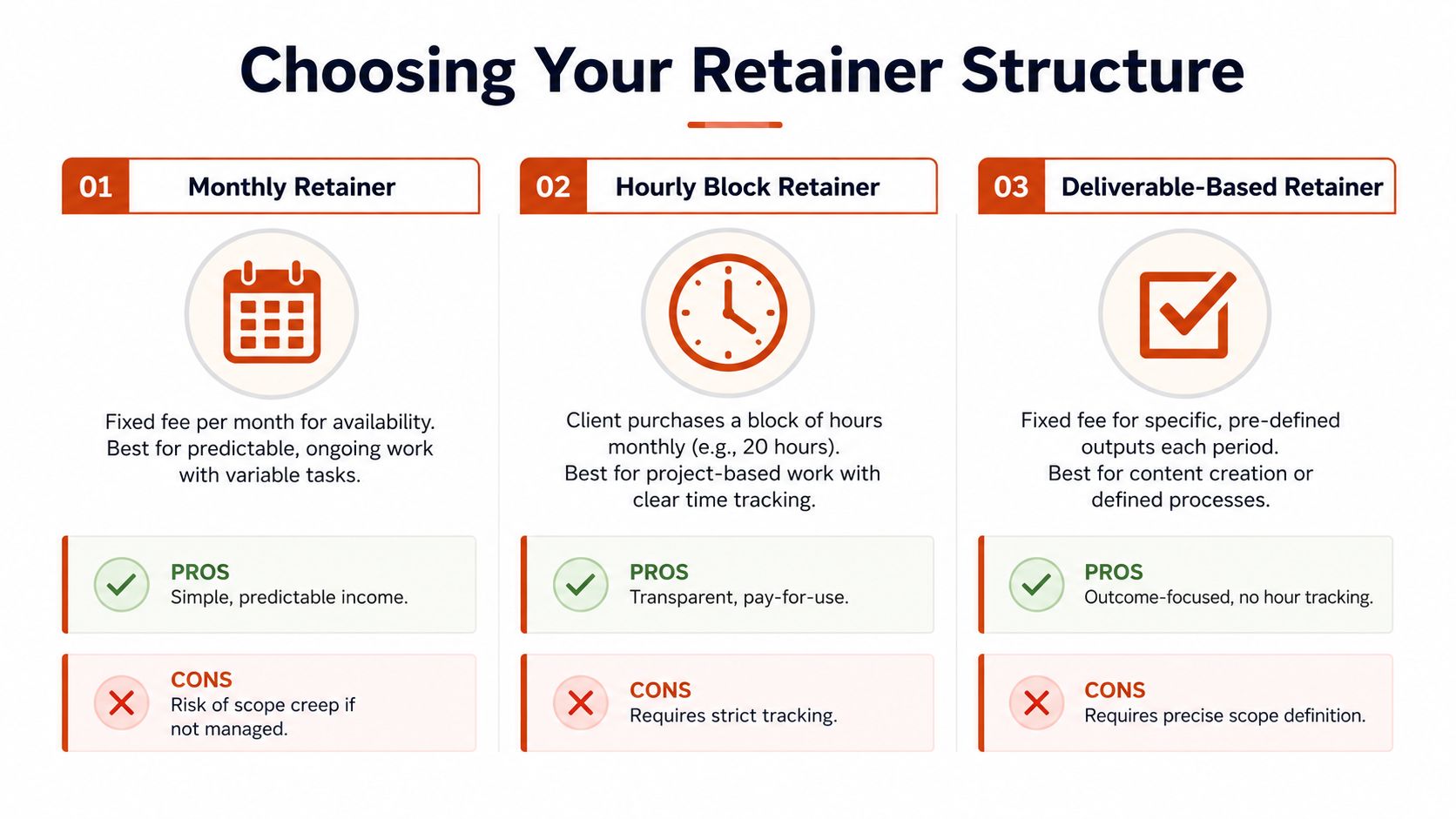
A retainer structure is like choosing the unit you sell. Monthly pricing sells access over a period of time, hourly blocks sell a pool of time, and deliverable-based retainers sell a defined output. The wrong choice usually creates friction later, because the client is buying one kind of promise while you are trying to fulfill another.
Monthly retainers work best when the work is ongoing
Monthly retainers fit ongoing support, advisory work, and repeat requests that change from week to week. The client pays for availability over time, so you are not renegotiating the relationship every time a new task comes in.
The weak spot is scope creep. A broad label like “marketing support” or “design help” can turn into an open-ended inbox, and the fee stays fixed while the work keeps growing. That is the point where hourly thinking and retainer thinking collide, because the client assumes access and you absorb extra ownership.
Hourly blocks and deliverable packages feel safer to buyers
Hourly-block retainers fit situations where the client can estimate usage but still wants a recurring relationship. A set block of hours gives both sides a visible limit, which works well for repeat work with uneven demand.
Deliverable-based retainers fit repeatable outputs, such as a set number of posts, pages, edits, or reports each month. Buyers often prefer this structure because they can see what they are getting without trying to interpret a time log.
If the client wants certainty, sell deliverables. If they want access, sell time or availability. If they want both, define the scope tightly enough that the extra work has to be priced separately.
For freelancers doing a lot of work through Upwork, the cleanest rule is to match the structure to the job pattern. Ongoing support, account management, and retainer-style advisory work usually fit monthly pricing. Task-driven jobs with visible time use often fit hourly blocks. Defined monthly output fits deliverable-based pricing, as long as the scope is tight enough that “extra revisions” does not become the deliverable.
The structural choice also changes how long clients tend to stay. As noted earlier, recurring retainer relationships are often longer than one-off project work, which is one reason service businesses like them. That does not mean every freelancer should force a retainer into a project that does not fit. It means the structure should match the work, or the relationship becomes a series of misunderstandings.
For pricing, start with delivery cost, then add margin. If you price only around hours, you can miss the full cost of revisions, admin, handoffs, and client communication. Delivery cost first, margin second, structure last. That order is usually safer than trying to force every job into an hourly frame.
A helpful way to separate the options is to use a services agreement for the recurring relationship and a statement of work for the specific output. If you want a plain-language breakdown of that split, this guide to master service agreements versus statements of work is a useful companion.
Contract Clauses That Actually Matter
A retainer agreement can look formal and still leave the important stuff vague. The clauses that matter most are the ones that decide how quickly you get paid, what work is covered, and whether the client can expand the engagement without expanding the fee. If you read only one page carefully, read the billing and scope language.
The clauses to inspect before you sign
Scope of services should describe what's included and what isn't. If the wording is broad, push it toward specific tasks, defined channels, or named deliverables.
Billing rate and rate changes should say how work is valued and when the rate can change. If the retainer covers a pool of hours, the agreement should explain whether all time is billed at one rate or whether different roles are priced differently.
Replenishment rules need a clear trigger. If the balance drops too low, who tops it up, when, and by how much? Without that trigger, you end up chasing payment after the cushion is already gone.
Expenses and third-party costs should be separate from the retainer unless the contract clearly says otherwise. Filing fees, stock assets, and vendor charges can eat into margin fast when they're bundled in.
Termination and notice should say how either side ends the relationship and what happens to unused money. If the contract is for a security retainer, the refund language matters.
For a broader legal framing of online contract language, the guide for business owners from Lerner & Weiss APC is a useful companion piece, especially if your engagement letters are getting more complex.
A short clause can do a lot of work:
Sample language: “Client payments are held against future work and earned as services are completed. Any unused balance will be handled according to the termination terms in this agreement.”
The distinction between a retainer agreement and a broader service contract matters too, especially if you're also using a master agreement and a statement of work. The master service agreement versus statement of work guide helps separate the governing terms from the project details, which is exactly where many retainers get messy.
Pricing a Retainer That Actually Pays You
The fastest way to underprice a retainer is to multiply hours by rate and stop there. That math ignores admin time, revisions, sales overhead, and the quiet creep that always shows up once the client realizes the retainer is live. A profitable retainer starts with delivery cost, then adds margin on purpose.
Start with cost, not with hours
Build the fee from delivery cost plus margin, not from a fantasy of perfectly billable hours. In agency pricing guidance, a 10 to 20 percent scope-creep buffer is recommended because retainers tend to absorb extra requests over time (NetSuite marketing agency retainers). That buffer is the difference between “this felt fine for three months” and “we're losing money.”
The same guidance says many agencies now price retainers from delivery cost plus target margin rather than fixed hours, and cites a 2025 agency-industry reference with an average net profit margin of 16%. Separate pricing guidance recommends 55–60%+ delivery margin, which shows how defensive the market has become about scope control. If your retainer is thin on margin, one extra revision round can wipe out the work.
Reprice before burnout, not after it
Repricing works best when it's tied to a visible change in scope, volume, or complexity. If the client adds channels, requests faster turnaround, or expects more strategy than execution, the fee should move with the work. A price increase feels less punitive when you can point to the changed workload rather than vague inflation language.
AI-assisted delivery complicates this further. If automation lowers your production cost, the temptation is to keep the same fee and pocket the spread, but that only works if the scope stays stable and the client still values the result. If the work has become easier, the risk is not always lower, because clients usually respond by asking for more.
For a deeper margin lens, the guide to improving profit margins is worth reading alongside your own retainer math, especially if you're trying to compare delivery efficiency against the contract fee.
Onboarding, Scope Management, and the First 30 Days
The first month is where the retainer either turns into a smooth operating rhythm or starts bleeding time. If you set up the relationship well, the client knows how to send requests, how fast you respond, and what happens when new work appears. If you don't, every ask becomes a mini negotiation.
What a clean kickoff looks like
Start with a kickoff call, then collect access, assets, and decision-maker names in one pass. Build a shared workspace where requests, deadlines, and approvals all live in the same place. That keeps the retainer from turning into scattered email threads and half-finished notes.
A lightweight tracker helps more than most freelancers expect. List the request, the status, the hours or deliverables used, and whether the request stayed inside scope. When a new ask arrives, tag it immediately as in-scope, out-of-scope, or needs approval.
For onboarding flow, streamline onboarding with EDocGen is a useful operational reference because it shows how structured intake reduces back-and-forth at the start of a relationship.
How to keep the relationship steady
The first status update should be boring in the best way. Confirm what was completed, what's next, and whether the balance or deliverable count is moving faster than planned. That keeps the client calm and gives you an early warning if the work is drifting.
If you sell on Upwork, mirror the external retainer terms inside the platform contract structure so the scope, payment cadence, and messaging history stay aligned. Tools that help you respond quickly and keep proposal follow-up organized can support that process, but the agreement still has to define the work clearly.
Cancellation, Renewal, and the Common Pitfalls
Retainers end badly when the contract is silent about endings. If the notice period, refund handling, and renewal terms aren't in writing, the final month turns into a billing argument instead of a clean handoff. Good retainers finish the same way they begin, with clear expectations.
The mistakes that cause the most pain
Vague scope is the biggest trap. If the work isn't named, it grows.
No replenishment trigger creates awkward chasing later. The client should know when the balance needs topping up before the balance hits zero.
Mixing expenses into the retainer makes the fee look larger than the actual service margin. Keep pass-through costs visible.
Ignoring churn signals lets a weak relationship run too long. If the client stops responding, delays approvals, or keeps trimming scope, the renewal conversation is already happening.
Repricing only after burnout is the one that hurts most. By then, the fee feels emotional instead of operational.
A churn-focused process is useful here, and the Creem churn analysis guide is a practical reference if you want to treat non-renewal as a management signal instead of a surprise.
Before any renewal conversation, run this quick check.
- Scope drift: Has the work expanded beyond the original promise?
- Response time: Is the client still answering on schedule?
- Balance health: Has the retainer been depleted faster than expected?
- Expense leakage: Are out-of-pocket costs still being separated cleanly?
- Renewal language: Does the contract say what happens next if nobody acts?
For legal retainers, the unused balance is commonly returned if it wasn't fully earned, and that refund expectation should be obvious before the relationship ends (Indeed retainer fee definition). For service retainers, the same principle is simpler, if the agreement says you earned against a prepaid balance, the client should be able to see exactly how much remains and why.
If you want a cleaner way to build, price, and manage retainers without guessing, visit Earlybird AI and see how its Upwork automation, analytics, and proposal workflow can support recurring client work while you keep the contract terms tight. It's a practical fit if you're trying to move from one-off hourly billing to a more stable retainer-based operating model.