
← Back To Blog
How to Improve Profit Margins: Agency & Freelancer Playbook

You're probably working harder than you did a year ago. More client calls. More proposals. More revisions. More software. More people to manage, if you run a small agency.
And yet the numbers in your bank account don't feel like they match the effort.
That usually isn't a workload problem. It's a margin problem. In service businesses, profit leaks rarely come from one dramatic mistake. They come from slow sales cycles, underpriced work, bloated delivery, and clients that look good on paper but gradually consume your time.
A lot of advice on how to improve profit margins starts and ends with cutting expenses. That matters. But for agencies and freelancers, the bigger blind spot is often sales efficiency. If you win the right work faster, with less manual effort, margin improves before delivery even begins.
Why Your Hard Work Is Not Boosting Your Bottom Line
Being busy can hide a weak business model for a long time.
A full calendar feels like progress, but activity and profitability aren't the same thing. I've seen teams hit revenue goals and still feel constant pressure because they were burning too many non-billable hours to land each client, then delivering work at rates that didn't leave enough room for profit.
The hidden leak is often before the project starts
Most owners look first at payroll, tools, or contractor costs. They should. But that's only half the story. The way you acquire clients changes margin just as much as the way you deliver the work.
A 2025 Gartner study found that companies with automated, high-frequency outreach reduced CAC by 34% compared to manual teams, which lifted net profit margins by converting the same revenue volume with less operational overhead, as cited in American Express's writeup on improving gross profit margin.
That matters for agencies because customer acquisition cost isn't just ad spend. It includes founder selling time, proposal writing, follow-ups, qualification calls, admin handoffs, and all the dead leads you chased manually.
Practical rule: If it takes too many unpaid hours to win a client, your margin is already damaged before kickoff.
Cost cutting helps, but it won't fix a slow sales engine
Cutting software or squeezing contractors can improve the numbers for a quarter. It usually doesn't create durable margin if your pipeline still depends on manual effort and inconsistent response times.
Service businesses also have a second problem. The same people who sell often deliver. When sales is inefficient, it doesn't just increase acquisition cost. It also pulls senior talent away from billable work.
That's why operational discipline has to include time discipline. If you haven't looked closely at addressing agencies' hidden drains, start there. Poor time management shows up as missed follow-ups, slow proposals, over-servicing, and constant context switching. Those are margin issues, not just productivity issues.
What actually changes the bottom line
The agencies with healthier margins usually do four things better than everyone else:
- They acquire clients faster so fewer non-billable hours are spent per deal.
- They price around value instead of hours.
- They remove bad-fit work even when that feels uncomfortable.
- They systemize delivery and sales so the owner isn't the glue holding everything together.
If your team is exhausted and margins are flat, don't assume you need more leads. You may need a more efficient way to convert the leads you already touch.
First Find Your True Profit Margin
Most owners don't have a pricing problem first. They have a measurement problem.
If you can't see profit by project, by client, and by service type, you'll keep making decisions based on revenue. Revenue is noisy. Margin tells the truth.
Use the basic formulas, then go one level deeper
Start with the standard definitions.
Gross profit margin
Formula: (Revenue - COGS) ÷ Revenue × 100
For a service business, COGS usually means direct delivery costs. Think contractor fees, delivery staff time, media buying tied to a client engagement, or any direct production cost required to fulfill the work.
Net profit margin
Formula: Net Income ÷ Revenue × 100
This is what remains after delivery costs, operating expenses, and non-operating items are accounted for.
This visual helps if your numbers feel muddled:

What service businesses should track every month
The formulas above are necessary, but they aren't enough.
For agencies and freelancers, I'd track these as operating metrics:
Project-level margin
Revenue from one project minus the direct labor and direct delivery costs tied to it. This shows whether a project looked profitable only because overhead was hiding the damage.Client-level margin
Add up all revenue from the client, then subtract direct work, revision load, account management drag, reporting time, and any unusual support burden. Some clients buy a lot and still hurt profit.Effective billable rate
Divide project revenue by the actual hours spent delivering it. This exposes under-scoped work fast.Sales effort per won client
Track proposal time, lead research, follow-ups, and calls required to close an account. This isn't a formal accounting metric, but it should absolutely inform how you think about margin.
If you only review business performance through total revenue and total expenses, unprofitable work can hide in plain sight for months.
Don't lump everything into overhead
A common mistake is throwing too much into one generic expense bucket. That makes it impossible to see what's broken.
Split your numbers into three layers:
- Revenue
- Direct delivery costs
- Operating overhead
Then review them by service line and client segment. If SEO retainers are strong but one-off website builds always sprawl, you need to know that. If strategy projects sell well but require heavy founder involvement, that should be visible too.
If you want a simple refresher on structuring this thinking, this guide to freelancer profit and loss is a useful companion. For a more agency-specific lens, it also helps to compare your thinking with this piece on advertising agency profit margin.
A clean diagnostic question
Before trying to improve profit margins, answer this without guessing:
- Which service has the highest margin?
- Which client has the lowest margin?
- Which project type takes longer than you price for?
- Which part of sales consumes the most unpaid time?
If you can't answer those quickly, don't change pricing yet. Fix reporting first.
Stop Undercharging and Price for Value
Most service businesses don't have a lead problem. They have an undercharging problem.
Hourly pricing feels safe because clients understand it and owners can justify it. But it caps upside, rewards slow delivery, and turns every conversation into a debate about time instead of outcome.
Cost-plus pricing is easy. It's also where margins stall.
When you price by labor hours plus a markup, you anchor your revenue to internal effort. Clients don't buy effort. They buy a result, a reduction in risk, speed, expertise, or access to an outcome they can't produce alone.

A 2023 McKinsey Global Survey on pricing and margin optimization found that companies using data-driven value-based pricing improved margins by up to 4.2%, and for service-based industries such as agencies and freelancers, the margin lift was 3.8%. Those findings are summarized in this article's verified research set.
That's why value pricing is usually the highest-impact move available if you already deliver solid work.
What value-based pricing looks like in practice
Here's the shift.
Bad pricing question: “How many hours will this take us?”
Better pricing question: “What is this outcome worth to the client if we solve it well?”
For an agency, that can mean pricing around:
- A sales system that shortens response time
- A landing page redesign tied to conversion quality
- A content engine that supports pipeline
- A rebrand that lets a firm move upmarket
- Ongoing account management that reduces execution risk
The price should reflect the value created, the complexity of the problem, the urgency, and the trust required to deliver it.
To calibrate your rate expectations, this breakdown of Upwork hourly rate is useful, especially if you still think in hourly benchmarks before packaging work differently.
A simple packaging model that works
Instead of selling one vague service, structure three levels:
Baseline option
Clear scope. Defined deliverable. Minimal strategic involvement.Core option
The version you want most clients to choose. Better support, stronger implementation, more strategic depth.Premium option
Faster turnaround, higher-touch collaboration, broader ownership, or additional optimization work.
This does two things. It creates a price anchor, and it lets clients self-select based on value and urgency instead of forcing you into custom pricing on every call.
A short explainer on pricing strategy can help frame this shift:
How to raise prices without creating chaos
Don't increase everything at once.
Start with:
- New clients first
- The services with the strongest outcomes
- The clients who demand the most senior attention
- Projects where speed or expertise clearly differentiates you
Charge for the decision quality, not just the production time.
If a client pushes back, that doesn't automatically mean the price is wrong. Sometimes the offer is unclear. Sometimes the buyer isn't the right fit. Sometimes you haven't tied your fee to a meaningful business outcome strongly enough.
What doesn't work is quietly keeping rates low and hoping efficiency alone will save you. It won't.
Systematically Cut Low-Margin Clients and Costs
Some revenue should be fired.
That sounds harsh until you look at the numbers. A client can be pleasant, pay on time, and still drag down your business if they create endless revisions, require constant hand-holding, buy the least profitable service, or block your team from taking better work.
Start with the client roster, not the expense sheet
Before you cancel software subscriptions or trim admin costs, rank clients by actual profitability.
The goal isn't to remove the smallest accounts. The goal is to remove the least efficient ones. A small retainer with clean scope and fast approvals can outperform a larger client that creates chaos.
A useful test is to review each client through these filters:
Margin reality
Are you making enough after delivery time, account management, and revision cycles?Energy cost
Does this account create internal churn, rework, or bottlenecks?Opportunity cost
Is this client occupying talent that could serve a higher-margin offer?Strategic fit
Does the work support the positioning you want more of?
A strong break-even mindset matters here. Verified data in this brief notes that eliminating 10% of underperforming product lines can improve overall margins by 8-12% when resources are redirected to stronger segments. The same logic applies to low-margin services and client categories in service firms.
Decide whether to fix, reprice, or exit
Not every weak-margin client should be dropped immediately.
Use three buckets:
Renegotiate
Raise pricing, reduce meetings, tighten revision limits, or narrow scope.Restructure
Move the client to a retainer, standardized package, or slower support tier.Release
End the engagement professionally if the account won't become healthy.
The worst clients often look profitable until you count the unpaid time around the work.
A clean offboarding script is usually enough. Thank them. Finish current commitments. Recommend a narrower alternative if appropriate. Don't over-explain.
Then audit operating costs with the same discipline
Once the client list is clean, review operating expenses line by line.
Look for:
- Duplicate software
- Underused subscriptions
- Premium plans no one needs
- Contractor overlap
- Reporting work the client never reads
- Manual admin steps that should be templated or automated
This part matters, but it's easy to overdo. Cutting a tool that saves senior staff time can backfire if it increases labor cost somewhere else.
The better question isn't “Can I remove this expense?” It's “Does this expense protect profit, save delivery time, or help us win better work?”
A short decision framework
If a cost or client stays, it should do at least one of these:
- Increase delivery efficiency
- Support premium positioning
- Reduce non-billable work
- Help retain stronger clients
If it does none of them, remove it or replace it.
Automate Your Sales Engine to Slash Acquisition Costs
Agencies lose margin in the gap between interest and response.
That gap is usually manual. Someone checks a platform late. Someone drafts a proposal from scratch. Someone forgets to follow up. Someone else replies after the buyer has already shortlisted faster vendors.
Speed changes what kind of work you win
On digital service platforms, response time isn't just a productivity metric. It shapes deal quality.
Verified research for this article states that in competitive markets like Upwork, the first 10 minutes of a proposal window determine 60% of conversion success, and a McKinsey analysis found that firms submitting within 5 minutes achieved 2.5x higher average contract values than firms submitting after 30 minutes, as referenced in this YouTube source link.
That's the missing link in most margin advice. If better projects go to faster responders, then proposal speed directly affects margin quality. The issue isn't only your rate card. It's whether you consistently get in front of the right buyer early enough.

Manual sales work is expensive, even when cash isn't leaving the bank
Founders often underestimate this because the cost shows up as time, not an invoice.
Every manually written proposal, inbox check, and follow-up sequence has a cost:
- senior hours diverted from delivery
- slower response times
- inconsistent pipeline coverage
- lower conversion on strong-fit leads
- more fatigue and lower follow-through
That's why sales automation belongs in any serious conversation about how to improve profit margins for service businesses.
If you want a broader definition before choosing tools, this explainer on what is sales automation is a good starting point.
What to automate first
Don't automate everything blindly. Automate the repetitive parts that don't benefit from custom thought every single time.
Start with:
- lead monitoring
- first-draft proposal generation
- follow-up sequences
- invite handling
- response routing
- pipeline visibility
For Upwork-focused teams, tools in this category can reduce non-billable selling time by handling early-stage outreach faster and more consistently. Earlybird AI is one option built for that workflow. It connects to Upwork accounts, learns what projects you want through feedback, drafts personalized proposals, automates follow-ups, and replies to client messages quickly.
The point isn't the tool itself. The point is the operating model. Faster, more consistent outreach lowers acquisition effort per client and protects margin.
If your sales process depends on one person being online at the right moment, it isn't a system. It's a bottleneck.
Grow Lifetime Value with Retainers and an Action Checklist
Winning clients efficiently is only half the margin equation. The other half is keeping revenue attached to the client for longer and expanding it without repeating the full acquisition effort.
That's why retainers are usually healthier than one-off projects. They smooth delivery planning, reduce sales volatility, and make staffing less reactive.
Move from projects to ongoing commercial relationships
A retainer works best when it solves an ongoing problem, not when it's just a payment plan for one project.
Strong retainer examples include:
- ongoing SEO implementation
- paid media management
- design support
- content production with strategy input
- lifecycle email optimization
- sales enablement support
The key is clarity. Define cadence, deliverables, response windows, reporting, and what sits outside scope. Retainers go bad when they become “everything whenever needed.”
Expand revenue inside accounts you already earned
Existing clients are usually the easiest place to grow profit because trust already exists and acquisition cost has already been paid.
Verified data for this article notes that cross-selling complementary products or services increases average transaction value by 18-22%, which can reduce the fixed cost allocation per unit sold by approximately 12-15%. In plain terms, selling more to the right client improves margin because the overhead burden is spread more efficiently.
That doesn't mean forcing random add-ons. It means offering adjacent work that improves the client's outcome.
Examples:
- a website client adds conversion copy
- a paid ads client adds landing page testing
- a branding client adds implementation support
- an SEO client adds content operations
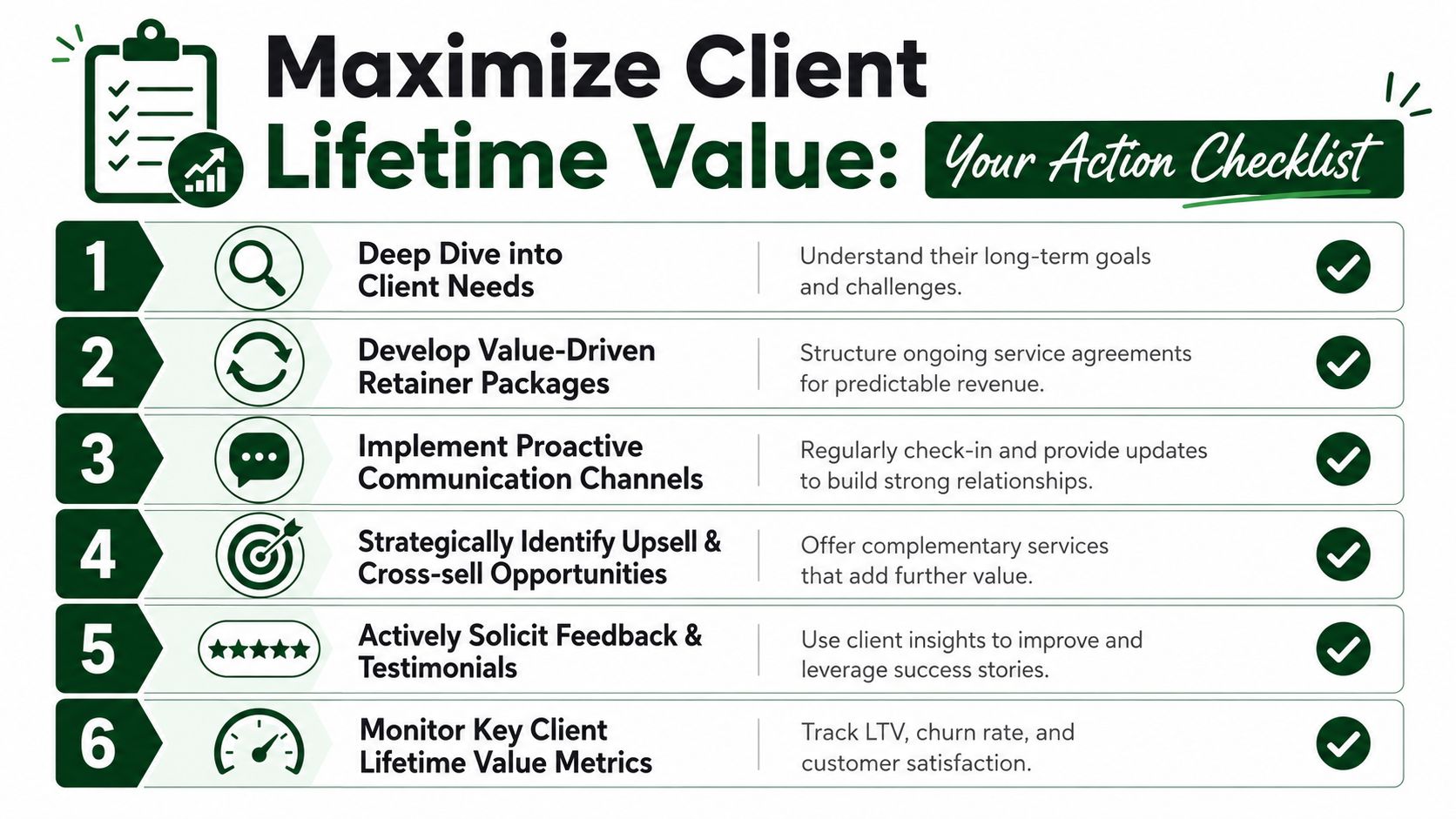
Your practical checklist
Use this as a working list, not a thought exercise.
Audit margin by client and service
Find the work that looks good in revenue reports but performs poorly in real profit.Reprice based on value
Package around outcomes, decision quality, speed, and risk reduction.Cut or repair weak-fit accounts
Tighten scope, move to a healthier model, or end the engagement.Reduce unpaid sales labor
Build a repeatable outreach and follow-up system.Create retainer offers
Turn recurring client problems into clear ongoing agreements.Plan upsells intentionally
Offer the next logical service before the client has to ask for it.
Clients don't become more profitable by accident. Someone has to design the commercial path.
Profit margin improvement usually doesn't come from one bold move. It comes from stacking a few disciplined ones. Better pricing. Faster sales. Cleaner accounts. Smarter packaging. Less wasted effort.
If Upwork is a meaningful part of your pipeline, Earlybird AI can help turn sales efficiency into a margin lever by automating proposal drafting, follow-ups, and client replies so your team spends less time on manual outreach and more time on billable, higher-value work.