

← Back To Blog
How Much Are Retainer Fees in 2026

Most small-business marketing retainers fall between $1,000 and $5,000 a month, while fuller programs and consulting can range from $5,000 to $50,000 or more, depending on scope, according to this marketing consultant pricing guide. The difference often comes down to what the fee reserves. A retainer pays for capacity and carries risk for both sides; it is not a discounted pile of hours.
One provider might reserve senior support for urgent requests. Another might include reporting, revisions, and account management. Compare the capacity, response expectations, and included work behind each quote before judging its monthly price.
Monthly Retainer Fees by Service in 2026
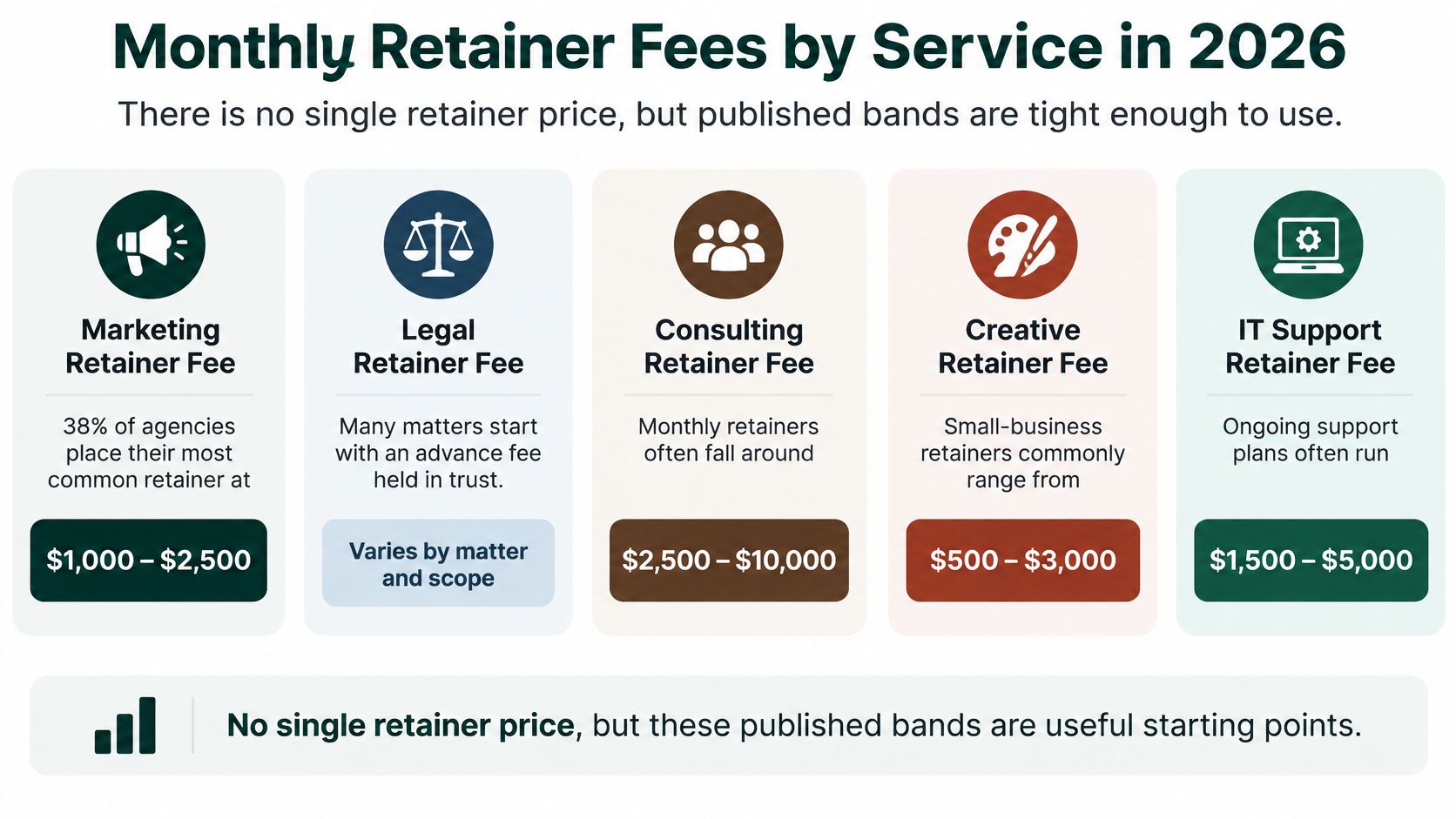
There's no single answer to how much are retainer fees, but the published bands are tight enough to budget against. Start with marketing, where most small-business buying happens. A marketing consultant pricing guide reports that 38% of agencies placed their most common retainer tier at $1,001 to $2,500 per month, while 22% charged $2,501 to $5,000 monthly. The same guide puts broader programs involving implementation, multiple channels, strategic oversight, and reporting at approximately $5,000 to $50,000 per month, with independent consultant rates of roughly $75 to $250 per hour and senior specialists and fractional marketing leaders reaching $150 to $500 per hour.
That hourly context matters because a retainer is usually those hours, reserved in advance. A limited advisory seat with a few calls and light review sits near the bottom. Managed execution across channels, with a team behind it, climbs fast.
How Firm Size Changes the Same Service
Scale shifts the number even when the service name stays identical. A retainer pricing guide by agency size places solo or boutique agencies at roughly $1,000 to $3,000 per month, small agencies at $2,500 to $7,500, midsize agencies at $5,000 to $15,000, and enterprise engagements at $15,000 or more. You're not just paying for more hours at the larger firms. You're paying for more stakeholders managed, more approvals handled, and a bench that covers holidays and sick days.
Specialist services show the same pattern. A 2025 survey of digital PR practitioners reported by BuzzStream, cited in retainer pricing statistics, found the average monthly digital PR retainer was $5,458, with half of retainers priced below $5,000 per month.
Legal, Finance, and Consulting Benchmarks
Outside marketing, the word retainer often means something narrower. LawPay's 2024 Benchmark Report found U.S. law firm retainer amounts requested in 2023 ranged from $1,973 for immigration practices to $4,015 for bankruptcy practices. Those are typically advance deposits, not the full cost of a matter.
Financial advice runs lower and steadier. Kitces reported, via SmartAsset's financial advisor cost guide, that subscription or retainer-based financial advisor services had a median annual fee of $4,500 in 2024, up from $3,000 in 2022.
So pick your band by scope first. Narrow support for a small business usually fits the lower marketing tiers. Multi-channel execution, enterprise stakeholders, or senior consulting belongs higher. If you're comparing outcome-based offers rather than hours, it helps to look at how providers structure pricing for qualified sales appointments, since a fee tied to booked meetings prices the result, not the activity. Then ask the question that decides whether any quote is fair. Is this fee a deposit against future work, paid access to reserved time, or payment for named deliverables?
What a Retainer Fee Really Pays For
Think of a retainer as reserving a table, not paying for the whole meal. You've secured the seats and the kitchen knows you're coming, but the final bill still depends on what you order. That's why clients get confused when a lawyer asks for more money after the retainer is paid. They thought they'd bought the case. They'd bought a starting balance and a place in the queue.
The image below maps that distinction before we get into the legal roots.
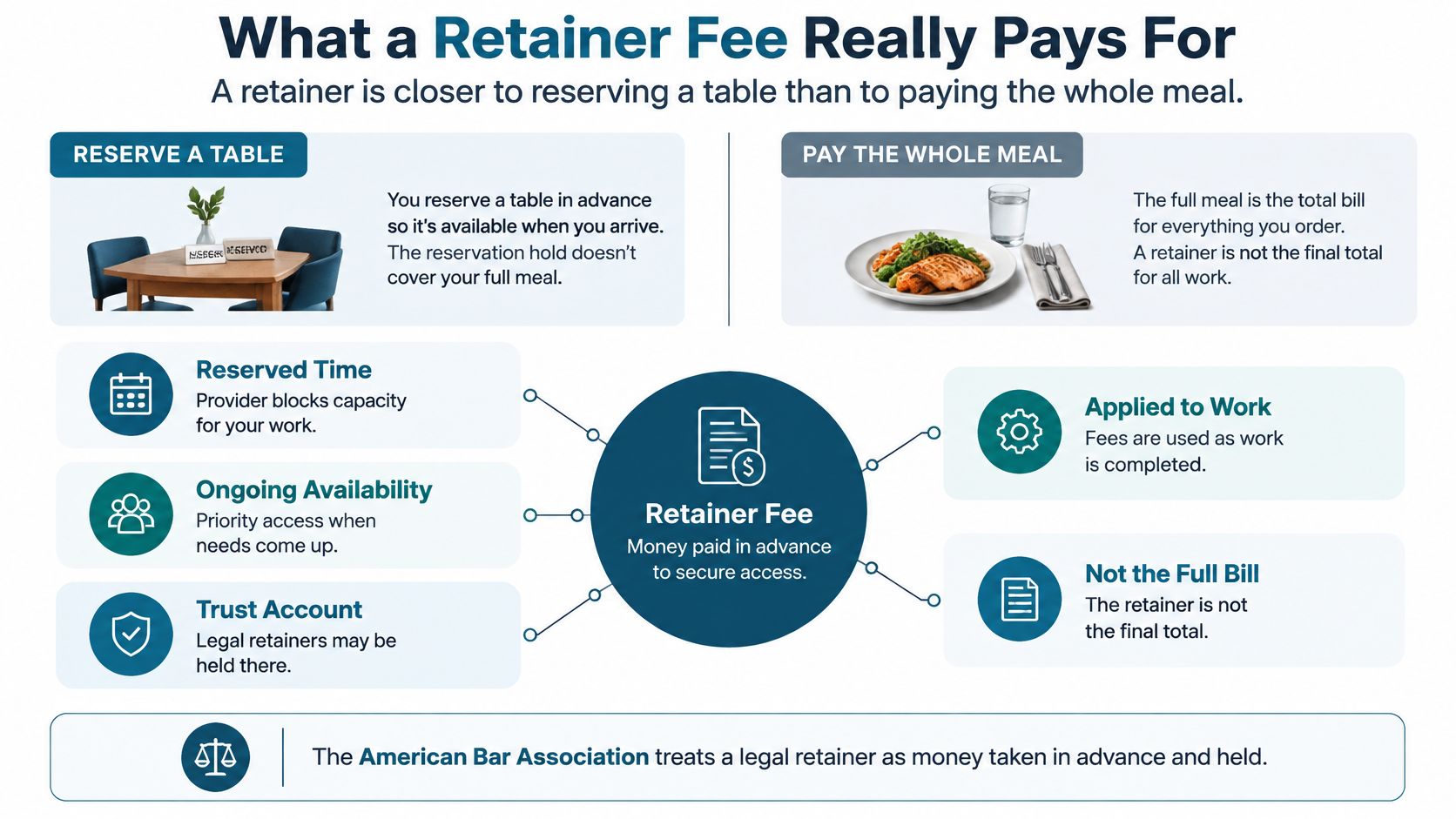
In legal services, the American Bar Association's fees and billing guidance defines a retainer as money obtained in advance and held as a reserve against which the lawyer charges for work performed. The ABA notes it may be structured as a flat fee, an hourly-rate deposit, or an availability payment, depending on expected workload, matter complexity, the lawyer's experience, and geographic market. It also states that unearned funds generally must be returned and advance payments should be kept in a trust account separate from the lawyer's operating funds.
The Three Things You Might Be Buying
Agencies and freelancers borrow the same word for three different arrangements, and mixing them up causes most disputes.
- Deposit retainer: You fund a balance, the provider draws it down at an agreed rate, and you top it up or pay invoices once it's gone.
- Availability retainer: You pay to keep a person or team free for you, even in a quiet month, because that time can't be sold to anyone else.
- Deliverable retainer: You pay a flat monthly fee for a named set of outputs, such as a set number of pages, campaigns, or reports.
Say a client pays a $4,000 legal deposit and the lawyer bills at a hypothetical $400 an hour. That deposit covers about ten hours of work, not the whole matter, and court deadlines don't care that the balance ran out in week two. The State Bar of California, referenced in the ABA guidance linked above, similarly describes a retainer as a fee that can guarantee a lawyer's availability for a particular case.
Before you compare two quotes, ask five questions. What's the starting amount? What's the drawdown rate? What triggers replenishment? Are unused funds refunded? And does the fee reserve time or pay for defined work? Two retainers with identical prices and different answers aren't the same product.
Hourly Deposits Fixed Scope and Value Pricing
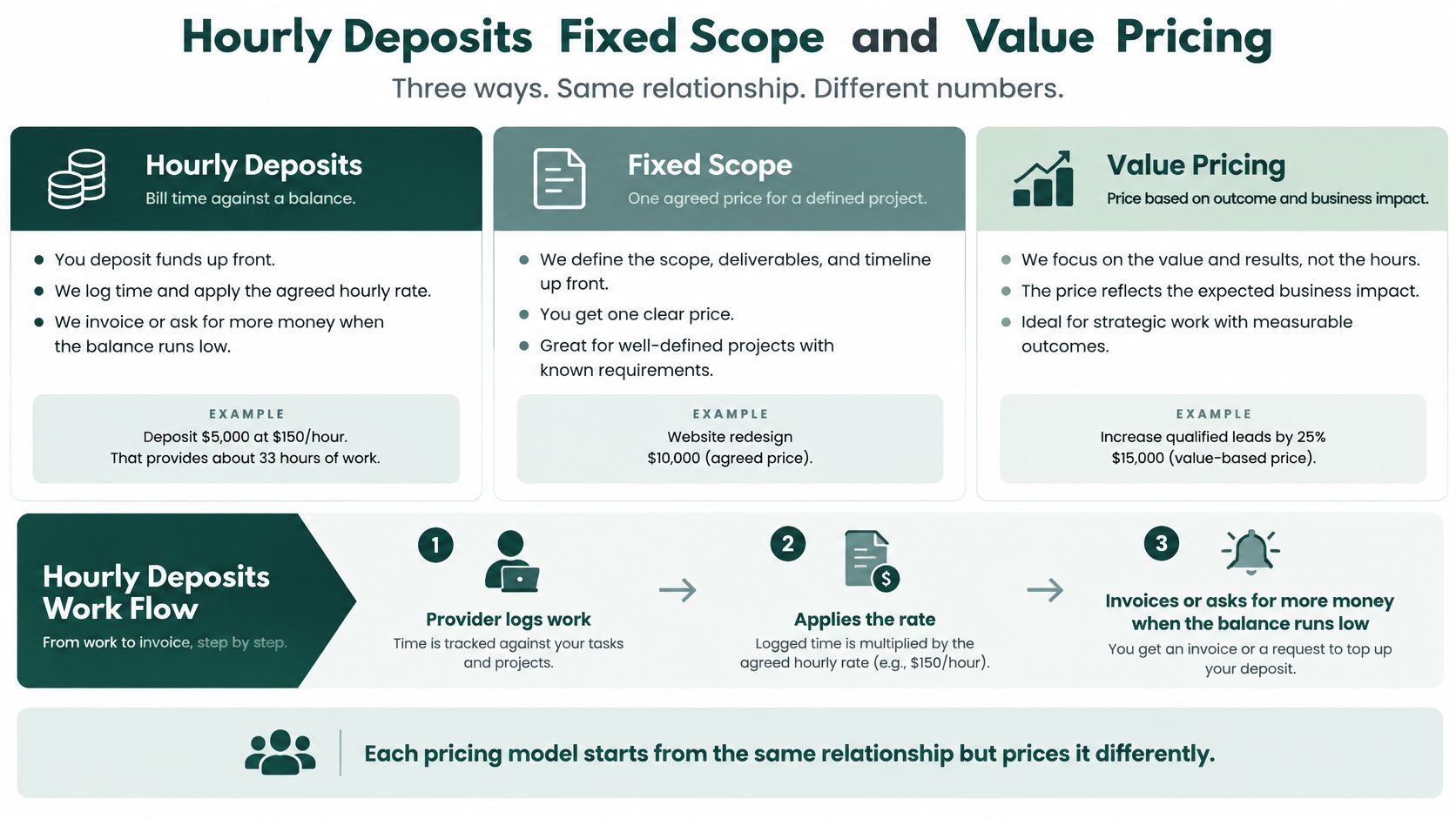
The same working relationship can be priced three ways, and each way shifts risk to a different side. The comparison below lays out the mechanics before we judge them.
Hourly Deposits
With an hourly deposit, the provider logs time, applies the agreed rate against your balance, and invoices you or asks for a top-up when the money runs low. You get a visible drawdown, which suits unpredictable work like ad hoc legal questions or irregular development fixes. The catch is that efficiency doesn't save you money, since you're buying minutes. It helps to know a fair underlying rate first, so check current Upwork hourly rate benchmarks before you accept whatever rate gets drawn against your deposit.
A project retainer guide from Paymo explains that retainers can be tied either to a predefined amount of work or to a reserved time commitment, with payment occurring monthly, quarterly, or annually. It also notes that in a trust-style structure the provider generally cannot treat the advance as earned until the contracted work is completed and billed, remaining unearned money is refundable, and a non-evergreen retainer does not automatically replenish, so work beyond the agreed budget is billed separately.
Fixed Scope
A fixed-scope retainer promises a stated number of deliverables, or a reserved block of hours, for one flat fee. It works best when outputs repeat cleanly month after month. Four articles, two email campaigns, one report. The client gets budget certainty. The provider carries the risk if each piece takes longer than planned, which is exactly why revision rounds and exclusions need to be written down.
Value Pricing
Value pricing charges for the outcome and for holding scarce senior capacity, not for the clock. A consultant whose advice prevents one bad hire or helps clear a stalled pipeline isn't fairly paid by the call. This model needs both sides to name the result in advance, such as qualified opportunities, cases closed, or revenue influenced.
A low monthly fee isn't automatically a bargain. It may simply omit account management, revisions, software, subcontractors, and the hours the provider kept off the market for you.
Choose hourly when demand is unpredictable and you want transparency. Choose fixed scope when deliverables repeat. Choose value pricing when the result is measurable and worth far more than the time involved. A longer prepay, quarterly or annual, should earn a modest discount, never an open-ended promise. And keep one rule in mind. If you can't name the unit being consumed, you don't have a price yet, only a guess.
What Moves a Retainer Up or Down
Price is a stack, not a personality test. Each layer you add has a cost, and each layer you remove should visibly lower the fee. When a provider can't explain which layer you're paying for, negotiation turns into haggling over vibes.
Scope is the biggest lever. Advisory access, meaning a few calls and document reviews, stays near the bottom of any band. Add implementation, several channels, strategy, and reporting, and you've bought a small department. A marketing agency pricing analysis from Haus Advisors reports that 49% of agencies report average retainers of $1,000 to $5,000 per month and 31% report $5,000 to $10,000, while SEO agencies charge substantially more than freelancers on monthly retainers, $3,209 versus $1,349. The same source places average net agency margins at only 13% in 2025.
The Levers Clients Underestimate
- Client size: A midsize company brings more stakeholders, more approval rounds, and heavier reporting than a solo founder, so account time grows even if deliverables don't.
- Industry risk: Regulated, technical, or high-stakes work needs senior people and slower, checked work, and that justifies senior rates.
- Geography and experience: Local market rates and a professional's track record still set the floor in law and consulting.
- Reserved capacity: Hours held for you can't be sold elsewhere, so idle time in a quiet month is a real cost, not free slack.
Then there are the costs clients never see. Sales time to win the account. Software seats. Subcontractors. Revision rounds. The provider's owner reviewing work before it ships. Strip those out of your mental model and every retainer looks overpriced. Include them and the floor question becomes clear. What's the minimum retainer that still protects margin after delivery labor, overhead, tools, and unsellable reserved time?
That 13% margin figure is why blind discounting is dangerous. If a client expects an AI efficiency discount while labor, management, and overhead stay put, a small price cut can erase the entire profit on the account. Automation should first make the work more profitable or faster, not automatically cheaper.
Use four quick moves when you negotiate. Narrow the deliverables to drop a tier. Add a specialist and accept the fee should rise. Count the stakeholders, because each approver adds account time. Separate advice from execution, since a quiet advisory seat can be cheaper than managed delivery but should still cover the time kept off the market. Write the included units down before you argue about the monthly number, and the number mostly argues for itself.
Sample Retainer Calculations You Can Reuse
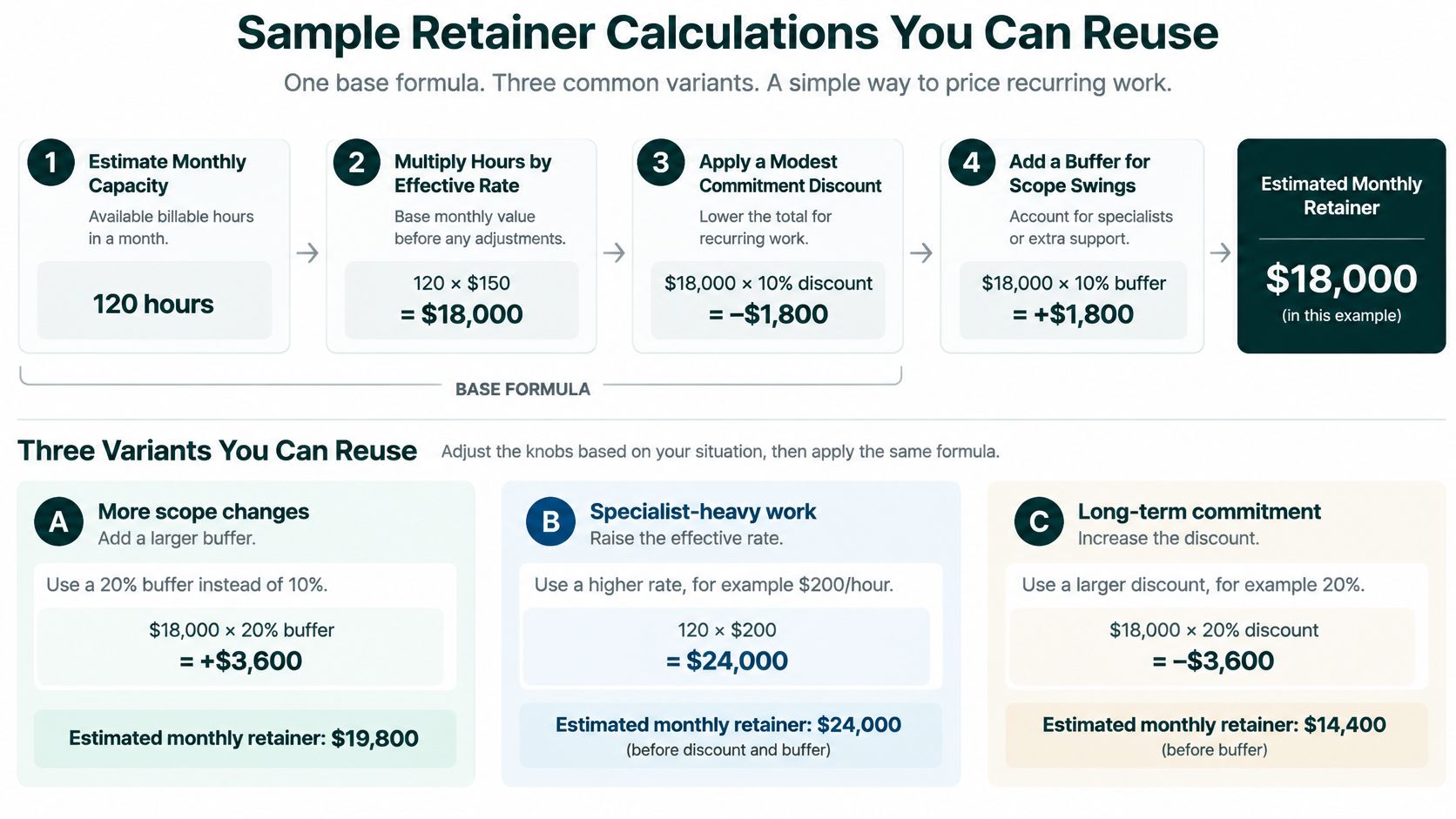
You don't need a finance degree to price a retainer. You need four steps, done in order, and the discipline not to skip the last one. The process below shows the sequence, then we'll run real numbers through it.
The Base Formula
Step one, estimate the monthly capacity you'll reserve. Step two, multiply those hours by your effective hourly rate. Step three, apply a modest commitment discount, since guaranteed recurring work is worth something. Step four, add a buffer for scope swings, specialists, or account management.
A retainer pricing guide from Rocketlane gives the reference case. A team allocating 30 hours monthly at a $125 effective rate produces a $3,750 workload value, and a 10% commitment discount yields $3,375, before adding any risk premium, specialist costs, or account-management overhead. The same guide places marketing and creative retainers around $3,000 to $15,000 per month, while management-consulting retainers commonly range from $5,000 to $25,000 per month for small and midsize businesses and $25,000 to $100,000-plus for enterprise clients.
Notice what the discount rewards. It rewards commitment, not volume of demands. The client gets a lower rate because the work is predictable, and predictability dies the moment scope becomes unlimited.
Three Variants You Can Copy
Freelancer advisory seat. Say a solo consultant reserves 15 hours at $150 an hour, which is $2,250. A 10% commitment discount gives $2,025. That's a sensible fee for calls, reviews, and light guidance. It is not a sensible fee for unlimited revisions or same-day turnarounds, and the agreement should say so.
Small agency delivery. Say an agency reserves 40 hours at $150 an hour, which is $6,000. Minus 10% gives $5,400. Add roughly 15% for account management and tools and you land near $6,210, squarely in the small to midsize band. If that number feels high to the client, cut hours or deliverables. Don't cut the management layer and pretend the work manages itself. It helps to sense-check the result against healthy advertising agency profit margin ranges before you send the quote.
Senior consulting. Say a specialist offers 20 hours at $300 an hour, which is $6,000 with no discount at all. That's defensible when the client is buying scarce expertise rather than volume. Discounting scarce capacity trains clients to wait for a sale that shouldn't exist.
Utilization warning: If the client consumes materially more than the reserved capacity, gross margin falls unless the agreement defines overage rates, rollover limits, or a scope-change mechanism.
That warning matters most for ongoing services like lead generation or sales operations. Your quote should list included accounts, outreach or proposal volume, response-management coverage, reporting, optimization time, and who handles escalations. The phrase ongoing support promises everything and defines nothing. Sanity-check your final number against the band for your firm size, then raise the fee or cut the units until the margin holds. Never do the reverse and hope a quiet month saves you.
Rollover Overages and Quiet Months
Most retainer fights aren't about the headline fee. They're about February, when the client used half the hours and wants them back in April, when they suddenly need double. Retainers assume flat demand. Real businesses don't have any.
The 2025 Promethean Research Digital Agency Industry Report indicates that 91% of digital agencies offer retainers and 88% offer both retainers and project work, while another benchmark in the same report notes 85% of agencies work primarily on retainer, with 86% of average monthly retainers at or below $10,000. So the model is everywhere, sitting right next to lumpy project demand. The contract has to absorb that mismatch, because goodwill won't.
Four Fair Ways to Handle Unused Time
No rollover means unused hours expire at month end. That's fair when the client paid for availability, since the provider held the time and turned other work away. It's the cleanest model and the one clients resist most.
Capped rollover lets a limited amount carry forward, perhaps one month of unused hours. It softens a quiet spell without building a buried bank of free work that detonates your schedule later.
Banked hours with expiry suit seasonal clients, such as a retailer who's quiet in summer and frantic in November. The expiry date must be written down, or the bank becomes a permanent liability on your calendar.
Outcome-based monthly scope skips hour banks entirely. The client pays for a defined result each month, and extra work is priced separately. Nobody argues about minutes because minutes were never the product.
Deposits, Pauses, and Rush Work
Deposit retainers need their own rule. An OBLIC explanation of evergreen retainers describes a client maintaining a $5,000 trust-account balance where, if $1,500 is earned and transferred at month end, the client deposits $1,500 to restore the balance to $5,000. Unearned money stays the client's until work is done, which is exactly why the balance must be tracked, not estimated.
Pauses deserve the same clarity. Set a minimum term, often three months, so the provider can staff the work properly. If a client pauses and the team gets reassigned, a restart fee is fair, because rebuilding context takes real hours. Urgent work outside the agreed window should carry a stated rush rate, agreed before anyone's weekend is at stake.
The decision rule is simple. More flexibility for the client means a higher fee or a smaller discount. That isn't punishment. The provider is holding capacity that may go unused, and somebody has to pay for the empty chair. Flexibility is a feature, and features have prices.
Agree the Terms Then Quote the Fee
Negotiate in the right order and the fee conversation gets short. Many clients do it backwards, agree a number under pressure, then spend six months arguing about what it includes.
First, confirm the units. Hours, deliverables, managed profiles, or qualified opportunities. Pick one primary unit and write it down. Second, show the calculation and the market band it lands in, so the client sees arithmetic rather than appetite. Third, trade flexibility openly. A larger discount is reasonable only if rollover is capped and the term runs at least three months. If you're the buyer in this conversation, solid agency selection advice for small businesses will help you ask these unit and scope questions before you sign anything.
Fourth, write the commercial controls. An explanation of attorney hourly and blended rates notes that a deposit engagement should identify the billing rate, billing increments, invoice frequency, minimum balance, treatment of unused funds, and conditions for refunding unearned amounts. Agencies can mirror that discipline with a prepaid monthly service credit tied to explicit consumption metrics and clear expiry rules.
Put the exclusions in the same document. Rush work, extra stakeholder rounds, ad spend, and third-party tools should never be discovered mid-engagement. Vague entitlements create scope fights. Measurable units make renewal math auditable, and auditable math renews calmly. Getting the document structure right matters too, so it's worth understanding the difference in a master service agreement vs statement of work before you decide where these terms live.
One last separation protects your margin. Keep the client retainer distinct from the tooling that delivers it. If you sell ongoing Upwork lead generation, we price Earlybird AI as a fixed cost starting from $167 a month billed annually, proposals go out as the individual freelancer, and our system replies to every lead within minutes and follows up until the call is booked. Treat that as delivery overhead inside your retainer calculation. Don't hand the efficiency back as an automatic discount, or you've automated your way to the same thin margin.
Send a one-page scope with units, rate, rollover rule, overage rate, and term before anyone agrees a monthly number. That's the whole discipline.
If your retainer depends on a steady flow of new conversations, price the outreach engine into your delivery costs instead of absorbing the manual hours yourself. Earlybird AI searches Upwork, sends personalized proposals fast, and follows up until calls are booked, so the capacity you're reserving for clients goes to paid work, not inbox chasing. Visit the site, see how the fixed monthly cost fits inside your retainer math, and quote your next client with the margin intact.


