
← Back To Blog
How to Open a Marketing Firm in 2026

You’re probably already doing the work.
You run campaigns for an employer, manage paid media for clients on the side, write strong copy, fix broken funnels, or rescue underperforming accounts after someone else made a mess. People trust you with revenue work, but you still hesitate when the idea of starting your own firm gets real.
That hesitation is normal. The jump from skilled marketer to agency owner is not about talent alone. It is about building a company that can sell, deliver, invoice, retain, and repeat without running on adrenaline.
Most advice on how to open a marketing firm stops at “pick a name, form an LLC, and make a website.” That is the easy part. The hard part is building a firm that does not depend on luck, referrals drying up, or you manually chasing every prospect while trying to fulfill client work.
A modern marketing firm needs four things from day one. A niche you can defend. Offers that clients understand quickly. Financial discipline. A client acquisition system that keeps moving whether or not you are in the mood to network.
From Dream to Blueprint Your Marketing Firm
A lot of firms start with a vague sentence like, “We help businesses grow.” That sounds safe, but it is usually the first mistake. Buyers do not hire broad promises. They hire specialists who sound like they already understand the problem.

The better starting point is a blueprint. Not a fantasy business plan with pages of filler, but a practical model for who you serve, what you sell, how you get clients, and what has to happen each week to stay solvent. If you want a useful primer on agency revenue mechanics, this breakdown of how marketing agencies make money is worth reviewing before you price anything.
The shift that matters
A freelancer sells labor. A firm sells outcomes, process, and reliability.
That difference changes everything:
- Positioning matters more: A firm needs a reason to be chosen beyond personal reputation.
- Sales must be repeatable: You cannot rely on “someone knows someone.”
- Delivery needs systems: Clients stay when they trust the process, not just the talent.
I’ve seen strong marketers stay stuck for years because they treat the business like a larger freelance practice. They keep every service open, customize every proposal from scratch, underprice the work to win early deals, and tell themselves systems can wait.
They cannot wait.
A new firm does not fail because the owner lacks marketing skill. It fails because there is no operating model under the skill.
The firms that stabilize fastest usually make one tough decision early. They narrow the market, simplify the offer, and build acquisition into the company from the beginning instead of hoping referrals appear.
That feels less glamorous than designing a brand identity. It is also what gives you a real business.
Validate Your Niche and Package Your Services
Trying to serve everyone is how new agencies become invisible. Broad positioning creates price pressure because buyers cannot tell the difference between you and ten other shops making the same claims.
The strongest starting move is narrowing your market enough that prospects feel recognized when they read your site, proposal, or outreach.
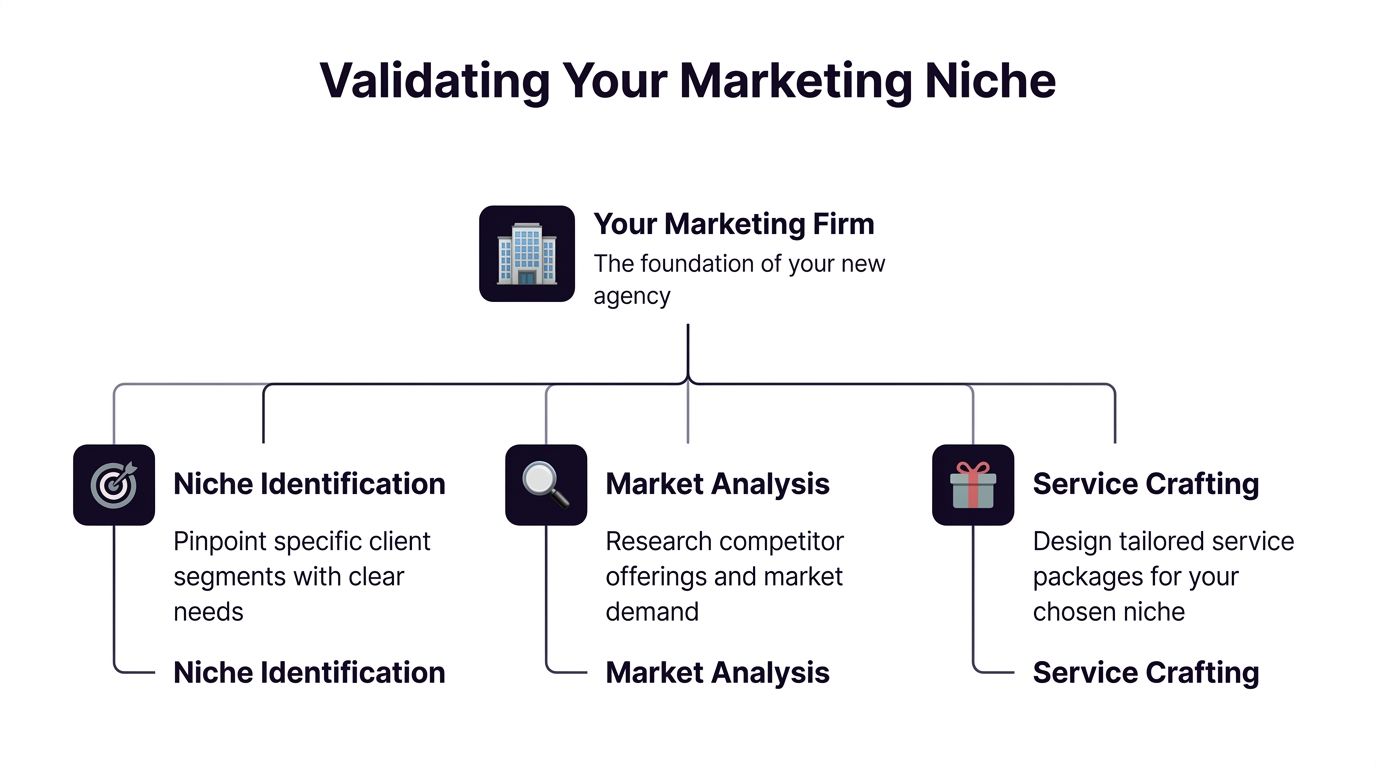
According to STFO’s guidance on starting a marketing agency, niche positioning works best when you identify a target market with limited competition and a specific number of prospective clients. The same source recommends profiling clients by pains, goals, constraints, and triggers rather than relying on demographics alone. It also notes that specialized agencies report significantly higher client retention and quicker client acquisition through personalized outreach.
Choose a niche clients can describe in one sentence
A bad niche sounds like this:
- We do digital marketing for small businesses
- We help founders scale online
- We offer SEO, PPC, email, social, design, and branding
A better niche sounds like this:
- Paid search and landing page optimization for local law firms
- Lifecycle email marketing for Shopify brands
- Local SEO and lead generation for home service businesses
- Demand generation for B2B SaaS teams with lean in-house marketing
The point is not to pick a niche that sounds trendy. The point is to pick a niche where you can become specific fast.
Use pains, goals, constraints, and triggers
Demographics make weak positioning. Behavioral detail makes usable positioning.
Build a short profile for your ideal client around four things:
- Pains: What is broken right now? Low lead quality, poor conversion rates, weak pipeline, messy attribution.
- Goals: What are they trying to accomplish? More booked calls, lower wasted ad spend, better retention, smoother handoff to sales.
- Constraints: What limits their action? Small team, budget scrutiny, founder approval bottlenecks, legacy tools.
- Triggers: What makes them buy now? Hiring a salesperson, missing pipeline targets, launching a new location, entering a new market.
This framework changes your sales message. Instead of saying, “We do paid media,” you say, “We help regional law firms stop paying for irrelevant clicks and turn search demand into qualified consult requests.”
That is easier to sell because it reflects the buyer’s reality.
Validate before you build too much
Do not spend weeks polishing a site before you test your position.
Start with a simple validation loop:
- Write a one-sentence positioning statement.
- Build two or three offer concepts.
- Show them to people in your network who know the market.
- Take sales calls.
- Listen for confusion.
If prospects ask, “So what exactly do you do?” your niche is still too loose.
If they immediately start describing their current problem, you are close.
If the market understands your offer only after a long explanation, the offer is not ready.
Package the work so buyers can say yes
Once the niche is clear, package services around business problems. Do not lead with hours. Lead with deliverables, process, and expected scope.
Three offer structures work well for a new firm.
Starter package for a defined win
This is the easiest sale when trust is low.
Examples include:
- Audit plus action plan
- Landing page rebuild
- CRM cleanup and email sequence setup
- Paid search account restructure
A defined project helps a prospect test your thinking without committing to a long retainer.
Core retainer for ongoing execution
Stability comes from this. Keep it narrow enough that your team can deliver consistently.
A good retainer usually includes:
- Clear channel ownership: For example, search, email, or local SEO
- Defined cadence: Weekly check-ins, monthly reporting, agreed revisions
- Boundaries: What is included, what is not, and what triggers a scope change
Strategic advisory for higher-trust clients
Some buyers need senior thinking more than daily execution. Advisory can work well if you have deep expertise in a niche and can guide an internal team.
This model protects your time, but only if your positioning is already strong.
Stop pricing like an employee
Hourly pricing creates friction because clients start watching time instead of value. Use it internally if you want to estimate workload, but do not make it the center of your offer.
Buyers prefer pricing that answers three questions:
- What do I get?
- How long will it take?
- What happens next?
If your proposal answers those clearly, price resistance usually becomes a fit discussion instead of a debate over line items.
Establish Your Business and Financial Foundations
A surprising number of talented marketers delay the boring setup work, then regret it as soon as the first dispute, late payment, or tax question appears. Formalizing the business early saves time and stress later.
Start with the legal wrapper. Most new owners choose between operating as a sole proprietor or forming an LLC. A sole proprietorship is simple, but it does not separate you from the business. An LLC creates a clearer line between personal and business liability, which matters once you sign contracts, collect deposits, and manage client assets.
That is not legal advice. It is operational advice. If you plan to build a firm instead of a casual side income stream, treat the company like a company.
Get the essentials in place early
You do not need an elaborate setup. You do need the basics:
- Business entity: Register the structure you choose.
- Business bank account: Keep client revenue and expenses separate from personal spending.
- Simple bookkeeping system: Use software from day one.
- Contract template: Do not start work off email promises.
- Invoice process: Decide how deposits, payment terms, and late follow-up work.
This is the difference between feeling like you started a business and running one.
Build a one-page operating plan
Your business plan does not need to impress a lender. It needs to guide your decisions.
A useful one-page plan includes:
- your niche
- your core offers
- your ideal monthly revenue mix
- your acquisition channels
- your delivery capacity
- your margin target
- your hiring trigger
That last item matters. Many owners hire because they feel busy. Busy is not a financial metric.
According to industry benchmarking summarized by My Codeless Website, marketing agencies operate with net profit margins within a certain range. The same source notes that agencies with a moderate number of active clients tend to generate maximum revenues with the fewest operational difficulties.
Those numbers should shape how you price and staff the firm. If your pricing leaves no room for software, revisions, admin time, sales effort, and inevitable client friction, you do not have a business. You have a job with extra overhead.
Price for sustainability, not optimism
New owners often underprice because they assume lower pricing reduces risk. It usually creates a different risk. The work becomes hard to deliver profitably, and the owner gets trapped doing too much for too little.
Use a practical pricing lens instead:
- Retainers fit recurring channel management.
- Project pricing fits defined builds, launches, and audits.
- Value-based pricing works when the commercial upside is clear and the client trusts you.
A useful internal exercise is to calculate your effective floor. Add your monthly personal draw target, software costs, taxes, contractors, and overhead. Then divide that by the billable capacity you can realistically sustain.
That internal number is not your market price. It is your warning line. If your proposals keep landing below it, your positioning, packaging, or sales process is off.
The market does not reward cheap agencies for long. It uses them until the delivery breaks.
Protect your downside
Your first contracts should cover a few essential items:
- scope
- revision limits
- payment terms
- access responsibilities
- timelines
- termination
- ownership of work product
Many early disputes are not really about performance. They are about assumptions. Good paperwork removes assumptions before they become arguments.
Financial discipline is the same. Review revenue by client, margin by service line, and time drain by account. You do not need a finance team to do this. You need the habit.
Build Your Automated Client Acquisition Engine
Most new firms do not fail because the service is weak. They fail because client flow is erratic. One month looks promising. The next is silent. Then the owner drops prices, says yes to bad-fit work, and spends more time prospecting than delivering.
That cycle is avoidable if acquisition is treated as infrastructure, not a side activity.

The old model was simple. Tell your network you launched, post on LinkedIn, attend events, ask for referrals, and wait. That can work, but it is slow and uneven. It is especially weak when you need clients now, not eventually.
A more practical approach is to build around buyer intent. Platforms like Upwork put you in front of companies actively looking for help. The challenge is competition and speed.
According to ProductLed Alliance’s discussion of underserved market positioning, freelancers secured billions of dollars in work on Upwork in a recent year, while many struggle with consistent leads because of competition. That same source says Upwork agency earnings were up significantly in a recent quarter and few new marketing firms were leveraging automation. It also highlights AI-assisted fast response workflows, including rapid responses, as a meaningful opportunity.
Why networking alone is too slow
Networking has a place. It is just not a complete acquisition system.
Referrals are unpredictable. Events take time. Social posting builds familiarity, but familiarity is not a pipeline. A new firm needs a way to show up where buyers already have intent and a budget conversation is already happening.
That is why Upwork matters. Clients there are not being “educated into awareness.” They are shopping for a solution.
Win the timing battle
On marketplaces, timing changes outcomes.
If a qualified lead posts a project and gets a stack of generic replies within minutes, the first strong response often gets the most attention. Not because it is always the best agency, but because buyers are busy and momentum matters.
That creates a clear operating advantage for firms that systematize:
- job monitoring
- niche filtering
- proposal drafting
- rapid follow-up
- inbox management
A manual process can do this for a while. Then fulfillment gets busy and the sales engine stalls.
Automation is not spam if the targeting is tight
Bad automation sprays low-quality proposals everywhere. Good automation narrows the field and increases relevance.
The difference comes down to rules.
A clean setup should define:
- Project fit: Which jobs match your niche, budget profile, and service line
- Disqualifiers: Red flags like vague scope, suspicious payment behavior, or poor-fit channels
- Proposal inputs: Service angle, industry language, likely pain points, and a specific first step
- Reply speed: Fast enough to be early, thoughtful enough to sound human
If you want a current view of how this category works in practice, this guide on AI for sales prospecting helps frame the role of automation without reducing sales to templates.
The point of automation is not to remove judgment. It is to apply judgment faster and more consistently.
What your acquisition engine should do every day
Think of your sales system as a lightweight assembly line.
A workable daily engine looks like this:
- Scan new opportunities in your chosen niche or service area.
- Filter for fit using budget, scope, vertical, and urgency.
- Generate a customized first response that reflects the buyer’s stated problem.
- Follow up quickly when a client asks a question or requests clarification.
- Move qualified conversations to a call with a clear agenda.
That removes a lot of dead time from the top of the funnel.
The owner still handles positioning, qualification, and closing. The repetitive searching and first-touch work no longer eats the whole day.
Keep the proposals short and specific
A strong Upwork proposal does not sound like a mini agency brochure. It should show that you understood the project and know what to do first.
Good proposal structure usually includes:
- Opening relevance: Mention the actual problem they described
- Service fit: Explain why your niche experience matches
- Simple next step: Audit, quick review, call, or initial plan
- Proof of process: Show how you work, not just what you know
Weak proposals usually fail in one of two ways. They are too generic, or they try to say everything.
This walkthrough is useful if you want to see a marketplace-focused workflow in action:
Use Upwork as a wedge, not your whole identity
A lot of owners resist marketplaces because they think serious firms should not need them. That is ego talking.
Upwork is a channel. Not a business model. You can use it to land initial clients, build cash flow, sharpen your offer, and collect proof of delivery. Later, you can layer in referrals, outbound, partnerships, and direct inbound.
The mistake is waiting for brand authority before you start selling.
If your firm can consistently identify good-fit projects and respond faster than competitors with a clear, niche-specific pitch, you have a practical edge. For a new agency, that edge matters more than polished thought leadership.
Deliver Excellence and Systematize Your Operations
The easiest client to close is often the one you already have, provided you deliver cleanly, communicate well, and create confidence early. Retention is not built by good intentions. It is built by repeatable operations.

The first impression usually happens after the sale. A messy onboarding process tells the client they may have bought chaos.
Build an onboarding sequence that lowers anxiety
Clients want three things in the first week. Clarity, momentum, and signs of competence.
A simple onboarding flow should include:
- Kickoff call: Confirm goals, stakeholders, communication rules, and success criteria
- Access checklist: Ad accounts, analytics, CMS, CRM, creative files, brand assets
- Timeline: What happens in the first week, first month, and first reporting cycle
- Decision ownership: Who approves copy, budgets, strategy shifts, and design
- Communication cadence: Where updates live and how often you meet
This reduces the most common early problem. The client assumes work has started, while your team is still waiting for access or approvals.
Use project management software like an operator, not a hobbyist
Many agencies buy tools and still run projects through scattered messages. That creates missed tasks, confused ownership, and late deliverables.
A project management system only helps if it reflects the way your firm works. Build templates for recurring motions:
- new client onboarding
- campaign launch
- monthly reporting
- creative review
- offboarding
As noted in the earlier workflow discussion, strong systems matter because operational consistency directly affects growth. For practical tool ideas, this roundup of software for a digital marketing agency is a useful starting point.
According to WordStream’s digital marketing statistics roundup, optimizing workflows with project management software can improve execution efficiency substantially and help agencies achieve high client satisfaction rates. The same source notes that email marketing delivers significant returns for every dollar spent, making it one of the strongest service lines for showing value quickly.
Pick at least one service with obvious commercial value
Some services are hard for clients to evaluate in the short term. Others create fast, visible signals.
Email marketing is often a strong anchor offer because buyers already understand the channel, and performance discussions are easier to tie to commercial outcomes than many vague “awareness” retainers.
That does not mean every firm should become an email shop. It means your service mix should include at least one offer where the client can clearly see the business case.
Create a reporting cadence that clients can follow
Many agencies over-report and under-explain.
A better reporting structure answers:
- What happened?
- Why did it happen?
- What are we changing next?
- What do you need from the client?
Keep dashboards for detail. Use meetings for interpretation.
Clients do not stay because you sent more slides. They stay because they trust your judgment.
Write SOPs earlier than you think you need them
Standard operating procedures sound tedious until you hire, delegate, or take a vacation.
Document the repeatable parts of delivery:
- proposal handoff to fulfillment
- campaign QA
- monthly review process
- asset request flow
- client escalation path
You do not need a giant operations manual. Start with checklists and screen recordings. The goal is consistency, not bureaucracy.
A systemized firm feels calmer to the client and less exhausting to run. That is what makes growth possible without quality slipping every time the workload spikes.
Scale Your Firm Intelligently and Measure Success
Growth gets romanticized. In practice, scaling too early can strain cash, lower quality, and lock you into payroll before demand is stable. Scaling too late creates another problem. The owner becomes the bottleneck for sales, strategy, delivery, and account management.
The answer is not “hire as fast as possible” or “stay lean forever.” The answer is building a decision framework.
Know what to track before you hire
A firm should know which numbers drive healthy growth, even if the tracking lives in a basic spreadsheet.
Watch these closely:
- Client acquisition cost: What it takes to win a client
- Client lifetime value: How much a client is worth over the relationship
- Net profit margin: Whether revenue is turning into business health
- Utilization: How much delivery capacity is being used
- Retention by offer type: Which services keep clients longest
- Pipeline quality: Whether your incoming opportunities fit your niche
If those numbers are fuzzy, hiring usually adds complexity faster than it adds advantage.
Hire employees for stability, contractors for flexibility
Full-time employees make sense when the work is recurring, the process is stable, and the role requires institutional knowledge. Contractors make sense when demand is uneven, the work is specialized, or you are still testing service lines.
Consider this practical approach:
- Hire employees for repeatable core functions.
- Use contractors for burst capacity or narrow expertise.
- Keep strategy and client communication close to leadership until the process is mature.
Many early firms overhire around hope. Then one slow quarter turns a manageable dip into a stress test.
Do not scale bad-fit clients
Revenue can hide damage for a while. A client that constantly changes scope, delays approvals, ignores strategy, or burns out your team is not just annoying. That account changes how the whole firm operates.
The hidden cost shows up in team morale, delayed work, and weaker delivery for good clients.
According to MarketingProfs on launch process pitfalls, high marketing talent turnover affects many firms and is often driven by thin resourcing and misaligned priorities. The same source notes that better planning and primary customer research can cut budget waste from a significant portion to a smaller amount, while continuous improvement and analytics can produce notable efficiency gains.
That is not just a marketing lesson. It is an agency management lesson. If your offers, staffing, and client promises are misaligned, turnover and waste follow.
Build a simple scaling trigger
Before adding headcount, ask:
- Is the demand recurring or temporary?
- Is the work already systemized?
- Can margin support the hire without assuming best-case sales?
- Will this hire remove a real constraint?
- Are we filling a skills gap or avoiding a process problem?
If the answer to the second question is no, document the process before you hire into it.
Hiring should solve a repeatable problem. It should not become a substitute for operational clarity.
A firm scales well when it protects focus, tracks the right numbers, and grows capacity only after the underlying service model is stable. That is less exciting than “10x” language. It is also how durable agencies are built.
Your Launch Kit Checklists and Final Thoughts
Starting a firm feels overwhelming when everything seems urgent at once. It gets easier when you reduce the launch to a handful of practical checklists.
Proposal essentials
- Client problem: Show you understand the pain in plain language.
- Recommended scope: Define what you will do first.
- Timeline: Give a realistic delivery window.
- Pricing: Present the fee clearly, without clutter.
- Next step: Make it obvious how the client moves forward.
Basic contract must-haves
- Scope definition: State what is included and excluded.
- Payment terms: Cover deposits, invoicing, and overdue handling.
- Revisions and approvals: Limit endless change cycles.
- Access responsibilities: Clarify what the client must provide.
- Termination terms: Explain how either side can end the engagement.
Pricing model options
- Project fee: Best for defined work with a clear finish line.
- Monthly retainer: Best for ongoing channel management and advisory.
- Hybrid model: Useful when setup work leads into ongoing execution.
A good launch is not flashy. It is disciplined. Pick a niche you can defend, package offers buyers understand, get the legal and financial basics right, and build an acquisition engine that does not depend on luck. That is how a marketer becomes a firm owner.
If you want to shorten the path from launch to booked calls, Earlybird AI is built for exactly that. It helps agencies automate Upwork prospecting, send customized proposals quickly, reply fast, and keep the top of the funnel moving without adding manual sales grind to your day.