
← Back To Blog
How to Write a Proposal on Upwork That Wins Replies
You've rewritten your opening, polished your portfolio, and sent another batch of proposals. Your Upwork inbox is still quiet. It's tempting to blame the cover letter, but the more useful question is whether those clients were realistic prospects in the first place.
Learning how to write a proposal on Upwork starts with deciding which jobs deserve an application. Then you need a short, credible message that connects the client's problem to your evidence, your approach, and an easy next step.
Why Most Upwork Proposals Fail Before They're Read
Consider a hypothetical freelancer applying to every automation job that mentions a familiar tool. Some clients want a complete sales operation rebuilt on a maintenance budget. Others need specialist database work, while the freelancer's strongest samples demonstrate email workflows.
The freelancer sends the same pitch to everyone, gets little engagement, and concludes that the opening needs more personality. That diagnosis skips the earlier problem: the applications went to clients with different needs, constraints, and expectations.
Qualification comes before persuasion. A sharper sentence won't make an unsuitable budget workable or turn an unrelated portfolio sample into convincing evidence.
Start with the client's decision
From the client's side, the useful questions are straightforward: Does this person understand the assignment? Can they show relevant work? Does their proposed scope make sense?
A biography-first proposal makes the client find those answers themselves. A poorly selected opportunity makes the answers unconvincing, regardless of how well you write.
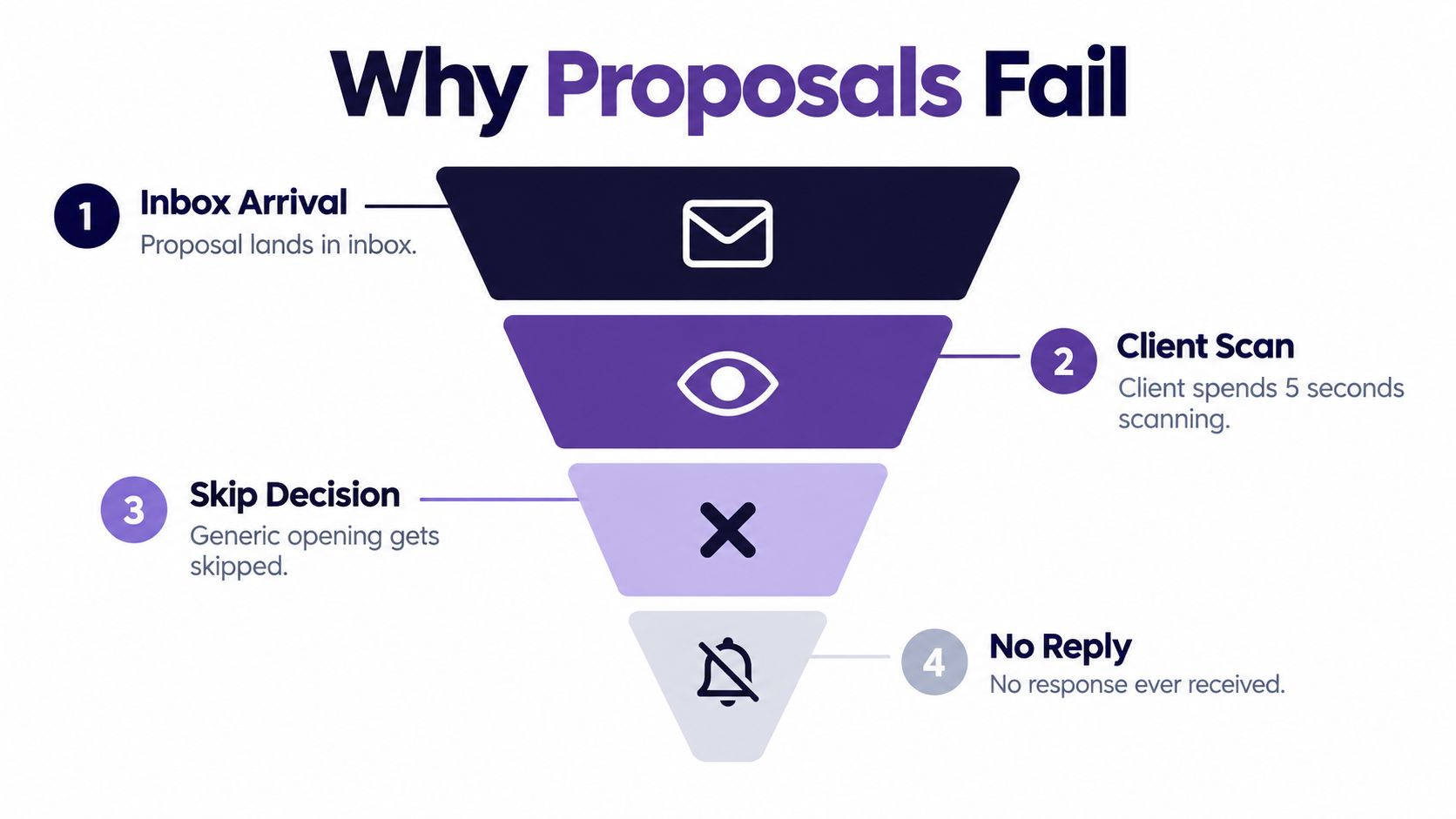
The funnel below illustrates how an application can reach a client without creating a reason to reply. Treat it as a conceptual model, not a measured response-time benchmark.
Look for these signals before investing in the pitch:
- A recognizable outcome. The client names something you can deliver, such as fixing lead routing rather than vaguely improving marketing.
- Relevant evidence. You have a sample that demonstrates the difficult part of the assignment.
- Workable constraints. Budget, access requirements, and deadlines don't contradict the requested outcome.
- A credible hiring path. The client's description and history give you a reasonable basis for discussing the project.
Broad demand can help you choose a specialty, but it doesn't establish fit for an individual listing. Upwork's 2024 in-demand-skills analysis examined earnings from January 1 through December 31, 2023, required at least 250 projects with active work per skill, and compared growth against 2022, identifying generative AI modeling, machine learning, and data analytics as the fastest-growing skills in data science and analytics.
That's evidence of marketplace activity, not permission to pitch every AI-related job. Use demand categories to organize your portfolio, then select the evidence that matches the actual assignment.
Practical rule: Don't improve the wording until you can explain why this particular client should consider your particular experience.
Qualifying the Job Post Before You Write a Single Word
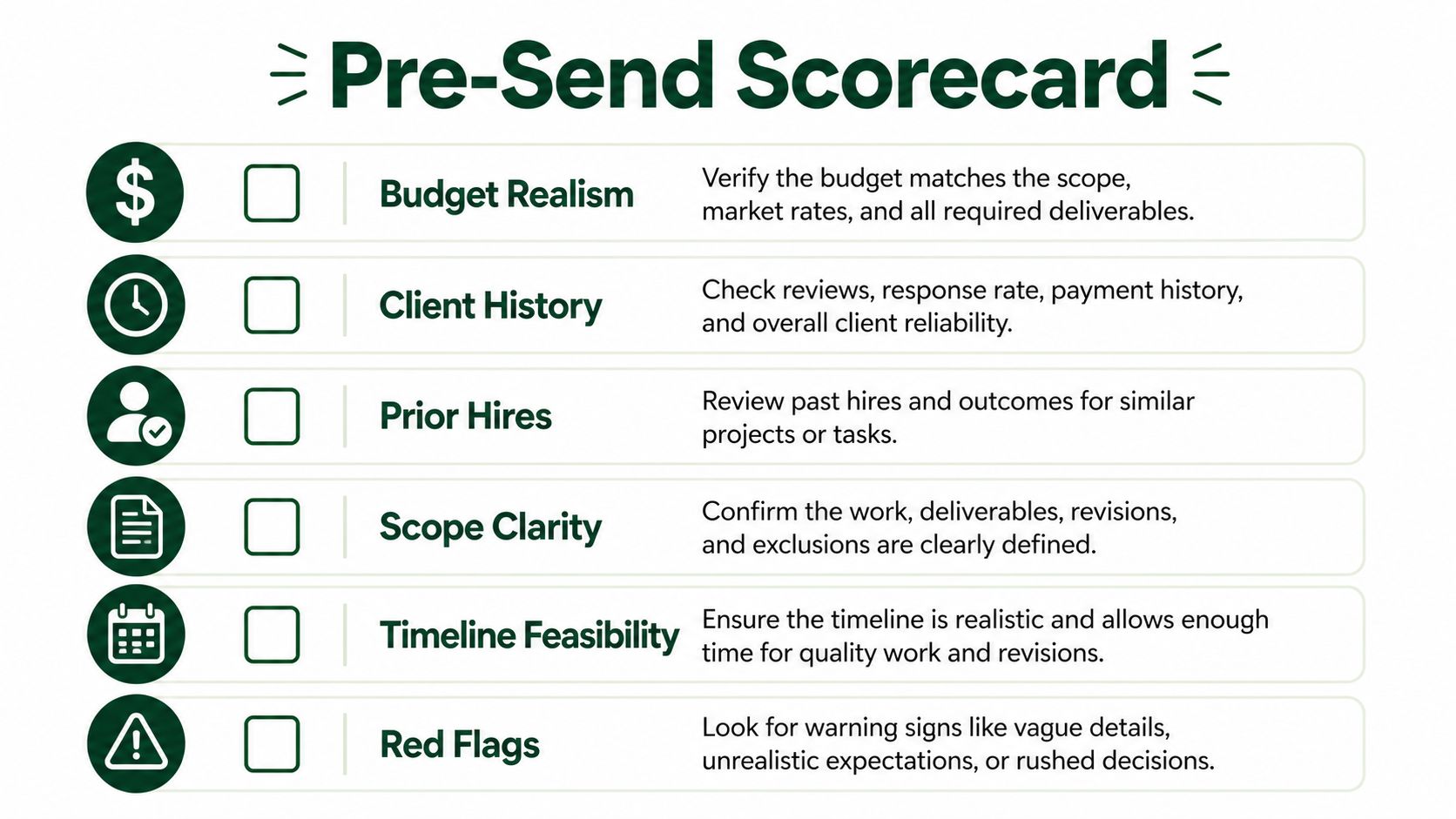
Give every opportunity a pre-send scorecard. Mark each check as pass, uncertain, or fail, and record the reason. The point isn't to generate a flattering score; it's to expose assumptions before you spend money or time.
A detailed description isn't automatically a good opportunity. A client can specify many tasks without defining acceptance criteria, available access, or a workable deadline.
Use this visual as a reminder of the operational checks, then add your own proof-fit assessment.
Check the commercial fit
- Budget realism. Compare the requested work with the price you'd need to deliver it responsibly. A small budget may support a bounded diagnostic, but not the full implementation described. Apply only if you can explain that distinction.
- Client history. Review available payment verification, spend, and feedback. An unverified payment method creates uncertainty, not automatic proof of fraud. Read the signals together.
- Prior hires. Look for evidence that the client has turned previous postings into working relationships. A new client has no such record, so you'll need more clarity from the current description.
Don't confuse an unknown client with a bad client. The trade-off is whether the potential fit justifies the extra discovery work.
Check delivery and risk
Scope clarity means knowing what you'll hand over and how the client will judge it. For a CRM workflow, that might include agreed routing rules, testing, and handover documentation. Check whether the deadline allows for access, feedback, and validation.
Off-platform risk deserves separate scrutiny. Requests to move the application conversation elsewhere, suspicious payment instructions, or demands for sensitive information should stop the process until you can verify what's happening.
Proof-fit is the final check. Can you demonstrate the hardest requirement, not merely name the software involved? A relevant workflow diagram may be more useful than an impressive but unrelated website.
Marketplace risk isn't hypothetical: Upwork reported that its systems reduced bad-actor client offers by 91% and bad-actor proposals by 82% in 2025. Those figures don't establish whether an individual listing is safe.
My suggested operating rule is to apply when most checks pass, resolve meaningful uncertainty, and treat serious safety concerns as vetoes. This isn't a validated platform benchmark. Agencies can use lead qualification frameworks to make those decisions consistent across bidders instead of relying on whoever happens to review the listing.
The Anatomy of an Upwork Proposal That Earns Replies
A cover letter can be excellent while the application package is inconsistent. You might describe a careful discovery process, submit a bid that assumes immediate implementation, and attach samples that have nothing to do with the requested work.
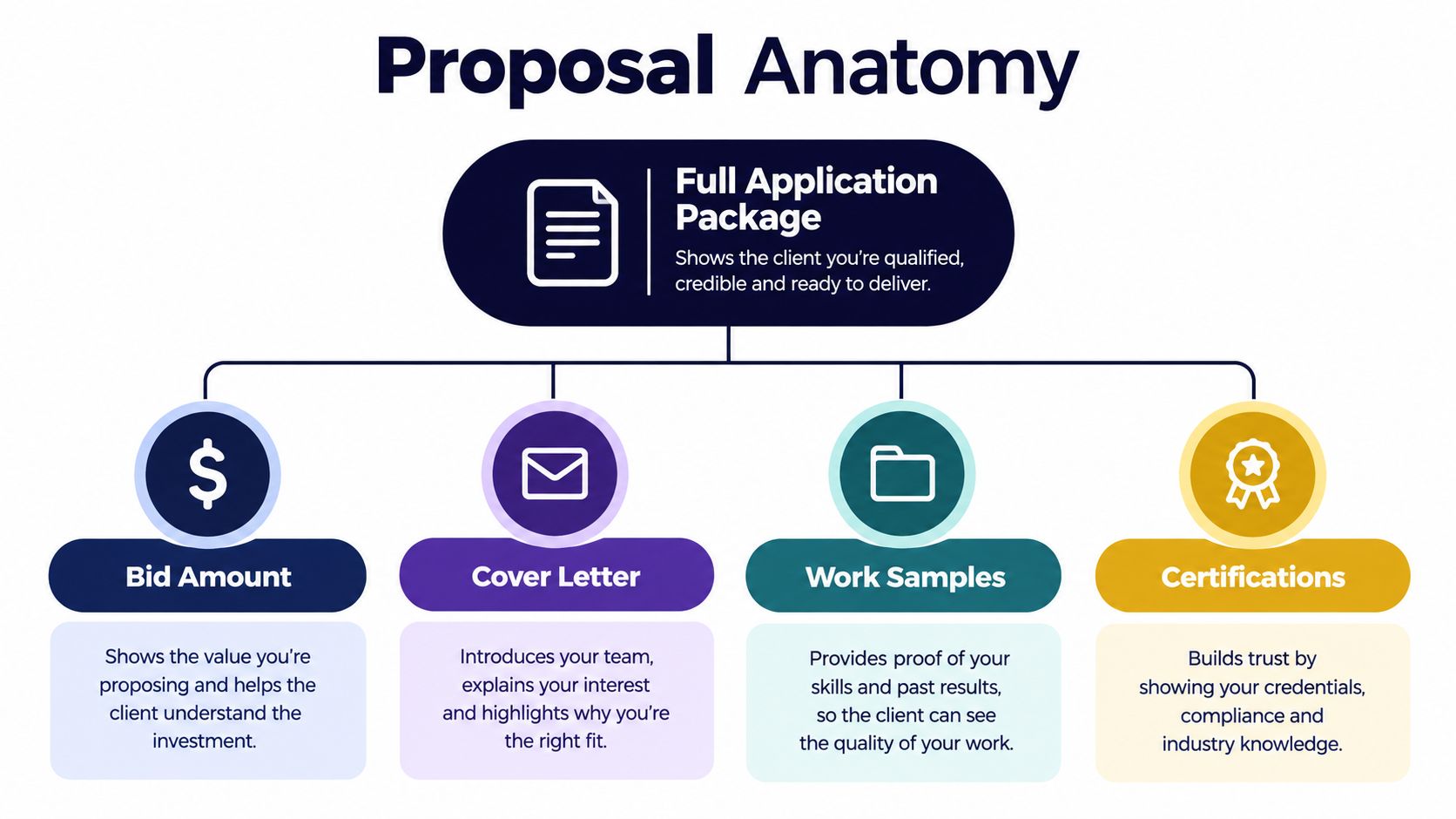
Upwork defines a proposal as the freelancer's bid and cover letter, with optional work samples, certifications, testimonials, or portfolio materials. Treat those elements as a coordinated package, not independent fields to complete.
The diagram separates the application components so you can check whether each supports the same offer.
Map the message to the assignment
Take an illustrative marketing automation listing: leads arrive through a website form, salespeople sometimes receive duplicates, and the client wants dependable CRM assignment. The proposal needs to address routing accuracy, testing, and ownership, not advertise every marketing service you provide.
Build the cover letter around these functions:
- Hook. Identify the stated problem and its consequence. Duplicate assignment creates confusion about who should contact a lead.
- Proof. Select a sample demonstrating routing logic, duplicate handling, or workflow validation. Explain what the client should notice in it.
- Plan. Describe the sequence from reviewing existing rules to implementing and testing the agreed change.
- Close. State the commercial assumption, ask a scope-relevant question, and suggest the next discussion.
Each part requires input from the job description or your actual work. That is why this structure is useful: you cannot complete it with a generic biography.
For broader proposal planning beyond a marketplace cover letter, Zemith's proposal writing advice is a supplementary resource. Keep the Upwork application focused enough to invite a conversation rather than turning it into a full consulting document.
Make the bid support the promise
If your proposed price covers an audit only, say so. If implementation depends on reviewing the current setup, identify that dependency instead of assuming the simplest possible case.
Attachments should answer a specific doubt. A workflow sample supports technical fit; a relevant testimonial can support confidence in communication. Neither should distract from the actual deliverable.
The client shouldn't have to reconcile different promises across your bid, cover letter, and portfolio.
Before submitting, check that the scope you describe is the scope you priced. That's a more useful final review than adding another sentence about enthusiasm.
Writing Each Section With Real Before and After Examples
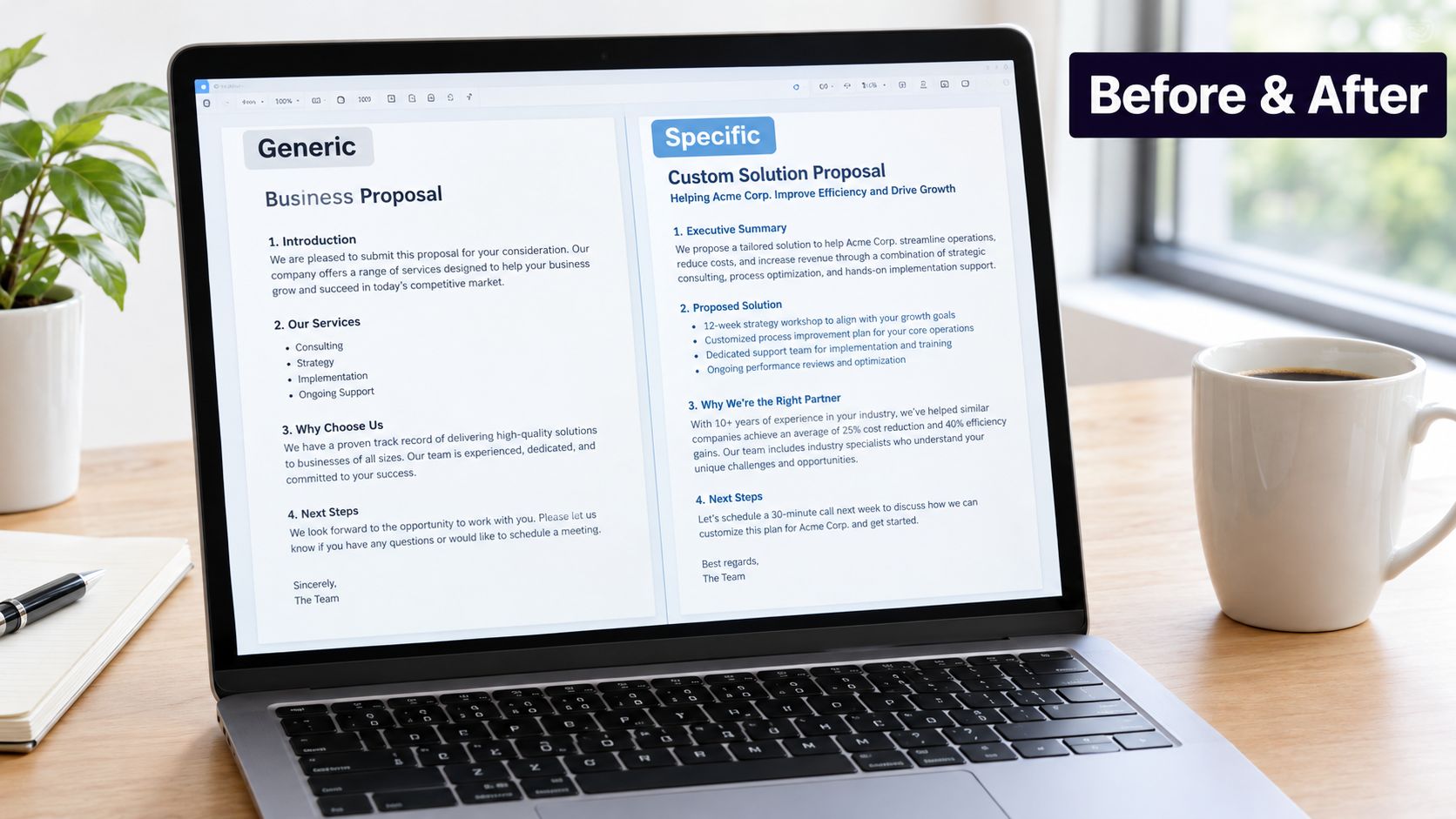
The difference between generic and customized writing is observable in the sentences. The examples below are illustrative drafts, not claims about completed client projects.
Use the comparison image as a reminder to replace broad assurances with job-specific information.
Replace biography with diagnosis
Before: “I'm an experienced automation expert and would love to help your business.”
After: “Your description points to duplicate lead assignment between the website form and CRM. I'd check the routing and duplicate-handling rules before changing the workflow.”
The second version demonstrates attention without pretending you've diagnosed a system you haven't inspected. That distinction matters: confident reasoning is useful; unsupported certainty isn't.
Before: “I offer automation, CRM management, integrations, and marketing services.”
After: “The attached routing sample shows the assignment conditions and exception handling I'd use to plan this work.”
Use that sentence only if the sample exists and supports it. If you have a documented outcome, include it accurately; if you don't, explain the artifact rather than inventing a performance metric.
Make the plan and close actionable
Before: “I'll deliver excellent work quickly.”
After: “I'd review the existing rules, confirm the intended owner for each lead type, and test the revised workflow before handover.”
Before: “I hope to hear from you soon.”
After: “Does the duplicate appear when the form submits or after the CRM creates the record? Reply through Upwork and we can confirm the scope before implementation.”
Upwork's proposal guidance recommends a concise structure covering the introduction, client questions, relevant background, rates, next steps, and follow-up. A useful drafting target is roughly 85–120 words across two or three short paragraphs, reserving the first one or two sentences for the client's problem; treat that as a working constraint, not a reason to omit required screening answers.
This video provides another proposal-writing reference.
Copy the architecture, not the claims
Your [stated problem] is affecting [business outcome]. I'd first check [specific dependency] before committing to [implementation].
My [relevant sample] demonstrates [capability]. I'd [review step], [delivery step], and [validation step], with [handover artifact] included.
My proposed [rate or fixed price] assumes [scope boundary], with [timeline] dependent on [access or feedback]. Does [clarifying question]? Reply through Upwork so we can confirm the next step.
Replace every bracketed field and delete anything you can't substantiate. If you use AI to draft, Unflag's guide to humanizing AI text offers supplementary editing guidance, but your priority should be accuracy and recognizable judgment, not merely a conversational tone.
Connects, Boosts, and the Proposal as a Sales Experiment
A proposal is also an acquisition expense. That changes the decision from “Can I write something for this job?” to “Is this opportunity worth the submission cost and preparation time?”
Upwork describes Connects as virtual tokens used for job proposals, boosted proposals, and the Availability Badge; new freelancers can earn 18 free Connects after submitting at least three proposals and spending at least 54 Connects, while boosts use additional Connects in an auction with variable winning bids. Don't treat a potential token reward as a reason to send applications you wouldn't otherwise justify.
Separate placement from persuasion
Boosting buys a chance at additional visibility, not a more convincing offer. Upwork displays a Boosted icon and provides analytics for comparing organic and boosted proposal views, interviews, and hires, as described in its Connects guidance.
Use those distinctions to investigate outcomes. If a boosted proposal attracts attention but produces no meaningful conversation, spending more doesn't resolve the underlying objection. The issue may be evidence, scope, pricing, or fit.
Invitations have different economics: responding to an invitation to apply doesn't cost Connects, and you can accept the offered terms or propose different ones. Still review the opportunity carefully. A cost-free application can lead to an expensive distraction.
Track the whole commercial path
Keep a proposal-level record with enough context to explain the result:
- Opportunity quality. Record the job category, qualification decision, and any unresolved concerns.
- Message variables. Save the opening, selected proof, bid, and whether you boosted.
- Funnel outcomes. Track qualified applications, replies, interviews, hires, revenue, and time spent preparing the application.
For agency reporting, Upwork data analytics can help structure the review around decisions rather than submission volume.
Calculate reply rate consistently, but don't make it your only success measure. A message that attracts unsuitable conversations can look successful while consuming delivery-team time. Revenue and project fit help distinguish useful replies from mere activity.
Experiment discipline: Change a clear variable, record what happened, and avoid declaring a winner from isolated results.
Follow-up belongs in the same review. Where an existing conversation permits it, send a useful clarification or relevant detail instead of repeating that you're checking in. The next message should reduce the client's uncertainty, not add pressure.
Fewer Proposals, Better Replies and the Case for Automation
“Send more” is incomplete advice. More applications can create more opportunities, but they can also multiply weak targeting, irrelevant evidence, and time-consuming conversations.
The practical case for automation is to remove repetitive work after you've defined good judgment. A tool should help enforce your criteria, not make you less selective because submission has become easier.
For an individual freelancer, saved searches, a proof library, and reusable drafting structures may be sufficient. An agency managing several bidders needs clearer ownership, shared qualification rules, and a record of which freelancer can support each claim.
Automate preparation without outsourcing accountability
Build the workflow around explicit decisions:
- Define project fit. Specify preferred deliverables, technical requirements, budget boundaries, and exclusions.
- Connect evidence to capabilities. Tag approved samples so a draft draws from relevant work rather than a broad service list.
- Review exceptions. Route unclear scope, unusual payment requests, and unfamiliar technical requirements to a person.
- Manage conversations. Prepare useful responses while keeping a human responsible for commitments, availability, and pricing.
If you're evaluating broader bid-management software, see how Bidwell helps bidding teams as another workflow reference. Assess tools against your actual review process rather than assuming every bidding product suits marketplace applications.
For marketplace-specific planning, automating Upwork proposals should begin with the inputs, approval boundaries, and reporting you need. Faster drafting is only useful when the resulting application remains truthful.
Keep communication and account rules separate from convenience
Upwork requires pre-contract communication to remain on its platform and prohibits sharing contact information in profiles, proposals, invitations, job postings, or other pre-hire contacts. Use its collaboration tools for introductions, interviews, and project scoping until a contract starts.
Account-security features don't, by themselves, establish that an automated workflow is permitted. Check current platform rules and access permissions before enabling submissions or messaging, and don't treat human-behavior simulation or regional network infrastructure as proof of compliance.
The sustainable objective isn't the largest application count. It's a repeatable process that helps your team recognize suitable work, present credible evidence, and handle interested clients without sacrificing accuracy or control.
Earlybird AI offers Upwork job discovery, personalized proposal automation, client-message handling, and analytics, using feedback to refine project selection. Visit the platform to assess how its workflow could support your qualification criteria and proposal process, and verify the appropriate controls before enabling automated activity.


