← Back To Blog
How to Write Winning Proposals That Land Clients
Most advice about how to write winning proposals is incomplete.
It tells you to be clear, persuasive, and customized. That part is true. But in marketplaces like Upwork, a polished proposal that arrives late often loses to a very good proposal that arrives early and speaks directly to the client's problem. In crowded feeds, clients don't review every option with equal care. They skim what they see first, shortlist fast, and move on.
That changes the job. You're not just writing to impress. You're writing to get opened, understood, and answered before the listing gets buried under a pile of generic bids. The core formula is elite personalization at speed.
Beyond 'Well-Written' to 'First and Best'
A proposal can be well written and still fail.
That's the part many freelancers don't want to hear, because writing feels like the hard part. But the harder truth is that clients rarely reward effort they never fully read. Standard guidance on proposals emphasizes clarity, structure, and alignment, yet it rarely addresses speed-to-first-response in competitive marketplaces, even though that can shape whether your proposal gets seen at all, as noted by Instrumentl's discussion of proposal guidance gaps.
Why writing quality alone doesn't carry the deal
Clients don't hire the “best writer.” They hire the provider who seems most likely to solve the problem with the least risk and the least friction.
That means a proposal has to do four things fast:
- Prove relevance: Show you understood the brief, not just the category.
- Reduce risk: Give the buyer a reason to believe you've solved similar problems before.
- Lower effort: Make the next step obvious and easy.
- Arrive early enough: Get reviewed before the client is exhausted by repetitive responses.
Practical rule: A winning proposal doesn't sound impressive first. It feels specific first.
I've seen agencies lose work because they optimized for polish instead of response time. They drafted elegant introductions, added too much company history, and wrote paragraphs no busy buyer was going to read. Meanwhile, the bid that won often did something simpler. It opened with insight, mirrored the client's language, and gave a clear path forward.
The marketplace standard is low, which changes the game
Most proposals in open marketplaces are still generic. They say things like “I am excited to apply,” “I have 10 years of experience,” or “I can do this perfectly.” None of that helps a client decide.
“First and best” is a different standard. It means:
- First enough to be seen early
- Best enough to feel custom
- Short enough to skim
- Concrete enough to trust
That's the operating model behind effective proposal systems. You aren't trying to write a literary masterpiece. You're trying to send a clear, credible buying argument before the client tunes out.
The Pre-Proposal Research That Wins the Bid
The strongest proposal is usually decided before the first sentence gets written.
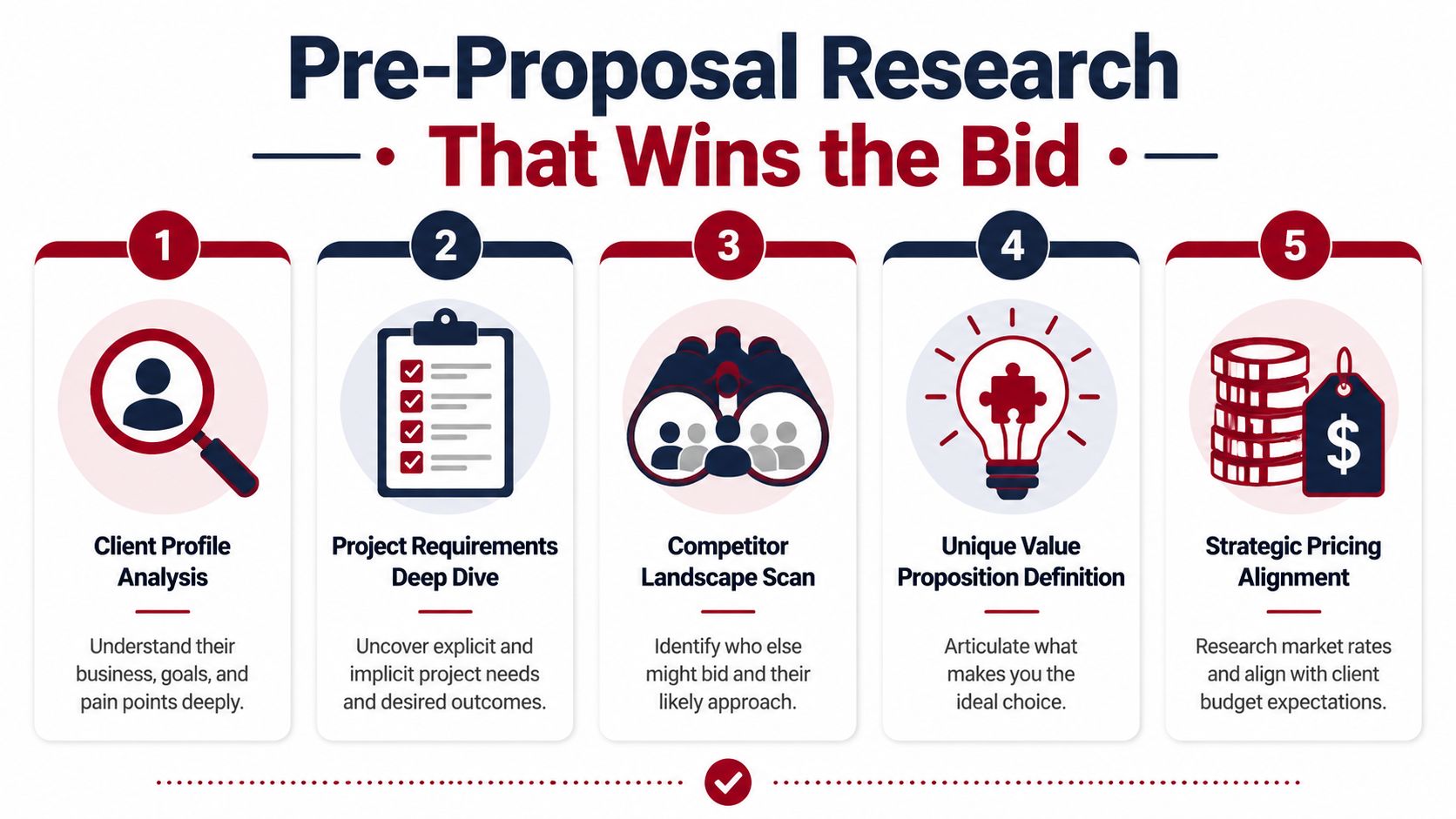
Serious proposal teams don't start with wording. They start with capture. Shipley recommends spending about 20% of total proposal effort on capture activities before drafting because requirements-mapped, data-rich responses score better and are more likely to win, according to Shipley's proposal guidance.
What to look for before you write
On Upwork, “research” doesn't mean spending an hour on detective work for every small job. It means extracting the details that let you sound like you paid attention.
Start with the client's job post, then widen the lens:
- Review the posting for hidden requirements
Look for what's stated directly and what's implied. If they ask for a landing page rewrite, are they really struggling with conversion clarity, positioning, or speed of execution? - Check client history on Upwork
Read previous job titles, past hires, and feedback they've left. Clients often reveal what they value by what they praise or criticize. - Visit the company site
You're looking for mismatches. Does the site positioning conflict with the brief? Is the offer unclear? Is the design polished but the copy weak? Those observations can become your opening hook. - Scan external presence
LinkedIn, product pages, blog content, or social feeds can expose urgency, growth stage, and internal priorities. - Define your fit before you pitch
Don't ask, “Can I do this?” Ask, “Why am I the logical choice for this exact job?”
The fast research checklist I use
When agencies train bidders, they often overcomplicate the process. The better approach is to gather only what can improve the proposal.
Use a checklist like this:
- Business context: What do they sell, and who do they sell to?
- Pain signal: What seems broken, unclear, delayed, or underperforming?
- Decision style: Do they sound technical, rushed, price-sensitive, or quality-driven?
- Scope clues: What deliverables are explicit, and what's missing?
- Proof match: Which past project, testimonial, or capability best maps to this job?
If you can't identify the client's likely pain point, you're not ready to write. You're still guessing.
What this research changes in the proposal
Good research improves more than personalization. It sharpens selection.
Sometimes the right move is not to bid. If the client's budget, history, or scope signals a poor fit, walking away protects your time and your close rate. Chasing every posting creates volume, not momentum.
When the fit is good, research gives you the raw material for a proposal that doesn't sound templated. It lets you say, in plain terms, “Here's what I think is going on, and here's how I'd handle it.” That's what separates a real response from a recycled one.
Structuring Your Proposal for Impactful Skimming
Clients skim proposals the way executives skim decks. They look for signal, not effort.
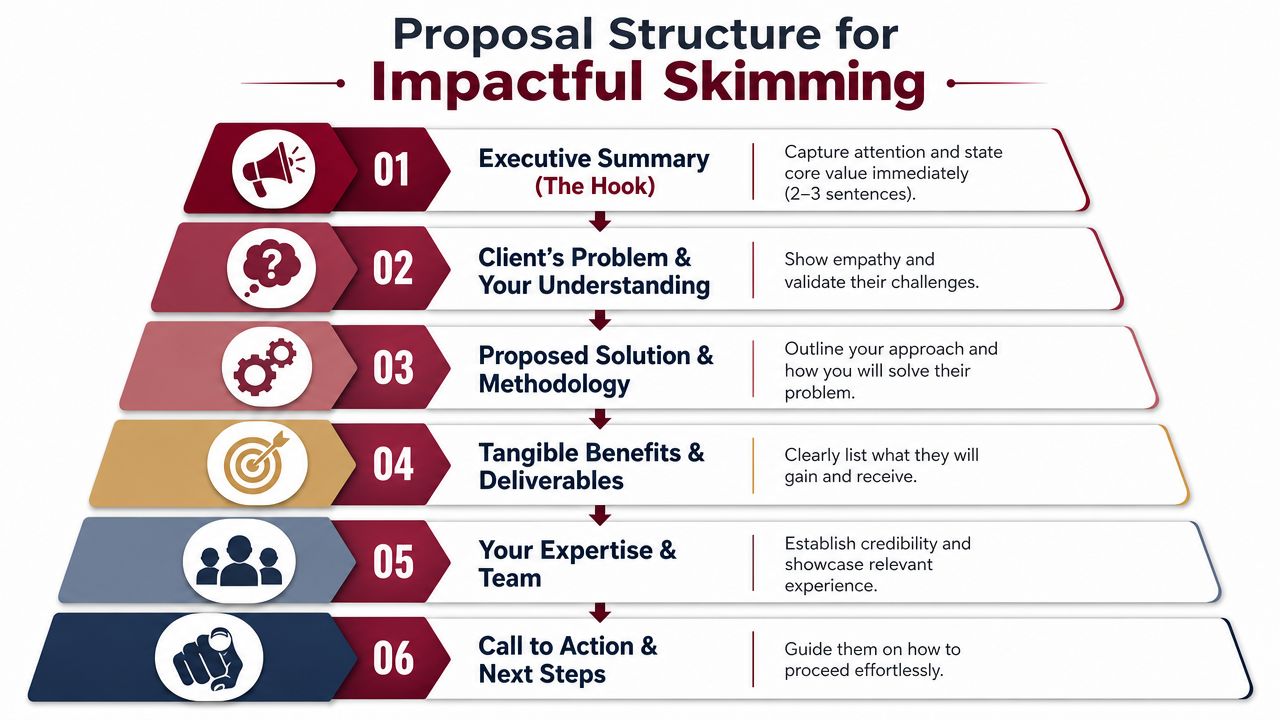
A strong structure makes that easy. Proposal guidance from Ideagen recommends a clear flow of introduction, problem statement, solution, methodology, timeline, budget, credentials, and conclusion in its article on how to write a winning proposal. That sequence works because it follows the buyer's natural questions.
The five-part proposal I use on marketplaces
For platform proposals, I compress that broader structure into a shorter format built for fast reading.
- Personalized hook
Open with one observation that proves you read the brief and looked beyond it. - Problem reframe
State what you believe the client needs solved. - Solution snapshot
Explain your approach in a few lines, not a full process manual. - Proof
Add relevant evidence. Similar work, short results narrative, testimonial, or capability match. - Clear next step
End with a low-friction action. A call, a quick audit, a short outline, or a direct answer to one open question.
For more ideas on organizing this kind of outreach, this guide on proposal letter format is useful if you want to compare a shorter marketplace style with a more formal proposal structure.
A visual breakdown helps if you want to see that hierarchy clearly:
Why each piece matters to the buyer
The hook earns attention. The problem reframe earns trust. The solution earns curiosity. The proof lowers risk. The call to action keeps momentum alive.
That sequence matters because buyers don't think in service categories. They think in anxieties:
- Can this person do it?
- Do they understand my situation?
- Will this be easy to manage?
- Am I about to waste time?
Your structure should answer those questions without forcing the client to hunt.
Skimming test: If a client reads only your first line, one middle sentence, and the final line, the proposal should still make sense.
What weak structure looks like
Weak proposals usually fail in one of three ways:
- They open with biography instead of relevance.
- They bury the solution under long setup.
- They close vaguely with “let me know” instead of directing a next step.
A proposal isn't a résumé paragraph pasted into a message box. It's a short decision document. Build it so a rushed buyer can understand it in seconds.
Writing Compelling Copy That Converts
Most proposal copy fails because it talks about the seller too much.
Clients don't care that you're “passionate,” “dedicated,” or “hardworking.” They assume basic professionalism. What they need is confidence that you understand the assignment and can execute without drama. The U.S. Office of Research Integrity says reviewers should not have their time wasted, the argument must be easy to follow, and the proposal should include only essential information in its proposal writing guidance. That applies to freelance proposals just as much as formal submissions.
Before and after examples that fix weak proposals
Here's the kind of copy I see all the time:
“Hi, I'm a full-stack marketer with years of experience helping brands grow. I'd love the opportunity to work with you on this exciting project.”
That sounds pleasant. It doesn't close deals.
A stronger version:
“Your job post suggests you don't need more content volume. You need a cleaner content system, tighter messaging, and someone who can ship without heavy management.”
Why it works: it names the likely issue, reduces ambiguity, and shifts focus to the buyer.
Another weak example:
“We offer SEO, content writing, paid media, design, development, and branding services.”
Better:
“For this project, I'd focus on three things only: fixing the service page structure, rewriting the offer so it's easier to understand, and tightening the conversion path from ad click to lead form.”
Why it works: fewer claims, more relevance.
If you want more side-by-side patterns, these job proposal examples are a solid reference point because they make the difference between generic and specific language easy to spot.
Write from the client's side of the desk
A simple edit improves most proposals fast. Replace self-focused language with buyer-focused language.
Instead of this:
- “I have extensive experience”
- “I'm confident I can help”
- “I would love to discuss”
Write this:
- “You need someone who can…”
- “The risk here is…”
- “The fastest path is…”
That shift changes the tone from applicant to advisor.
The copy principles that actually matter
Not every line needs to be clever. It needs to be usable.
Keep these rules tight:
- Lead with a diagnosis: Start with what's happening, not with your enthusiasm.
- Name the work plainly: Clients trust concrete language more than polished fluff.
- Cut empty intensifiers: “Highly,” “really,” and “very” rarely add value.
- Use proof carefully: Mention only proof that maps to this exact project.
- End with movement: Ask for the next step in a way that's easy to say yes to.
Good proposal copy feels like a competent operator thinking out loud, not a marketer trying to impress.
Compelling copy doesn't sound bigger. It sounds sharper.
Setting Your Price, Timeline, and Follow-Up Strategy
Many good proposals die in the final third.
The writing lands. The client is interested. Then the price feels arbitrary, the timeline feels vague, or the proposal ends without any real follow-up plan. That's where deals stall.
Price for fit, not for comfort
Freelancers often underprice because they think a lower number feels safer. Sometimes it does the opposite. It can signal inexperience, unclear scope, or future chaos.
For proposal work, I think in three pricing lenses:
- Hourly works when scope is still moving.
- Fixed price works when deliverables are clear and bounded.
- Value-based framing works when the buyer cares more about outcome than task count.
The mistake isn't choosing one model over another. The mistake is presenting a number with no logic behind it. Clients want to understand what they're buying, what's included, and where the boundaries are.
Timelines are trust signals
A timeline isn't just scheduling. It's proof that you've thought through execution.
Ideagen's guidance emphasizes including a realistic timeline with milestones and completion dates in winning proposals, as noted earlier in the article. On marketplaces, that usually means translating your process into a short roadmap the client can visualize.
A weak timeline says, “I can finish quickly.”
A stronger timeline says something like this:
- Kickoff and alignment: confirm goals, inputs, and access
- First build or draft: deliver initial version for review
- Revision window: refine based on feedback
- Final delivery: handoff and next-step recommendations
That format tells the client what happens next. It lowers management anxiety.
Follow-up isn't optional
If a client has shown interest, silence doesn't always mean no. It often means they got distracted, compared options, or needed internal input.
Benchmark reporting cited by Cobl found that proposals sent within 24 hours of a conversation can increase win probability by up to 25%, and adding case studies or testimonials can raise the chance of winning by 73% in its roundup of sales proposal statistics. The lesson isn't to spam clients. It's to move quickly and reinforce credibility.
A useful follow-up sequence usually does three things:
- Restates the fit: remind them why your approach matches the brief
- Adds one useful detail: answer a likely objection, clarify scope, or share a relevant proof point
- Asks for one concrete step: short call, approval, or question reply
What doesn't work is passive messaging. “Just checking in” adds no value. A good follow-up gives the buyer a reason to re-engage.
Testing and Scaling Your Proposal Workflow with AI
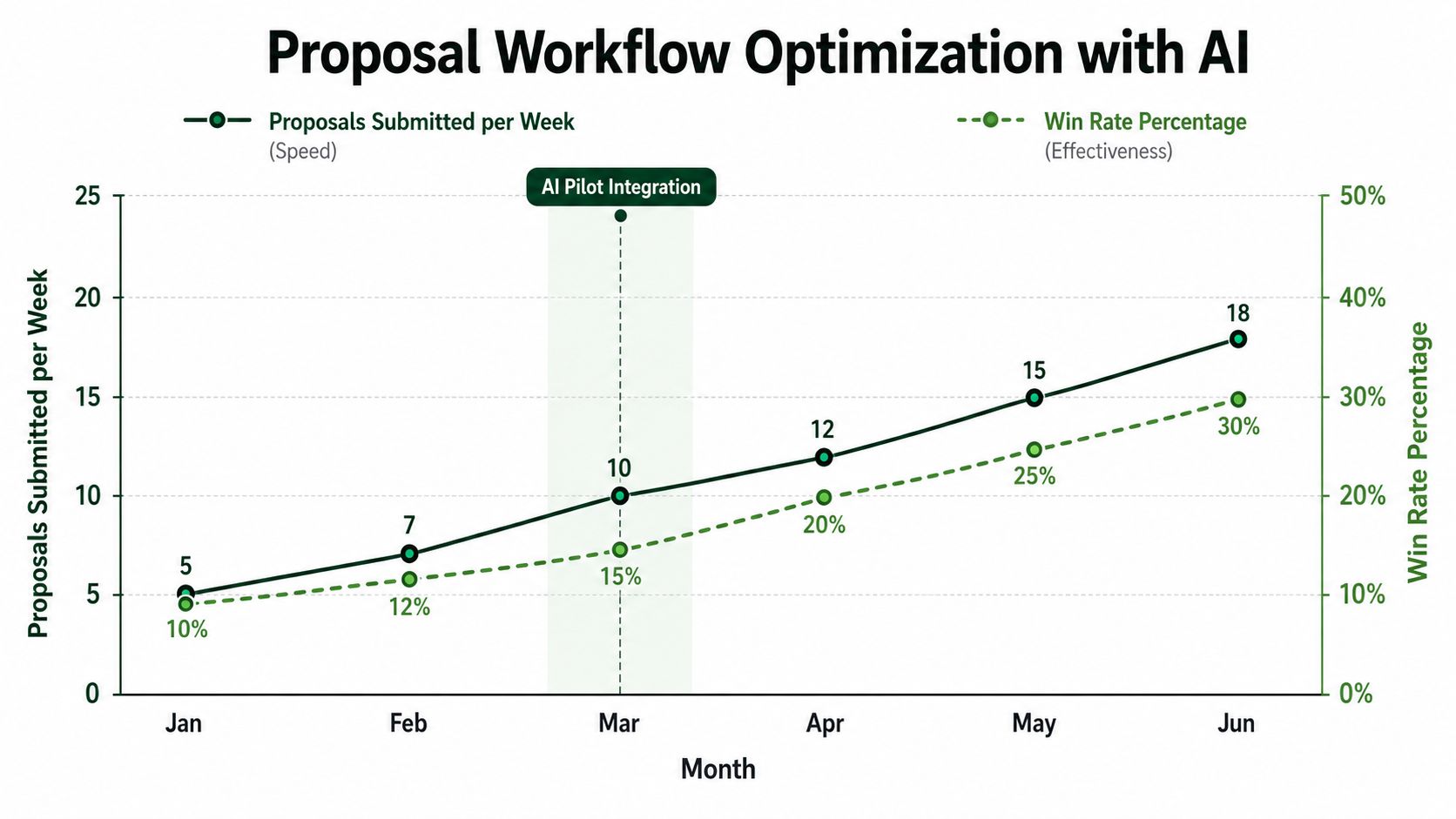
Once you know how to write winning proposals manually, the next challenge is consistency.
Many teams don't fail because they lack talent. They fail because their process is too slow, too manual, or too dependent on one person having the energy to personalize everything from scratch. That's where testing and automation start to matter.
What to test in your workflow
You don't need a complicated analytics stack. Start with a few variables:
- Opening line style: observation vs direct solution
- Proof format: testimonial snippet vs short relevant case summary
- Call to action: invite to chat vs one qualifying question
- Proposal length: tighter version vs slightly more detailed version
- Response speed: immediate vs delayed but more customized
Track replies, qualified conversations, and closed deals. That gives you feedback on what moves buyers.
Use AI carefully or it will make you sound generic
AI is now normal in application and outreach workflows, but there's a trust problem. A 2024 survey found 46% of U.S. job seekers used generative AI for application materials, while 44% of hiring managers said they were less likely to hire if they suspected AI-written submissions, according to Harvard Medical School's summary of the survey context.
That's the central trade-off. AI can speed up research, drafting, and follow-ups. It can also flatten your voice and produce the exact same pattern every other bidder is using.
The fix is simple:
- Use AI for signal gathering
- Use AI for first drafts
- Use AI for variation and testing
- Do a human pass for judgment, tone, and specificity
If you're comparing systems built for this workflow, this overview of AI tools for proposal writing is a practical starting point. One example is Earlybird AI, which connects to an Upwork account, learns ideal project patterns from feedback, and automates project search, personalized proposal drafting, replies, and follow-up. That kind of setup is useful when the bottleneck isn't knowing what to say, but saying it fast enough and often enough without turning every proposal into obvious template output.
Automation should handle repetition. Humans should handle judgment.
The teams that scale proposal win rates don't automate taste away. They automate the slow parts so good judgment can show up earlier and more often.
If your agency is trying to win more Upwork work without adding more manual bidding hours, Earlybird AI is built for that workflow. It helps teams find relevant projects, draft personalized proposals quickly, reply to leads, and follow up automatically so you can stay early in the client's inbox while keeping the message specific to the job.