
← Back To Blog
Industry Performance Standards: Boost Freelancer & Agency
You can do good work on Upwork and still lose the job if you reply too slowly, send a vague proposal, or miss the client's real evaluation criteria. A freelancer can spend hours polishing portfolio samples, then watch the opportunity go to someone who answers first, sounds more specific, and looks easier to trust. That gap between skill and winning is where industry performance standards matter most.
In practice, standards are not just for big companies with compliance teams. They shape how buyers judge you, how platforms rank you, and how clients decide whether you feel dependable enough to hire again. If you understand the standard behind the score, you can build a business that looks more professional, performs more consistently, and closes faster.
Your Introduction to Performance Standards
A lot of freelancers think the client is hiring only for the visible deliverable, a landing page, a spreadsheet cleanup, a sales deck, a migration plan. The key assessment usually begins earlier. The client is also judging whether you answer fast, ask the right questions, keep promises, and make the buying process feel safe.
That's the quiet power of industry performance standards. They turn an unspoken expectation into a measurable outcome, so success isn't based on vibes or personal preference. In building performance standards, the same logic applies, because the standard sets a quantified threshold and leaves room for different ways to reach it, while mandatory data collection and normalized data make enforcement technically reliable (U.S. Department of Energy, BPS overview).
For a freelancer or agency, that mindset is useful because it shifts the question from “Did I do enough?” to “Did I meet the outcome the buyer prioritizes?” On Upwork, that might mean response time, clarity, consistency, or a stronger fit between the proposal and the job post. If you're serious about those differences, it helps to think about understanding KPIs vs. metrics before you start tracking everything that moves.
Practical rule: A performance standard only helps if the buyer can see the outcome and you can measure your path to it.
What Industry Performance Standards Really Mean
Think of a prescriptive standard like a recipe. It tells you exactly which ingredients to use and how to combine them. A performance standard is different, because it cares about the finished dish, the texture, the flavor, the result on the plate.
That distinction matters in business. In technical documentation and manufacturing, a standard is only useful when the data is reproducible, and the underlying values come from R&D, quality control, or third-party testing with explicit test conditions, sources, and dates (Atropim technical data sheet guidance). Once the measurement rules are clear, different vendors, batches, or workflows can be compared in a way that's technically valid.
For service businesses, the equivalent is simple. You don't need the same process as every competitor, but you do need a standard that defines what good looks like. That usually includes three pieces:
- A target outcome. The buyer or platform needs a clear threshold, such as response speed, delivery quality, or a reliability score.
- A measurement rule. Everyone involved must know how the result is checked, not just what gets checked.
- Traceable data. If the number can't be reproduced, it's a weak signal and a weak management tool.
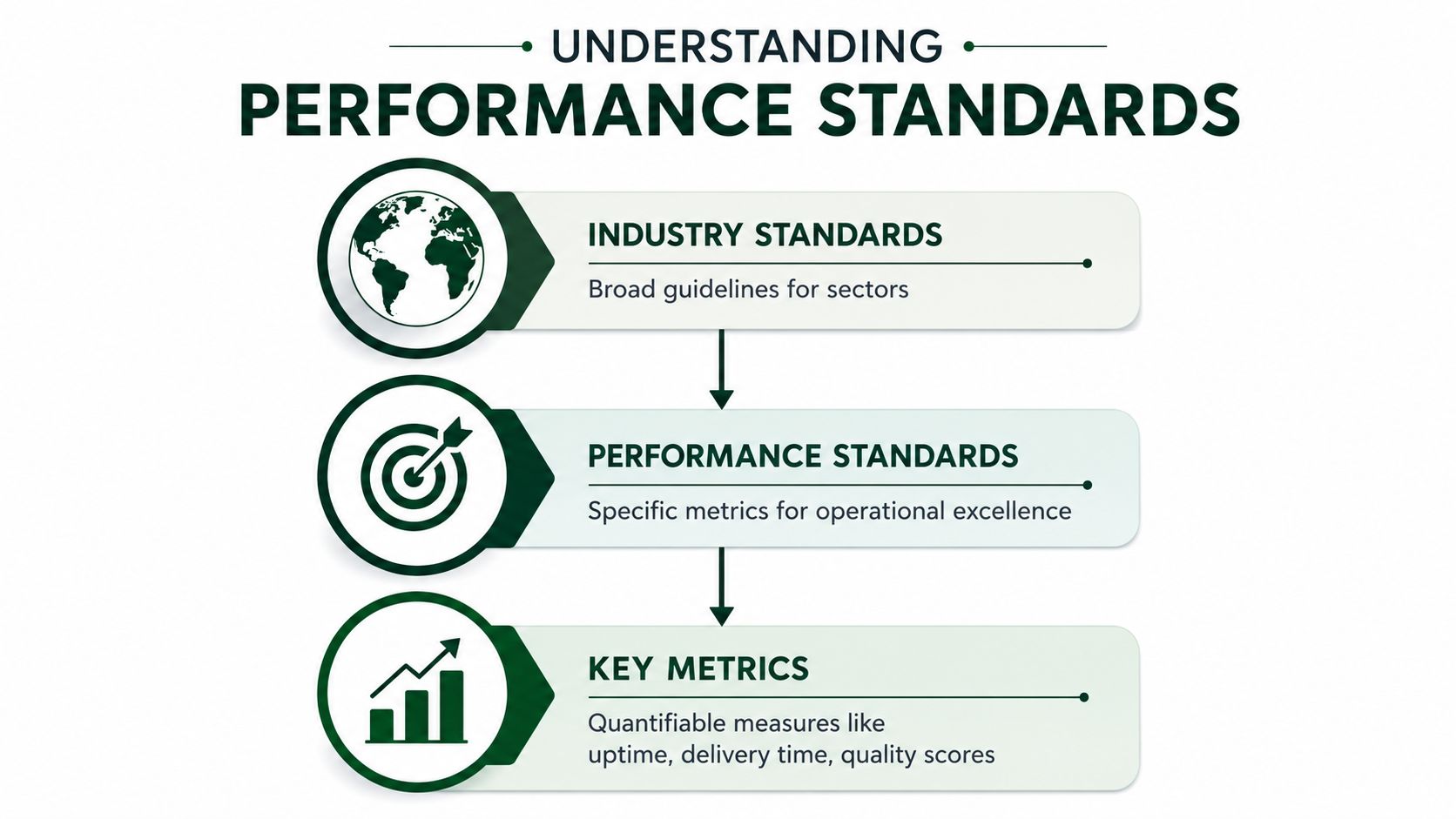
A useful way to keep the terminology straight is to separate standards from metrics. The standard is the rule or threshold, the metric is the number you watch, and the KPI is the metric tied to a business outcome you care about most. For a clean explanation of that relationship, understanding KPIs vs. metrics is a helpful reference point.
The cleaner the measurement rule, the less time you spend arguing about what the number means.
Key Examples of Performance Standards in Action
A software buyer expects uptime and reliability, a logistics customer expects on-time delivery, and a manufacturing buyer expects low defects. NIST's Baldrige criteria frame this more broadly, because they include customer requirements like rapid response, multilingual service, low defect levels, and socially responsible behavior, then ask organizations to turn both quantitative and qualitative data into operational action (NIST Baldrige criteria commentary). That's why generic quality talk falls flat. Buyers care about specific evidence that the work will hold up.

For freelancers and agencies, the same idea shows up in platform behavior. A proposal that arrives early, reads as personalized, and answers the job's actual pain points is effectively competing against the buyer's internal standard for “worth replying to.” The platform may not publish a formal handbook for every expectation, but the pattern is obvious. Fast reply times, a clear offer, and a consistent client experience signal reliability, while scattered messaging and missed follow-ups push you down the list.
What Upwork sellers should treat as standards
Proposal speed is only part of it. Clients also judge whether your wording matches the brief, whether your pricing feels coherent, and whether your next step is easy to understand. Those are outcome measures, not vanity numbers.
A useful mental model is this:
- Response behavior. How quickly do you acknowledge the opportunity?
- Proposal fit. How closely does the pitch reflect the actual job?
- Reliability signals. Do your messages, profile, and portfolio all reinforce the same promise?
- Follow-through. Do you stay present until the buyer makes a decision?
For a practical comparison of how clients track engagement signals, this guide to client engagement metrics is a strong companion read. It's not about chasing every stat. It's about knowing which behaviors buyers interpret as confidence, competence, and low risk.
How to Measure and Report on Your Performance
If a standard is vague, measurement gets messy fast. The fix is to define one outcome, one supporting metric, and one review rhythm. That's why building performance standards are so strict about mandatory data collection and normalized building-level information, because without clean inputs, benchmarking and enforcement stop being technically reliable (U.S. Department of Energy, BPS overview). The same logic applies to a freelance business.
Start with a short list of performance numbers that map to revenue. For an Upwork seller, that might include proposal response speed, reply time to client messages, win rate from qualified proposals, and delivery accuracy against scope. Don't track ten things if only three affect your decisions.
The fastest way to make this useful is to give every metric a definition you can repeat. If one teammate counts a reply as “fast” in two hours and another counts it in six, the dashboard is noise. If you want the data to help you improve, the collection method has to stay consistent from one week to the next.
A simple reporting cadence can look like this:
- Daily. Check incoming jobs, response time, and open threads.
- Weekly. Review proposals sent, replies received, and the quality of lead fit.
- Monthly. Compare what you won with what you pursued, then adjust your targeting.
Sales efficiency calculations can be useful here because they force you to connect activity to actual pipeline movement. That matters more than a pile of isolated counts.
Here's the key point. If your numbers don't help you make a decision, they're just decoration. Good reporting tells you where to spend time, which templates are working, and where your process is leaking attention.
A short clip on measurement discipline can help teams stay honest about what the numbers really mean.
For a practical benchmark on message quality and response behavior, this internal reference on client engagement metrics fits neatly with the measurement approach above.
A Playbook for Meeting and Exceeding Standards
The best performers don't wait until their output looks weak. They build a system that makes good performance easier to repeat than bad performance. That's true in sustainability, where IFC guidance says projects should apply technically and financially feasible measures for resource efficiency and greenhouse gas reduction, because practical implementation matters as much as the standard itself (IFC Performance Standards). It's also true for solo sellers and agencies trying to win more work.
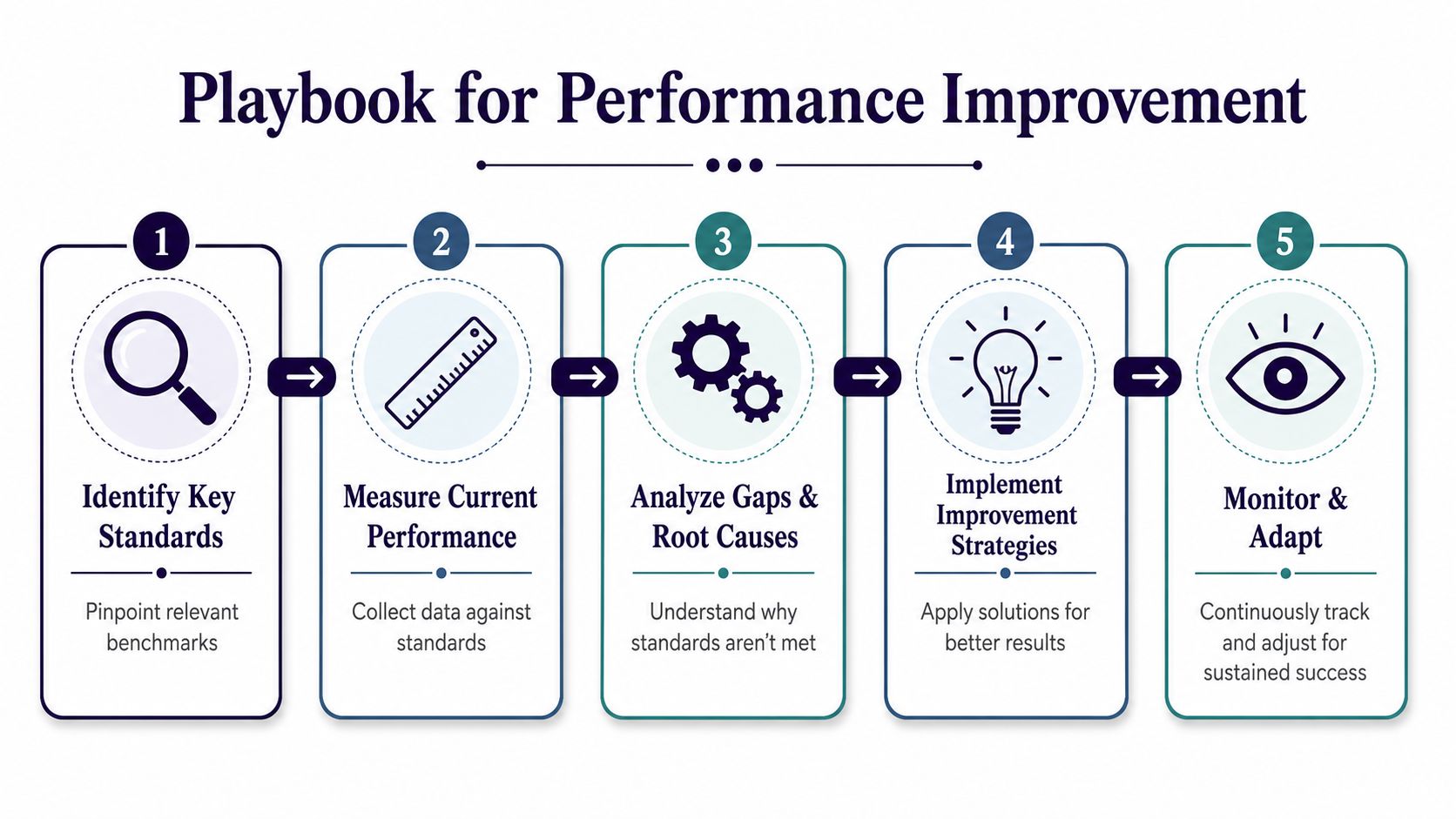
Identify the standard before you optimize
Not every metric deserves your attention. If you're on Upwork, the standard might be faster initial replies for inbound leads, better proposal relevance for competitive jobs, or cleaner handoff language for agency teams. Write down the one outcome you want to improve, then define what “good” means in plain language.
Measure the current baseline
Before changing anything, capture a week or two of actual performance. The goal isn't perfection. The goal is to see where delays happen, where proposals stall, and which job types create the most friction.
Practical rule: Don't automate a broken process. First measure the delay, then fix the delay.
Find the root cause, not just the symptom
If response times are slow, the problem might not be work ethic. It might be too many manual steps, no prewritten opening, unclear routing, or uncertainty about which leads deserve priority. If proposal quality is inconsistent, the issue may be missing templates or too much rewriting from scratch.
Use templates where judgment is repetitive
Templates work when the structure is stable and the details change. Proposal intros, discovery questions, and follow-up notes are good candidates. The more often the same type of message appears, the more value you get from a reusable framework.
Automate the handoff points
The highest-friction moments are usually the worst places to be manual. Initial replies, lead sorting, reminder prompts, and follow-up scheduling can often be standardized so the team spends more time on selling and delivery. For a business owner watching margins closely, these profit margin improvement ideas connect nicely to that efficiency mindset.
That's where the core advantage comes from. You're not trying to look busy. You're building a process that makes the standard easier to meet every day.
Monitor and adjust without waiting for a miss
Standards only stay useful when you revisit them. Recheck the numbers, compare them with actual client outcomes, and change the workflow if the same issue keeps showing up. If the standard is clear but the process is messy, the fix usually lives in the process, not in more effort.
Transforming Standards into Your Competitive Edge
Most sellers treat standards like compliance paperwork, then wonder why their business feels crowded and hard to differentiate. The better approach is to use standards as a way to prove reliability at every stage, from first reply to final delivery. When you can measure your performance, improve it, and explain it clearly, clients have less reason to hesitate.
That's also how you build a sharper position in the market. Instead of saying you're “high quality,” you can show the behaviors behind that claim, consistent response, clear process, and disciplined follow-through. A useful companion on that positioning work is unique value proposition examples, because standards become more persuasive when they support a specific promise.
The biggest shift is mental. Industry performance standards stop being abstract rules and start acting like a business advantage. They help you reduce wasted motion, defend your pricing with evidence, and make your client experience easier to trust.
If you want that advantage to show up in your Upwork pipeline, build the measurement habits first, then tighten the workflow, then automate the repetitive parts that keep you from responding at the right speed. A more systematic business usually wins more work, keeps more clients, and feels less chaotic to run.
Ready to turn faster replies and stronger follow-through into more won work? Earlybird AI helps freelancers and agencies respond quickly, stay consistent, and build a client experience that feels easier to trust. If you want a simpler way to improve proposal speed, follow-ups, and day-to-day performance, see how Earlybird AI can support your workflow.