← Back To Blog
LinkedIn Demand Generation: Your 2026 Playbook

Most LinkedIn advice fails because it treats the platform like a bucket of tactics. Post three times a week. Send more connection requests. Launch a Lead Gen Form campaign. Comment on influencer posts. None of that is wrong, but none of it is a strategy.
LinkedIn demand generation works when organic content, paid distribution, and direct outreach support each other. If those pieces run separately, you get scattered activity and weak attribution. If they run as one system, LinkedIn becomes a dependable pipeline channel instead of a frustrating time sink.
Beyond Random Acts of Marketing on LinkedIn
The numbers alone explain why random execution is expensive. LinkedIn generates between 75% and 85% of all B2B social media leads, 89% of B2B marketers use it for lead generation, and 40% identify it as the single most effective channel for high-quality leads, according to Joe Apfelbaum's LinkedIn stats roundup.
That scale creates two opposite outcomes. Teams with a system build momentum quickly. Teams without one burn time in three familiar ways: they publish posts nobody remembers, run ads that collect names sales won't touch, and send outreach that feels disconnected from anything the buyer has seen before.
The fix isn't more activity. It's sequencing.
A practical LinkedIn engine has three jobs:
- Create familiarity through content that teaches, challenges assumptions, or frames a problem clearly.
- Capture intent through paid campaigns that move buyers from interest to action.
- Convert attention through outreach that references real context instead of cold generic pitches.
LinkedIn rewards coordination more than volume.
When those parts connect, a prospect sees a useful post, later gets served the right ad, then receives a message that feels timely rather than intrusive. That's the difference between doing LinkedIn and building demand on LinkedIn.
Laying the Foundation for High-Intent Demand
Most underperforming LinkedIn programs have a setup problem, not a creativity problem. The targeting is broad, the profile reads like a résumé, and the company page says what the business does instead of why the buyer should care.

That matters because LinkedIn isn't just a networking site. In 2025, it delivered a 121% Return on Ad Spend for B2B advertisers, with engagement rates rising 44% year over year, as reported in the same LinkedIn stats roundup. If you're sending paid or organic traffic into weak positioning, you're wasting an asset that can produce real revenue.
Start with an ICP you can actually target
Skip vague personas like "marketing leaders at growing companies." Build an Ideal Customer Profile using filters you can operationalize in LinkedIn Sales Navigator and Campaign Manager.
A usable ICP includes:
- Company reality like industry, company size, geography, and whether the company structure fits your offer.
- Buyer role such as job function, seniority, and influence over the budget or workflow you're trying to change.
- Trigger conditions including hiring, new funding, expansion into a market, category shifts, or visible signs of process strain.
The test is simple. If a sales rep can't build a prospect list from your ICP in Sales Navigator without guessing, the ICP isn't ready.
Rewrite the profile for the buyer, not for yourself
Founders and agency leaders often waste the most valuable real estate on self-description. Buyers don't care that you're passionate, results-driven, and experienced. They care whether you understand their problem.
A stronger headline looks like this:
- Weak version "Founder at ABC Agency helping brands grow"
- Stronger version "Helping B2B SaaS teams turn LinkedIn traffic into qualified pipeline"
The "About" section should do the same job. Lead with the pain, not the biography. Explain who you help, what problem you fix, and what kind of outcome your process is designed to support. Then use the Featured section to stack proof assets like a teardown post, a webinar replay, a framework PDF, or a strong article.
For company pages, write the About section like a category page, not a boilerplate mission statement. Be specific about the audience and the operational problem you solve.
Practical rule: If your profile could belong to ten other consultants in your niche, it won't convert warmed traffic.
Treat your profile and page like conversion assets
Before traffic scales, tighten the basics:
- Banner image should communicate the problem space or offer clearly.
- Featured section should guide the next step, not just display random links.
- Company page posts should reflect your core themes so visitors immediately understand what you talk about.
- Team profiles should align around similar positioning if multiple people are involved in outreach.
If you want a useful reference point for structuring the moving parts, this LinkedIn Lead Generation Strategy Guide is worth reviewing because it helps teams think in terms of systems rather than isolated tactics.
Building Your Organic Content and Authority Engine
The fastest way to kill organic momentum is to publish content that asks for demand before you've created any. "Book a call." "We help companies scale." "DM me if you need leads." That kind of content only works when the market already knows and trusts you.
Most companies need a different sequence. They need content that earns attention first.

Build around a few repeatable pillars
A good organic program usually comes from three to five content pillars. More than that and the message gets muddy. Fewer than that and the feed starts sounding repetitive.
One B2B agency might build around these themes:
- Buying mistakes that prospects make before they hire an agency
- Execution teardowns showing what strong campaigns look like and where they break
- Category education that helps buyers understand trade-offs
- Operator perspective drawn from sales calls, audits, and real implementation work
The key is that each pillar should map to a real buyer concern. If the audience keeps asking about attribution, content on attribution becomes a pillar. If buyers struggle to evaluate vendors, teach them how to evaluate vendors. Organic authority grows when content reflects the conversations happening in pipeline, not just what the marketing team wants to talk about.
Demand creation content doesn't sound like a pitch
The strongest LinkedIn posts often don't mention the service directly. They reframe a problem. They challenge a common assumption. They make the buyer reconsider how they're approaching a familiar task.
A simple example:
A founder posts, "Most LinkedIn campaigns fail before launch because the company page, founder profile, and landing page all tell different stories." That post creates demand because it helps a buyer diagnose an issue they may not have named yet.
A weaker version would be, "We run high-converting LinkedIn campaigns. Book a strategy call."
One teaches. The other asks.
Educational content warms future demand even when the buyer doesn't engage publicly.
Format matters less than consistency and fit
Teams often overthink whether they should publish text posts, carousels, short video, or long-form articles. The better question is whether the format fits the message.
Use text posts when a sharp opinion or observation is enough. Use PDF carousels when you're teaching a process that benefits from sequence. Use short video when tone, trust, and delivery matter. Use comments as a distribution channel, not an afterthought.
If you're trying to build a more durable presence instead of chasing shallow visibility, this guide on strategies for meaningful LinkedIn growth is a useful companion read.
Organic works best when it feeds the rest of the system
The core value of organic content isn't just inbound interest. It's the lift it gives to paid campaigns and outreach later.
When a prospect clicks your name from an ad or message, your recent posts become silent proof. They can see what you think, how you explain things, and whether your expertise feels real. That's why I rarely separate content from conversion planning. The posts are part of the funnel.
A practical content rhythm usually includes:
- Top-of-feed teaching that names a problem and offers a point of view
- Mid-funnel proof such as mini case breakdowns, process snapshots, or common objections handled in public
- Bottom-funnel invitations that point to a resource, event, or next conversation without sounding desperate
For teams that want more perspective on how LinkedIn fits into broader B2B pipeline building, this piece on B2B lead generation on LinkedIn is a solid reference.
Activating Demand with Precision Paid Campaigns
Organic content builds recognition. Paid campaigns turn that recognition into measurable movement. A common mistake is running paid LinkedIn as if every impression should convert immediately.
That rarely works in B2B. Buyers need context first.

Use a sequence, not a single ad
A stronger approach is a staged campaign path. According to HyperClapper's LinkedIn demand generation guidance, a high-performance methodology requires a 3-stage content sequence of educational ad, case study ad, and then Lead Gen Form ad, plus a minimum 30-day foundation phase. That setup is tied to a 10 to 20% form-fill rate and at least 70% ICP fit.
That matters because each asset has a different job:
- Educational ad introduces the problem and frames your perspective.
- Case study ad gives buyers confidence that the approach works in practice.
- Lead Gen Form ad captures demand after the audience has enough context to act.
If you skip the first two steps and lead with a form, you'll often pay to collect low-intent leads who aren't ready for sales.
Audience quality beats audience sprawl
Strong LinkedIn campaign delivery usually comes from disciplined audience construction, not giant targeting pools. Expert benchmarks from Directive Consulting recommend audience sizes between 50K and 500K while layering job function, seniority, company size, industry, and interests in a way that still preserves delivery quality, as outlined in their modern marketer's playbook for LinkedIn B2B lead generation.
That range forces useful decisions. You can't target everybody. You have to decide which segment matters most right now.
A practical audience build often includes:
- Core persona filters from your ICP
- Matched audiences for target accounts or customer lists
- Retargeting pools from site visitors, video viewers, and form openers
- Exclusions for current customers, competitors, recruiters, and low-fit segments
Those exclusions matter more than is often realized. Bad traffic isn't just wasted budget. It pollutes your lead quality signals and makes campaign optimization harder.
Before launching, it helps to review a visual model of the campaign flow:
Optimize for sales outcomes, not vanity lead volume
The paid media trap on LinkedIn is cheap-lead thinking. If the campaign objective is only to lower form costs, teams often loosen targeting, remove friction, and end up with contacts that sales won't pursue.
Directive's benchmarks also point to a better operational standard: focus on Cost Per Acquisition on SQLs, not just cost per lead. The same source notes that limiting form fields reduces friction, immediate CRM sync improves follow-up speed, and A/B testing hooks, CTAs, and form lengths is essential.
Good LinkedIn paid media doesn't ask, "How cheaply can we get a lead?" It asks, "Which sequence produces qualified conversations sales wants more of?"
That shift changes creative, targeting, and reporting. It also makes paid campaigns easier to defend because they tie to pipeline quality instead of dashboard theater.
Converting Demand with Scalable Targeted Outreach
Direct outreach works best after the market has already seen signs of competence. That's why outreach should come after the profile is sharp, the content is active, and the paid system has started warming the audience. Otherwise, every message has to create trust from scratch.
Bad outreach still follows the same script. "Hi, I help companies like yours with X. Open to a quick chat?" Buyers recognize it instantly. It sounds automated because it usually is.
Context beats cleverness
A useful first message doesn't need to be witty. It needs to show relevance.
Good context can come from several places:
- Post engagement where the prospect commented on a topic tied to your offer
- Company movement such as a hiring push, repositioning, or new market focus
- Shared problem space based on role, team structure, or visible execution gaps
The point isn't personalization theater like inserting a first name and company. The point is to prove that the message belongs to that buyer.
One practical template is simple: reference a visible signal, name a likely challenge, and offer a useful observation without asking for a meeting immediately.
The Challenger style works because it creates tension
There are times when a direct but thoughtful challenge gets more replies than a polite compliment. Directive's 2026 guidance notes that A/B testing hooks, CTAs, and form lengths is essential, and that the Challenger model of guessing the prospect's problem is effective in initial LinkedIn messages, according to their LinkedIn B2B lead generation playbook.
That approach works when the message sounds informed, not arrogant.
For example, instead of writing, "Would love to connect and learn more about your goals," a better opener might say that many teams in their position create plenty of engagement on LinkedIn but lose momentum because paid, content, and SDR follow-up aren't connected. That's specific enough to spark curiosity and broad enough to invite correction.
If the first message could be sent to a thousand people unchanged, don't send it.
Build short sequences that earn the next reply
Most outreach sequences should feel like a conversation, not a campaign. Three or four touches are usually enough if each one adds something new.
A simple sequence can look like this:
- Connection request with a brief reason tied to role, content, or market context
- First follow-up that shares an observation or asks a sharp question
- Second follow-up that offers a useful asset, teardown, or relevant example
- Final touch that closes the loop respectfully
In this area, a lot of teams over-automate. They queue generic nudges that increase volume but lower trust. Better systems use automation to manage workflow and timing while keeping the message itself grounded in context.
If you're looking for a broader view of how teams generate B2B leads on LinkedIn, it's useful to compare frameworks and see where your current process is too generic.
And if your sales motion extends beyond LinkedIn messaging into prospect research and multichannel workflow, this guide to AI for sales prospecting helps frame where automation should support reps instead of replacing judgment.
Operationalizing and Automating Your LinkedIn Machine
Most advice becomes less detailed at this point. Plenty of guides explain how to post, target, and message. Few explain how to run the whole system repeatedly without creating compliance problems, slow follow-up, or internal chaos across multiple users.
That operational layer is what separates a one-off campaign from a durable machine.
Track the funnel with the right plumbing
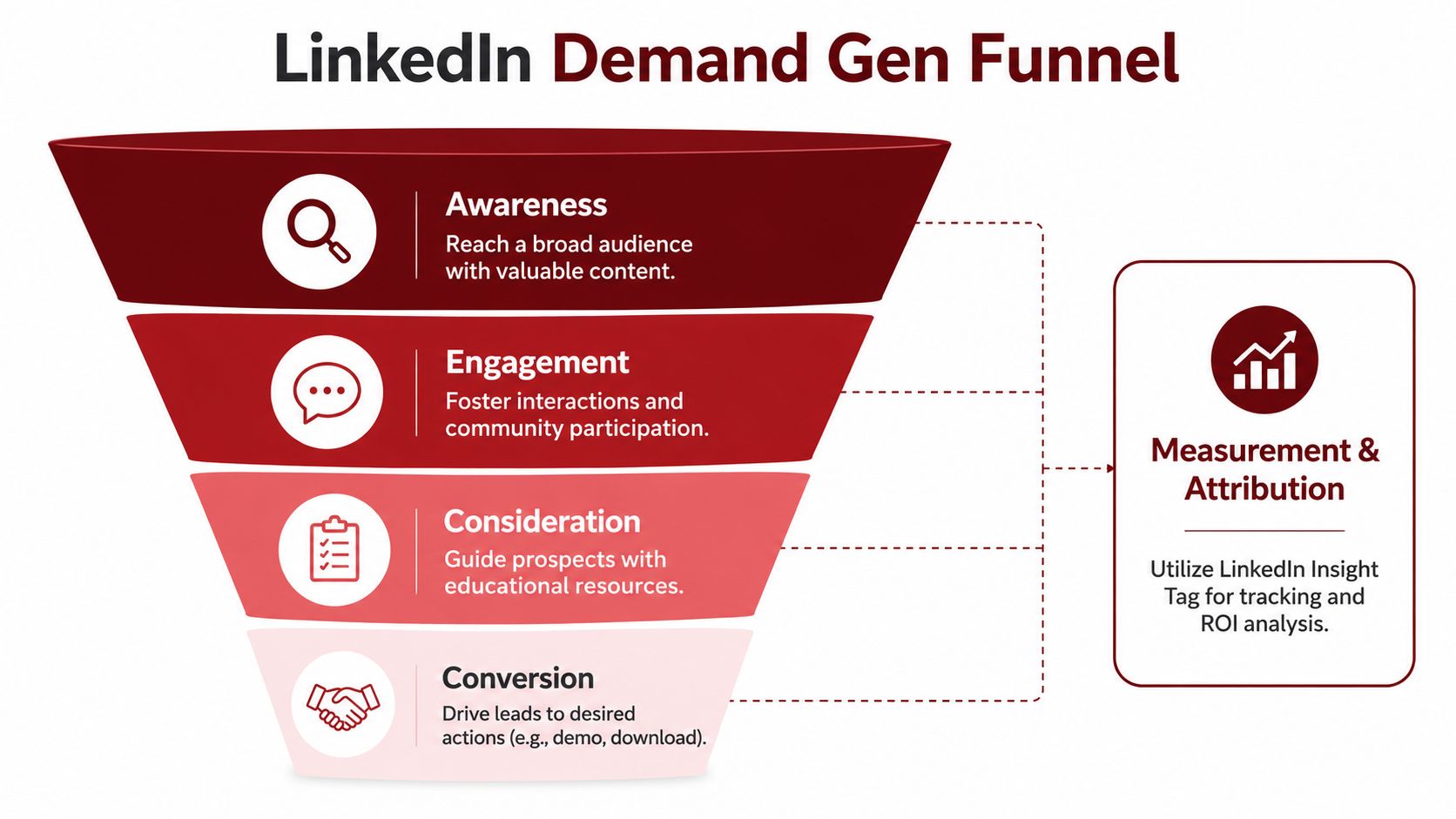
If LinkedIn is part of your demand system, attribution can't stop at form submissions. You need to know which content, ads, and outreach touches influence pipeline progression.
A disciplined setup includes the basics from the paid section's methodology:
- LinkedIn Insight Tag installed across landing pages for view-through conversion tracking
- Retargeting audiences built from meaningful engagement signals like strong video consumption and form interaction
- CRM sync that pushes leads fast enough for sales to respond while intent is still fresh
- Matched audiences aligned with SDR or AE outreach so paid and outbound don't collide
The goal isn't perfect attribution. You won't get that on LinkedIn because some influence happens through profile visits, team mentions, and private conversations. The goal is operational visibility. You want enough signal to know which motions deserve more budget, more effort, or a different handoff.
Automate process, not impersonality
Automation becomes dangerous when teams use it to fake relevance at scale. That's when accounts get noisy, buyers get annoyed, and platform risk rises.
Used properly, automation should handle the repetitive layer:
- queueing follow-ups
- spacing actions across the day
- assigning accounts or lists
- logging responses and next steps
- triggering alerts for a human reply
The human part should still own segmentation, message strategy, exception handling, and high-value conversations. That's especially true in agency environments where several team members or bidder accounts may be operating at once.
Respect limits and protect account health
Safe automation depends on restraint. Guidance for LinkedIn outreach operations notes that safe daily automation limits are around 50 to 70 requests with randomized send times, and that this is especially important in multi-user agency workflows where compliance and account health matter. I won't link that source here because it isn't necessary for the point. The operational lesson is what matters.
A few rules keep teams out of trouble:
- Keep activity human-shaped rather than blasting large batches on a fixed clock.
- Separate roles clearly so multiple users don't create overlapping behavior on the same account.
- Review message quality regularly because weak personalization creates trust issues long before it creates platform issues.
- Pause automation around anomalies like sudden spikes in acceptance drops or unusual account warnings.
Automation should reduce admin work. It should not remove judgment.
For teams building repeatable outreach and sales workflows, this guide on what sales automation is is useful because it frames automation as process design rather than just software.
From Playbook to Performance
Strong LinkedIn demand generation doesn't come from one great post, one clever ad, or one aggressive outbound sprint. It comes from a connected system.
The foundation gives you targeting clarity and conversion-ready profiles. Organic content builds familiarity and authority. Paid campaigns amplify the right message in the right sequence. Outreach turns warmed attention into real conversations. Operations keep the whole engine measurable, compliant, and scalable.
That's the difference between sporadic activity and repeatable pipeline creation. In 2026, the teams that win on LinkedIn won't be the loudest. They'll be the ones that coordinate every touchpoint so buyers experience one coherent journey instead of disconnected marketing.
If you want help operationalizing outbound systems beyond LinkedIn, Earlybird AI is built for teams that need safe, scalable automation around prospecting, messaging, follow-up, and multi-user workflows. It's a practical fit for agencies and service businesses that want less manual sales admin and a more consistent pipeline engine.