← Back To Blog
LinkedIn Lead Generation Service: A Complete Guide (2026)
Some months, your team has more sales calls than it can handle. Then the pipeline goes quiet, referrals dry up, and everyone starts treating outbound as an emergency project again. That feast-or-famine pattern is exactly why so many agencies start looking for a linkedin lead generation service in the first place.
The problem usually isn't effort. It's that LinkedIn outreach gets run inconsistently, by the wrong person, with weak targeting, poor follow-up, or risky automation. Done well, it becomes a dependable pipeline channel. Done badly, it turns into ignored messages, wasted ad spend, and account headaches.
Why Your Business Needs a Lead Generation Strategy for LinkedIn
A lot of B2B firms still treat LinkedIn like a nice-to-have channel. That's a mistake if you sell services, software, consulting, or anything else that depends on reaching decision-makers directly.
LinkedIn drives 80% of all B2B leads generated from social media, and HubSpot data cited by Sopro says it is 277% more effective for lead generation than other social networks. The same source notes that salespeople who engage on LinkedIn are 51% more likely to meet quotas. LinkedIn also has over 1 billion members, which gives B2B teams reach at a scale few other professional channels can match (Sopro's LinkedIn lead generation statistics).
That matters because most agency pipelines don't fail from lack of market demand. They fail because outreach is too sporadic to build momentum. One week the founder is sending connection requests. The next week delivery work takes over. Then someone runs ads without clean audience filters, or an SDR blasts generic messages and burns the account's reputation.
LinkedIn is where B2B intent lives
The primary advantage of LinkedIn isn't just audience size. It's context. People are already there in a business mindset, reviewing peers, checking vendors, watching job moves, and engaging with industry content. That gives you a cleaner environment for prospecting than broad consumer platforms.
If you want a useful primer on the channel itself, this guide on lead generation with LinkedIn is a good companion read.
Practical rule: If your agency depends on high-value deals, you need at least one repeatable outbound channel you can control. LinkedIn is often the most direct one.
Strategy beats random activity
A lead generation strategy for LinkedIn means deciding five things upfront:
- Who you target by role, industry, company type, and buying context
- What offer you lead with so outreach feels relevant, not needy
- How you start conversations without jumping straight into a pitch
- When you follow up so warm signals don't go cold
- What you track so the channel improves instead of drifting
Without that structure, LinkedIn becomes busywork. With it, the platform can support a predictable client pipeline.
What Exactly Is a LinkedIn Lead Generation Service
A linkedin lead generation service is best thought of as a specialized sales function built around one platform. Not just a tool. Not just an ads manager. Not just someone sending connection requests.
It's a system for finding the right prospects, starting conversations, qualifying interest, and moving people toward a booked meeting.
The best providers operate like a focused outbound team. They define your ideal customer profile, build prospect lists, shape messaging, manage outreach cadence, and feed responses into your CRM or calendar process. Some do this manually. Some use LinkedIn-native ads. Some combine Sales Navigator with third-party data and workflow tools.
What the service actually includes
At a practical level, most LinkedIn lead gen services cover some version of the following:
- ICP and targeting work so you're not prospecting everyone with a title that sounds close enough
- List building through LinkedIn Sales Navigator and account filtering
- Profile positioning because outreach from a weak profile underperforms
- Message development for connection requests, follow-ups, and replies
- Lead handling so replies turn into conversations instead of sitting in an inbox
- Reporting and optimization around acceptance quality, reply quality, and meeting output
Some vendors stop at top-of-funnel outreach. Others stay involved until meetings are qualified and booked. That difference matters. If a provider says they generate leads, ask whether they mean contacts, replies, or actual sales conversations.
A modern workflow looks more like signal-based selling
The most effective services don't send messages at random. They watch for signs that a prospect is easier to engage right now.
According to Cognism, advanced teams use LinkedIn Sales Navigator tracking with third-party tools to monitor activity signals like job changes or content engagement. Those signals can trigger personalized outreach sequences that achieve up to 3x higher response rates, and prospects are 5x more likely to respond within 24 hours of signaling intent (Cognism's LinkedIn lead generation guide).
That changes the job of a linkedin lead generation service. Instead of brute-force outreach, the service becomes a timing engine.
A job change, a fresh post, or a visible content interaction is often a better reason to start a conversation than “just checking in.”
What it is not
It's not magic. It won't fix weak positioning, a vague offer, or a sales team that can't run discovery.
It's also not just automation software with a dashboard. Software can send actions. A real service should make judgment calls about targeting, messaging, pacing, and qualification. That's why the strongest providers combine process, tooling, and human oversight.
If you hire one, you're not buying messages. You're buying a repeatable outbound motion on LinkedIn.
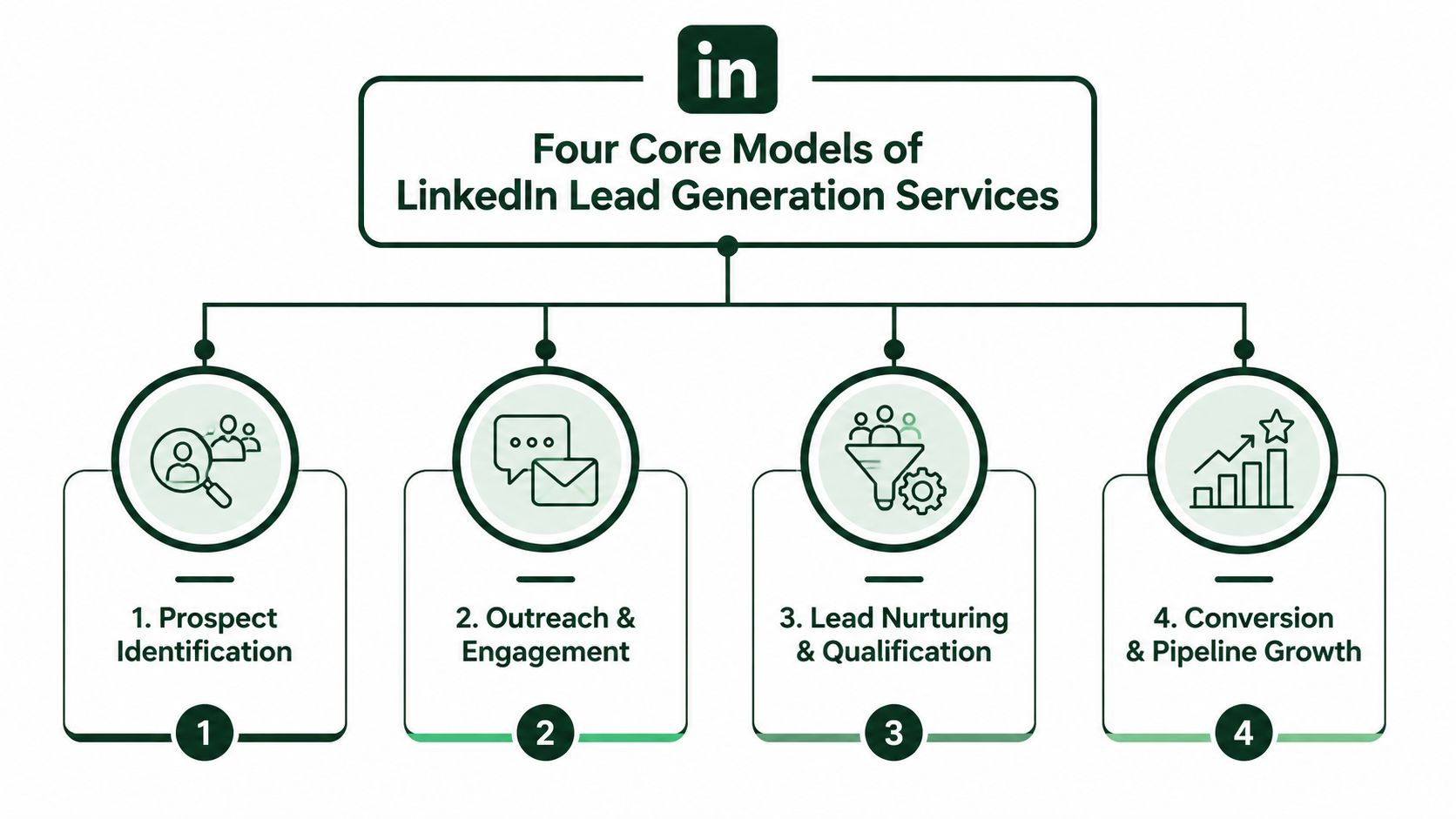
Four Core Models of LinkedIn Lead Generation Services
There isn't one right way to buy LinkedIn pipeline. There are four common models, and each one creates a different mix of control, speed, cost, and risk.
Full-service managed agency
This is the most hands-off option. A managed agency usually handles targeting, list building, profile recommendations, copy, campaign management, follow-up logic, and reporting.
It fits teams that want output without building an internal outbound process from scratch. It also suits founders who know LinkedIn matters but don't want to manage freelancers, tools, and message testing themselves.
The upside is coordination. A good agency can keep the whole motion moving and catch weak spots early. The downside is dependency. If the provider owns the process too heavily, your team may not learn what is driving results.
This model works best when you want execution plus strategic oversight. It works badly when the agency hides behind vanity metrics and won't show you audience logic, message testing, or compliance methods.
Independent freelancer or contractor
This route is leaner. You hire one person to run part of the motion, often prospecting, messaging, or campaign setup.
Freelancers can work well for narrow use cases. Maybe you already know your ICP, have a strong offer, and just need someone disciplined to manage inboxes and outreach. In that setup, a contractor can be efficient.
But the trade-off is fragility. One person may be good at copy and weak at targeting. Or strong at list work and weak at qualification. If they disappear, the process can stall fast.
A freelancer is usually a good fit when:
- You already have sales leadership and need support, not strategy
- You can review campaign quality yourself
- You want flexibility without a long agency engagement
It's a poor fit if you expect one contractor to act like a strategist, SDR manager, copy lead, and RevOps operator at the same time.
Self-managed tools and automation
This model gives you maximum control. Your team owns the account, messaging, list criteria, and campaign decisions. Tools help with workflow, but your staff carries the responsibility.
For some agencies, this is the right answer. If you already have solid outbound instincts and want to scale activity without hiring more SDRs, software can help operationalize the work.
The trap is obvious. Teams often buy tooling before they've built a clean process. They automate weak targeting, generic copy, and poor sequencing. Then they blame the platform when responses stay flat.
A useful benchmark for outreach quality is whether your system helps your team prospect with better timing and sharper targeting. If it doesn't, it's just faster noise. For teams interested in broader workflow design, this piece on AI for sales prospecting is relevant.
Control is valuable only if someone on your team knows how to use it.
LinkedIn-native ads and Lead Gen Forms
This model is different because you're not relying on direct outbound messaging. You're paying LinkedIn to put your offer in front of a defined audience and capture leads natively.
For companies with a clear offer, strong creative, and enough budget to test audiences, this can work very well. The key asset here is LinkedIn Lead Gen Forms, which keep users inside the platform and pre-fill their information.
According to HeyReach, this ad-driven model can produce an average conversion rate of 13%, which is over three times the industry benchmark for landing pages. The same source explains that native pre-filled forms reduce friction and can cut drop-off by up to 60% compared with sending users to an external site (HeyReach on LinkedIn lead generation strategy).
This model is often strongest when:
- You have a clear downloadable offer or demo angle
- Your sales team can follow up fast
- You want scale without direct account-based messaging
It's weaker if your offer is hard to explain quickly or your internal follow-up is slow. Paid lead capture can fill the top of the funnel. It won't rescue a poor handoff process.
Navigating Critical Risks and LinkedIn Compliance
Most buying decisions become disorganized at this stage. A provider promises scale, shows a nice dashboard, talks about personalization, and skips the uncomfortable part. How are they operating the account, and what happens if LinkedIn sees the activity as spam?
That question matters because enforcement got tighter. Firebrand notes that LinkedIn's 2025 algorithm updates tightened spam detection, and data cited from the 2026 HubSpot State of Marketing Report says 40% of B2B marketers using automation faced account restrictions in 2025. It also notes that conversion rates can drop 60% after a suspension (Firebrand on LinkedIn B2B lead generation best practices).
Not all automation is equally risky
Many people jump from that fact to a simplistic conclusion. Automation is dangerous, so everything must be manual. In practice, the actual distinction is between crude automation and controlled automation.
Crude automation usually looks like this:
- Fixed activity patterns that don't resemble normal user behavior
- Generic message templates sent across broad lists
- Aggressive volume jumps with no account warm-up logic
- No segmentation discipline so the wrong people get the wrong pitch
- No human review loop for replies and campaign quality
That combination gets noticed because the behavior is obvious. It also creates bad business outcomes even before compliance becomes a problem.
What safer operations look like
Providers that take compliance seriously usually think in terms of operational hygiene, not just activity volume. They pay attention to pacing, sequence logic, account reputation, and messaging relevance.
Ask whether the service uses measures such as:
- Variable delays instead of robotic timing patterns
- Regional or clean access practices that align with normal account behavior
- Human review checkpoints before scaling campaigns
- Audience exclusions to avoid double-contacting bad-fit prospects
- Reply handling rules so engaged prospects move into real conversations fast
Field note: The safest outreach usually doesn't feel “automated” to the recipient because the campaign is built around relevance and restraint.
Compliance is also a brand issue
Even if your account avoids restriction, reckless LinkedIn activity can still damage your positioning. Prospects notice repetitive messaging. They notice when a founder account sounds like a low-quality SDR script. They notice when your team follows up too many times without context.
That's why compliance isn't just about staying under platform thresholds. It's about protecting trust while you scale.
A linkedin lead generation service should be able to explain its safety model in plain language. If a provider gets vague, changes the subject, or says “don't worry, we've never had issues,” assume they don't have a serious governance process.
How to Evaluate and Choose the Right Provider
Most bad buying decisions happen because the client asks surface-level questions. How many leads will you get me? How fast can you launch? What's your monthly fee?
Those questions matter, but they don't tell you whether the provider can build a channel that lasts.
Start with process, not promises
A strong provider should be able to walk you through how they think. Not just what they deliver.
Ask them to explain:
- How they define your ICP
You want to hear specifics about role, industry, company context, exclusions, and buyer triggers. - How they build and refine messaging
Good providers talk about hypotheses, testing, and reply quality. Weak ones talk about “proven scripts.” - How they manage replies
A lot of firms generate outreach activity, then leave your team to salvage the inbox. - How they protect account health
If they can't explain this clearly, stop there. - How they report performance
Reporting should connect top-of-funnel activity to booked conversations, not just show effort.
If you need a frame for thinking about the human side of outbound ownership, this explainer on what a sales development representative does is useful context.
What a serious proposal should include
A provider proposal should feel operational, not promotional. Look for evidence that they've thought through execution.
The best ones usually include:
- Target account logic with clear inclusion and exclusion criteria
- Message examples customized for your market, not generic samples
- Workflow detail covering prospecting, outreach, reply handling, and handoff
- Tool transparency so you know what software and data sources are involved
- Safety language that describes how they reduce platform and brand risk
If the document is heavy on branding language and light on mechanics, be careful.
Red flags that usually show up early
Some warning signs are easy to miss because they sound confident in a sales call.
Watch for providers that:
- Guarantee meetings without discussing fit
- Talk about volume more than relevance
- Avoid showing sample messaging
- Won't explain how accounts are accessed or operated
- Use case studies that highlight attention metrics instead of sales outcomes
Ask for one anonymized campaign example that shows targeting logic, message flow, and reply handling. If they can't provide that, they probably don't run a disciplined process.
Choose for fit, not just capacity
The best provider for a founder-led niche agency may be the wrong one for a multi-account sales team. Some firms are better at high-touch outreach. Others are built for ad-led demand capture. Some are good operators but need strong client direction. Others bring more strategic input.
Choose the model and partner that match your internal reality. If you have no outbound owner, don't buy a tool-heavy setup that assumes sales ops maturity. If you already have strong messaging and process discipline, you may not need a full-service agency.
A good linkedin lead generation service should make your pipeline more systematic. It shouldn't make your operation more fragile.
Setting KPIs and Onboarding Your New Service
After you have selected a provider, the actual work begins. Most campaigns underperform early because onboarding is vague. The provider starts building lists before the ICP is settled, writes copy before the offer is clear, or launches without rules for handling replies.
Track the metrics that show sales movement
Don't obsess over raw activity. Connection requests sent and impressions generated can be useful diagnostics, but they aren't business outcomes.
Focus on a KPI stack like this:
- Connection acceptance quality so you know targeting is working
- Reply quality because not all responses are useful
- Meetings booked with clear qualification standards
- Show rate so booked calls occur
- Pipeline contribution based on real opportunities created
If you run ads, also look at lead quality after handoff. Native lead volume can look healthy while sales rejects most of it.
Give the provider what they need before launch
A clean onboarding package speeds up learning and reduces wasted outreach. At minimum, your provider should get:
- Your ICP definition with segments you want and segments you don't
- Your offer and positioning in plain language
- Case studies or proof points they can use responsibly
- Existing sales collateral such as decks, landing pages, and objection notes
- CRM rules and ownership so replies don't get lost or duplicated
The first campaign should not try to target everyone. Start with the narrowest credible segment and learn fast.
Treat the first phase as calibration
Early results are for pattern-finding. Which audience accepts? Which message angle gets real conversations? Which replies indicate buying intent versus polite curiosity?
That mindset helps teams stay disciplined. Instead of asking whether the channel “works,” ask whether the process is getting sharper each cycle. That's how a linkedin lead generation service turns from a vendor experiment into a stable pipeline engine.
If your agency wants a safer way to automate outbound on Upwork with fast response times, human-like behavior, and hands-on coaching, take a look at Earlybird AI. It's built for teams that want to replace manual bidding and inconsistent follow-up with a system that helps turn more opportunities into booked calls.