
← Back To Blog
What Is a Sales Development Representative and Why Your Agency Needs One
Forget all the corporate buzzwords for a moment. A Sales Development Representative (SDR) is the person on a sales team with one critical job: generating qualified opportunities. They're the opportunity scouts, the ones on the front lines searching for potential clients and making sure they’re a good fit before handing them off to the person who closes the deal.
The Foundation of Modern Sales Growth

Think of it like a popular restaurant. You have the chefs (the closers) who are masters at preparing the main course. But someone has to be out front greeting guests, checking their reservations, and getting them seated and ready to order. That front-of-house host is the SDR of the sales world. Their job isn’t to close the sale; it’s to fill the pipeline with a steady stream of high-quality leads.
This division of labor became a game-changer when businesses realized that having one salesperson juggle everything—finding, qualifying, and closing every single deal—was a recipe for burnout and inefficiency. By specializing the roles, companies created a much more focused and effective sales machine.
The Core Mission of an SDR
An SDR’s world revolves around the very top of the sales funnel. They are the first point of contact, tasked with prospecting for new leads and then qualifying them using a framework like BANT—which checks for Budget, Authority, Need, and Timeline. Their days are filled with outreach through cold emails, phone calls, and LinkedIn messages, with every single touchpoint meticulously logged in a CRM.
The ultimate goal is simple: book a meeting or appointment for an Account Executive. The AE then takes the baton, runs the product demo, and works to finalize the deal. By filtering out anyone who isn't a good fit, SDRs make sure the closers spend their valuable time only on opportunities that have a real shot at converting.
This role isn't just a niche—it's a massive part of the economy. In the US alone, there are over 666,491 Sales Development Representatives, a number that proves just how much businesses depend on them to get the sales process started, particularly in tech and B2B services.
But it’s a tough, high-pressure job. A striking 34% of SDRs leave their position in less than a year, often worn down by the constant grind of hitting ambitious quotas. You can dig into more SDR demographics and job trends to see the complete picture.
This high-turnover, high-cost reality brings up a crucial question, especially for the freelancers and agencies on platforms like Upwork. In an age of sophisticated AI and automation, is a human SDR still the smartest way to generate leads? As we go through this guide, we’ll tackle that question head-on and show how new tools and strategies can provide a more efficient path to growing your business.
The Daily Grind of a Sales Development Representative

To really get a feel for the SDR role, you have to look past the job title and peek into their daily routine. It’s a high-volume, high-pressure world defined by relentless activity and meticulous organization. An SDR's day isn't about leisurely chats; it's a structured sprint against the clock to hit some pretty demanding goals.
Think of how a typical morning kicks off. It almost always starts with prospecting—the digital equivalent of panning for gold. SDRs sift through huge lists of potential contacts, using their buyer personas and a few key tools to spot the individuals who look like a perfect fit for their company’s solution. This isn't a quick scan; it's a detail-oriented hunt for the right people at the right companies.
Once that target list is built, the real work begins: the outreach blitz. This is where the grind truly sets in. An SDR’s day is a carefully orchestrated mix of communication, hitting prospects from multiple angles to grab their attention and, hopefully, start a real conversation.
Core Daily Activities of an SDR
The main job is to run multi-channel outreach campaigns, which means their day gets broken down into very specific blocks of activity. It usually includes a mix of these:
- Cold Calling: This is the classic. It means dialing dozens, sometimes hundreds, of numbers to connect with decision-makers. The goal is to deliver a quick, compelling pitch and see if there's a genuine need. It takes a ton of resilience to get past gatekeepers and handle constant rejection.
- Email Campaigns: SDRs live in their inboxes, crafting and sending personalized email sequences. The good ones don't just blast out generic templates; they do their homework and add specific details about the prospect's company or role to make the message stand out. For some solid ideas on this, check out our guide to writing effective lead generation emails.
- Social Selling: This is about more than just sending connection requests on LinkedIn. It’s about using social platforms to engage in professional conversations, share valuable content, and warm up what would otherwise be a completely cold lead.
All of this constant activity points toward a single objective: lead qualification. The SDR acts as the gatekeeper, filtering out anyone who isn't a good fit. They ask the tough but necessary questions about budget, authority, and timing to make sure only the most promising leads are passed over to an Account Executive.
An SDR might spend hours each day on tasks that aren't even direct selling. Logging calls in the CRM, updating contact records, researching target companies, and prepping for the next day's outreach all eat up a huge chunk of their time.
This mountain of admin work is a big reason why burnout is so common in the profession. The sheer volume of manual tasks required to hit aggressive targets—like booking 15-20 qualified meetings a month—can be completely draining. This reality is exactly why automation is becoming such a game-changer, offering a way to lift that heavy burden and turn the workflow from a manual grind into a smart, efficient process.
Understanding the Key Players on a Sales Team
If you’ve ever tried to build a sales process, you've probably drowned in a sea of acronyms. SDR, BDR, AE… what’s the difference, and who does what? It’s easy to get them mixed up, but getting this right is the foundation of a scalable growth engine.
For agency owners, knowing how these roles fit together is a game-changer. Think of it like a relay race. To win, you need to know exactly who runs each leg of the race and when to pass the baton.
SDR vs. BDR: The Inbound and Outbound Split
On the surface, Sales Development Representatives (SDRs) and Business Development Representatives (BDRs) seem to do the same thing: find and qualify leads. They're the ones at the very beginning of the sales journey. The main difference usually comes down to where they find those leads.
Sales Development Representatives (SDRs) are typically on inbound duty. They handle leads who have already raised their hand. Someone filled out your contact form, downloaded a whitepaper, or signed up for a webinar. The SDR's job is to follow up fast, make sure they're a legitimate prospect, and book a discovery call.
Business Development Representatives (BDRs) are the hunters, focusing on outbound prospecting. They build lists of ideal clients from scratch and reach out cold. Their world is filled with cold calls, personalized emails, and LinkedIn messages, all aimed at starting a conversation with people who don't know you yet.
Now, in the real world, many companies use these titles interchangeably. Don't get too hung up on the acronyms. The core function is identical: create qualified opportunities for the closers. Both are entry-level roles focused on feeding the top of the sales funnel.
Think of SDRs and BDRs as the scouts for a professional sports team. Their entire job is to find promising talent (qualified leads) and persuade them to come in for a tryout (the sales meeting). They aren't coaching the team or playing in the championship game—they just find the future stars.
Account Executive: The Closer
Once a scout has found a promising player and scheduled the tryout, they pass the baton. This is where the Account Executive (AE) steps in. The AE is the closer.
After an SDR or BDR books a qualified meeting, the AE takes over the relationship entirely. They run the demo, dig deep into the prospect's needs, handle negotiations, and ultimately, get the contract signed. Their job is to convert that initial interest into real, paying business.
In our relay race, the SDR/BDR runs a strong first leg, finding the opportunity and building initial momentum. They then make a clean handoff to the AE, who has the expertise to sprint across the finish line and win the deal.
For small agencies and freelancers on platforms like Upwork, this is a crucial concept. You’re often the scout, the runner, and the coach all at once. By mentally separating the prospecting work (SDR/BDR tasks) from the closing work (AE tasks), you can clearly see where automation can take over the heavy lifting. This frees you up to do what you do best: close deals and serve your clients.
The Hidden Costs of Hiring an SDR
When your agency starts growing, bringing on your first Sales Development Representative feels like the obvious next move. But before you post that job opening, you need to understand that the real cost goes far beyond a simple salary. The true price of an SDR is a tangled web of direct expenses, hidden operational costs, and serious financial risks that catch most founders by surprise.
Let's start with the basics: compensation. The average base salary for an SDR in the US hovers around $57,921. That figure alone can be a tough pill to swallow. But once you factor in commissions and bonuses, that number easily swells to over $83,110. You can dig deeper into SDR compensation trends and data to see just how much these figures can vary.
For small agencies or freelancers, that $83,000+ represents a huge opportunity cost. Think about it—landing just one or two solid clients could cover a huge chunk of that expense for the entire year.
The Overlooked Financial Burdens
It doesn't stop at salary, though. The expenses start to pile up quickly once you look beyond the paycheck. Bringing a new person onto the team means opening your wallet for a lot more:
- Recruitment and Hiring: Finding a great SDR is a job in itself. You're either paying thousands in recruiter fees or sinking countless hours into screening resumes and conducting interviews—time you could be spending on billable work.
- Onboarding and Training: A new SDR isn't a plug-and-play solution. They need weeks, sometimes months, of intense training on your services, your ideal customer, and your sales process. All that time spent training them is time you aren't spending on growing the business.
- The Essential Software Stack: To be effective, an SDR needs a toolkit. This means paying for a CRM, sales intelligence platforms, and email automation software. These licenses can easily tack on hundreds, if not thousands, of dollars per year. Our guide to essential software for a digital marketing agency breaks down what these costs can look like.
This is where the SDR fits into the typical sales organization, feeding the pipeline for the rest of the team.
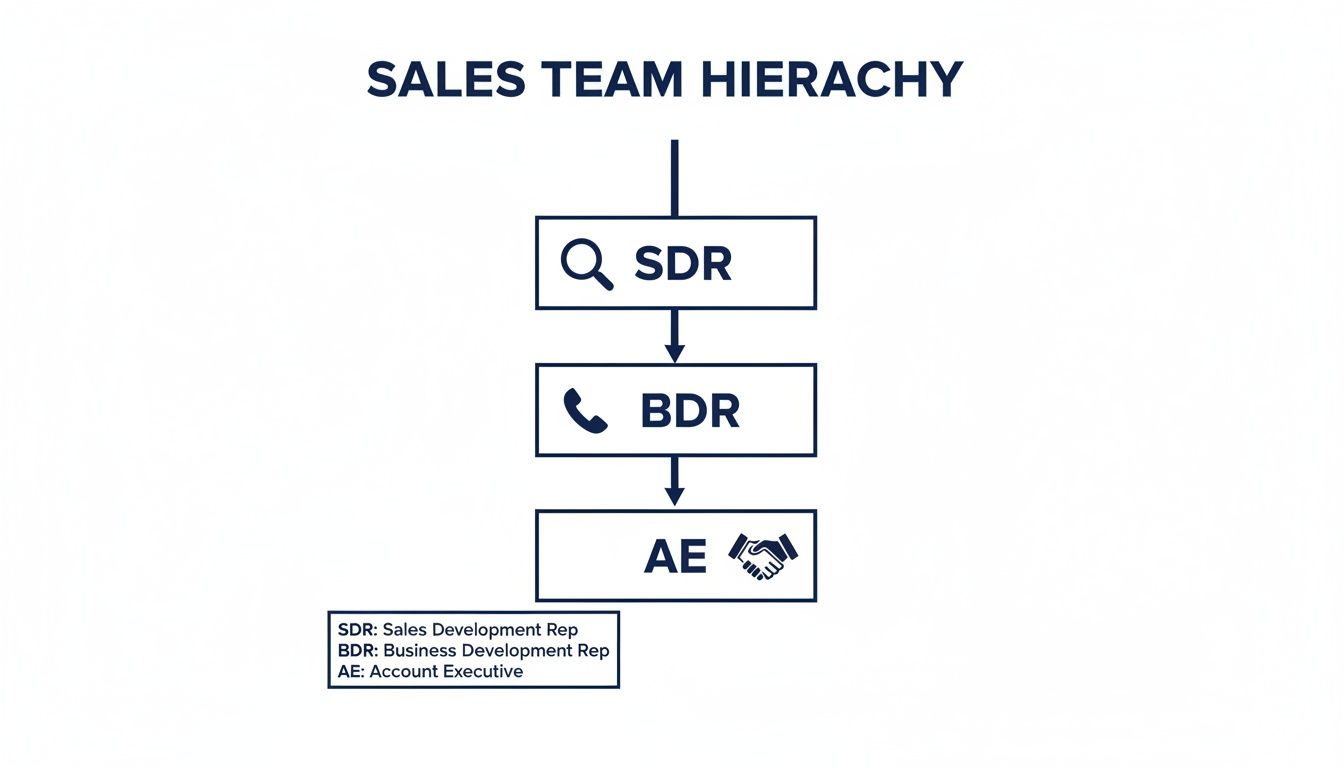
As you can see, their entire job is to keep the engine running, and that engine requires constant fuel in the form of management, money, and resources.
But the single biggest cost—and the one that can truly derail a small agency—is turnover. The SDR role is notorious for burnout. When an SDR quits after just a few months, you've not only wasted thousands on a bad hire but you're also right back at square one, ready to start the expensive and time-consuming process all over again.
When you add it all up—the direct salary, the hidden operational drains, and the very real risk of high turnover—hiring a traditional SDR starts to look less like a smart investment and more like a major financial gamble. It's no wonder so many agencies are now looking for a more strategic and cost-effective way to generate leads.
How Automation Replicates the SDR Function

If you're a freelancer or run an agency, the idea of hiring a full-time Sales Development Representative probably sounds intimidating. Between the cost, the risk, and the sheer effort of managing someone, it can feel like a non-starter. But what if you could get all the benefits of an SDR—and then some—without the high overhead? That's where smart automation comes in.
Think of an AI-powered platform as your dedicated, always-on sales team, one that's been built from the ground up to win in competitive marketplaces. Instead of a person manually digging for leads and writing proposals one by one, automation handles the entire top-of-funnel process for you.
It's like having a scout who scans for projects 24/7 that are a perfect fit for your skills. This is the digital version of an SDR’s prospecting, only it never sleeps, never gets tired, and never misses an opportunity.
Achieving Unbeatable Speed and Efficiency
The single biggest edge automation gives you is speed. On a competitive platform, being one of the first to apply is a game-changer. An automated system can spot a new job post and fire off a highly personalized proposal in minutes—something a human SDR simply can't do consistently.
This speed comes from eliminating the grunt work that slows SDRs down. While the SDR role has always been a mix of hustle and tech, some major roadblocks persist. For example, a staggering amount of sales time is wasted on administrative busywork, which contributes to burnout in a field where many SDRs quit within 18 months. You can see the full data on the evolution and challenges of the SDR role.
Automation cuts through all that noise. It prospects, personalizes bids, and sends follow-ups without fail, giving you a massive first-mover advantage. Your proposal lands in front of the client while your competitors are still scrolling through job feeds.
Automation isn't just about moving fast; it's about moving smart. The system learns from your past projects and simple feedback, getting better and better at spotting high-value opportunities. In effect, it’s not just prospecting—it’s qualifying leads for you.
From Manual Grind to Automated Wins
By taking over the repetitive, high-volume tasks, automation frees you up to do the work that actually closes deals: talking to clients and building relationships. It effectively mirrors the most valuable parts of an SDR's job but with superhuman consistency.
Here’s a quick look at how it maps to the SDR workflow:
- Prospecting: The system acts as your 24/7 opportunity scout, continuously scanning for new leads that match your ideal client profile.
- Outreach: It crafts and sends tailored proposals at scale, making sure every potential client gets a message that feels relevant and personal.
- Follow-Up: It can manage initial client replies and send follow-ups, ensuring no conversation gets dropped and every lead has a chance to move forward.
This whole process directly solves the problems of cost and burnout that come with hiring a human SDR. For a closer look at how these systems operate, check out our guide on what is sales automation. By making this shift, freelancers and small agencies can compete with the power of a full sales team, turning their prospecting grind into a reliable stream of high-quality clients.
Common Questions About Sales Development
When you're running an agency or working as a freelancer, you’re always thinking about growth. That naturally leads to questions about sales development and how to build a reliable pipeline without spending all your time prospecting.
Let's walk through some of the most common questions. Getting these answers straight will help you decide whether to hire a person, lean on technology, or find a smart combination of both.
What Are the Most Important Skills for a Successful SDR?
A great Sales Development Representative is a unique blend of artist and scientist. While you can train someone on a product, there are a few core traits you just can't teach. These are the non-negotiables.
First and foremost, you need resilience. An SDR hears "no" constantly. They get ignored, rejected, and shot down day after day. A successful one has the mental fortitude to not take it personally and to start every morning fresh, ready to go again.
Beyond sheer grit, a few other skills are vital:
- Sharp Communication: This isn't just about being a smooth talker. It’s about writing emails that actually get opened and running discovery calls that feel like a helpful conversation, not an interrogation. They have to uncover a prospect's real pain points.
- Serious Organizational Skills: An SDR is juggling hundreds of leads at once. Without a rock-solid system for tracking every interaction in a CRM, promising leads will absolutely get lost in the shuffle. It's that simple.
- Being Coachable: The sales game is always changing. The best SDRs are hungry to learn. They see feedback not as criticism, but as a shortcut to getting better and hitting their numbers faster.
Finally, they have to be comfortable with technology. A modern SDR works with a whole stack of tools, from prospecting databases to automation platforms. They need to be able to pick them up quickly and use them to work smarter, not just harder.
Can AI Completely Replace a Human SDR?
For the repetitive, top-of-funnel work? Absolutely. In fact, AI and automation are often better at it. This is especially true for freelancers and agencies trying to compete on fast-moving platforms.
Think about the most time-consuming parts of an SDR's job, and you'll see where automation shines:
- Lead Sourcing: An AI can scan job boards 24/7, finding your ideal projects the moment they’re posted—something no human could ever do.
- Initial Outreach: Automated systems can draft and send highly personalized proposals and messages at a scale that's physically impossible for one person.
- Consistent Follow-Up: This is where most manual efforts fail. An AI never forgets. It will follow up on every single proposal, every time, until you get a response.
The future of sales development isn't about AI replacing humans. It's about creating a powerful partnership. Automation does the heavy lifting—the prospecting, the initial outreach, the follow-ups—so human experts can focus on what they do best: building relationships, handling complex questions, and closing deals.
In this model, automation becomes your tireless lead generation machine. It serves up warm, interested replies, freeing you from the daily grind so you can focus only on conversations that lead to revenue.
How Is Success Measured for an SDR or an Automation Tool?
While the goal is the same—fill the sales pipeline—how you measure success is a bit different for a human SDR versus an automation platform.
For a traditional Sales Development Representative, success is mostly about output. You might track activities like calls and emails, but what really matters to the business are the results of that effort:
- Qualified Meetings Booked: This is their primary job—setting appointments for the person who closes the deal.
- Pipeline Value Generated: This measures the potential revenue from all the opportunities the SDR has sourced.
For an SDR automation tool, the measurement is much more direct and tied to real business outcomes. You're not measuring "effort" at all, just pure results. The key metrics are:
- Client Reply Rate: What percentage of your automated outreach is actually starting a conversation?
- Meetings Booked: How many discovery calls are being scheduled directly from the tool's activity?
- Contracts Won and Revenue Generated: This is the bottom line. How much new business did the platform actually help you close?
Ultimately, you’re judging both on their ability to create opportunities. But with automation, you get a much clearer, more direct line of sight from the tool's cost to the money it puts in your bank account.
Stop chasing leads and start winning them. With Earlybird, you get an always-on sales team that finds perfect-fit projects, crafts personalized proposals, and gets you first in the client's inbox. Let automation handle the grind so you can focus on closing deals.
Discover how agencies are scaling their outreach and winning more clients at https://myearlybird.ai.