
← Back To Blog
Master Market Trend Analysis: Grow Your Freelance Business

You can feel this problem on Upwork before you can name it.
One month, clients want broad “social media help.” A few weeks later, they're asking for short-form video systems, repurposing workflows, and AI-assisted content ops. Then another category tightens up, budgets get squeezed, and the freelancers who looked well-positioned suddenly compete in a crowded lane. If you're only reacting to posted jobs, you're always late.
That's why market trend analysis matters for freelancers and agencies. Not as a corporate research exercise, but as a practical way to spot where demand is moving before your profile, proposals, and offers fall behind.
Why Market Trends Matter for Your Freelance Business
Most freelancers lose opportunities unnoticed. They don't lose because they're bad at the work. They lose because they keep selling yesterday's version of the service while clients start paying for the next one.
A copywriter keeps pitching generic blog packages while buyers shift toward product-led SEO content. A designer keeps emphasizing logos while clients ask for conversion-focused landing page systems. An agency keeps offering task execution while buyers want someone who understands workflow automation, reporting, and response speed.
That gap is where revenue slips.
Modern trend analysis became prominent as markets grew more data-intensive in the late 20th century, and in finance it uses historical price and trading-volume data to identify whether a market is moving up, down, or sideways so people can make forecasting and timing decisions. The larger shift was from simple description to probabilistic prediction (The Knowledge Academy on trend analysis). That same mindset applies to freelance services. You're not trying to predict the future perfectly. You're trying to make better bets than the average seller.
What this changes on Upwork
When you track trends well, you stop asking vague questions like “What service should I offer?” and start asking sharper ones:
- Where is demand becoming more specific: Are clients hiring for generalists, or are they defining narrower problems with clearer business outcomes?
- Which services are commoditizing: If everyone can offer it, can you still sell it at a premium?
- What adjacent skill is becoming valuable: Do clients now expect strategy, implementation, reporting, or automation on top of your core craft?
Practical rule: The freelancer who understands the buyer's changing context usually beats the freelancer with the longer skills list.
You don't need a research department to do this. You need a repeatable way to notice shifts early, validate them, and turn them into positioning. That's how trend analysis becomes income, not theory.
The Core Concepts of Market Trend Analysis
At its simplest, market trend analysis means looking at data over time so you can detect direction, persistence, and change. In business use, that often means comparing patterns across quarters, years, or longer periods, and combining historical data with real-time signals to build a more complete view of where things are heading (AskAttest on market trend analysis).
For a freelancer, the “data” isn't just a stock chart. It can be job post language, repeat requests from clients, shifts in required tools, changes in project scope, and whether buyers are bundling new expectations into familiar work.

The four trend types that matter
Think of trends like weather patterns. You're not just checking today's temperature. You're deciding what season you're operating in.
- Uptrends mean demand is strengthening over time. On Upwork, that might look like more buyers requesting the same service category, more specific skill combinations, or more urgency around solving a similar problem.
- Downtrends mean demand is fading, or at least becoming harder to win profitably. You may still see jobs, but they start looking thinner, more generic, or harder to differentiate.
- Sideways trends mean the category still exists, but it isn't clearly expanding. This often creates crowded competition because sellers keep entering a market that isn't opening up much.
- Seasonal trends show up at predictable times. Some clients buy around launches, fiscal resets, holidays, or annual planning cycles.
TAM, SAM, and SOM for freelancers
Corporate strategy loves TAM, SAM, and SOM. The ideas are useful if you translate them into freelance reality.
TAM in freelance terms
Total Addressable Market is the full universe of buyers who could theoretically pay for your skill.
If you're a B2B email marketer, TAM is not “everyone on Upwork.” It's every business that might buy email strategy, copy, automation, or lifecycle work.
SAM on platforms
Serviceable Available Market is the part you can access.
For many freelancers, that means buyers on platforms, in a specific language, in a specific budget band, needing work you can deliver remotely and credibly.
SOM is where revenue gets real
Serviceable Obtainable Market is the narrow slice you can win.
That might be “SaaS onboarding email optimization for seed to Series A teams” or “conversion copy for health and wellness brands with existing paid traffic.” Through this approach, your positioning stops sounding broad and starts sounding expensive in the right way.
Broad markets create visibility. Narrow markets create trust.
A lot of weak positioning comes from confusing TAM with SOM. Saying “I help businesses grow online” speaks to a huge market and almost nobody in it. Saying “I help B2B SaaS teams turn free-trial drop-off into lifecycle email improvements” speaks to a smaller market and gets remembered.
How to Perform Market Trend Analysis Step by Step
Most freelancers overcomplicate this. You don't need a giant spreadsheet first. You need a routine that helps you notice patterns, test them, and act before everyone else rewrites their profile.
A practical approach is to repeat trend work on a fixed cadence, monthly, quarterly, or yearly, so you can compare like-for-like periods and separate structural change from one-off spikes or seasonal noise. That's also what makes different pattern types useful, because upward, downward, horizontal, short-term, long-term, and seasonal movement each call for different actions (NetSuite on trend analysis).
To make the workflow concrete, use one niche as a running example. Say you're a freelancer exploring AI-assisted content operations for B2B SaaS.
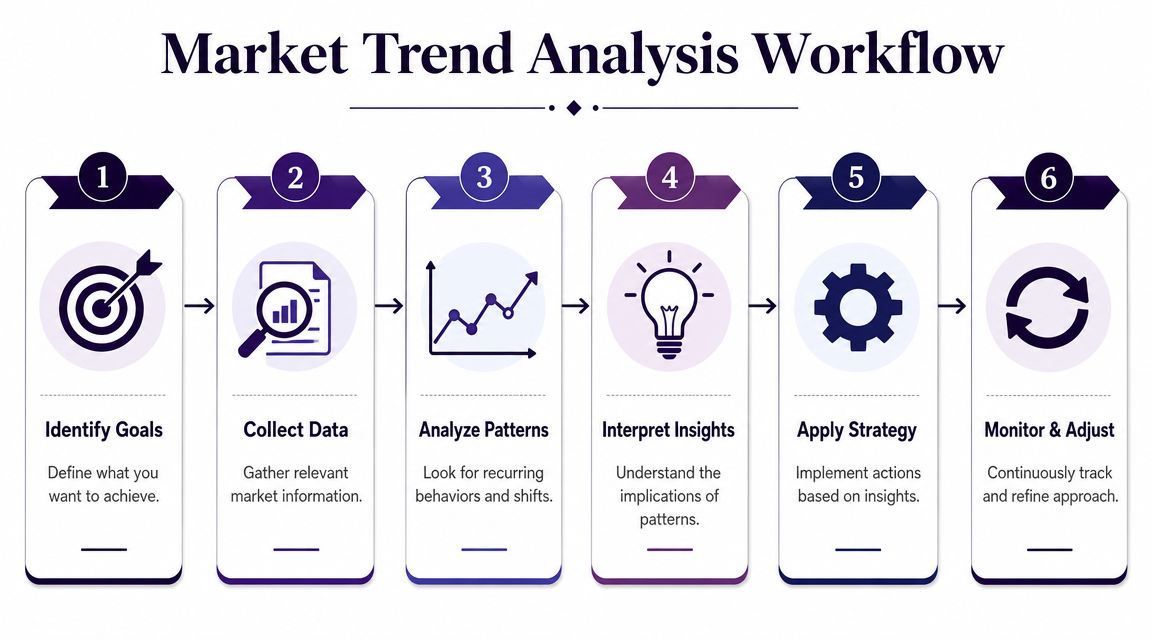
Step one and step two
Define one market question
Start narrow.
Bad question: “What's trending in marketing?”
Better question: “Are B2B SaaS buyers on Upwork shifting from standalone blog writing toward AI-assisted content systems, editing, and workflow management?”
That question gives you something observable. You can now look for repeated language, repeated deliverables, and repeated buyer pain.
Gather evidence from buyer behavior
Collect signals from places where clients reveal intent.
Look at:
- Upwork job posts: Save examples with repeated terms, tools, and deliverables.
- Client profiles and hiring history: Notice whether buyers repeatedly hire for adjacent services.
- LinkedIn posts from target buyers: Watch for operational complaints, team bottlenecks, and new expectations.
- Industry newsletters and product updates: These often reveal what companies are trying to implement, not just what they're talking about.
Don't try to score everything. Just capture patterns in plain English.
Step three and step four
A short video can help if you want another angle on the workflow before applying it to your own niche.
Separate recurring patterns from random noise
A common mistake involves individuals seeing three interesting posts and deciding a whole market has changed.
Instead, ask:
- Is the signal appearing across multiple clients?
- Is it showing up over time, not just in one week?
- Does it change what buyers are paying for?
- Does it alter your positioning, process, or deliverables?
If the answer is mostly no, you may be looking at noise.
One flashy topic doesn't equal a durable service category.
Translate the pattern into an offer
Once a trend looks real, convert it into a sales asset.
If buyers keep asking for “content strategy” but the actual need is managing AI-assisted production quality, your offer might shift from “blog writing” to “editorial systems for AI-assisted B2B content.” That affects your title, profile overview, portfolio framing, and proposal language.
Step five and step six
Test in the market quickly
Use small, reversible changes first:
- Rewrite your headline around the sharper pain point.
- Adjust two or three proposal templates to reflect the trend.
- Create one focused portfolio item that frames your work around the emerging problem.
- Track response quality instead of just response volume.
Review on a cadence
Put this on your calendar.
A monthly review is usually enough for freelancers. A quarterly review works well for agencies with larger service lines. The point isn't perfection. The point is staying close enough to demand that your offer evolves before your pipeline weakens.
Finding Reliable Data Without a Corporate Budget
You don't need paid enterprise research tools to do useful market trend analysis. You need enough signal to avoid guessing.
Freelancers usually have an advantage here. You're closer to buyer language than a corporate team is. You see raw demand in job posts, invites, discovery calls, and proposal feedback. That's messy data, but it's often more actionable than polished reports.
Start with the sources buyers can't help revealing
The best low-cost research source is often the place where clients ask for work in public.
Use Upwork itself as a dataset. Search one niche repeatedly and track:
- How buyers describe the problem: Are they asking for execution, strategy, audits, systems, or ongoing ownership?
- What skills get grouped together: A writing role that repeatedly includes CMS management, analytics, and prompt editing is telling you the service has changed.
- How urgent the language feels: “Need help” is different from “need someone to build and own this workflow.”
You can strengthen that with open-web signals. Google Trends can hint at attention shifts. LinkedIn can reveal operator pain. Product release notes often show where teams are investing. Industry newsletters help you understand why the buyer is asking for something now.
Build a lightweight evidence stack
Don't rely on one signal source.
A practical mix looks like this:
- Platform demand: Saved searches and job post reviews on Upwork
- Search interest: Google Trends for category language
- Buyer conversation: LinkedIn posts, comments, and newsletters
- Execution evidence: Tool documentation and product update logs
- Reporting context: Agency-facing resources such as SEO reporting software for agencies, which can help you understand how client expectations around reporting and accountability are evolving
If a trend appears in search chatter but not in client buying behavior, treat it carefully.
Not every visible topic becomes a good service line. Buyers may talk about a problem long before they know how to purchase a solution for it. Your job is to find the point where discussion becomes spend.
What not to trust too quickly
Freelancers waste time when they treat hype like demand.
Be skeptical of:
- Viral posts: They often signal attention, not purchasing intent.
- Broad “top trends” lists: These are usually too generic to shape a profitable offer.
- Single-client anecdotes: Useful for clues, dangerous as strategy.
Reliable trend work doesn't require a corporate budget. It requires repeated observation, a simple note-taking habit, and the discipline to validate before you reposition your business around a passing spike.
Using Trend Analysis to Win More on Upwork
Most advice often falters at a specific point. People explain how to “spot opportunities,” then stop before the point that matters. You still need to turn the insight into profile clicks, better conversations, and booked work.
A useful principle from underserved-market research is that the primary challenge isn't just spotting growth. It's distinguishing meaningful demand shifts from noise by combining trend signals with transactional behavior and checking whether growth persists across channels and customer cohorts (Luth Research on underserved market analysis). For Upwork, “transactional behavior” means what clients post, repeat, and hire for.
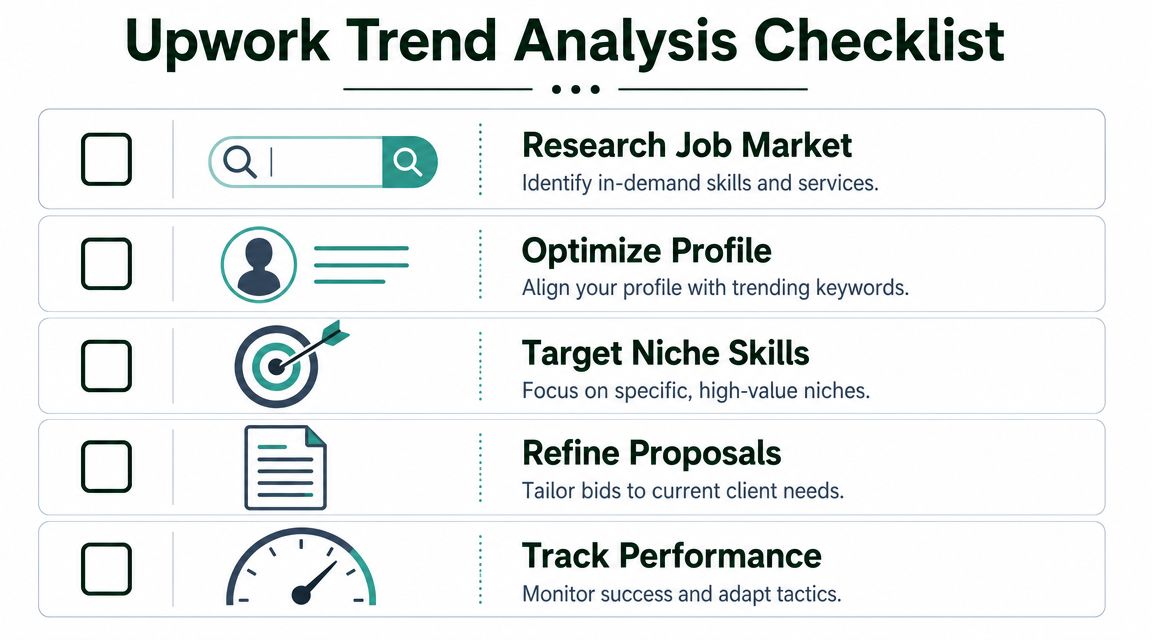
Optimize your profile around demand that's holding up
A strong profile doesn't describe everything you can do. It mirrors the way good buyers define current problems.
If your niche is shifting, update these areas first:
- Title: Make it specific enough to reflect current demand. “Email Marketer” may be too broad. “Lifecycle Email Strategist for SaaS Onboarding and Retention” is closer to how buyers think when the work becomes more operational.
- Overview: Lead with the business problem, not your biography. If clients now care about systems, quality control, or speed, your first lines should show you understand that shift.
- Portfolio: Reframe old work through the current market lens. A content sample can become evidence of editorial process, distribution planning, or workflow design if that's what buyers now value.
If you work with teams, material on agencies on Upwork can help you think through positioning and delivery in a more structured way.
What works
Profiles win when they absorb trend language without sounding stuffed with keywords. If buyers repeatedly ask for “content ops,” “retention,” “RevOps support,” or “conversion-focused UX writing,” those phrases belong in your profile only if they match the work you do.
What doesn't
Blindly copying trending words. Buyers can tell when a profile is optimized for search but disconnected from actual competence.
Use proposal language that proves market awareness
Most proposals sound like interchangeable labor. They explain credentials, attach samples, and ask for a call.
A trend-aware proposal does something better. It helps the client feel understood in the context they're operating in now.
For example, instead of saying:
“I'm an experienced copywriter who can help with your email campaign.”
You might say:
“You're not just asking for more emails. You're trying to improve onboarding flow while keeping messaging consistent across an evolving product experience. That usually means the copy itself is only part of the job.”
That kind of line works because it reflects the buyer's actual operating problem.
Clients rarely hire the person who lists the most skills. They hire the person who frames the problem most clearly.
A useful proposal structure is:
- Name the problem beneath the task.
- Show you recognize the current market shift affecting it.
- Offer a focused next step.
- Keep the scope believable.
Choose niches with better economics, not just louder buzz
Trend analysis is most valuable when it tells you where to move next.
The right niche isn't always the fastest-growing topic in public conversation. Often it's the service area where clients are under pressure, have budget, and struggle to find someone who can connect execution to outcomes.
Look for a niche when:
- buyers are requesting combinations of skills that many freelancers don't package together,
- the problem is recurring rather than one-off,
- and your background gives you credibility that others can't fake quickly.
That's why “AI content” alone is a weak niche. It's broad, noisy, and easy for sellers to claim. But “AI-assisted editorial QA for B2B SaaS teams publishing at scale” is a much stronger niche if job posts and client conversations keep pointing there.
Validate before you pivot hard
Before changing your whole business, test the niche in three places:
- Profile response: Do better-fit clients start viewing, inviting, or replying?
- Proposal quality: Are conversations becoming more strategic and less price-first?
- Project shape: Do clients ask for larger scopes, ongoing retainers, or adjacent work?
If those signals improve, the niche may be real. If they don't, refine again.
Operationalizing Your Trend-Spotting Efforts
Good market trend analysis isn't a one-time brainstorm. It's an operating rhythm.
That matters more now because AI is changing how analytical and sales work gets organized. One data point from labor research is especially relevant here: AI-exposed occupations saw employment growth of 30% from 2022 to 2025 versus 12% for less-exposed jobs, which suggests AI is already reshaping who does this work and how teams structure it. The same analysis argues that some of the best opportunities now come from operational bottlenecks created by AI adoption, including response-speed expectations (Hanover Research on market analysis solutions).
For freelancers and agencies on Upwork, that means trend-spotting can't live only in your head. You need a system.
Build a personal trend dashboard
A simple version is enough.
Create a recurring workflow with:
- Saved Upwork searches: One for your core niche, one for adjacent services, one for experimental opportunities.
- Google Alerts and RSS feeds: Focus on buyer industries, not just freelancer advice.
- A swipe file: Save job posts, invite language, and proposal wins in one place.
- A review cadence: Weekly for signal collection, monthly for decisions.
The point is not to gather everything. The point is to make patterns visible before they become obvious to the whole platform.
Add automation where speed matters
Manual monitoring works, but it breaks when you get busy. That's usually the exact moment good opportunities start slipping by.
Tools can help at different layers:
- Feed readers and alerts help you collect signals.
- CRM or pipeline tools help you track what converts.
- Automation platforms help you act quickly when a matching opportunity appears.
One example is sales automation for service businesses. In the Upwork context, Earlybird AI can connect to an account, learn project preferences from feedback, and automate job search, proposal drafting, and message handling. Used carefully, that shifts trend analysis from passive research into an always-running response system.
The value of a trend isn't just noticing it. The value is noticing it fast enough to act before the inbox fills up.
Keep human judgment in the loop
Automation can speed up response and coverage. It can't decide your positioning for you.
You still need to review:
- whether your chosen niche is getting stronger or weaker,
- whether proposal language reflects current buyer priorities,
- and whether the work you're winning is moving you toward better clients or just more activity.
That mix matters. Trend analysis should make your business sharper, not just busier.
Turning Market Insights into Predictable Income
Freelancers who rely only on skill eventually run into pricing pressure. Freelancers who pair skill with market trend analysis stay closer to where demand is moving.
That's the primary payoff. You stop selling generic services into crowded categories. You start aligning your profile, proposals, and offers with the problems buyers are actively trying to solve now. On Upwork, that can mean better-fit invites, stronger proposal conversations, and work that has more room for strategy and retention.
The biggest shift is mental. You're no longer waiting to see what clients ask for. You're building a habit of studying demand, validating it, and repositioning before your competitors catch up.
That's how trend analysis becomes practical. It gives you a way to avoid stale niches, sharpen your offer, and build income that feels less random and more repeatable.
If you want help turning trend signals into faster Upwork action, Earlybird AI is one option to look at. It's built for freelancers and agencies that want to automate job discovery, proposal drafting, and client replies on Upwork so promising opportunities don't sit untouched while you're doing delivery work.