
← Back To Blog
Master Opportunity Identification: Win High-Value Upwork

You open Upwork, type in your usual keywords, and start scrolling. Half the feed is vague. A chunk of it is underpriced. Some posts look promising until you click through and realize the client has a history of ghosting, hiring cheap, or rewriting scope midstream.
That routine feels productive because you're active. It usually isn't.
Most freelancers and agencies lose on Upwork because they treat the platform like a job board. They react to whatever appears in the feed, write proposals for whatever looks decent, and hope volume makes up for weak selection. It rarely does. You don't build a stable pipeline by bidding harder. You build it by getting much better at opportunity identification.
On a platform as fast as Upwork, opportunity identification means spotting the projects that are worth your attention before everyone else burns time chasing noise. It's the discipline of reading weak signals, filtering for commercial value, and choosing work that fits your expertise, margins, and delivery model.
That mindset matters beyond freelancing. The Kauffman Indicators report that in 2025, 83.5% of new entrepreneurs in the United States started a business by choice rather than necessity. That matters because the strongest growth usually comes from proactively finding openings, not from scrambling for survival work.
Beyond Bidding Moving to Opportunity Identification
Reactive bidding creates the same bad pattern over and over. You spend time on low-probability jobs, underinvest in research, and end up competing on speed or price instead of relevance. If you're running an agency, the cost gets worse because every weak proposal consumes delivery team context, sales attention, and management time.
Opportunity identification fixes that by changing the unit of analysis. You stop asking, "Can we bid on this?" and start asking, "Is this a real buying situation with strategic value?" Those are very different questions.
What reactive freelancers miss
Most low-quality bidding behavior comes from three habits:
- Reading only the job title: A broad title can hide a serious buyer, but it can also hide a confused one. You need the full context before deciding.
- Treating all leads as equal: A quick website fix, a retainer-friendly growth project, and a technically complex integration aren't the same business opportunity.
- Chasing visible demand only: The best clients often reveal themselves through specificity, urgency, and previous platform behavior, not flashy budgets.
Practical rule: Don't evaluate an Upwork post as a task list. Evaluate it as a buying event.
What good opportunity identification looks like on Upwork
A strong Upwork operator does a few things differently. They maintain a narrow view of what counts as a fit. They look for signs of clarity, repeatability, and expansion potential. They pass on projects that might close but won't improve the business.
For agencies, the feast-or-famine cycle begins to break. Once lead selection becomes disciplined, proposal quality improves because the team writes fewer, sharper proposals. Sales conversations improve because the jobs entering the pipeline already match what the agency is built to deliver.
The practical shift is simple. Stop acting like a bidder. Start acting like an owner screening market opportunities in real time.
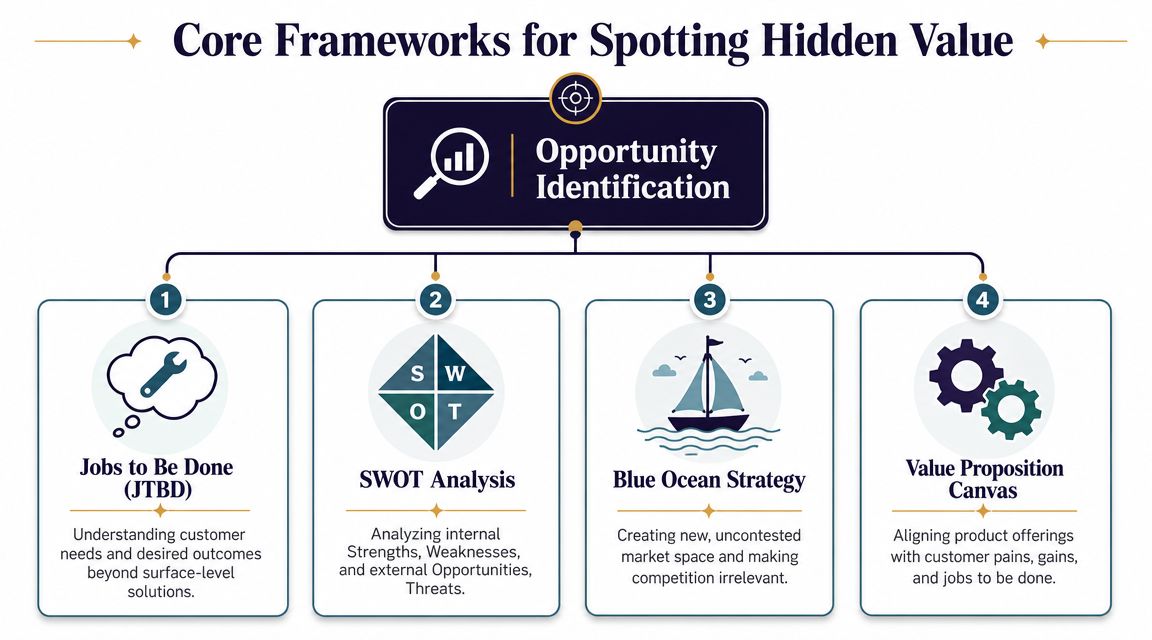
Core Frameworks for Spotting Hidden Value
The agencies that consistently win strong Upwork clients usually aren't guessing. They're using mental models, whether they call them that or not. Experience matters here. Research summarized in Small Business Economics argues that prior knowledge and experience are critical to opportunity identification, which is why seasoned operators can filter market signals faster than newer sellers can (review summary on RePEc).
A clean visual helps anchor these frameworks.
Read the job behind the job
The first useful framework is Jobs to Be Done. On Upwork, clients often ask for outputs when what they really want is a business result.
A client says they need a landing page. Maybe they do. But often the true job is validating demand, improving conversion, making paid traffic profitable, or giving a sales team something usable next week. If you only respond to the surface request, you sound like every other vendor. If you identify the true job, you can frame your proposal around outcomes, dependencies, and smarter scope.
That creates pricing power. It also filters out bad-fit clients fast. If a buyer wants a strategic outcome, they usually engage with strategic questions. If they only want a pair of hands at the cheapest rate, they usually don't.
Use pain, gaps, and differentiation together
The second and third frameworks are pain point analysis and gap analysis. These matter because a lot of Upwork posts are incomplete by design. Clients don't always know what to ask for. Your edge comes from seeing what is missing.
Look for gaps like these:
- Operational gaps: The client asks for execution but reveals no process, owner, or success metric.
- Capability gaps: The post combines strategy, implementation, analytics, and ongoing support into one role.
- Commercial gaps: The stated budget doesn't match the technical complexity or timeline.
These gaps aren't always reasons to walk away. Sometimes they're the opportunity. A vague request can hide a larger engagement if you can diagnose the underlying need and shape it into a sensible scope.
A fourth framework is value proposition fit. Ask whether your agency has a real advantage here. Not "can we do it," but "do we have a stronger angle than generalists?" On Upwork, generic capability loses. Narrow relevance wins.
Later in the buying cycle, this kind of thinking also makes proposals more persuasive because you're not pitching services. You're pitching an informed solution to a problem the client hasn't fully articulated yet.
For a short primer on the broader idea behind finding market needs, this overview from Harvard Business School on identifying market needs is useful.
A quick explainer can also help ground these models before applying them to platform work.
Reading the Signals on the Upwork Platform
Generic business advice says to find unmet needs. That's fine as a starting point. Upwork is different because the need is already partially visible. The key skill is reading the platform signals around that need before the window closes.
Recent guidance on digital opportunity discovery points out that in fast-moving markets, signals show up in live behavior, search patterns, online conversations, and platform shifts rather than static market maps. That's exactly how Upwork behaves, and it's why old advice about "finding a niche" often feels too slow for the platform environment (Product-Led Alliance on identifying market opportunity).
Client signals that save you from bad bids
Before looking at your proposal angle, read the client as carefully as the project.
Some signs usually point in the right direction:
- A clear hiring pattern: Clients who regularly hire and leave thoughtful feedback often know how to buy.
- Evidence of seriousness: A detailed history, coherent job posts, and normal communication usually beat dramatic budgets with no track record.
- Reasonable expectations: If the client's past work suggests they understand scope, revisions, and timelines, the chance of a healthy engagement goes up.
Weak signals matter too. A client who repeatedly posts broad requests and hires no one is telling you something. A history of poor feedback left for freelancers is another warning. So is language that suggests confusion about ownership, timeline, or decision rights.
The fastest way to improve proposal ROI is to reject more jobs before writing a single line.
Project signals that reveal commercial value
A vague post isn't always worthless, but specificity is usually a strong positive signal. Compare "Need help with website" to "Need Stripe integrated into a Webflow membership site with gated content and subscription logic." The second client may not write a better proposal brief, but they usually understand the problem better. That tends to produce cleaner sales conversations and fewer pricing battles.
Look for the signs beneath the words:
- Concrete systems mentioned: Webflow, Stripe, HubSpot, GA4, Shopify, Zapier, Meta Ads. Specific stack details usually mean a real project exists.
- Business context: Product launch, migration, funnel drop-off, team bottleneck, campaign deadline. Context makes urgency credible.
- Defined constraints: Existing assets, timeline windows, stakeholder limitations, or handoff requirements. Constraints mean the client is thinking operationally.
If your team relies on speed, job timing matters too. The first useful move isn't writing faster. It's seeing stronger opportunities sooner. Setting up faster Upwork job alerts helps reduce the lag between posting and review so your team spends its time on fresh, relevant jobs instead of stale ones.
Why timing changes the quality of opportunity identification
On Upwork, a good opportunity can degrade quickly. The client gets flooded. Better-fit competitors show up. The buyer mentally commits to a direction. That means opportunity identification isn't just pattern recognition. It's pattern recognition under time pressure.
Teams that win consistently build a habit of checking signal quality immediately, then moving on or leaning in without hesitation.
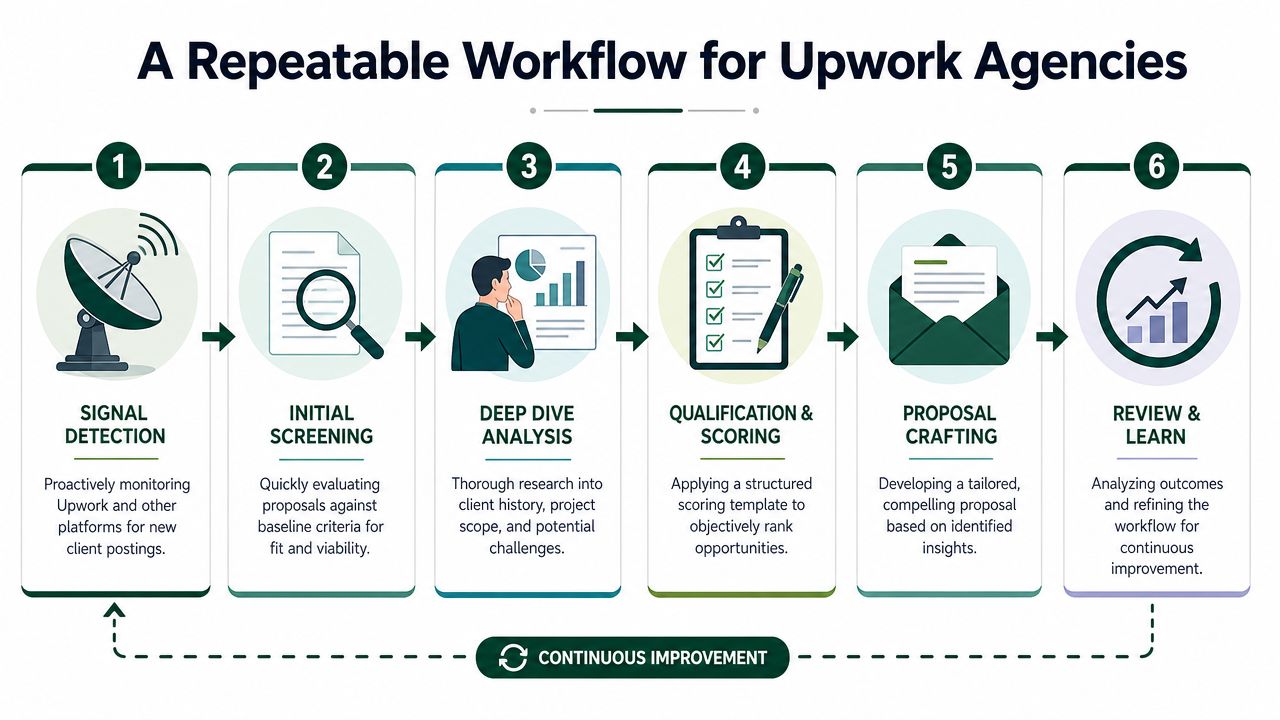
A Repeatable Workflow for Upwork Agencies
Agency owners often keep lead qualification in their own heads. That's fine until volume rises or someone else starts helping with outreach. Then quality gets inconsistent fast. The answer isn't more hustle. It's a workflow that turns judgment into process.
This visual captures the operating sequence.
Build the search layer properly
Most agencies sabotage themselves at the top of the funnel. Their saved searches are too broad, too crowded, or built around service labels instead of buying intent.
A better approach is to separate searches by commercial pattern:
- Core capability searches
These map directly to what you already sell well. Think "Klaviyo email flows," "HubSpot implementation," or "Webflow development" instead of generic words like "marketing" or "website." - Problem-led searches
These catch clients who describe pain rather than solution. Examples include migration, conversion drop, broken tracking, CRM cleanup, or handoff support. - Stack-combination searches
These often uncover premium opportunities because they imply complexity. A client using multiple systems usually needs integration and judgment, not just task execution.
Apply a five-minute screen
Once a job appears, your first pass should be fast and ruthless. Agencies waste a lot of time by doing deep research on leads that should have been discarded in under five minutes.
Use a short screen like this:
- Is this inside our narrow delivery zone? If the answer is "sort of," pass.
- Does the client sound clear enough to buy? Not polished. Clear.
- Is there evidence of a real project, not curiosity? Systems, deadlines, outcomes, existing assets.
- Can we explain a useful angle quickly? If you can't see a proposal hook, the job may not have enough substance.
- Would we still want this client after the first project? This question removes a surprising amount of bad work.
If a job survives the screen, then assign someone to research client history, likely stakeholders, and the probable project shape before any proposal gets drafted.
Turn tacit judgment into a team standard
The best workflows don't make everyone robotic. They make good judgment transferable. That means documenting examples of what to reject, what to escalate, and what deserves immediate action.
A practical internal checklist usually includes:
- Disqualifiers: Red-flag behaviors, unrealistic asks, or pricing mismatches.
- Priority triggers: Strong-fit tech stacks, recurring work patterns, or signs of growth-stage buying.
- Proposal guidance: Which questions to answer first, what proof to include, and when to lead with diagnosis instead of credentials.
A repeatable workflow doesn't reduce expertise. It protects expertise from being wasted on the wrong leads.
There is also a structural reason to work this way. Opportunity screening is stronger when treated like portfolio selection instead of a one-idea bet. Karl T. Ulrich describes this as innovation tournament logic: generate many options, then filter against explicit constraints like market size, differentiation, founder fit, and capital intensity. The same idea transfers well to agency lead selection on Upwork because it forces tradeoffs instead of gut-driven chasing (Karl T. Ulrich on opportunity identification).
For agency teams, the final step is review. Keep a simple record of what got screened in, what got pitched, what got replies, and which patterns keep producing qualified calls. That feedback loop matters because your market shifts, your positioning evolves, and the platform never stays still for long.
How to Score and Prioritize Your Opportunities
A lot of agencies already know how to find decent jobs. The bottleneck is choosing which ones deserve serious effort. That's where agencies often get emotional. They chase a recognizable brand, a flashy budget, or a project that sounds exciting, then ignore fit, timing, or delivery risk.
This is where a scoring model earns its keep. Guidance from Harvard Business School and similar sources points to a real gap in mainstream advice: people talk about how to find opportunities, but not enough about how to rank them once you've found them. The strongest opportunity isn't automatically the biggest unmet need. It's the one that fits your resources, expertise, and timing.
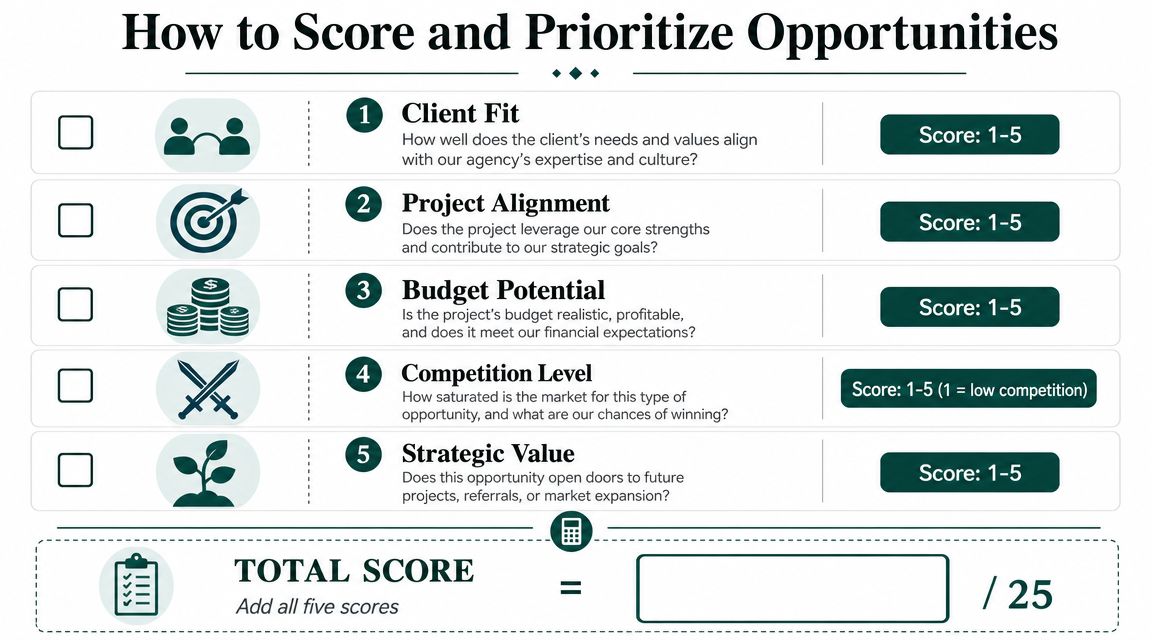
Use a simple score before you write
You don't need a complicated model. You need one that your team will implement. Score each lead on a one-to-five basis across a few criteria, then decide whether the total justifies proposal time.
A practical scoring set looks like this:
- Client fit
Does this buyer match the kind of client your agency serves well? Consider communication style, project maturity, and likely collaboration quality. - Project alignment
Is the work close to your core strengths, or does it pull you into custom edge cases and delivery sprawl? - Budget potential
Not just stated budget. Look at whether the project shape suggests profitable scope and whether the client appears to understand the value of specialist work. - Competition level
Some jobs attract a flood of interchangeable proposals. Others are niche enough that relevance matters more than volume. Score accordingly. - Strategic value
Could this lead into retainer work, implementation support, analytics, maintenance, additional channels, or referrals?
Make the score operational, not theoretical
The score only works if it changes behavior. Set thresholds. For example, your team might decline anything below a certain total, escalate jobs with a high strategic value score, and fast-track jobs that score well on fit plus urgency.
That removes a lot of avoidable debate. It also helps newer team members make decent decisions without waiting on the owner.
If you already use lead qualification in other channels, adapt that thinking here. This guide on how to qualify sales leads is useful because the same discipline applies on Upwork. You want a consistent way to separate interesting from investable.
Common scoring mistakes
Often, teams don't fail because the model is bad. They fail because they misuse it.
Watch for these traps:
- Overweighting budget: A one-off project with an attractive budget can still be a weak account.
- Ignoring founder or team fit: If the client is disorganized, adversarial, or unclear, that pain shows up later in delivery.
- Scoring after the proposal is half-written: At that point, the team is defending sunk effort, not evaluating opportunity.
- Treating all points as equal in every season: A small agency with limited bandwidth may need to prioritize fit and simplicity over expansion potential.
The score isn't there to prove a lead is good. It's there to stop you from justifying a lead you already want to chase.
Once the model is in place, review closed-won and closed-lost jobs against the score. You'll quickly see whether your team is overvaluing prestige, undervaluing repeatability, or missing the kinds of jobs that convert into stable accounts.
Automating Opportunity Discovery and Outreach
Manual opportunity identification works. It also hits a ceiling fast.
At low volume, an owner can scan the feed, qualify leads, write proposals, and still run delivery. At agency scale, that breaks. The work becomes repetitive, response time slows, and the people with the best judgment spend too much of their day doing filtering tasks that software can support.

What automation should actually do
Automation isn't useful just because it saves clicks. It's useful when it preserves your standards while increasing coverage and speed.
In practice, that means a tool should help with things like:
- Monitoring searches continuously: New jobs appear at awkward times. Machines don't care.
- Applying first-pass filters: Stack, niche, phrasing patterns, exclusions, and urgency markers.
- Supporting proposal prep: Pulling the right context together so humans start from a better draft, not a blank page.
- Handling fast follow-up: A strong lead can go cold if nobody replies quickly after the first client response.
Ulrich's innovation tournament analogy becomes practical. Instead of having humans inspect every option manually, automation lets you generate and filter a much larger pool of opportunities with explicit criteria. You still need human judgment at the point of positioning and closing. You just stop wasting that judgment on low-value scanning.
Where agencies should keep humans in the loop
Some owners swing too far and try to automate everything. That's usually a mistake. Keep people involved where nuance matters most:
- Final qualification: Especially for unusual or strategically important projects.
- Offer shaping: Good agencies don't just answer briefs. They reshape them.
- Sales calls and objection handling: Trust still gets built person to person.
- Learning from outcomes: Humans need to review what signals produced strong clients and weak ones.
One option in this category is Earlybird AI's Upwork lead automation workflow, which is designed to search for jobs, learn from user feedback on what to pursue, and support proposal and reply workflows on Upwork. That's the kind of use case where automation acts more like an always-on sales assistant than a replacement for agency judgment.
The payoff is focus. Senior people spend less time digging through mediocre jobs and more time improving positioning, refining offers, and closing the right accounts.
Start Building Your Client Pipeline Today
If your Upwork pipeline feels inconsistent, the problem usually isn't effort. It's selection.
Strong agencies don't grow by responding to more job posts. They grow by getting sharper at opportunity identification, reading platform signals quickly, and prioritizing the leads that match their strengths. Once that discipline is in place, proposals improve, sales conversations get easier, and the work you win gets more repeatable.
Start with one change. Tighten your saved searches. Add a five-minute screen. Score every lead before anyone writes a proposal. If your volume is already high, look at where automation can take over the repetitive parts without removing human judgment from the moments that matter.
The goal isn't to bid more efficiently. It's to stop acting like a bidder at all.
If you want a more systematic way to handle Upwork lead generation, Earlybird AI helps agencies automate job discovery, proposal drafting, and follow-up while keeping human input in the qualification and closing stages. It's a practical option for teams that want a steadier pipeline without adding more manual sales overhead.