
← Back To Blog
Request for Proposal Web Development: A Complete Guide
You're staring at three vendor proposals, and none of them seem to be answering the same question. One talks about design polish, another lists a CMS and a few integrations, and the third sends a neat price without explaining how the site will be maintained after launch. That's the normal failure mode for request for proposal web development, and it's why so many teams end up choosing on instinct instead of evidence.
A strong RFP changes that dynamic. It forces vendors to respond to the same outcomes, the same technical expectations, and the same commercial terms, so the comparison stops being a guessing game. It also saves your own team from the hidden drain of proposal work, which is one reason benchmark research found companies spend 23.8 hours on a single RFP on average and involve 7.3 staff members, while very large firms can spend 35.2 hours and need 28.2 days to submit one, according to MarketingProfs' RFP benchmark summary. Smaller firms with fewer than 100 employees still spend 15.2 hours and 4.2 days on average, which is exactly why vague documents create expensive chaos.
Why Most Web Development RFPs Fail Before They Start
The fastest way to wreck a web development procurement is to send vendors a wish list and call it a brief. I've seen teams ask for “a modern website,” “better UX,” and “more SEO performance,” then wonder why every proposal feels different enough to be useless. One agency proposes a branding refresh, another suggests a full technical rebuild, and a third assumes a content project. The buyer doesn't have three options, they have three separate interpretations.
That mismatch usually comes from missing outcomes, missing evaluation criteria, and missing post-launch expectations. When an RFP only describes features, vendors fill in the blanks with their own assumptions. When an RFP names the business result, the technical constraints, and the support model, vendors have to answer the same question in the same language.
Practical rule: if two proposals can't be compared line by line, the RFP wasn't specific enough.
This is also where the internal cost shows up. Procurement, marketing, operations, and IT all spend time reviewing answers that don't align, then stakeholders start negotiating against each other instead of against the vendor's actual approach. In practice, the most expensive part of a weak RFP isn't the agency fee. It's the rework after kickoff, when the team discovers the scope was never shared clearly enough to price or deliver.
A good request for proposal web development process doesn't start with vendor names. It starts with a document that makes ambiguity expensive for the vendor, not the buyer.
Defining Scope and Outcome-Based Requirements
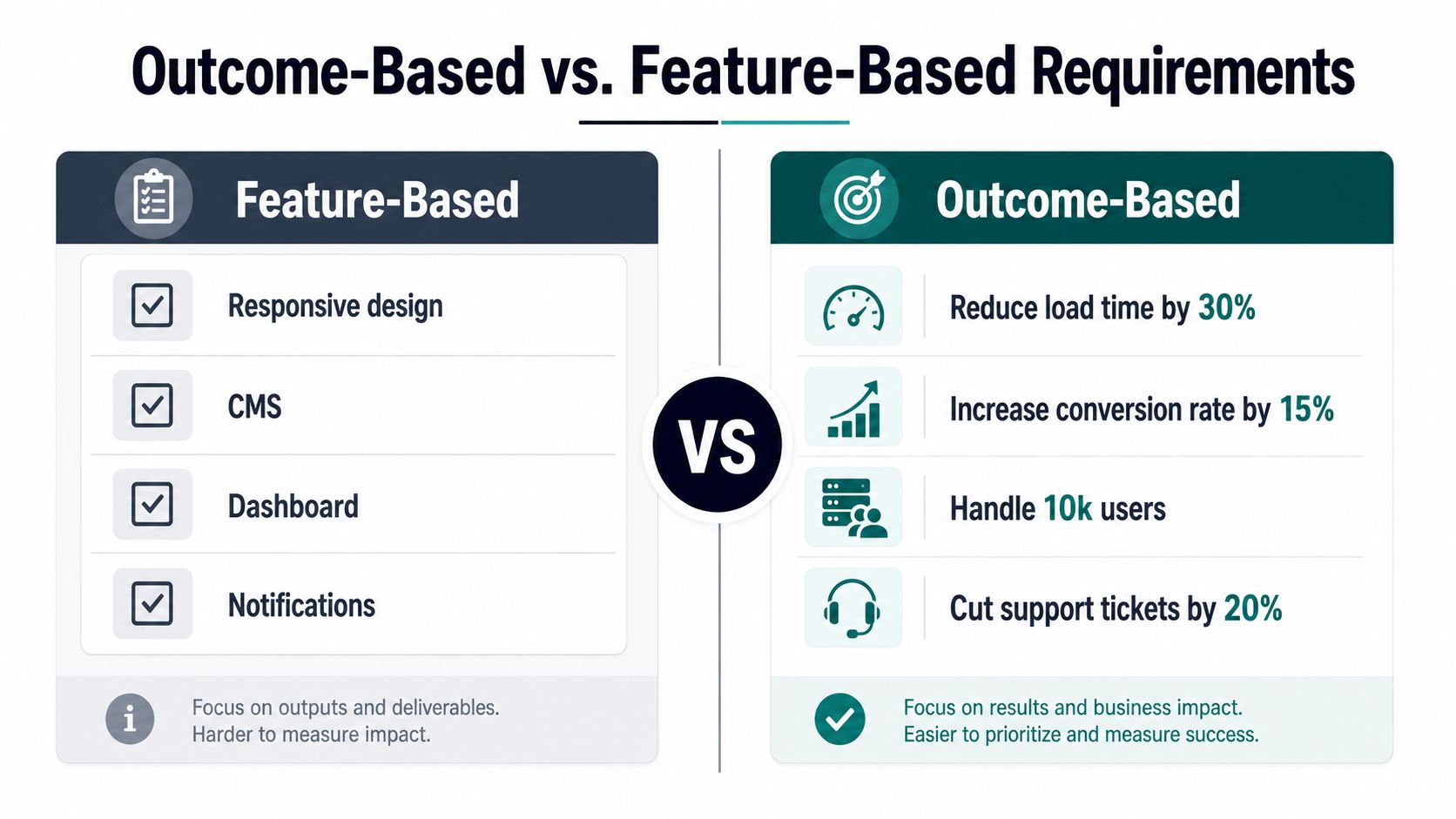
Outcome-based scoping is the difference between asking for “better design” and asking for a site that supports a specific business result. Vendors can respond to outcomes. They can't reliably price a vibe. The clearer the objective, the easier it is to compare proposals on substance instead of style.
Replace feature language with measurable intent
Weak requirements sound like this, “mobile-friendly pages, a CMS, and a cleaner homepage.” Those words don't tell a vendor what success looks like, what trade-offs matter, or what has to be preserved during the build. Stronger language sounds like, “the site must support a faster checkout flow, preserve the current content taxonomy during migration, and make analytics events visible to the internal team.”
That shift matters because newer guidance increasingly pushes teams to define outcomes, not features, and to use mirrored response formats so vendors can be compared consistently. A practical model is to create a must-have vs. nice-to-have matrix, then ask vendors to answer each requirement with a clear status, not a paragraph of marketing language. If you need a place to organize the contract language that underpins that process, find web design contracts alongside your RFP drafting notes so the commercial terms match the scope.
A good requirement tells a vendor what has to be true when the work is finished.
Scope the dependencies that break budgets later
The best RFPs call out integrations, content migration, data ownership, and third-party tools before the proposal stage. If the project depends on a CRM, marketing automation platform, search layer, or analytics setup, name it. If the current site has hundreds of pages, mixed media, or legacy URL patterns, say that too. Vendors need to know what's moving, what's staying, and what has to be rebuilt.
This is also where many teams forget to define the difference between baseline functionality and business-critical dependencies. A content editor workflow may look routine until it touches approvals, permissions, and multilingual publishing. A design requirement may look simple until it intersects with accessibility or server-side tracking. The more explicit the dependency map, the less room there is for bidder optimism.
For teams formalizing the discovery phase, the internal guide on requirement gathering methods is a useful companion when you're translating stakeholder input into something vendors can price.
Technical Requirements and Post-Launch Accountability
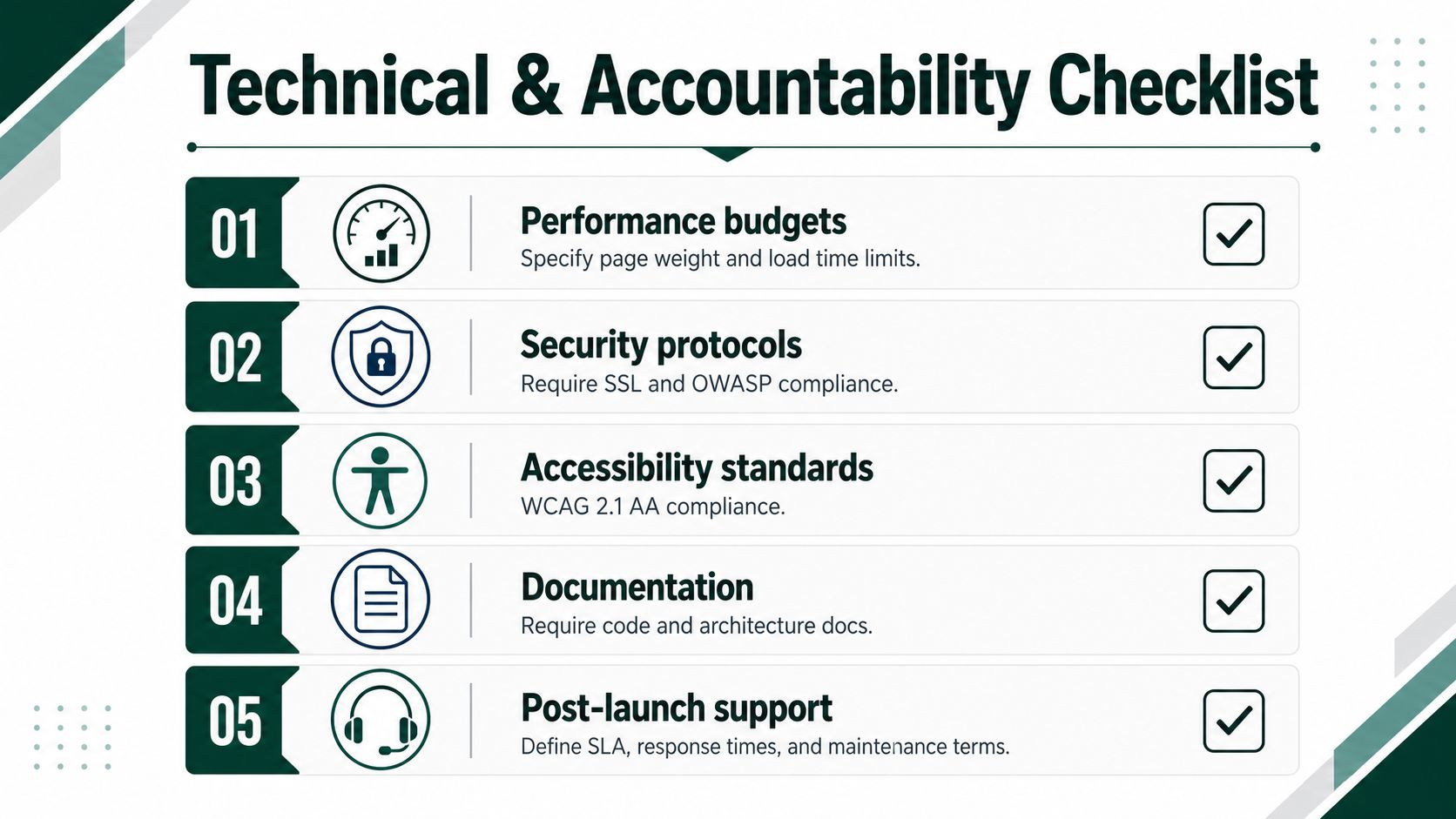
A site can look complete at launch and still fail in production. That usually happens when the RFP treats design, templates, and a few integration notes as the whole job. The risks show up later in performance, security, accessibility, documentation, and support, so those expectations need to be written into the request from the start. A 2026 technical requirement document template helps teams spell out those obligations in plain language instead of hiding them inside vague scope notes.
Name the technical mandates clearly
A strong document should specify what the vendor has to build for, not just what the site should look like. In practical terms, that means requirements such as semantic HTML, advanced schema markup, zero-trust security architecture, server-side analytics deployment, and WCAG 2.2 AA accessibility compliance when those needs are relevant to the project. Beck Digital's 2026 technical requirement document template is a useful reference point because it shows how technical mandates can be stated directly instead of buried in vague language.
The reason this matters is simple. If you only ask for “secure” or “accessible,” you are letting vendors define their own target. If you specify the compliance bar, the analytics model, and the data architecture expectations, the answers become comparable. You also reduce the chance that a team submits a low-cost bid by excluding the work you care about most.
Write post-launch obligations into the RFP
Launch is only the handoff point. Mature buyers write the proposal around ownership after launch, because that is where many projects get expensive. The RFP should explicitly cover warranty expectations, monitoring, support response, accessibility maintenance, hosting responsibilities, and ongoing optimization. The evaluation question is not just whether they can build it, but whether they will stay accountable for it.
That gap shows up in real projects every time a site needs structured data maintenance, content updates, security patches, or performance tuning. If you expect escalation paths, response windows, and a defined support model, require those terms in the bid. If the commercial structure will later be split between delivery and support, the discussion around master service agreement vs statement of work helps teams keep contract language aligned with operational accountability.
Budget Structure and Timeline Mechanics
Budget clarity is where a lot of otherwise good RFPs collapse. Buyers ask for “a quote,” vendors respond with very different assumptions, and then everyone pretends those numbers are comparable. They usually aren't. A well-built RFP separates the build from the ongoing relationship so the commercial picture is visible from the start.
Split initial build costs from ongoing support
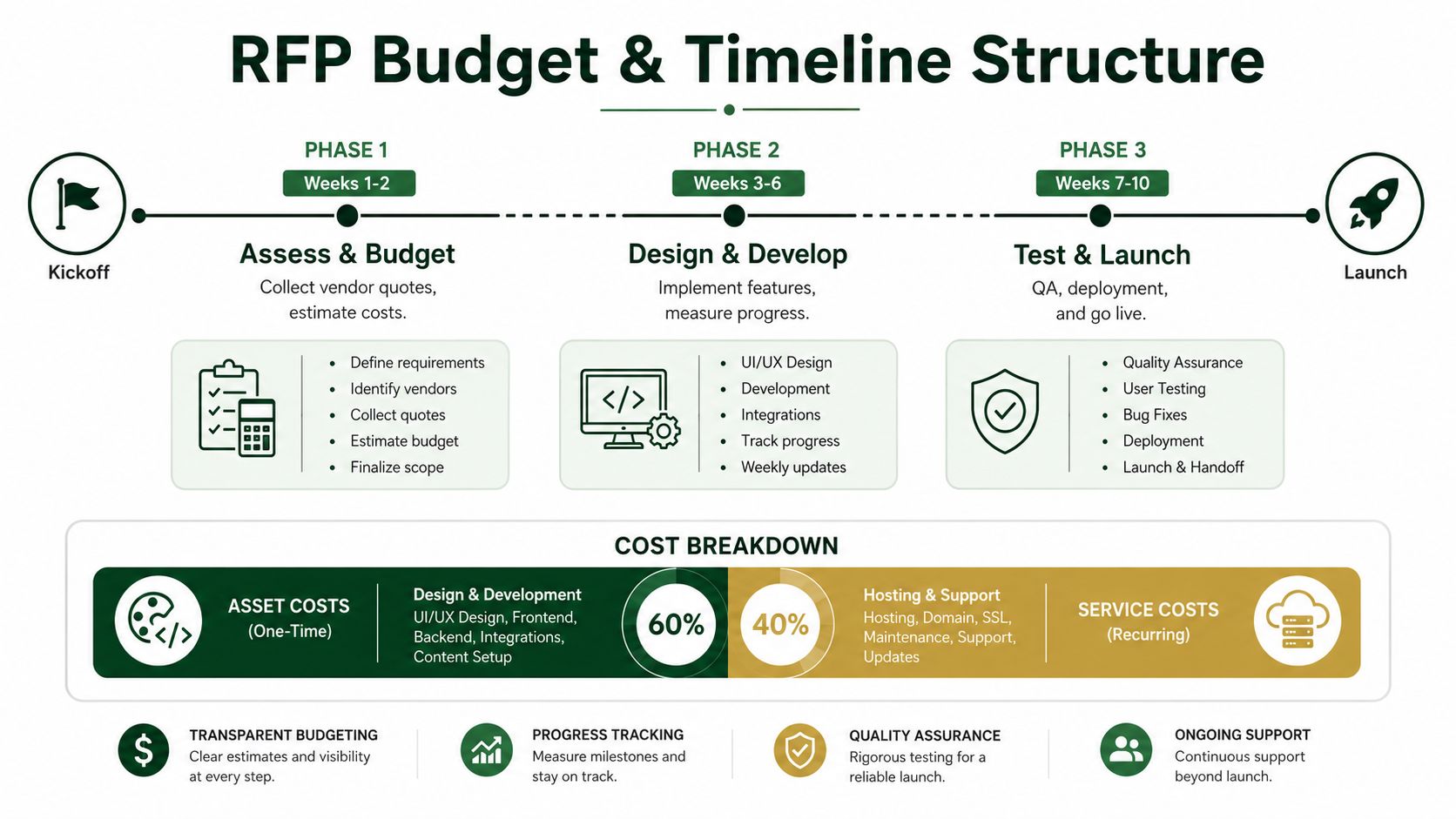
One of the cleanest approaches is to divide the budget into Assets (Parts) & Service (Labor), then add an Ongoing Support / Retainer section for post-launch work. New Media Campaigns' website RFP guidance makes that separation explicit, and it reflects how experienced teams already think about website procurement. Design files, development work, content migration, hosting, maintenance, and support are not the same thing, even if one vendor can provide all of them.
When everything gets lumped into a single number, buyers lose the ability to see where the money is going. That creates trouble later when a change request appears or support expectations turn into contract friction. Itemized pricing also helps surface whether a vendor is investing in planning, QA, documentation, or just trying to close the deal quickly.
Make the timeline mechanical, not aspirational
A serious RFP should specify the proposal deadline, milestone timing, and when vendors will hear back if they're selected. One template from One Nine's website development RFP guidance calls out both the response deadline and the decision notification schedule, which is the right mindset. Vendors should know when questions are due, when finalists are notified, and when kickoff is expected.
Short timelines aren't a strategy. They just push hidden work into the vendor's margin or your own review queue.
The mistake I see most often is a timeline that gives the buyer weeks to decide and the vendor days to respond. That doesn't produce a better proposal, it produces thinner thinking. Build enough time for questions, clarifications, and internal review, then keep the schedule tight enough that the project doesn't drift into a half-built holding pattern.
Evaluation Criteria and Vendor Scoring Framework
If the RFP doesn't define how you'll score responses, the loudest opinion in the room wins. That's not procurement, that's a committee vibe check. A clear scoring framework keeps the conversation anchored to the same criteria, which is the only way to compare proposals fairly when multiple stakeholders are involved.
Build the scoring model before the proposals arrive
A useful framework usually includes technical approach, team qualifications, project management method, timeline realism, and post-launch support. Urban Insight's model RFP template is helpful because it shows how detailed evaluation sections, minimum qualifications, submission requirements, and scoring criteria make the process less subjective. If every proposal has to answer the same prompts, the review team can judge substance instead of polish.
A practical scoring model can look like this:
Evaluation CriterionSuggested WeightWhat to AssessTechnical approachHighWhether the vendor understands the scope, integrations, and risk pointsTeam qualificationsMediumRelevant experience, roles, and depth of the delivery teamProject managementMediumCommunication rhythm, process clarity, and change controlTimeline feasibilityHighWhether the proposed schedule is credible and sequenced wellPost-launch supportHighWarranty, maintenance, monitoring, and optimization commitments
Use presentations and references to test reality
Written proposals rarely tell the whole story. A polished deck can hide weak planning, while a plain response can come from a team that's excellent. That's why presentations and reference checks belong in the scoring process, not as an afterthought. If you're sourcing a partner for performance-led work, the internal article on best conversion rate optimisation UK firms is a good reminder that the right team is the one that can tie delivery decisions to measurable business outcomes.
The best vendor isn't always the most persuasive writer. It's the team that can explain trade-offs without hand-waving.
Minimum qualifications should be used early, before scoring starts in earnest. If a bidder can't meet the required scope, timeline, or support expectations, don't burn committee time on them. The cleaner the intake filter, the easier the final decision gets.
How Agencies and Freelancers Should Prepare Winning Responses
The best proposals read like direct answers to the buyer's actual concerns. The worst ones read like recycled agency brochures with a price attached. Buyers can spot the difference quickly, and they usually trust the team that makes their job easier.
Mirror the structure and language of the RFP
If the buyer asked for outcomes, answer with outcomes. If they asked for technical assumptions, answer with technical assumptions. If they want post-launch support, don't bury that in a footnote. The more closely your response maps to the RFP sections, the easier it is for evaluators to compare you against competing bids.
That's also where many teams lose points unnecessarily. They overinvest in generic introductions, under-explain the riskiest parts of the project, and leave evaluation questions half answered. A tighter approach is to lead with the buyer's stated goal, then show exactly how your process addresses it. For teams refining proposal writing, the internal guide on web development proposals is a good companion because it focuses on how evaluators read these documents.
Prove capability instead of claiming it
Claims about “expertise” don't carry much weight unless they're attached to relevant work, team structure, or a clear method. If the project involves accessibility, show how you handle it. If it depends on analytics or support, explain the operating model. If a requirement doesn't fit your process, say so early rather than promising something you can't sustain.
That honesty usually helps more than overpromising. Buyers would rather hear a vendor decline a weak fit than discover the gap halfway through delivery. Keep your clarification questions specific, respond on time, and use the submission window to remove ambiguity rather than create more of it.
One practical option for teams that need to manage proposal volume across multiple opportunities is Earlybird AI, which automates Upwork job finding, proposal drafting, replies, and follow-up workflows. It's relevant here because it sits in the same operational world as proposal response management, where speed and consistency matter.
Your Complete RFP Template and Implementation Checklist
A usable web development RFP doesn't need to be bloated. It needs to be complete, specific, and easy to evaluate. The document should give vendors enough context to price accurately, enough structure to answer consistently, and enough commercial detail to make the next step obvious.
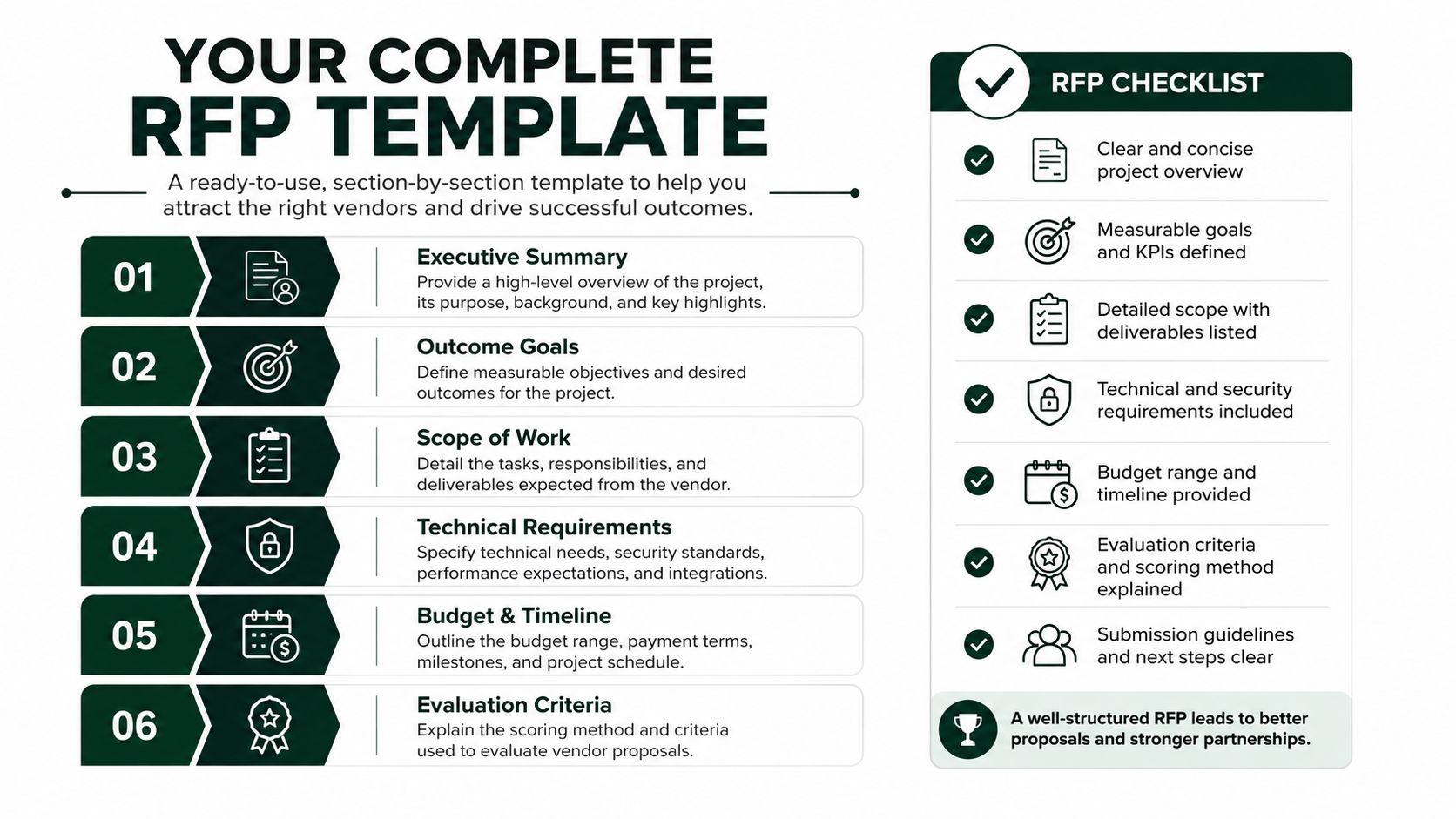
A practical section-by-section outline
Use this structure as the backbone of the document:
- Executive Summary. State the business problem, the project's purpose, and the decision context.
- Outcome Goals. Define the measurable results or operational changes you want from the project.
- Scope of Work. Describe the pages, functionality, integrations, migrations, and dependencies.
- Technical Requirements. List the performance, accessibility, security, analytics, and support expectations.
- Budget and Timeline. Separate build costs, service costs, and the response and decision schedule.
- Evaluation Criteria. Explain how proposals will be scored and what minimum qualifications apply.
A strong internal workflow matters as much as the RFP itself. Make sure stakeholders agree on the scope before release, define who answers vendor questions, and decide in advance whether addenda will be issued if clarifications change the bid environment. If the document changes materially, extend the deadline rather than forcing vendors to guess.
The final check is simple. If a vendor could read the document and know what to build, what to price, how to support it, and how they'll be judged, the RFP is doing its job. If not, it still needs work.
If you're building or tightening a request for proposal web development process, Earlybird AI can help you manage the response side of opportunity flow while you focus on the brief itself. Visit Earlybird AI to see how its proposal drafting, reply automation, and follow-up workflow can support a faster, more disciplined sales motion.