
← Back To Blog
A Guide to Running a Digital Marketing Agency in 2026

So, you're great at marketing and ready to turn that skill into a business. That’s the first step. But running a successful digital marketing agency isn't just about being a marketing pro; it's about building a real, profitable company from the ground up.
This means shifting your focus from just doing the work to creating systems for finding and serving the right clients. It's about positioning yourself as a high-value expert from day one, not just another freelancer with a website.
Laying the Foundation for a Profitable Agency
Let's be real: the biggest mistake new agency owners make is trying to be everything to everyone. They see the allure of big creative campaigns and think that offering a huge menu of services is the path to success. It's not. That’s the fast track to burnout and commoditization.
The most successful agencies are built on a solid, strategic foundation. Before you even think about your first proposal, you need to resist that "full-service" temptation. Your real first step is to get hyper-specific and define your niche. This is your secret weapon. Instead of just offering SEO, you become the agency for B2B SaaS companies trying to rank for high-intent keywords. Don't just do "social media"—specialize in running targeted ad campaigns for local e-commerce brands.
Specializing is how you stop competing on price and start competing on expertise. It lets you build repeatable processes, deliver incredible results, and charge a premium for it. You’re no longer a generalist; you're the go-to expert.
Carving Out Your Market Share
The good news? The market is absolutely massive. We’re talking projections of $667.6 billion in 2024, on its way to over $800 billion by 2026. With a compound annual growth rate (CAGR) of 9%, it’s clear that businesses are desperate to invest in their online presence.
This doesn't mean you should cast a wide net. It means even a tiny, well-defined slice of that pie can make you incredibly successful. Your job is to find a profitable corner of the market you can completely own.
Think about it in these terms:
- Industry-Specific: Could you become the undisputed marketing expert for dental practices, law firms, or luxury real estate agents?
- Service-Specific: What if you were known as the absolute best at technical SEO audits, Google Ads for e-commerce, or HubSpot automation?
- Audience-Specific: You could also focus on businesses that serve a unique customer base, like companies targeting new parents or high-net-worth retirees.
Structuring Your Services and Pricing
Once you know who you’re serving, your service offerings should snap into place. Get specific. "Content Creation" is vague and cheap. "Monthly Blog Content Packages for B2B Tech Startups" is specific and valuable. It implies a clear system with defined deliverables, like a set number of articles, keyword research, and performance reports.
Pricing is the next hurdle where most new agencies stumble. The temptation to undercharge just to land those first few clients is huge, but it sets a dangerous precedent. You need a pricing model that reflects the real value you deliver and guarantees healthy profit margins from the very beginning.
Here are the most common models:
- Project-Based Fees: A flat fee for a project with a clear start and end, like a website redesign or a one-off campaign launch. This is perfect for clients who need a specific outcome without a long-term commitment.
- Monthly Retainers: This is the bedrock of agency stability. A recurring monthly fee for ongoing work like SEO, content marketing, or ad management. It creates predictable revenue for you and consistent results for the client.
- Value-Based Pricing: This is the top tier. Your fee is tied directly to the business results and ROI you generate. It's harder to sell but is by far the most profitable model once you can prove your impact.
Nailing these core elements—your niche, your services, and your pricing—is what separates a struggling freelancer from a scalable, profitable agency. When you get this right, you're building a business designed for growth and have a much clearer picture of how marketing agencies make money.
Automating Your Client Acquisition Engine
If you’re running an agency, you know the grind. The constant hunt for new leads, the hours spent writing custom proposals, the messy spreadsheet you use to track follow-ups… it’s a recipe for burnout. This manual, inconsistent effort leads to that dreaded feast-or-famine cycle, a major bottleneck that keeps you from closing deals and doing the work you’re actually good at.
The way out is to stop chasing clients one by one and start building a predictable, automated system to bring them to you. Imagine an engine that’s always running in the background, finding the best projects, firing off personalized proposals in minutes, and nurturing conversations until a meeting is on your calendar. This isn't science fiction; it's how smart agencies build a steady, reliable pipeline of qualified leads.
Ditching the Manual Grind
The old way of finding clients on platforms like Upwork just doesn't cut it anymore. By the time you spot a good project, digest the details, and write a thoughtful proposal, you're already late to the party. The client is buried under a mountain of applications, and your hard work gets lost. If you want to win, you have to be first.
Your edge comes from two things: speed and personalization. Data shows that being one of the very first to apply gives you a massive advantage in getting a reply. But speed alone is just spam. The real magic happens when you combine that speed with a proposal that feels like it was written specifically for that client.
Your job is no longer to be a proposal writer, churning out 10 applications a day. Your job is to be an engine builder—to create a system that can intelligently apply to 50, getting you to the front of the line every single time.
Before you can build this engine, you need a solid foundation. You have to know exactly who you serve, what you sell, and how you price it. These three pillars—niche, services, and pricing—are what fuel the logic of your automation.
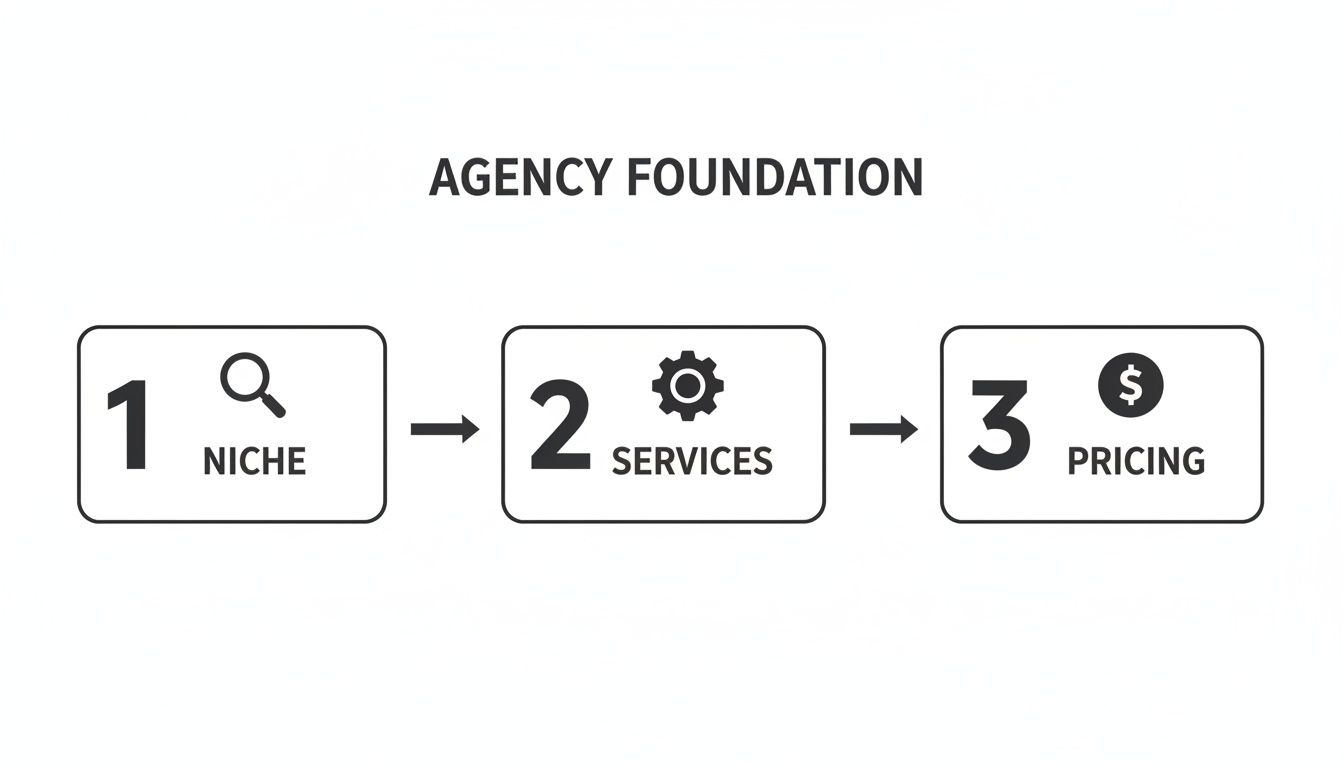
Without this clarity, automation is impossible. Your system needs to know what a great client looks like, what services to offer them, and at what price point.
Your Automated Upwork Playbook
Upwork is a goldmine for high-quality leads, but it's fiercely competitive. You need a system. Here’s a breakdown of how to build an automated engine that consistently pulls in projects from the platform.
Pinpoint Your Ideal Project DNA
First, your system needs to know what a "perfect" project looks like for your agency. This goes way beyond basic keywords. You need to define the complete DNA of an ideal opportunity.
- Client History & Budget: Filter for clients who have a proven track record of spending on the platform and consistently leave positive feedback.
- Project Specifics: Use negative keywords to automatically reject projects you don’t want. For example, if you’re a high-end SEO agency, you might filter out terms like "cheap," "logo design," or "entry-level."
- Client Details: Target specific geographic locations or focus on clients who post in a language your team is fluent in.
Prepare Hyper-Personalized Templates
The goal here isn't to send a generic, one-size-fits-all proposal. Instead, you'll create a library of proposal templates that are about 80% complete. The remaining 20% is where the magic happens. Modern AI-powered tools can scan a new job post and instantly fill in the blanks with hyper-personalized details like the client’s name, their stated goals, and the specific problems they mentioned.
The result is a proposal that feels completely custom but is generated and ready to send in seconds.
Automate and Follow Up
This is where your engine truly comes to life. With a dedicated automation platform, you can set your system to constantly scan Upwork for new jobs that match your ideal project DNA. The moment a match is found, it submits your hyper-personalized proposal—often within minutes of the job being posted. We’ve seen agencies using this exact method double their reply rates.
But don't stop at the first message. Once a client responds, your system can take over with automated follow-ups, gently nudging the conversation forward and guiding them to book a discovery call right in your calendar. To get a better handle on the strategy behind this, it’s worth reading up on what sales automation is and how these principles apply directly to an agency model.
By taking these tedious, repetitive tasks off your plate, you’re free to focus on what actually grows the business: talking to warm leads, fine-tuning strategy, and making sure your team is delivering incredible work. Client acquisition is no longer a daily chore; it’s a predictable, scalable machine that runs itself.
Building Scalable Delivery Systems and Workflows
Landing that new client feels great, but the real test is delivering results, month after month. In the beginning, you can get by with custom, hands-on work for one or two clients. But that approach completely falls apart the second you try to scale. If you want to grow, you have to move from frantic, one-off efforts to structured, repeatable delivery systems.
This is your agency’s operational backbone. It's what ensures every client gets the same high-quality service, no matter who on your team is handling the work. Without these systems, you’re not really building an agency—you're just creating a more stressful freelance job for yourself.

Crafting a Seamless Onboarding Experience
The moment a client signs your contract, the clock starts. Your first interactions will set the tone for the entire relationship. A messy, confusing onboarding process immediately plants seeds of doubt. On the other hand, a smooth, professional experience proves they made the right choice and builds instant trust.
Your job here is to make the client feel like they're in capable hands. This is your first real chance to show them you’re not just creative, but also incredibly organized.
A rock-solid onboarding process usually involves a few key pieces:
- The Welcome Packet: Put together a polished document that outlines what happens next, introduces their main point of contact, and explains how to access any shared tools like a Slack channel or project management board.
- The Kickoff Call Agenda: Never wing the first call. Send an agenda ahead of time covering project goals, KPIs, and a checklist of any access you’ll need (like Google Analytics or ad accounts). This shows you respect their time.
- An Information-Gathering Questionnaire: To avoid a storm of back-and-forth emails, create a detailed form to collect everything you need upfront. Think brand guidelines, target audience details, competitor info, and past marketing efforts.
A standardized onboarding process isn't just about impressing clients. It's a system that drastically cuts down on administrative setup time, freeing up your team to jump straight into strategy and execution.
Standardizing Your Core Service Workflows
Once onboarding is done, the real work begins. If you want to deliver consistent results for 5, 10, or 20 clients at once, you have to standardize how you execute your services. This means creating a repeatable playbook for everything you offer, from SEO to content marketing to PPC management.
Think of it like a recipe at a high-end restaurant. The head chef has a proven, documented process for every dish. This guarantees quality and allows the entire kitchen staff to produce the same excellent result, every single time. Your service workflows are your agency's recipes for success.
For instance, a standardized monthly SEO workflow could be structured by weekly focuses:
- Week 1: Technical Check-up & Fixes. Kick off the month by running a full site crawl with your favorite tools. You're looking for broken links, slow pages, and other technical gremlins to prioritize and fix.
- Week 2: On-Page Optimization. Dive into keyword research for a batch of target pages. From there, you'll optimize meta titles, descriptions, and refine the on-page content to align with your targets.
- Week 3: Content & Authority Building. This is where you execute the content plan. Publish that month's blog post and start targeted outreach to earn valuable backlink opportunities.
- Week 4: Reporting & Strategy. Compile all the performance data into a clear, concise client report. Analyze what worked, what didn’t, and use those insights to map out your priorities for the upcoming month.
This kind of structured approach is what separates a professional agency from a chaotic group of freelancers. It ensures nothing gets missed, helps new hires get up to speed quickly, and makes managing a growing client roster feel controlled and predictable. This is the operational discipline that turns your services from a cost into a clear, reliable investment for your clients.
Hiring Talent and Scaling Your Team
As your client list grows, you're going to hit a wall. It’s inevitable. There are only so many hours in a day, and trying to juggle strategy, client work, sales, and reporting by yourself is the fastest way to burn out.
Real growth isn't about working harder—it's about building a team that can execute your vision at scale. The big shift is going from a hands-on-keyboard operator to a leader. It’s a completely different skillset, focused on finding, managing, and empowering other talented people. You simply can't do it all, and if you want to grow past a handful of clients, you shouldn't have to.
Finding Your First Hires
The good news is you’re not fishing in an empty pond. The talent pool for digital marketing is deep and getting deeper. The Bureau of Labor Statistics projects that demand for marketing pros will jump 10% by 2026, which is faster than most other jobs. Digital marketing skills are also pegged as some of the most valuable for 2025. You can dig into more of the data on this trend over at WordStream's digital marketing statistics page.
Your first hire is a massive decision, and my advice is almost always the same: start with freelancers or contractors. It gives you the flexibility to ramp up your delivery power without the financial weight of full-time salaries and benefits.
Here’s how you can think about bringing on your first team members:
- Project-Based Freelancers: Perfect for one-off tasks. Need a quick website audit or a set of ad creatives for a new campaign? A platform like Upwork is gold for finding specialists for these short-term gigs.
- Retainer-Based Contractors: When you have ongoing work, a contractor on a monthly retainer provides much-needed consistency. This is a great fit for roles like a content writer or a PPC manager who can take over a few client accounts.
- White-Label Partners: This is a smart shortcut to expanding your services. Partnering with another agency that specializes in something you don't—like web development or complex SEO—lets you sell that service immediately, with them doing the work behind the scenes.
Creating Effective Multi-User Workflows
Hiring people is just step one. The real magic happens when you integrate them into a smooth, efficient system that lets you scale. Once you have multiple specialists working on different client accounts, things can get chaotic fast without clear processes. This is especially true if you're managing several freelancers through a platform like Upwork.
The trick is to build workflows that are simple, repeatable, and don't rely on one specific tool. Everyone on the team needs to know exactly what they’re responsible for and how their piece of the puzzle fits into the bigger client strategy.
Your goal isn't just to delegate tasks, but to delegate outcomes. A well-defined workflow empowers your team to take full ownership of their work, which frees you up to focus on strategy and client relationships.
For example, here’s what a practical content creation workflow looks like with a distributed team:
You, as the Strategist, map out the monthly content topics and keywords for a client. You put this brief into a project management tool like Asana or Trello. The Writer gets a notification, writes the draft, and submits it for review. The Editor then polishes it for quality and tone before a Virtual Assistant takes the final piece, uploads it to the client’s WordPress, formats it, and schedules it to go live.
This clear hand-off system creates consistency and efficiency, no matter where your team members are located.
Augmenting Human Talent with Automation
Scaling your team doesn't always mean adding more headcount. Smart automation can be a force multiplier, giving a small team the power to handle a much larger workload. By automating repetitive admin and sales tasks, you free up your people to do what they do best: creative, strategic work that clients pay for.
For instance, instead of hiring a full-time salesperson to hunt for leads and write proposals, you could use a tool like Earlybird AI. It can automatically find ideal projects on platforms like Upwork, write surprisingly personalized pitches, and even handle the follow-ups. This keeps your sales pipeline full while your delivery team stays completely focused on client results.
Using AI in Your Agency Safely and Effectively
Let's be real: AI is no longer a 'nice to have' in the agency world. It’s become a core part of how smart agencies get ahead and stay competitive. But before you dive in, we have to talk about safety. A wrong move here can put your agency, and more importantly, your clients' accounts, in serious jeopardy.

There’s a world of difference between a dumb "bot" and intelligent automation. The market is full of cheap tools that use risky tactics like data scraping or spammy outreach—the kind of stuff that gets accounts flagged and banned. Intelligent automation, on the other hand, is designed to mimic actual human behavior. It works within platform rules, letting you scale up your efforts without sending up red flags. This is the only way to build a sustainable process around AI.
What “Safe” AI Automation Actually Looks Like
True AI platforms aren’t just about speed; they’re built on a foundation of security. When you’re evaluating any automation tool, especially for something as critical as outreach on Upwork, there are a few non-negotiables. These are the details that separate a game-changing asset from a ticking time bomb.
From my experience, any tool you use must have these features:
- Clean Regional IPs: The system absolutely must use residential, non-datacenter IP addresses that match your actual location. This makes the AI's activity look exactly like your own.
- No Password Storage: A secure platform will never ask for or store your login credentials. Period. It should use browser-based authentication (like cookies) just like you do when you log in yourself.
- Human-like Variability: People don't click at the exact same interval every single time. A safe AI tool knows this and builds in slight, random delays and variations to its actions. This avoids the predictable patterns that platforms are built to detect.
The goal of safe AI isn't to replace you. It's to replicate what you do at scale. Think of it as an extension of yourself that follows the same rules, just much, much faster.
Turning an Expense Into an Advantage
When you get AI right, it completely changes your agency's financial picture. The most obvious win is in your cost-per-lead (CPL) and overall client acquisition spending. We're seeing intelligent automation totally reshape how agencies find new business, boosting output while slashing costs.
For instance, a WSI case study showed that AI-powered segmentation and nurturing cut the Cost Per Lead by 34% for B2B clients. With 92% of businesses planning to invest in generative AI and a market growing at a 26.7% CAGR (according to HubSpot), agencies that get on board now are building a serious competitive advantage.
This isn’t just about saving a few bucks. It’s about freeing up your team’s time—your most valuable asset—from tedious, repetitive work so they can focus on strategy, creativity, and client relationships.
Practical Ways to Use AI in Your Agency
AI’s usefulness goes way beyond just finding leads. You can weave it into almost every corner of your operations, turning manual bottlenecks into slick, automated workflows. It's especially powerful for writing proposals, which can be a massive time-drain. You can see this in action by checking out this list of the best AI tools for proposal writing.
Here are a few ways we’re seeing agencies put AI to work right now:
- Hyper-Personalized Outreach: The AI can read a client's job post or website, then instantly draft a proposal that speaks directly to their needs, goals, and even mimics their company's tone of voice.
- Intelligent Lead Filtering: Forget scrolling through hundreds of projects. You can train an AI to find and flag only the opportunities that fit your ideal client profile, saving your team hours every single week.
- Automated Reporting: AI tools can plug into Google Analytics, pull the most important KPIs, and generate a solid first draft of a client report, often highlighting key trends and insights for you.
By adopting AI with a safety-first mindset, you’re doing more than just making your agency run a little smoother. You’re building a smarter, more scalable, and more profitable business that can compete with anyone.
Tackling the Big Questions for New Agency Owners
Starting a digital marketing agency is one thing; running it profitably is another. You're going to hit roadblocks and face questions that feel impossible to answer. Let's walk through some of the most common challenges you'll face and how to think through them like a seasoned pro.
How Should I Price My Services?
Figuring out what to charge is often the first major hurdle. If you price too low, you'll end up with nightmare clients and burn yourself out. Price too high, and you might not get any bites. There’s no magic number, but you can start with a model that fits where you are right now.
Most agencies lean on one of three core pricing structures:
- Project-Based: This is your classic one-and-done deal. You charge a flat fee for a specific project with a clear start and end, like a website audit or a three-month social media campaign launch. It's simple, easy for clients to approve, and perfect for getting your first few wins on the board.
- Monthly Retainer: This is the holy grail for agency cash flow. Your client pays a set fee every single month for ongoing work—think SEO, content creation, or ad management. This model gives you predictable revenue and lets you build a real, long-term strategy for your client.
- Value-Based: This is the expert-level move. Instead of billing for hours or tasks, you tie your fee directly to the results you deliver. This could be a percentage of revenue from an e-commerce campaign or a bonus for hitting a specific lead goal. You need serious confidence and a solid track record for this, but the upside is huge.
The price you set on day one is not your price forever. Once you have solid case studies and can confidently point to the ROI you generate, it's time to raise your rates. Your goal is to get paid for the value you create, not just the hours you put in.
When Is It Time to Hire? Employee vs. Freelancer
You can only wear all the hats for so long. As you bring on more clients, you’ll quickly find there aren't enough hours in the day. Deciding between a freelancer and your first full-time employee is a make-or-break moment for your agency.
For most, starting with freelancers is the smart play. It keeps your overhead low and gives you incredible flexibility. Need a top-tier Google Ads specialist for one client? You can hire one on contract without committing to a salary and benefits. Think of freelancers as your on-demand special ops team.
A full-time employee, however, is an investment in your agency's core. They become part of your culture, learn your processes inside and out, and can grow with the business. The right time to make that first hire is when you have consistent revenue and a steady stream of work that needs more than 20-30 hours a week to manage. If you're spending more time managing projects than doing deep work, it's time.
How Do I Actually Prove My Worth to Clients?
If you can't prove your value, you're just an expense waiting to be cut. Clients pay for results, not effort. Measuring and communicating Return on Investment (ROI) isn't just a nice-to-have; it's how you keep clients happy and paying you for the long haul.
It all starts with setting the right Key Performance Indicators (KPIs) from day one. Ditch the vanity metrics like social media impressions or likes. You need to track the numbers that matter to the client's bank account.
Depending on your service, you should be laser-focused on metrics like these:
- SEO: Track organic traffic, sure, but more importantly, focus on keyword rankings for money-making terms and the actual number of leads or sales coming from search.
- PPC: Go beyond Cost Per Click (CPC) and Click-Through Rate (CTR). The metric that truly matters is Return on Ad Spend (ROAS). For every $1 they spend, how many dollars did you make them?
- Content Marketing: Don't just count blog posts. Measure how your content generates leads through gated downloads, how long people stay on the page, and which articles are contributing to closed deals.
Package this data into a simple report that tells a story. Explain what the numbers mean, celebrate the wins, and be upfront about what you're adjusting for the next month. This level of transparency builds incredible trust and positions your agency as a true partner in their growth.
Are you tired of the manual grind of finding clients on Upwork? Earlybird AI acts as your always-on sales team, automatically finding ideal projects and crafting hyper-personalized proposals to get you noticed. Stop competing and start winning. Discover how our members double their reply rates and land more clients at https://myearlybird.ai.