
← Back To Blog
Scaling Freelance Business: Scaling Your Freelance
You're probably in the phase where the business looks healthy from the outside and feels fragile on the inside. Clients keep coming in, referrals still work, your calendar is packed, and revenue is better than it's ever been. But every new project creates a new problem. You're doing sales, delivery, admin, revisions, hiring, and client therapy. Growth starts to feel like punishment.
That's the wall most freelancers hit. The work proves there's demand, but the business still depends on one person. That's why scaling freelance business isn't just about getting busier or adding help. It's about redesigning how work is sold, delivered, and renewed so the business can support more people than just you.
From Overwhelmed Freelancer to Agency Founder
The first shift is mental. A freelancer gets paid for doing the work. An agency owner gets paid for building a machine that helps other people do the work well.
That sounds obvious until you try it. It's common to hire too early, too loosely, and for the wrong reason. They feel overwhelmed, so they bring in help. Then they realize they haven't built clear offers, documented delivery, or created any predictable way to bring in more clients to feed the new capacity. Now they've added payroll pressure to an already messy business.
That's the part most advice skips. Paro's overview of freelance growth points out that most scaling advice overlooks the main bottleneck, demand generation, especially for freelancers trying to move into a team model and those who rely on marketplaces like Upwork.
Practical rule: Don't hire to escape chaos. Build a model that can absorb work profitably, then hire into that model.
A lot of freelancers think the path looks like this:
- Step one: get more clients
- Step two: hire people
- Step three: become an agency
In practice, the order is different.
- Clarify the offer first. If every project is custom, nothing scales cleanly.
- Build delivery systems next. People can't execute what only exists in your head.
- Create repeatable acquisition. A team without lead flow becomes overhead fast.
- Then hire. Bring in specialists when the business can keep them busy.
The key move is from operator to architect. You still stay close to quality and sales, but you stop acting like the only person who can make the business work.
If that transition is on your radar, this guide on how to create an agency is a useful companion to the operational side of the shift.
Productize Your Services for Repeatable Delivery
Custom work feels premium. In reality, too much customization creates hidden drag. Sales calls run long, proposals take forever, scope gets fuzzy, and every client expects a different workflow. That might work when you're solo. It breaks when other people have to deliver.
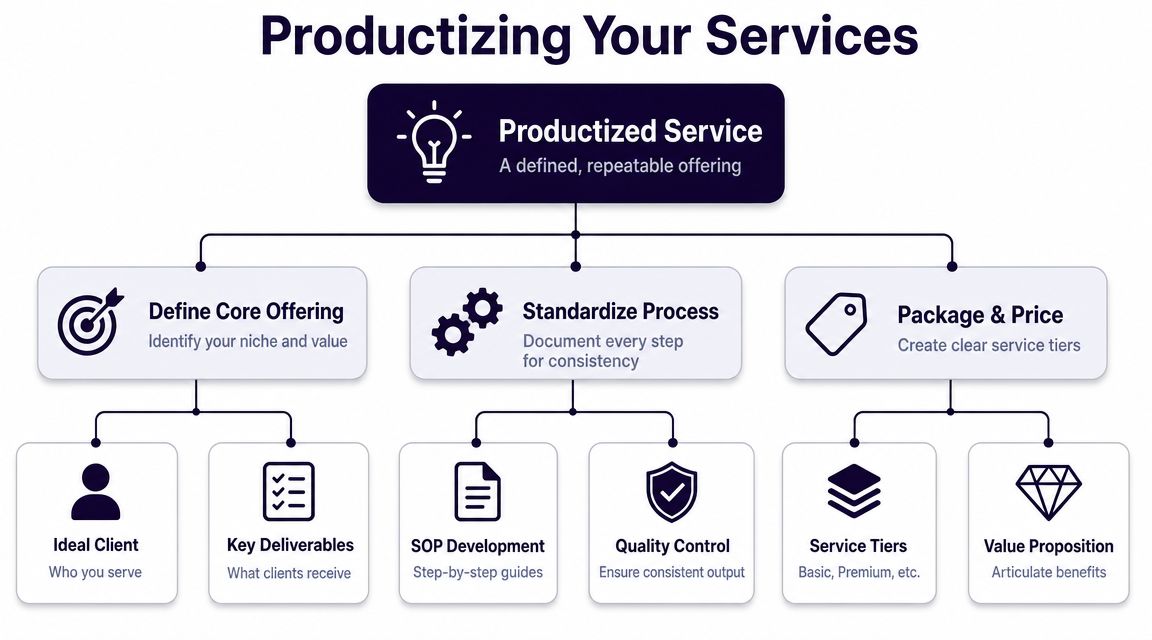
Productizing doesn't mean turning your service into a cheap commodity. It means defining what you do, who it's for, what's included, what isn't, and how the work moves from kickoff to completion.
Start with what already works
Most freelancers already have raw material for a productized offer. Look at past projects and sort them by three filters:
- Profitability: Which work left room after revisions, admin, and client management?
- Repeatability: Which projects followed a similar pattern each time?
- Client clarity: Which offers were easiest for buyers to understand and say yes to?
You're looking for the overlap. That's usually where the first scalable offer lives.
For example, “digital marketing support” is vague and hard to staff. “Monthly landing page optimization for SaaS companies” is much easier to sell, scope, and assign. The narrower offer usually wins because the client can see the outcome and your team can follow a repeatable process.
Turn a service into a package
A productized package needs boundaries. Without them, you're still freelancing with nicer formatting.
Build each core offer around a few fixed parts:
- Ideal client
Pick the kind of buyer you want more of. Not everyone who could hire you. - Defined deliverables
Spell out what they receive. If you can't name the output clearly, the offer is still too broad. - Process stages
Show the path from onboarding to delivery. Clients trust what they can visualize. - Scope limits
Revisions, timelines, communication rules, and exclusions matter more than is often realized. - Tiered packaging
Basic, higher-touch, or strategic versions can work well if each tier reflects real differences in effort and value.
Productized services protect margin because they reduce decision fatigue on both sides. The client knows what they're buying. Your team knows what they're delivering.
Pricing for scale, not just survival
A common mistake is trying to scale low-margin work. If your pricing barely supports you as a solo operator, it definitely won't support management time, tools, contractors, and quality control.
One practical tactic is to raise rates by 10%–25% once you have clear signals of demand, such as a full calendar or a year with a client, as noted in LessAccounting's guidance on scaling a freelance business. That kind of increase works best when the offer is already specialized and demand is real.
This isn't just about earning more. It creates room to outsource parts of delivery without destroying margin.
What productizing changes in the sales process
When your service is defined, the sales process gets simpler:
- Proposals get shorter because you're not inventing a new solution every time.
- Calls get cleaner because you're diagnosing fit, not designing from scratch.
- Handoffs improve because the team receives a known package, not a custom promise.
- Profit becomes visible because you can compare similar jobs against each other.
The before-and-after is stark. Before productizing, each sale feels like winning a one-off project. After productizing, each sale strengthens the system.
That's when delegation stops being risky and starts being practical.
Build Your Agency's Operating System
Most freelancers don't need more hustle. They need a stable operating system. If the business only works when you remember every detail, it isn't a business yet. It's a talented person with a full inbox.
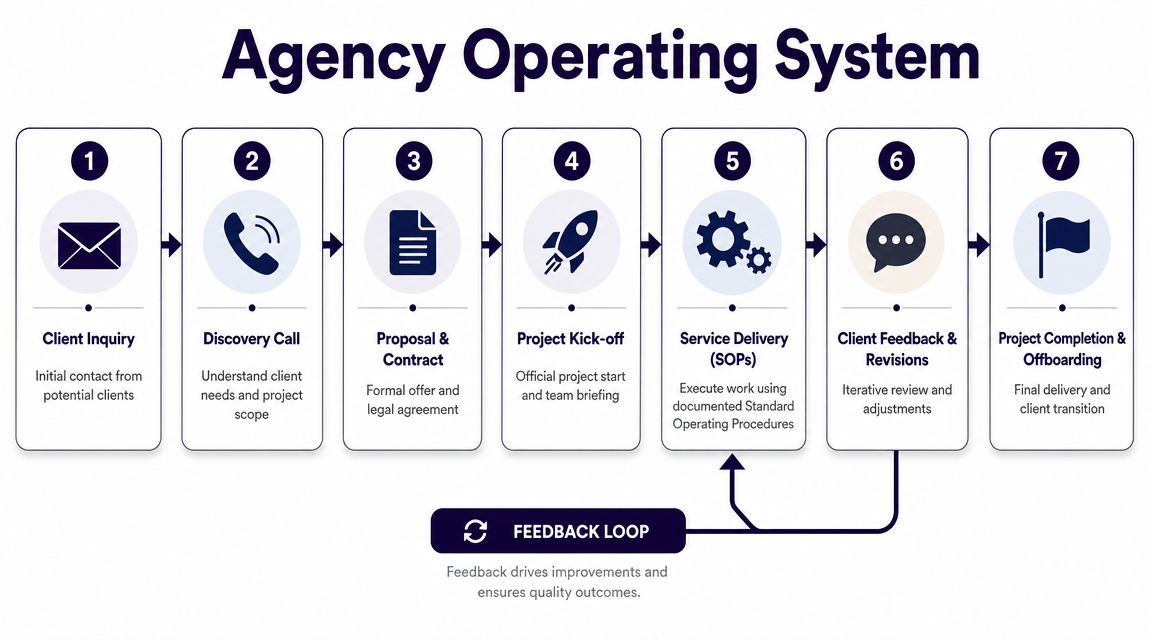
An agency operating system is just the set of rules, tools, and documented steps that make delivery consistent. Think less “corporate bureaucracy” and more “franchise manual.” The point is simple. Two different people should be able to produce work in a similar way without constant intervention from the founder.
The core systems to build first
You don't need a complicated stack. You need a stack that answers four operational questions.
- Where does work live? Use a project management tool with clear owners, statuses, deadlines, and templates.
- Where do conversations happen? Keep internal communication in one channel and client communication in another. Mixed communication creates missed details.
- Where do files live? Store proposals, briefs, assets, and final deliverables in a consistent folder structure.
- Where is process documented? Keep SOPs in one searchable place, not scattered across voice notes, chats, and memory.
If your team can't answer those questions quickly, execution slows down and quality slips.
For founders comparing different software categories for operations, this breakdown of advertising agency software is useful because it frames tools by function instead of hype.
Document the moments that create friction
A lot of people document the wrong things. They start with giant operations manuals nobody reads. Start smaller. Document the points where projects usually wobble.
That usually includes:
- Client onboarding
- Project kickoff
- Internal brief creation
- Review and quality control
- Revision handling
- Final delivery and offboarding
Each SOP should answer a few basic questions:
- What triggers this process?
- Who owns it?
- What inputs are required?
- What does good output look like?
- What happens if something is missing or late?
Build for handoff, not just reference
An SOP that only makes sense to you isn't an SOP. It's a note. Good process documentation is written so a new person can follow it without sitting next to you all day.
That means using:
- Checklists for repeatable actions
- Templates for proposals, briefs, and client updates
- Examples of good completed work
- Review criteria so quality isn't based on mood
If you find yourself re-explaining the same step twice, document it. If two people are doing the same task differently, standardize it.
Protect quality without becoming a bottleneck
Founders often swing between two bad options. They either control every detail or disappear completely. Neither works.
A better model is to create review gates. Let the team own the workflow, but define a few checkpoints where someone verifies that the output matches the standard. This keeps you out of the weeds while protecting client experience.
A simple operating rhythm helps:
- kickoff brief
- production
- internal review
- client-facing review
- final delivery
- post-project notes
That last step matters. The business gets better when completed work feeds the system. Every missed deadline, messy handoff, or confusing revision request should become a process improvement, not just an annoyance you forget by next week.
Hire and Onboard Your First Team Members
The wrong first hire creates more work than it removes. That happens when freelancers try to hire a copy of themselves. It feels logical. You want another person who can do everything. In practice, generalists are harder to train, harder to manage, and often unnecessary at the start.

The better first hire is usually a specialist in delivery. Bring in the person who can take a defined slice of client work off your plate while you stay focused on sales, scoping, relationships, and system design.
Don't hire for relief. Hire for leverage.
If you're still the main rainmaker, your time is most valuable in places that grow the business:
- sales conversations
- offer refinement
- proposal strategy
- client retention
- quality standards
- process improvement
That means your first team member often shouldn't be another founder-type operator. It should be the person who handles a narrow, high-frequency part of fulfillment well.
Examples include:
- A designer if visual production eats your week
- A developer if implementation slows delivery
- An editor or content operator if revisions pile up
- A project coordinator if client communication and task tracking are swallowing your time
What to test before you trust
Portfolios matter, but they don't tell you how someone works inside your system. Paid test projects are more revealing than long interviews.
Look for signs like:
- Can they follow a brief without overcomplicating it?
- Do they ask smart questions early?
- Can they meet deadlines without being chased?
- Do they improve from feedback?
- Can they work within constraints instead of always reinventing the task?
That tells you more than charisma ever will.
The first people you hire shape your standards. If you tolerate chaos early, you'll spend a long time undoing it later.
Onboard with context, not just access
New hires don't become useful because you added them to your tools. They become useful when they understand how the business thinks.
A solid onboarding flow should include:
- The offer
What the agency sells, who it serves, and what good delivery means. - The workflow
How projects move from signed client to final delivery. - The SOP library
The exact processes they'll use most often. - Examples
Good briefs, strong deliverables, clean revisions, and final outputs. - Communication rules
When to ask, when to decide, and when to escalate.
Here's a useful walkthrough on team and agency growth that pairs well with this stage:
Give ownership in layers
New people shouldn't own everything on day one. But they also shouldn't stay stuck in shadow mode forever.
A good progression looks like this:
- Observe first
- Execute with review
- Own a defined task
- Manage a complete workflow with checkpoints
- Recommend improvements
That progression builds confidence without risking client work.
The payoff is bigger than capacity. Once delivery no longer depends on you personally, you can finally spend more time on the part most freelancers neglect. Keeping the pipeline full enough to support a team.
Automate Your Client Acquisition Engine on Upwork
Many scaling plans encounter a critical failure point. The founder gets organized, productizes the offer, hires help, and then realizes referrals aren't reliable enough to support payroll. A bigger team needs a steadier pipeline than “someone might send a lead next month.”
That's why scaling freelance business lives or dies on client acquisition. Internal systems matter, but they only matter if work keeps entering the system.
On Upwork, many freelancers start with manual prospecting. They search for jobs, open listings one by one, write proposals from scratch, reply when they remember, and hope timing breaks their way. That can work when you're solo and patient. It doesn't hold up when your business needs consistent meetings and a team waiting for billable work.
Manual prospecting stops scaling fast
The bottlenecks are predictable:
- You respond too slowly. Good jobs attract attention fast.
- You apply inconsistently. Busy delivery weeks kill pipeline activity.
- You rewrite too much. Custom proposals eat time and reduce volume.
- You miss follow-up windows. Leads go cold because nobody owns response speed.
A freelancer can live with those gaps. An agency can't. Once you have overhead, pipeline inconsistency becomes a business problem, not just a productivity issue.
Build a repeatable Upwork motion
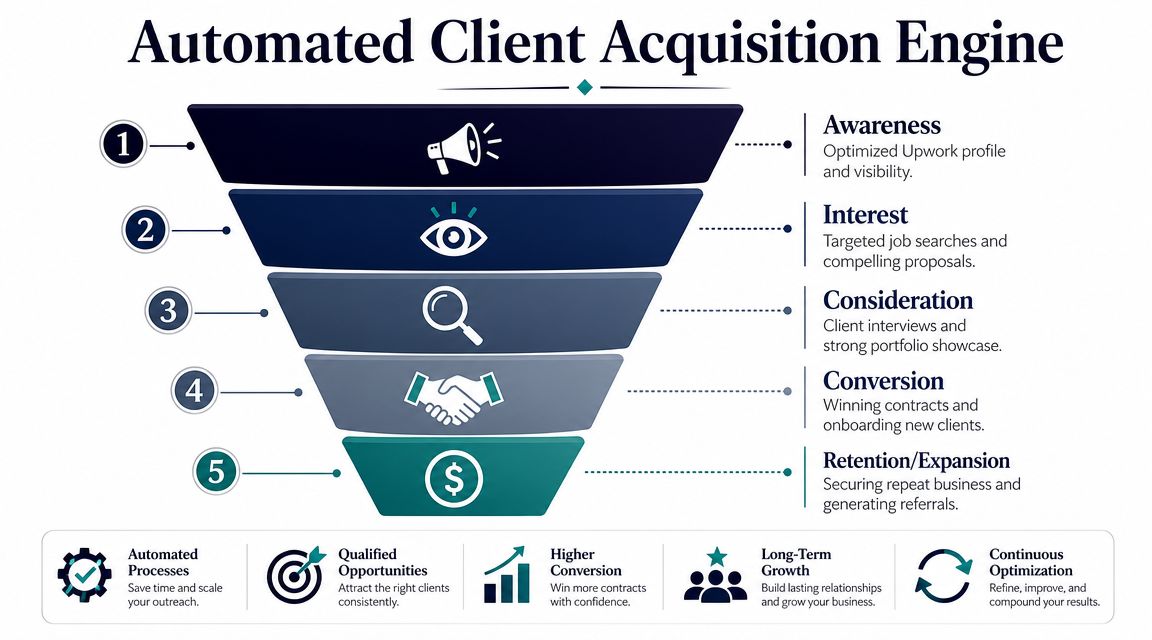
A scalable acquisition engine on Upwork usually has five parts.
Define the jobs worth pursuing
Not every posted job is worth a proposal. You need filters that reduce noise. Look at fit by service type, client quality, urgency, budget realism, and whether the project matches your productized offer.
Scale isn't volume alone; it's qualified volume. If your team spends time chasing poor-fit work, the system looks active while producing weak results.
Create proposal structure, not proposal spam
Strong proposal systems don't send the same generic pitch everywhere. They use repeatable building blocks:
- opening lines tied to the client's problem
- a short proof section aligned to the job
- a clear next step
- language matched to your offer and positioning
That keeps personalization without rebuilding every message from zero.
Treat speed like a sales advantage
Fast response wins attention. A practical benchmark is to keep discovery calls to 15–20 minutes and optimize them for conversion rather than information gathering. One freelance scaling framework says this can improve conversion from calls by at least 50%, which makes your sales process a measurable growth lever, according to Brandi Mowles' freelancing guide.
That benchmark matters upstream too. If your proposals and replies happen quickly, you increase the chance of getting to that call in the first place.
Clients on marketplaces often buy momentum before they buy certainty. The provider who responds clearly and quickly gets the meeting.
Build follow-up into the workflow
A lot of deals are lost because nobody follows up after the initial proposal or first client reply. On Upwork, that usually happens because the founder is juggling delivery and forgets to return to the thread.
Create a simple response system:
- first reply handled quickly
- meeting request sent early
- unanswered threads revisited
- interview scheduling pushed forward without delay
The goal isn't to sound robotic. The goal is to remove dead time from the conversation.
Where automation fits
Automation helps when it removes repetitive actions without removing judgment. On Upwork, that usually means using systems to monitor job fit, draft proposals from approved frameworks, route replies quickly, and keep follow-up moving.
One option in this category is Earlybird AI's Upwork proposal automation workflow, which is built for job finding, personalized proposal drafting, and automated replies on Upwork. That kind of setup is useful when you want a repeatable sales layer instead of relying on a founder to manually check the platform all day.
The key is this. Automation should support your positioning, not replace it. If your offer is vague and your portfolio is weak, faster outreach won't fix that. But if you already know who you serve and what problems you solve, automation can turn an inconsistent marketplace habit into a real pipeline.
The shift that matters most
Most freelancers think scaling means building a team. It does, but only partly. The deeper change is building a business where lead flow doesn't depend on your spare time.
Once that happens, Upwork stops being a place where you hunt for random gigs. It becomes one channel in a repeatable acquisition system that can feed an actual agency.
Track KPIs and Avoid Common Scaling Pitfalls
If you don't measure the business, you'll manage it by stress level. That's how founders end up making decisions based on a busy week instead of actual performance.
The useful KPIs at this stage aren't vanity metrics. They're the numbers and signals that tell you whether the machine is healthy.
Track the indicators that change decisions
Start with metrics that answer operational questions:
- Lead flow: Are enough qualified opportunities entering the pipeline?
- Reply quality: Are proposals and outreach turning into real conversations?
- Sales efficiency: Are meetings converting into signed work?
- Project profitability: Which offers produce margin after labor and revisions?
- Team utilization: Do you have idle capacity, or is delivery overloaded?
- Retention and expansion: Do clients stay, renew, and buy additional work?
You don't need a massive dashboard. You need a short list you review consistently and use.
The mistakes that stall growth
Scaling problems usually aren't dramatic. They're accumulations of small, avoidable errors.
Some of the most common ones:
- Hiring before the pipeline is stable
Extra capacity feels good until there isn't enough work to support it. - Keeping offers too custom
Every exception makes staffing, pricing, and fulfillment harder. - Underpricing in the name of growth
Low-margin work creates busyness without financial strength. - Founders staying buried in delivery
If you're still the main operator, the business can't mature. - No quality controls
Teams don't fail because people are bad. They fail because standards are unclear. - Ignoring culture because the team is small
Small teams feel informal, but habits set early become the company later.
Growth doesn't solve operational weakness. It exposes it.
Scaling a freelance business is never a clean graduation from freelancer to agency owner. It's a sequence of redesigns. You tighten the offer, build the system, hire deliberately, fix sales, and then repeat the cycle at a higher level. That's normal. The goal isn't to make the business perfect. It's to make it less dependent on you each quarter than it was the quarter before.
If Upwork is part of your growth plan, Earlybird AI helps turn manual bidding and message handling into a repeatable outreach system. It's built for freelancers and agencies that want consistent proposal activity, faster replies, and a client acquisition process that doesn't depend on someone watching the job feed all day.