
← Back To Blog
SDR Value: Metrics, ROI & Human vs. Automation
You're probably looking at a pipeline that feels heavier than it should. A few meetings show up, some prospects ghost, and the question is blunt, not theoretical, whether the SDR function is producing enough pipeline to justify the spend, or whether automation could do the same job with less drag. That's where SDR value stops being a buzzword and becomes a math problem you can run.
The useful way to think about it is simple. Start with the meetings and opportunities your SDR motion creates, subtract the full cost of running that motion, then pressure-test the result against deal quality and lifetime value. If you can't do that cleanly, you're making hiring decisions on instinct, and instinct gets expensive fast.
Why SDR Value Is the First Question Sales Leaders Ask
A founder usually doesn't wake up wondering about acronym theory. The moment is a stalled pipeline review, a board meeting, or a week where outbound activity looked busy but the calendar stayed thin. At that point, the only question that matters is whether the SDR function is producing enough qualified demand to deserve another month of budget.
That's why SDR value should be treated as a calculation, not a label. If the function creates meetings that turn into real opportunities, it can justify itself. If it mainly creates activity, then the team is consuming payroll, tools, and manager time without enough downstream return.
The practical question behind the acronym
There's another layer of confusion that slows teams down. SDR can mean different things in different contexts, from Special Drawing Right in finance to Standard Dimension Ratio in pipe engineering, and even Sdr in surface metrology. If your team searches the term without a clear frame, you'll get fragmented explanations instead of a usable answer. One useful reference point for the sales motion itself is what a sales development representative does, because the role only matters when you connect it to booked meetings and pipeline creation.
Practical rule: if you can't connect SDR activity to a meeting, an opportunity, or revenue, you're not measuring value, you're measuring motion.
The rest of the decision is straightforward. First, define what the SDR function produces. Second, measure what it costs in total. Third, compare human execution with automation. Fourth, decide whether you need to hire, automate, or do both. That sequence beats dashboard tourism every time.
What SDR Value Actually Means for a Modern Agency
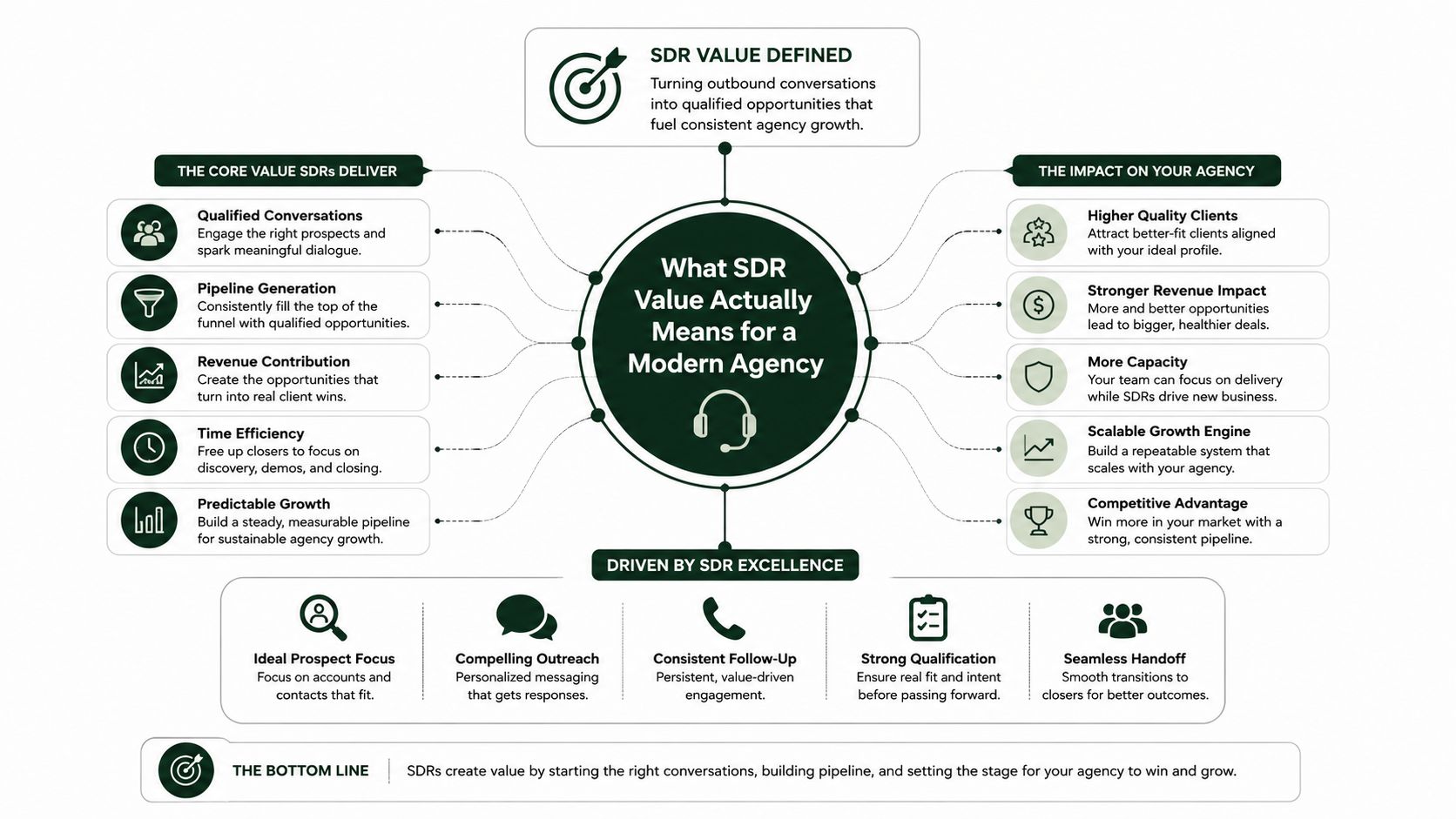
An SDR is only valuable if the meetings and opportunities they create are worth more than the full cost of running the function. For a plumber, a lead is valuable only if it turns into paid work. For sales, the same logic applies, qualified meetings are the asset, and cost is the bill attached to generating them.
The four levers that move value
The cleanest model is this, SDR value = net pipeline revenue created minus the total cost of the SDR function. That cost includes salary, management time, tools, data, deliverability setup, and the operational drag that usually gets ignored. If you only count base pay, you'll overstate value and hire too fast.
The four levers are volume, conversion, deal quality, and cost. More outreach only helps if the reply quality holds. Better conversion only helps if the meetings are with the right accounts. Lower cost only helps if it doesn't crush response rates or brand trust.
A common mistake is to equate SDR value with compensation. Salary is just one input. A lower-paid rep who books low-intent calls can be less valuable than a more expensive rep who consistently lands buying conversations.
Why misreading value leads to bad staffing decisions
When teams overvalue activity, they overhire. When they undervalue outreach, they underinvest and assume inbound will fill the gap. Both mistakes usually show up as shallow pipeline and manager frustration, not as a neat line item error.
If you want a reusable mental model, use this: more meetings are good only when they create enough downstream opportunity to cover the full motion. That's true whether the motion is human, automated, or hybrid. It's also why SDR value is a business question before it's a headcount question.
The Core Metrics That Drive SDR Value
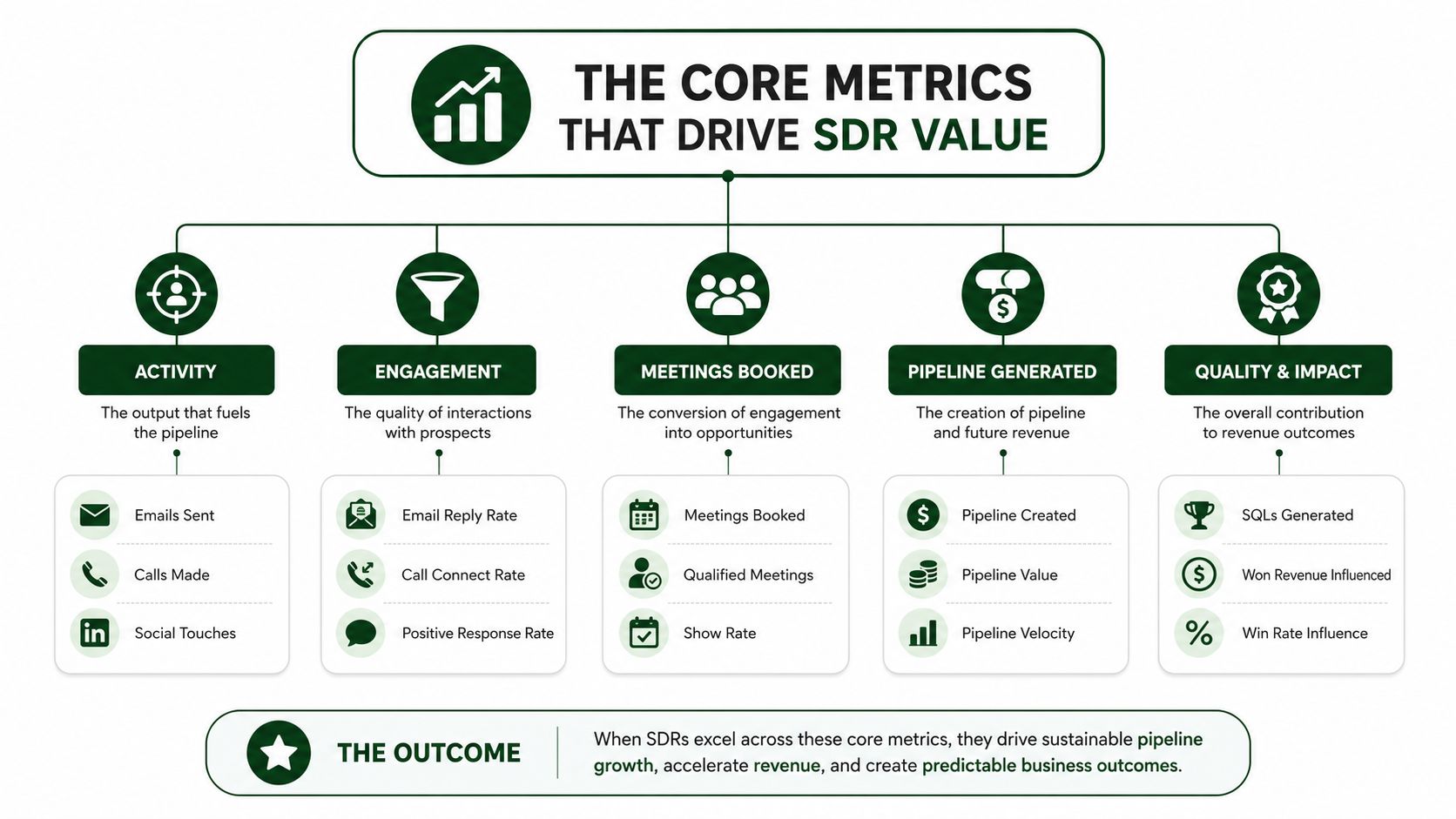
The dashboard should be small enough that a manager can explain it in one conversation. Teams don't need twenty widgets. They need four numbers they can trust, review weekly, and tie directly to pipeline.
Lead volume and why raw output still matters
Lead volume is the number of prospects touched or sourced in a given period. It matters because low volume can hide a decent conversion rate, but it still won't produce enough meetings to support growth. In a small or midsize agency, a healthy number is the one that gives you enough activity to test messaging without burning the team out, not a vanity target that looks good in a CRM.
Lead to meeting conversion rate and why quality beats noise
This is the metric that tells you whether your outreach lands. A higher rate usually means your targeting, offer, and message are aligned. A lower rate means your list quality or positioning is off, or your follow-up is too weak to earn a reply. If you need a structure for tracking these numbers, templates for tracking team KPIs are useful because they keep the scorecard focused on the few inputs that matter.
Cost per meeting and why it beats cost per touch
Cost per meeting takes the full SDR function and divides it by the meetings that are booked. That makes it more honest than cost per email or cost per call, because those channels can look efficient while producing nothing useful. A team can spend less on outreach and still end up with more expensive meetings if conversion drops.
LTV to CAC and why it protects you from bad wins
LTV to CAC tells you whether the customer value justifies acquisition cost over time. It's the guardrail that stops a team from celebrating booked calls that turn into low-value clients. A strong SDR motion should improve this ratio, not just create more calendar events.
The best SDR scorecard is boring on purpose. If a metric doesn't change a hiring, automation, or targeting decision, it doesn't belong on the main dashboard.
Calculating SDR Value with a Simple ROI Formula
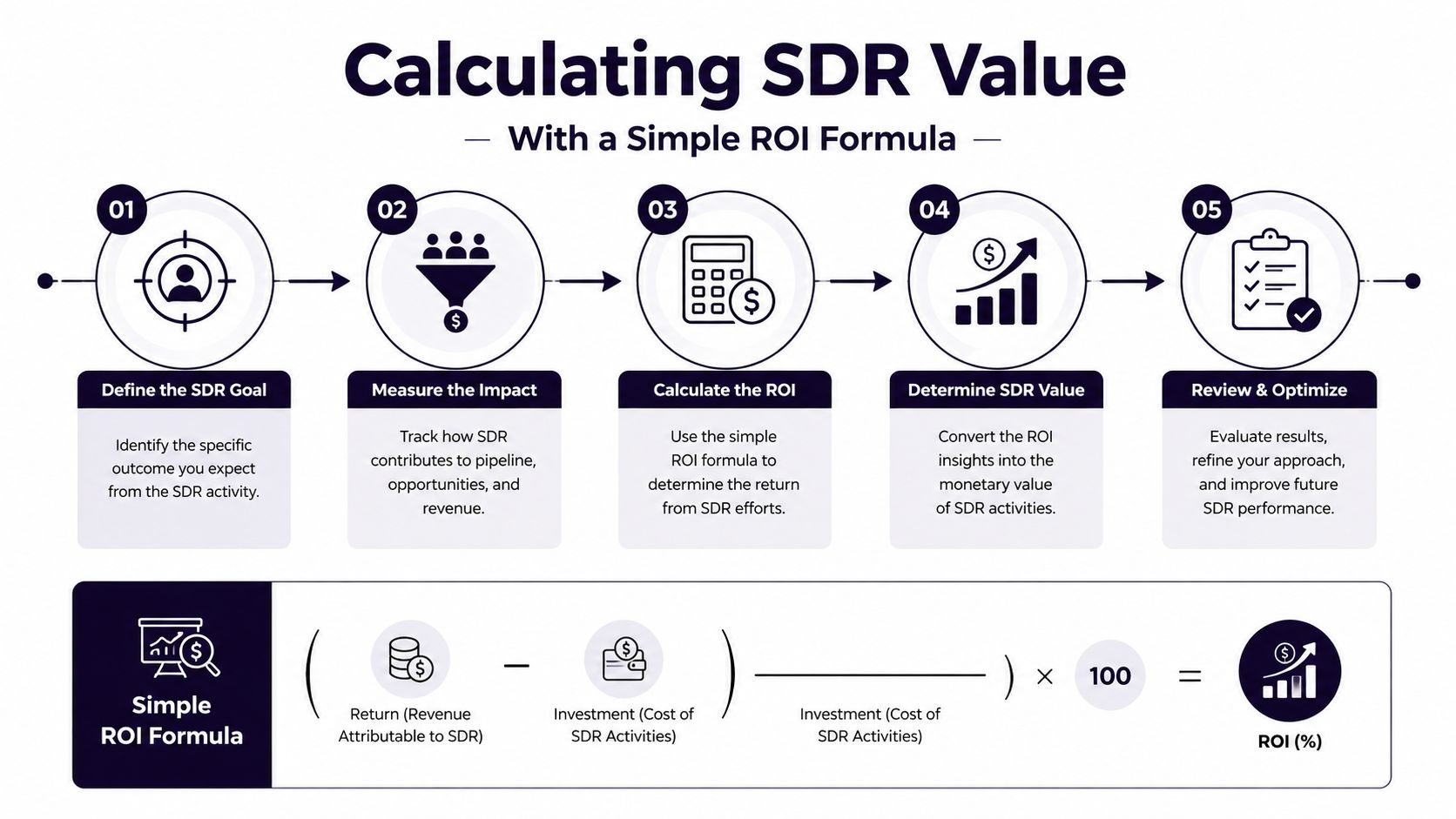
The easiest way to test SDR value is to work backward from revenue. Start with outreach touches, convert that into replies, then into meetings, then into opportunities, then compare the pipeline created with the full cost of the motion. If the math only works when you assume perfect follow-up, the motion is fragile.
A simple way to build the model
Use this sequence in a spreadsheet. Touches create replies, replies create meetings, meetings create opportunities, and opportunities create expected revenue. Then subtract the fully loaded cost of the SDR motion, not just compensation.
A practical model for a small agency starts with 400 outreach touches, a 3% reply rate, and a 25% meeting-to-opportunity conversion. From there, plug in your average deal value and your full SDR cost. The point isn't to chase a perfect forecast, it's to see which assumption changes the result.
What usually moves the answer most
Reply rate and deal size usually matter more than small salary changes. If your message gets ignored, cheap labor doesn't fix the economics. If your deals are small, a lower-cost SDR won't save a weak unit model.
That's why the final checkpoint should be LTV to CAC. If the motion generates clients that stay valuable over time, the upfront cost can make sense. If the deal closes but the customer economics are thin, the SDR function is merely accelerating a bad fit.
The spreadsheet test that keeps you honest
Run the model twice, once with your current assumptions and once with a slightly worse reply rate. If the economics collapse quickly, you don't have a staffing problem, you have a targeting or offer problem.
You can also stress-test deal size. If a modest increase in average contract value makes the model work, that tells you the SDR motion is sitting too close to the edge and needs better qualification. The math should guide the team toward better fit, not just more activity.
Human SDRs vs Automation Across the Metrics That Matter
Human SDRs and automation don't compete on the same terms. Humans are better when the conversation gets messy, when the buyer needs nuance, or when the account requires real judgment. Automation is better when speed, consistency, and after-hours coverage decide whether you win the first reply.
Speed and consistency
Automation usually wins on response speed because it doesn't wait for someone to log back in. It also wins on consistency because every message follows the same rules. Human SDRs can still outperform on context, but only if the rep has enough time and coaching to keep quality high.
If you want a practical overview of the tool category, AI SDR tools for small businesses is a useful way to frame what these systems do before you compare features. I'd also separate this from sales automation, because automation as a motion is broader than one channel or one inbox.
Cost per meeting and the compliance floor
Automation often lowers cost per meeting when the workflow is repetitive and the offer is simple. Human SDRs can be more expensive per meeting, but they're sometimes the right answer when each conversation is high stakes. The wrong comparison is salary versus software fee. The right comparison is meeting quality, follow-through, and the operational burden each option creates.
Compliance matters either way. Teams need to think about account safety, regional IP hygiene, and password handling before they scale outreach. If a system is fast but brittle, it can create a short-term lift and a long-term mess.
Decision rule: if the first reply can be standardized, automation deserves a hard look. If the first reply depends on judgment, a human still has a clear edge.
Earlybird AI fits naturally in this category because it connects to an Upwork account, learns project preferences from feedback, and automates proposal writing and reply handling while keeping account-safety design in view. That matters because speed without safety is just risk with a nicer interface.
A Decision Framework for Hiring, Automating, or Going Hybrid
The cleanest decision starts with three questions. What is your current cost per meeting, what is your reply rate, and how much pipeline do you need in the next 90 days. If you can answer those three questions, you already know more than many organizations that jump straight to a headcount request.
When hiring a human SDR makes sense
Hire when your deals need judgment, the buyer journey is complex, and your current reply rate is already healthy enough that better execution would pay off. A human rep is also easier to justify when the account list is narrow and each conversation has meaningful upside. For deeper context, outsourced sales development can help you compare in-house and outsourced coverage before you commit.
When automation is the better move
Automation fits when your outreach is repetitive, your targeting is clear, and the team needs more volume without adding more manual work. It's especially useful when pipeline gaps come from slow follow-up, inconsistent messaging, or missed after-hours opportunities. An automated lead sourcing tool can help teams build the front end of that motion without making every rep manually hunt.
When hybrid is the safest bet
Hybrid works when you want automation to handle first touch, follow-up, and routing, while humans handle higher-intent conversations. That usually gives the team better cost control without giving up nuance where it matters most. It also keeps the model flexible when pipeline pressure changes from one quarter to the next.
The simplest rule is this. If reply quality is weak, fix the message and targeting first. If reply quality is decent but labor is expensive, automate more. If the account value is high and the conversation gets complex, keep a human in the loop.
Two Mini Case Studies That Show SDR Value in Practice
A three-person design agency had a part-time SDR who booked calls, but too much time went into manual follow-up and proposal prep. They moved the front end of the motion toward automation, then focused the team on closing the right conversations. The KPI that mattered most was booked calls, and the trade-off was obvious, less manual control in exchange for cleaner throughput.
A content agency took the opposite path. They kept a human SDR for enterprise leads because the conversations required more judgment, but they automated top-of-funnel outreach so the rep could spend time on the higher-value accounts. Their decision hinged on reply quality, not just volume, and they accepted that not every lead needed a human touch at the start.
Both teams made the same core decision. They stopped asking whether SDRs were good or bad and started asking where human judgment changed the economics. That shift is what made the motion sustainable.
Your Next Steps to Capture More SDR Value This Quarter
Start with a 30-day baseline. Measure lead volume, lead-to-meeting conversion, cost per meeting, and LTV to CAC, then calculate the true cost of your current SDR motion. After that, run a one-week automation pilot on a single channel and compare the result with your human workflow.
If the pilot improves speed without hurting meeting quality, expand it. If the economics are still weak, revisit targeting and deal quality before you hire. SDR value isn't a number you set once, it's a moving target you keep testing against real pipeline.
If you want to see what always-on outreach looks like in practice, visit Earlybird AI and review how it handles proposals, replies, analytics, and account-safety design in one workflow. It's a practical fit when you want to measure SDR value against booked conversations instead of manual effort.