← Back To Blog
Craft a Winning SEO Work Profile: The Ultimate 2026 Guide

You're good at SEO. You've fixed crawl issues, cleaned up content structures, and improved rankings for real businesses. Yet your profile sits there with a few views, weak inquiries, and clients who either disappear or haggle over price.
That usually isn't a skill problem. It's a positioning problem.
A strong SEO work profile doesn't act like a resume. It acts like a landing page built to convert one kind of buyer. If your profile reads like “SEO expert, keyword research, on-page SEO, link building, technical SEO,” you sound like everyone else. In a market where the global SEO services market is estimated at $83.98 billion in 2026 and projected to reach $148.86 billion by 2030, growing at a CAGR of 17.1% according to these SEO market projections from SeoProfy, more buyers are entering the market, but so are more sellers.
The freelancers who win better projects treat their profile as a sales asset. They niche down. They show proof. They make it easy for a client to say, “This person understands my situation.”
If your current profile gets seen but doesn't convert, that's where to fix it. For a useful companion framework, look at this guide to Upwork profile optimization.
Why Your SEO Work Profile Isn't Getting Clicks
Most underperforming SEO profiles fail before a client reads the second line. The headline is too broad. The first paragraph talks about passion instead of outcomes. The service list tries to cover every possible deliverable. The result is a profile that sounds capable, but forgettable.
Clients don't hire “capable.” They hire “relevant.”
Generic profiles blend into the scroll
A buyer searching for help with a Shopify collection page issue, local service pages, or a technical cleanup after a traffic drop doesn't want a general speech about SEO. They want a specialist who sounds close to their problem.
That's why broad labels like these often underperform:
- SEO Expert: Too vague. It doesn't tell the client what you solve.
- Digital Marketer: Too wide. It weakens your SEO identity.
- SEO Specialist for All Businesses: It removes urgency and specificity.
A click-worthy SEO work profile narrows the frame. It signals industry, platform, service type, or business stage.
Practical rule: If your headline could belong to 10,000 other freelancers, it won't pull strong clicks.
Clients scan for fit, not completeness
Many freelancers keep stuffing more skills into the profile because they think range creates trust. In practice, range often lowers perceived expertise. Clients don't reward a profile for listing every tactic. They reward it for sounding like the right hire for this exact project.
That's the mindset shift. Your profile isn't there to document everything you can do. It's there to help the right client self-select.
Your profile has one job
It should answer three silent questions fast:
- Do you work with businesses like mine
- Have you solved this kind of problem before
- Can I trust what you're claiming
If one of those is unclear, clicks stall, invites drop, and profile views go cold. The fix starts at the top.
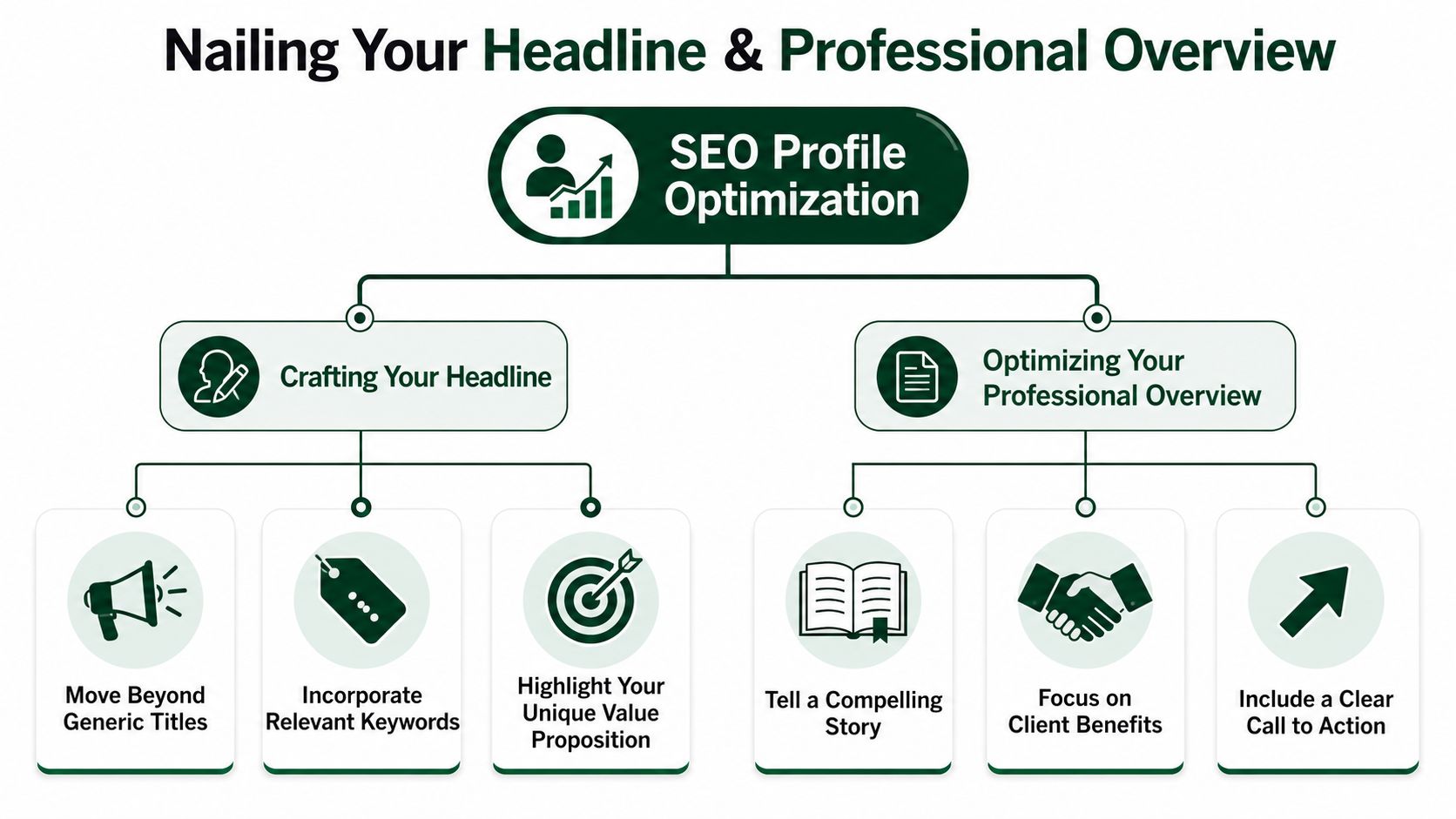
Nailing Your Headline and Professional Overview
Your headline and overview do most of the heavy lifting. If they're generic, the rest of the profile doesn't matter much. If they're sharp, even a short profile can outperform longer ones.
Write a headline that targets demand
The fastest upgrade is moving from identity-based wording to buyer-based wording.
Bad headline examples:
- SEO Expert
- SEO Specialist
- Digital Marketing and SEO Consultant
Better headline examples:
- Technical SEO Specialist for SaaS Sites and Content-Heavy Platforms
- Local SEO Specialist for Multi-Location Service Businesses
- Ecommerce SEO for Shopify, Category Pages, and Collection Growth
- B2B SEO Consultant for Lead Gen Sites and High-Intent Content
The pattern is simple. Pick a market, problem, or platform. Then add the service angle you want to sell.
A good headline usually includes some combination of:
- Client type: SaaS, ecommerce, local service business, B2B, publisher
- Platform or stack: Shopify, WordPress, Webflow
- Primary problem: technical SEO, local SEO, content strategy, recovery, migration support
- Commercial angle: lead generation, non-branded growth, category visibility, location page optimization
Avoid the general profile trap
A profile that says “I help businesses grow online with SEO” sounds harmless, but it creates no association in the client's mind. Specificity does.
One of the clearest examples comes from a Reddit case where a business profile generated zero leads until the positioning shifted to a niche phrase like “state movers X”, with matching H1, title, and meta tags. Once the profile and pages became specific, business started coming in, as described in this discussion on niche keyword positioning and local specificity.
That principle applies directly to your SEO work profile. Don't say you serve everyone. Use the language your buyer would type.
If you need help tightening that positioning, these unique value proposition examples are a useful reference point.
A profile gets stronger when it excludes the wrong buyer on purpose.
Structure the overview like a sales conversation
Most SEO overviews waste the first lines explaining what SEO is. Don't do that. Clients already know why they're shopping. They're looking for someone who can execute.
A better overview follows this flow:
Start with the problem the client already feels
Open on a real business pain, not your biography.
Examples:
- Traffic is flat because your site architecture and content targeting are working against each other.
- Your pages are indexed, but they're not earning clicks because intent and page format don't match.
- You're publishing content, but it isn't turning into qualified leads.
That kind of opening earns attention because it sounds familiar.
Position yourself as the guide
Now give the client a reason to trust your process. Keep it grounded.
You can say you work across technical audits, content mapping, internal linking, metadata refinement, Search Console analysis, and competitor gap reviews. You can mention tools like Google Analytics, Search Console, Semrush, Ahrefs, and Screaming Frog if those are part of your delivery.
What matters is the framing. Speak in terms of problem solving, not feature dumping.
End with a narrow invitation
Don't close with “contact me for all your digital marketing needs.” That weakens the whole message.
Use a direct CTA like:
- If you need a technical SEO cleanup before scaling content, send your site and the main issue you're seeing.
- If your local pages aren't driving leads, share the target city and service line.
- If you need an SEO audit before a rebuild or migration, I'll tell you what has to be protected first.
That sounds like a working engagement, not a generic pitch.
Building a Portfolio That Closes Deals
A profile gets attention. A portfolio closes the sale.
Clients know freelancers exaggerate. They've seen “ranked clients on page one” and “grew traffic fast” too many times. On Upwork, vague proof often gets ignored because it forces the client to trust you without evidence.

Show evidence the way buyers evaluate it
On Upwork, clients often want verifiable proof of ranking success. A strong portfolio item should include the search phrase used, the number of results returned for that phrase, the page's ranking position, and a direct link to the ranked page, as outlined in these Upwork SEO job expectations for proof of results.
That changes how you present work.
Weak portfolio line:
- Improved client SEO performance through on-page optimization and keyword research.
Stronger portfolio line:
- Optimized a service page around a defined search phrase, documented the ranking position, and linked directly to the live page so the client could verify the result.
The difference is trust.
Build each case study around one visible win
Don't try to cram every tactic into one portfolio sample. Pick one core achievement and make it easy to understand.
A simple case study structure works well:
The situation
Describe the business context in plain language.
Example:
A local service company had service pages, but they weren't aligned with location intent. The site looked broad, and the profile messaging didn't map to the terms buyers were using.
The work
List the moves that mattered.
- Reframed the target keyword set: Shifted away from generic service terms toward location-specific and buyer-intent phrases.
- Reworked page signals: Updated titles, H1s, internal links, and supporting copy to match the page's actual intent.
- Added proof points: Included screenshots, Search Console snapshots, and a direct link to the live page.
The proof
At this point, many freelancers become lazy. Don't write a summary. Show the artifact.
Include:
- Ranking snapshot: Before and after positions if you have permission to show them
- Keyword phrase: The exact phrase targeted
- Direct URL: So the buyer can verify the page exists
- Context note: Why that phrase mattered to the business
For more ideas on how to package portfolio evidence, this guide on building a portfolio in Upwork is worth reviewing.
If a client has to guess what changed, the portfolio item is too weak.
Use visuals, but keep them disciplined
A screenshot is powerful when it proves one thing clearly. It's weak when it becomes clutter.
Good visual attachments include:
- Search results snapshots: Showing the page and query context
- Search Console screenshots: Highlighting page-level movement or query visibility
- Audit excerpts: One annotated screenshot from Screaming Frog, PageSpeed Insights, or a crawl report
Bad portfolio visuals include giant dashboards with no explanation, blurred screenshots, or vanity metrics disconnected from the business problem.
Don't fake a case study if the work was small
You don't need massive enterprise projects. Smaller projects can still sell if the outcome is concrete. An indexation cleanup, a local page rewrite, a metadata overhaul, or a category page restructuring can all work as portfolio pieces if the story is tight and the evidence is real.
That's the standard. Less chest-thumping, more proof.
How to Price and Package Your SEO Services
Pricing gets easier once your profile stops selling “SEO” as a vague bucket and starts selling specific outcomes. Buyers hesitate on open-ended hourly work because they can't see the finish line. Packages reduce that friction.
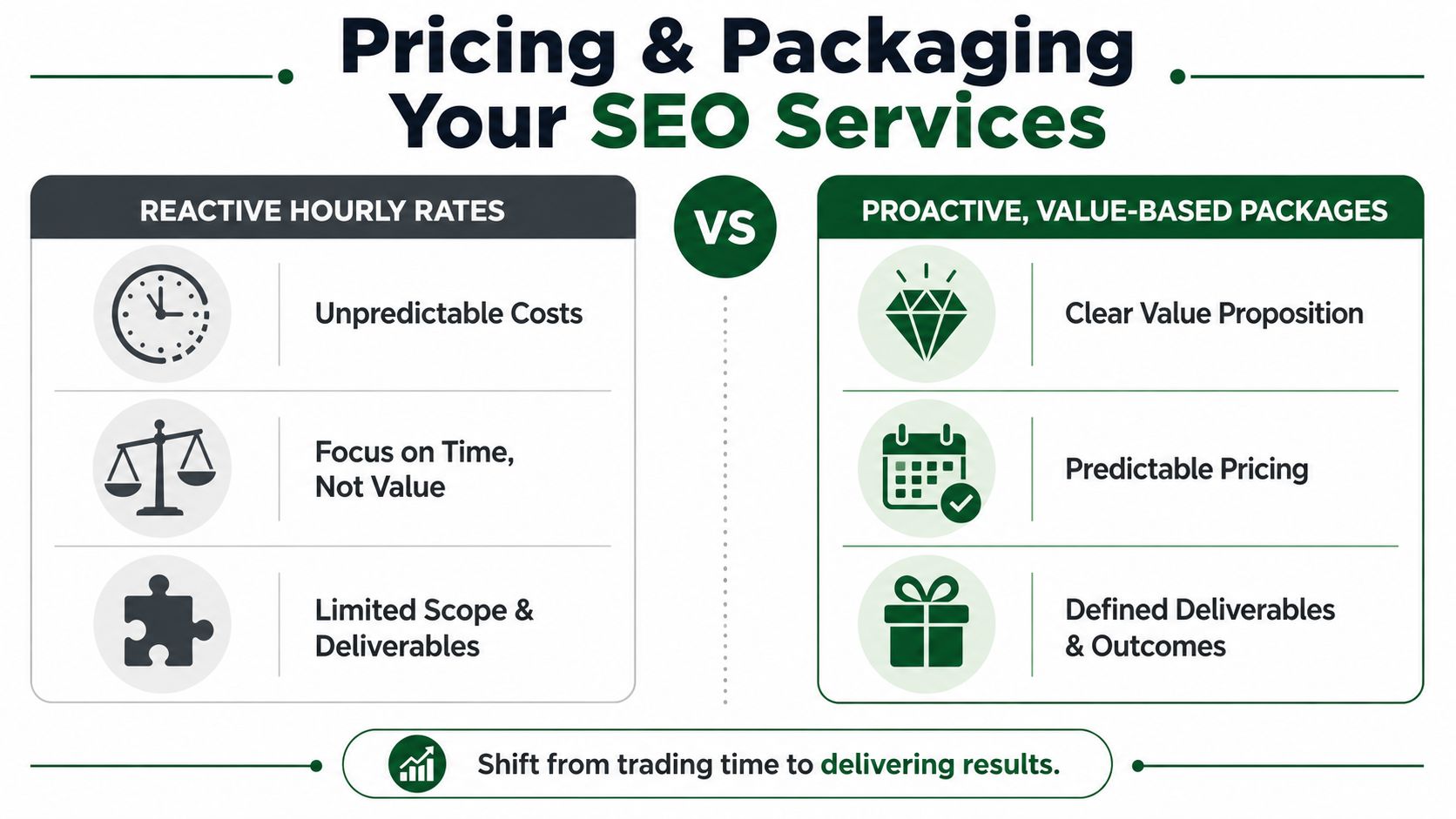
Hourly pricing creates the wrong conversation
Hourly billing has its place. It works for advisory calls, small fixes, and narrowly scoped troubleshooting. But for core SEO work, it often creates tension.
The client starts asking:
- How many hours will this take?
- Why did this task take longer?
- Can we pause halfway?
That shifts attention away from business priorities and toward time tracking.
Package-based pricing usually performs better because it defines the deliverable up front. The client sees what they're buying. You control scope better. The work feels strategic instead of piecemeal.
Use packages that map to buying intent
Clients usually hire around one of a few clear needs. Your packaging should reflect that.
Audit package
Best for buyers who know something is wrong but don't know where.
Include items like:
- Technical crawl review
- Indexation and internal linking analysis
- Metadata and page template review
- Search Console issue review
- Prioritized action plan
This works well as a fixed project because the output is concrete.
Monthly management package
Best for businesses that already believe in SEO and want consistent execution.
Include a defined mix such as:
- Ongoing technical monitoring
- Keyword and page opportunity reviews
- Content briefs or optimization cycles
- Reporting tied to rankings, traffic quality, conversions, and backlinks
The key is clarity. Don't sell “monthly SEO support.” Sell what gets touched each month.
Specialized project package
Higher-value positioning often thrives.
Examples:
- Local SEO page expansion
- Shopify collection and category optimization
- Content pruning and site architecture cleanup
- Pre-migration SEO review
- Schema and rich snippet implementation
These packages convert better than broad retainers when the client has one pressing problem.
A useful pricing mindset check sits below.
List the tools buyers search for
Tool visibility matters because clients often filter candidates by platform familiarity. If your profile doesn't mention the tools they expect, you may never make the shortlist.
According to Agency Jet's review of SEO hiring expectations, job descriptions consistently require proficiency in Google Analytics, especially GA4, Google Search Console, Semrush, and Ahrefs, with Semrush appearing in 86% of listings and Ahrefs and Screaming Frog appearing in over 75% each.
That doesn't mean you should dump a tool list into your overview. It means your service packages and profile skills should naturally reflect the stack you use.
Price the deliverable, not your anxiety
Freelancers underprice when they're unsure how to defend scope. Packages solve that by turning SEO into named engagements with boundaries.
The moment your service has a name, a deliverable, and a clear fit, it becomes easier to sell.
A client doesn't want to buy your hours. They want to buy a technical cleanup, a local visibility push, or a content-led growth plan they can understand.
Turning Profile Views Into Client Conversations
A polished profile still won't fill your pipeline if your proposals sound like everyone else's. Most freelancers lose here. They open with greetings, generic compliments, and a recycled paragraph about years of experience. The client skims three lines and moves on.
The first message should do one thing. Make the client feel understood fast.
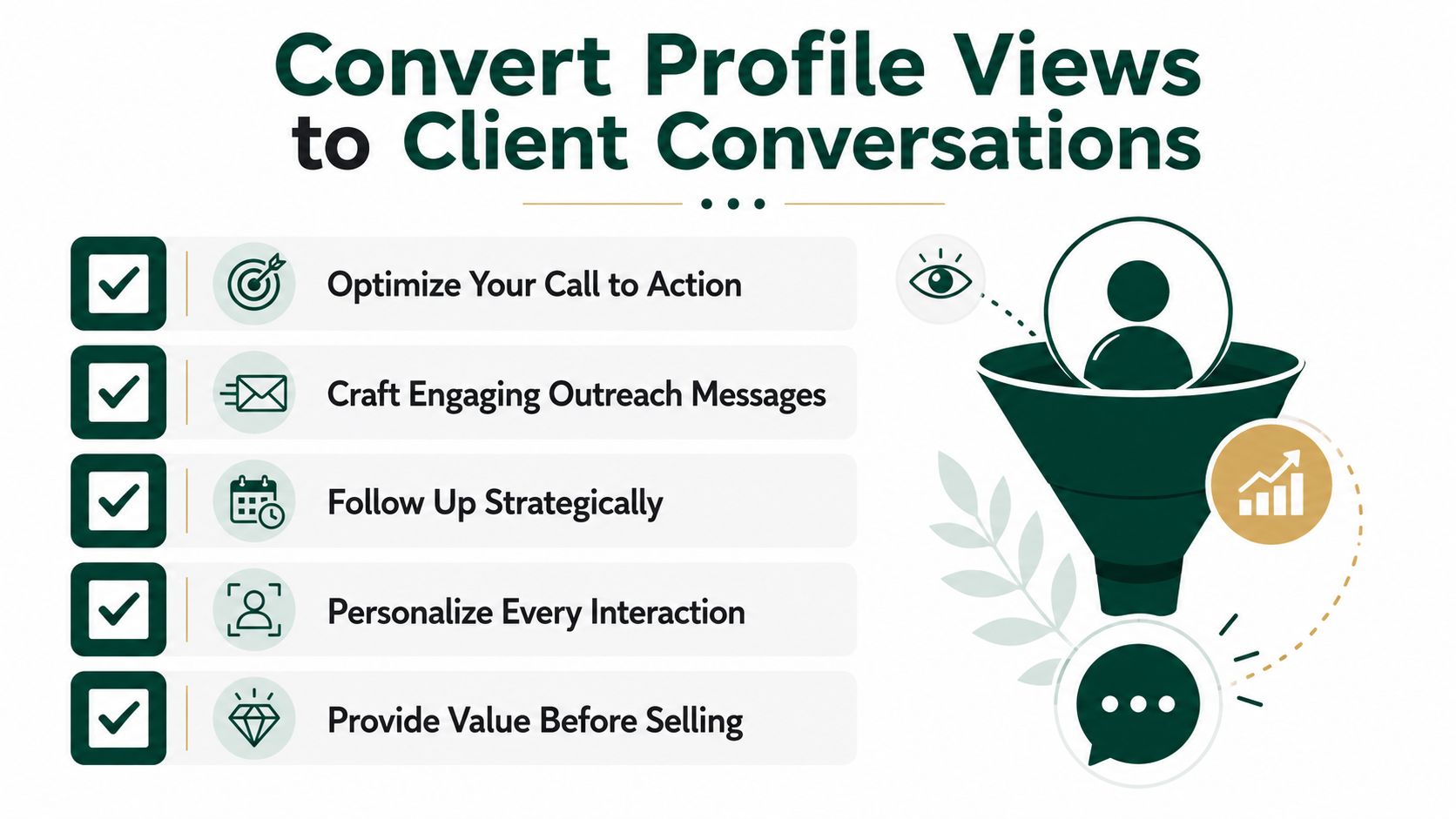
Open with the client's problem, not your intro
Bad proposal opening:
- Hi, my name is Alex and I'm an SEO specialist with experience in all areas of search engine optimization.
Better proposal opening:
- I looked at the issue you described, and this sounds less like a keyword problem and more like a page structure and intent mismatch.
That kind of opening earns a reply because it introduces diagnosis. It feels like work has already started.
Attach proof directly to the proposal
Upwork guidance for SEO profiles recommends skipping the explanation of what SEO is and instead attaching portfolio proof, such as ranking snapshots that show movement like position 12 to 4, directly in the proposal, as discussed in this walkthrough on SEO profile proof and proposal attachments.
That matters because clients won't always click through your full profile before deciding whether to respond.
Use attachments that support the exact job post:
- For local SEO jobs: Attach a screenshot of a location page ranking example or a local page structure sample.
- For technical SEO jobs: Attach one annotated crawl screenshot showing a fix you've handled before.
- For content optimization jobs: Attach a before-and-after snippet showing changes to title, H1, internal links, or content format.
Use short proposal scripts that create momentum
Here are three practical formats.
The diagnosis opener
Use this when the client already described symptoms.
- I reviewed your post, and the issue sounds concentrated in one area: your pages exist, but they're not aligned tightly enough with search intent. I'd start by checking page format, internal linking, and query-to-page mapping before expanding content.
The proof-led opener
Use this when the client wants evidence.
- I've handled similar SEO work where the deliverable was documented with live ranking proof, including the search phrase, ranking position, and direct page link. If helpful, I can send a matching example with the proposal so you can verify the format yourself.
The strategic opener
Use this when the client sounds experienced and wants a thinking partner.
- I wouldn't treat this as a generic SEO retainer. I'd break it into a technical review first, then decide whether the bigger constraint is crawlability, page intent, or content gaps.
A strong proposal gives the client a next step they can say yes to quickly.
End with smart questions
Avoid “Let me know if you'd like to discuss.” That creates work for the client.
Ask narrow questions instead:
- Which pages matter most commercially right now?
- Are you trying to improve local visibility, non-branded traffic, or conversions from existing organic traffic?
- Has anything major changed recently on the site structure, CMS, or page templates?
Those questions do two things. They show competence, and they move the conversation into a discovery call naturally.
Your SEO Profile Is a Living Asset
The best SEO work profiles don't stay fixed. They evolve the same way a well-managed site does. You watch what attracts the right buyers, remove what creates friction, and keep sharpening the message.
That's where many freelancers stall. They rewrite the profile once, then leave it untouched for months. Meanwhile, the market shifts, buyer language changes, and their strongest project examples never make it into the profile.
Treat your profile like an SEO asset
A strong profile deserves the same discipline you give client work.
That means reviewing:
- Headline fit: Does it still match the type of work you want more of
- Overview clarity: Are the first lines still sharp, or have they drifted back into generic wording
- Portfolio relevance: Do your current samples reflect the projects you want next
- Package alignment: Are you selling named offers, or did your services become fuzzy again
If your profile starts attracting the wrong leads, don't just blame the platform. Audit the message.
Keep fresh proof in circulation
Old wins lose force. Not because they're false, but because buyers want signs that you're active and current.
Add new examples when you can show something verifiable:
- a better page structure
- a cleaner local landing page model
- a stronger audit excerpt
- a useful ranking snapshot you're allowed to share
You don't need a huge library. You need a small set of portfolio assets that prove your current best work.
The long-term advantage is coherence
Most freelancers improve one pillar and neglect the others. They niche down but don't show proof. Or they have proof but package services poorly. Or they have a strong profile but send weak proposals.
The profiles that consistently win good work combine all three conversion pillars:
- Clear niche positioning
- Verifiable evidence
- Active, thoughtful outreach
That combination is what turns an SEO work profile from a static bio into a client acquisition system.
Keep asking one question: does this profile make the right client feel like they found the right specialist?
If the answer is no, keep editing. That's not busywork. That's sales.
Earlybird AI helps freelancers and agencies turn a strong Upwork profile into consistent pipeline. It connects to your Upwork account, learns which projects fit through simple feedback, and helps automate proposal writing, outreach, follow-up, and reply handling so opportunities don't sit untouched. If you want a system that supports faster outreach and smarter profile optimization, take a look at Earlybird AI.