
← Back To Blog
Master the Solution Selling Approach: Win High-Value

You're probably doing the work.
You read the job post carefully. You write a custom proposal. You mention relevant experience, stack, portfolio, delivery process. Then nothing happens. No reply. No call. No project.
That usually isn't a writing problem. It's a positioning problem. On Upwork, most freelancers still sell deliverables. Better freelancers sell expertise. The ones who consistently win strong projects sell clarity around the client's problem.
Why Your Upwork Bids Are Being Ignored
Most ignored proposals sound professional and still fail.
They fail because they read like this: “I'm a full-stack developer with seven years of experience in React, Node, and AWS.” Or: “I've helped brands grow with SEO, content, and paid ads.” None of that is useless. It's just early. The client hasn't decided they care yet.
The race to the bottom starts with feature-based bidding
A client posts, “Need help fixing low conversion rates on landing pages.”
Ten freelancers respond by listing tools: Figma, Webflow, CRO, GA4, Hotjar, A/B testing. Another ten talk about turnaround time and communication. A few drop portfolio links and hourly rate. The client now sees a wall of sameness.
That's how good freelancers get pushed into commodity pricing. They're competing on surface-level capability because they never changed the frame of the conversation.
The solution selling approach exists to change that frame. It was formally originated by Frank Watts in 1975 and later codified by Mike Bosworth in 1983, marking the shift from product-led selling to problem-led selling in complex B2B work, as outlined in this history of solution selling. The core move was simple and still effective now: stop leading with the thing you sell, and start with the unresolved problem the buyer is dealing with.
That old shift fits Upwork better than most freelancers realize.
What this looks like on the platform
On Upwork, “product-led” usually means selling your service package. “Problem-led” means translating a task request into a business issue.
A job post says “need email marketer.” The deeper issue might be weak onboarding, poor lead nurture, low demo attendance, or an offer that isn't converting. A post says “need designer for homepage refresh.” The actual issue could be low trust, unclear positioning, or expensive paid traffic landing on a page that doesn't explain the offer.
The client rarely buys your service first. They buy relief from confusion, delay, leakage, or missed revenue.
If your current process is still built around more bids, better templates, and tighter pricing, it's worth rethinking how you're bidding on Upwork effectively. More activity helps only if the message is aimed at the true problem.
That's the escape hatch from bid-and-pray. You stop sounding like another vendor and start sounding like the person who understands what the project is trying to fix.
The Core Principles of Solution Selling
The method sounds complex, but the operating principles are practical. On Upwork, they decide whether your proposal gets skimmed, saved, or answered.

Diagnosis comes before prescription
The easiest way to explain this is with a doctor analogy. A serious doctor doesn't hear one symptom and hand over medication. They ask questions, look for causes, rule out noise, and then recommend treatment.
Freelancers skip that step all the time. They see “need SEO” and prescribe blog posts. They see “need ads manager” and prescribe campaign restructuring. They see “need copywriter” and prescribe new copy. That's not diagnosis. That's pattern-matching.
Mindset shift: Stop asking, “How do I show I can do the work?” Start asking, “What is this client trying to change, fix, or avoid?”
Business impact matters more than service vocabulary
One of the core rules of the methodology is that sellers should present a customized solution in terms of business impact and ROI, and avoid focusing on specs and features until the problem is shared and clearly defined between buyer and seller, as explained in Highspot's overview of solution selling.
For freelancers, that means your first move usually shouldn't be a service menu.
It should be language like this:
- For a designer: “If the page is getting traffic but not converting, the problem may be message clarity before visual polish.”
- For a media buyer: “If lead quality is poor, campaign changes alone may not fix the handoff between ad promise and landing page.”
- For a developer: “If the rebuild is meant to improve sales efficiency, the workflow and integration issues matter as much as the codebase.”
Clients respond when they can see the business consequence of the issue.
Relevance beats persuasion
A lot of proposal advice teaches persuasion tactics too early. Better persuasion often starts before the pitch. Framing, timing, and attention all matter. If you want a useful lens for that, Cialdini's pre-suasion principles for conversions is a strong resource because it shows how context shapes receptiveness before someone evaluates your offer.
On Upwork, pre-suasion looks like matching the client's own stakes. If they care about missed demos, don't open with your award-winning design process. If they care about churn after onboarding, don't lead with your Klaviyo certification.
Communication has to lower effort
The best solution sellers aren't the most verbose. They make the client's decision easier.
That means:
- Use plain language: Replace jargon with the client's business language.
- Mirror the job post carefully: Reflect the core issue without parroting every sentence.
- Make the next step obvious: Ask one or two sharp questions. Don't send an essay.
If your proposal makes the client work to understand your value, they'll move on to the person who made the problem feel simpler.
That's the core discipline behind the solution selling approach. You diagnose first, tie your offer to business impact, stay relevant to the buyer's context, and communicate with enough clarity that replying feels easy.
A Step-By-Step Guide for Upwork Freelancers
Most freelancers overreact to the wrong signal. They see a fresh posting and rush to be fast. Speed matters, but speed without diagnosis just produces faster rejection.
A better workflow starts with the job post itself.
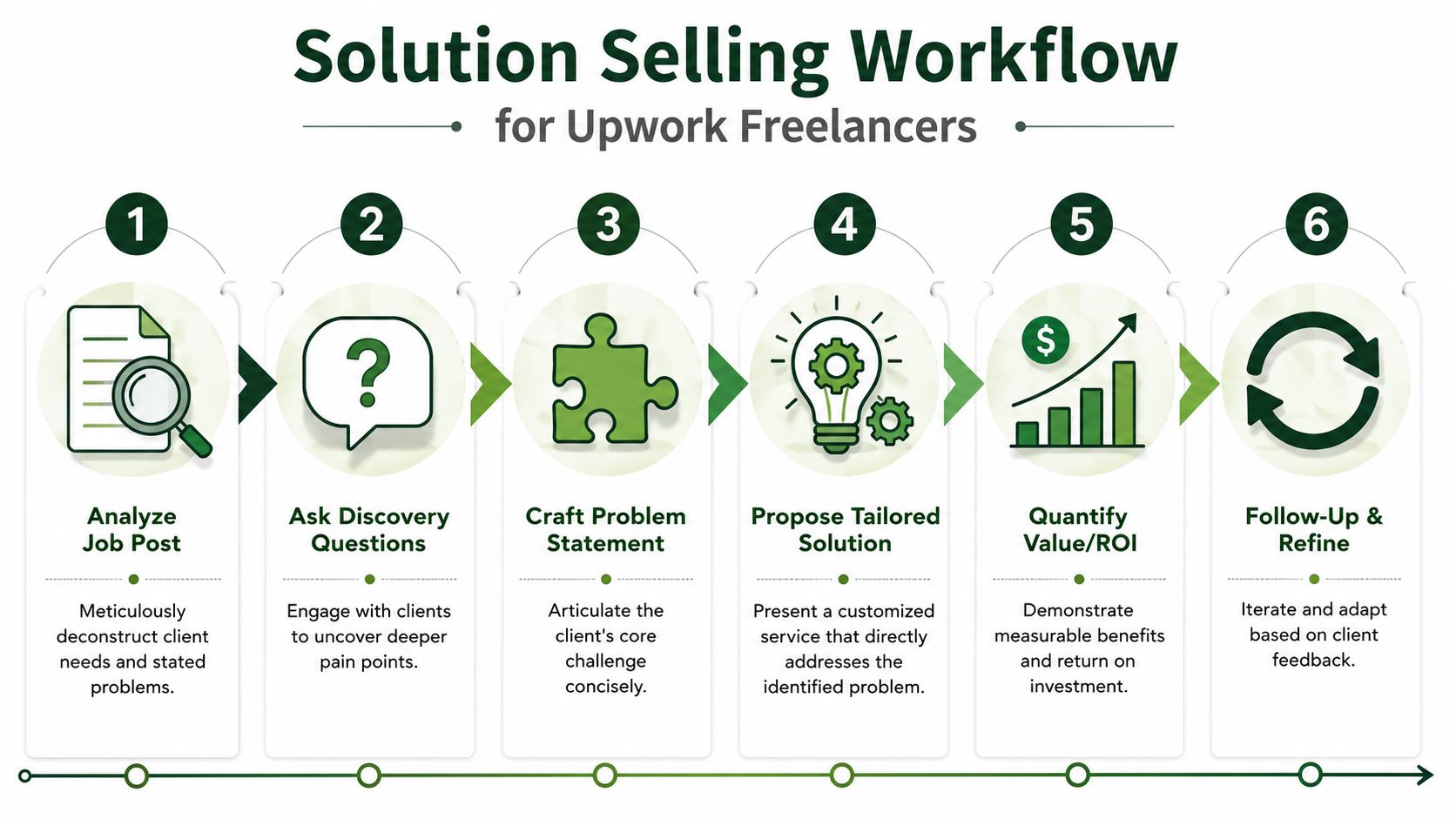
Read for pain, not tasks
A job post gives you two layers of information. The first is the visible task. The second is the likely business pain underneath it.
Here's how to pull that apart:
Look for trigger language
Phrases like “urgent,” “not converting,” “need to fix,” “frustrated,” “replace current freelancer,” or “stuck” usually signal pain, not just workload.Identify what the client thinks they need
Example: “Need email flows set up in Klaviyo.”Form a hypothesis about the underlying issue
That could be weak lifecycle messaging, poor segmentation, missing post-purchase retention, or no abandoned cart recovery.Decide whether the problem is worth diagnosing
Some posts are purely transactional. Some are clearly strategic. Don't force consultative selling onto a client who just wants a simple production task.
If your current outreach still starts with portfolio links and rate, it helps to tighten your process for submitting a proposal on Upwork so the first message opens a conversation instead of trying to close one.
Send a proposal that earns a reply
Your first proposal isn't the whole sale. It's an invitation to a better conversation.
A simple structure works well:
Start with the likely problem
“It sounds like the issue may be bigger than redesigning the page. If traffic is already there, the bottleneck could be message clarity, trust signals, or the handoff from ad to page.”Show pattern recognition
“I see this often when brands request a redesign but the actual leak is in positioning and offer communication.”Ask two diagnostic questions
“Are visitors dropping before the CTA, or are they clicking through and not converting later in the funnel?”
“Has anything changed recently in traffic source, pricing, or offer structure?”Suggest a next step
“If helpful, I can review the current page and outline what's likely design-related versus strategy-related before we scope the work.”
That gets you out of the vendor pile.
A useful walkthrough sits below if you want to see the thinking in action.
Run discovery like a consultant
Once the client replies, your job is to clarify cause and cost.
The framework matters here because solution selling includes a value-engineering phase where the seller calculates ROI and TCO to turn a diagnosed problem into a measurable financial outcome, according to Umbrex's solution selling framework. On Upwork, you usually won't build a formal spreadsheet on the first call, but the principle still applies. You need to connect the issue to money, wasted time, missed leads, delivery friction, or operational drag.
Use questions like:
- Current state: “What's happening now that made this project urgent?”
- Root cause: “What have you already tried, and where did it break down?”
- Impact: “What happens if this stays as-is for the next few months?”
- Decision logic: “How will you decide whether this project worked?”
Practical rule: If you can't explain the cost of inaction, the client will treat your proposal like a nice-to-have.
Co-create the solution before you scope it
Don't jump straight from discovery to quote.
Reflect the problem back in plain language first. Then outline the solution in stages. Then confirm priorities. This avoids the classic mistake of selling work the client didn't want.
For example:
- “It sounds like the homepage isn't the only issue.”
- “You're also losing clarity between paid traffic intent and the page message.”
- “I'd fix this in two parts: first the offer and page structure, then the design layer.”
That's the moment the client stops seeing a freelancer and starts seeing a thinking partner.
Example Proposal Language That Wins Projects
The difference is easier to see in writing than in theory.
Say an Upwork client posts this:
“We need help improving our SaaS landing page. Traffic is decent, but trial signups are low. Looking for a copywriter or conversion-focused marketer who can review the page and suggest improvements.”

The proposal most freelancers send
“Hi, I'm a conversion copywriter with experience in SaaS landing pages, email funnels, and CRO. I've worked with startups and can help improve your landing page for more signups. I write clear, persuasive copy and can start right away. Please see my portfolio for examples.”
Nothing is wrong with it. It's just weak.
It tells the client what the freelancer does. It doesn't show any real understanding of the problem. The client could paste that proposal under almost any SaaS copywriting job and it would still fit.
The proposal that starts the right conversation
“Traffic being decent but trial signups staying low usually means the page is attracting interest but losing conviction before the action.
From the way you described it, I'd want to check three things first: whether the value proposition is immediately clear, whether the page explains the product in the language your buyer uses, and whether the trial CTA feels low-risk enough for someone seeing you for the first time.
Before suggesting a rewrite, I'd want to know:
- What kind of traffic is landing there now?
- Are visitors engaging with the page and not converting, or bouncing early?
- Has the offer, pricing, or trial structure changed recently?
If you'd like, I can review the current page and send back a short diagnosis on what looks like a messaging issue versus a UX issue. Then we can decide whether this needs copy changes only or a broader conversion pass.”
That proposal does four jobs at once.
Why the second version works
First, it reframes the task as a business problem. The job post says “improve landing page.” The proposal says, in effect, “you may have a conviction problem, not just a writing problem.”
Second, it shows specific pattern recognition. Not generic confidence. Not “I'm an expert.” Pattern recognition.
Third, it lowers risk. The freelancer doesn't push a full engagement immediately. They offer a diagnosis first.
Fourth, it opens a conversation the client can answer quickly.
A strong proposal doesn't dump your credentials on the client. It gives them a better way to think about their own situation.
Proposal lines you can adapt
Use these as building blocks, not scripts:
- For developers: “This sounds less like a code issue in isolation and more like a workflow bottleneck that's surfacing in the product.”
- For media buyers: “If the campaigns are producing clicks without qualified leads, the leak may be in targeting, offer match, or the page experience after the click.”
- For designers: “A visual refresh may help, but if users aren't understanding the offer, the structure and messaging need attention first.”
- For SEO consultants: “If traffic is the ask, I'd also want to understand whether the site is converting current visitors well enough before scaling acquisition.”
The best proposal language doesn't try to sound impressive. It tries to sound useful.
Key Performance Indicators for Solution Sellers
If you switch to a solution selling approach and only track proposals sent, you won't know whether the change is working.
Proposal volume is an activity metric. It's not the result that matters. If you need a clean framework for separating reporting noise from decision-making metrics, KPIs vs metrics explained is worth reading because it forces a useful distinction.
Track movement between stages
The strongest freelance sales systems measure progression, not just output.
Good KPIs for this approach include:
Proposal-to-reply rate
Are more clients answering because your proposals identify the core issue?Reply-to-call rate
Are your messages creating enough trust and curiosity to move into discovery?Call-to-proposal acceptance rate
After diagnosis, are clients accepting the solution you scoped?Average project value
Are you winning larger, more strategic work instead of one-off tasks?Quality of client language
Are clients describing outcomes and constraints more clearly in replies, or are they still talking only about isolated tasks?
These tell you whether you're moving from commodity work toward consultative work.
Use win rate carefully
There is one benchmark worth keeping in mind. When paired with strong qualification and real ROI modeling, the solution selling approach typically improves win rates by 5% to 15% in complex B2B sales environments, according to Prospeo's summary of solution selling outcomes.
That doesn't mean you should expect an identical lift on Upwork. The platform behaves differently. Job quality varies, clients disappear, scopes change, and some buyers are still shopping on price. But the directional lesson holds. Better qualification plus better diagnosis tends to improve close quality.
What improvement actually looks like
In practice, the early signs are often qualitative before they become numerical.
You'll notice things like:
- Clients ask better questions: They stop asking only about rate and turnaround.
- Calls get sharper: Less time goes to capability proof, more time goes to business context.
- Scopes become easier to defend: Your price has logic because it's tied to a diagnosed issue.
- Fewer mismatched projects get through: You stop “winning” jobs that should have been avoided.
If your top metric is still “how many proposals did we send,” you're optimizing for motion, not for leverage.
A useful habit is to review five recent wins and five recent losses. Look for patterns in the opening message, the quality of diagnosis, and whether value was framed clearly enough. That audit usually tells you more than another week of bidding harder.
Common Mistakes to Avoid on Your Journey
Freelancers usually don't fail at solution selling because the method is flawed. They fail because they imitate the language without changing the behavior.
Mistake one is over-diagnosing too early
Some people hear “be consultative” and turn a proposal into a mini workshop. They ask six questions, write three paragraphs of theory, and make the client work far too hard before there's any trust.
Keep the first contact light. You need enough diagnosis to show relevance, not enough to deliver free strategy.
Mistake two is asking fake-deep questions
“What keeps you up at night?” sounds consultative and usually lands badly on Upwork. It's too broad, too polished, and too disconnected from the job post.
Ask contextual questions instead:
- Better for a designer: “Are people reaching the page and not taking action, or are they dropping before they understand the offer?”
- Better for a developer: “Is the issue slowing internal operations, customer experience, or both?”
Those questions sound grounded because they are.
Buyers can tell when a question came from actual thinking versus a sales script.
Mistake three is pitching the solution before the problem is shared
This one kills a lot of otherwise strong proposals.
You see the post. You know exactly how you'd solve it. You pitch the package, timeline, deliverables, and price. The client hasn't even confirmed that your interpretation is correct.
That creates friction fast. Nobody likes being prescribed work for a problem they haven't agreed they have.
Mistake four is solving the wrong problem well
This happens more than people admit.
A client asks for SEO content. Often, the issue is weak offer positioning. A client asks for a redesign. Often, the issue is poor traffic quality. A client asks for automation. Often, the issue is messy internal process.
You can execute perfectly and still disappoint them if the diagnosis was off.
The correction that usually works
Use a simple discipline before every proposal or call:
- State the visible task
- Name the likely underlying issue
- Ask what evidence would confirm or reject that hypothesis
- Only then suggest a path
That keeps you sharp without becoming theatrical about discovery.
Scaling Your Approach with Smart Automation
The hardest part of applying solution selling on Upwork is timing.
The platform rewards speed. Good jobs get crowded quickly. But consultative selling takes thought. That tension is real. If you wait too long, the client has already shortlisted other freelancers. If you move too fast, you sound generic.

What automation should do
Automation is useful when it handles the repetitive front end of outreach without pretending to replace judgment.
That means it can help with:
- Job monitoring: spotting relevant posts fast
- Signal sorting: identifying roles with actual pain, urgency, or complexity
- First-draft personalization: tailoring the opening around the likely issue
- Fast follow-up: keeping the conversation alive while the opportunity is still warm
For teams thinking through that workflow, Stimulead's AI sales playbook is a practical reference because it treats AI as process support rather than magic.
What automation should not do
It shouldn't fake empathy. It shouldn't run full discovery by itself on nuanced projects. It shouldn't generate polished nonsense that sounds consultative but ignores the client's actual context.
That trade-off matters because most guides talk about active listening and customized solutions, yet they miss the harder truth that AI can mimic human questioning without real-time listening, and research on this hybrid model remains scarce, as discussed in Zendesk's guide to solution selling.
That's why the safest model is not “automate the whole sales conversation.” It's “use automation to earn the conversation faster.”
The practical hybrid model
A sensible setup looks like this:
Use automation for speed at the top of funnel
It identifies strong-fit posts and gets a relevant first message out quickly.Let humans handle diagnosis once the client engages
This is where nuance matters. You need to hear hesitation, contradiction, priorities, and budget reality.Use systems to maintain follow-through
Scheduling, reminders, reply management, and pipeline visibility can all be systematized.
If you're trying to scale this without turning your proposals into copy-paste sludge, a structured workflow for automating Upwork proposals helps most when it protects the human part instead of replacing it.
The win isn't “AI writes everything.” The win is getting to qualified conversations faster while keeping your judgment focused on diagnosis, scoping, and closing.
If you want a faster way to apply the solution selling approach on Upwork without living in the proposal tab all day, Earlybird AI is built for that. It handles the speed layer of outreach so you can spend more time where deals are won: diagnosing the client's problem, shaping the right solution, and moving strong-fit opportunities into calls.