
← Back To Blog
How to Start an Agency in 2026: The No-Fluff Guide

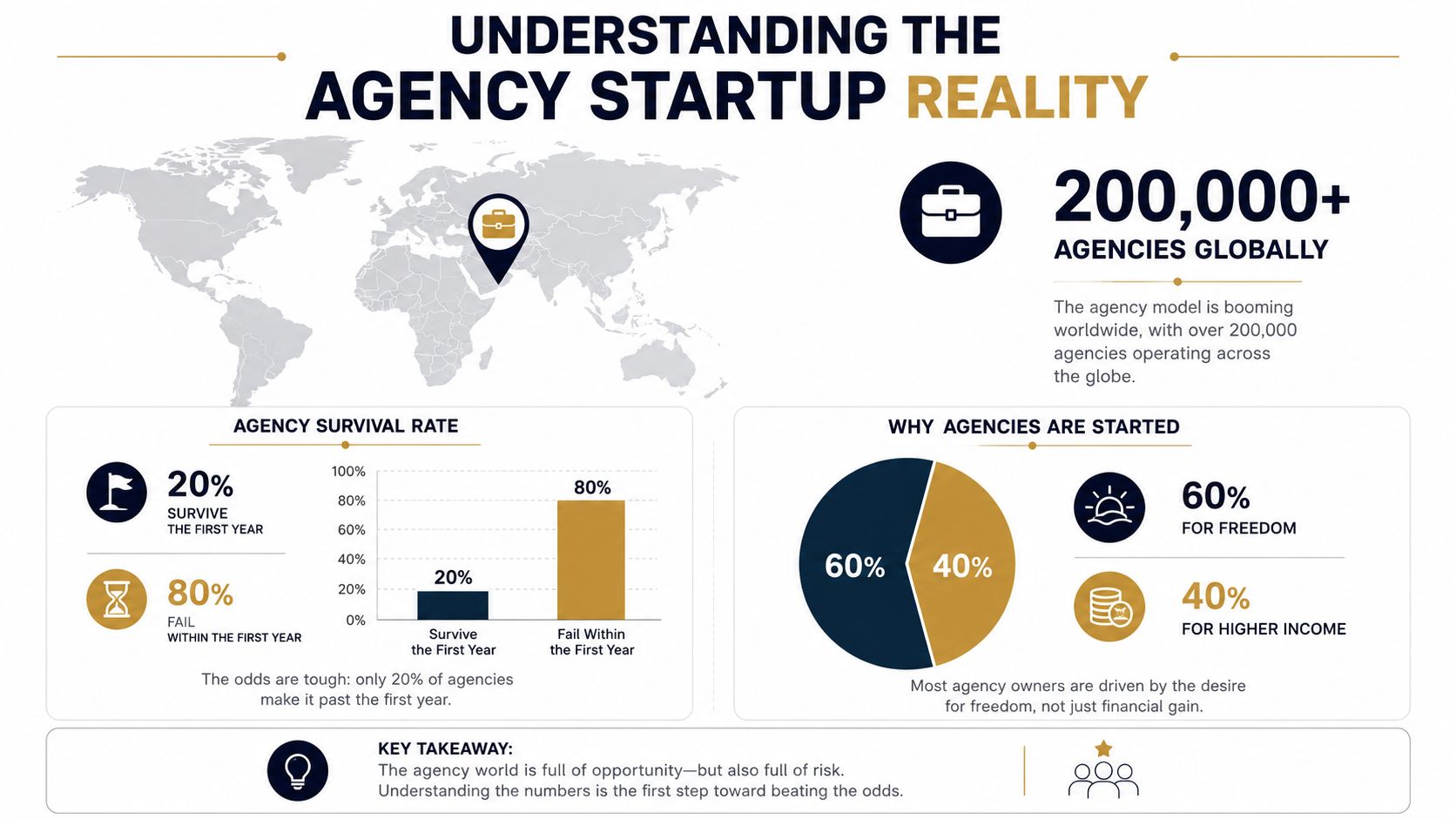
Most agencies don't fail because there isn't demand. They fail because the market is crowded, fragmented, and easy to enter, while survival is much harder than most first-time founders expect. One 2026 roundup says there are 200,000+ agencies globally and 114,014 advertising agencies in the U.S. as of 2026, up 4.4% from 2025 and growing at an average of 6.7% per year over the prior five years, which tells you the opportunity is real and the competition is relentless at the same time (industry statistics on the agency market).
That's the part most “start an agency” guides skip. The harder truth is that survival, not launch, is the filter. In the UK, only 36.7% of agency-cluster businesses born in 2019 were still active five years later, which means roughly 63 in every 100 had closed by that point, and the average digital agency earned a 13% after-tax net margin in 2025, down from a long-run average of about 15% since 2015 (UK agency survival and churn index). If you want to start an agency that still exists years later, you need to think like a founder managing probabilities, not like someone chasing a logo and a website.
One practical way to think about this is to treat every early decision as a margin decision. The agencies that survive usually get sharp about positioning, pricing, and client acquisition before they hire, before they overbuild, and before they pretend referrals will save them. If you want a useful companion to the outbound-first model, founding an outbound agency is a helpful lens because it reinforces a simple truth, outbound is often the earliest reliable way to get signal from the market.
Practical rule: if you can't explain who you serve, what you solve, and how clients find you, you don't have an agency yet. You have a loose idea with overhead attached.
A lot of founders also underestimate how much this business rewards clarity on how money flows. If you want a grounded breakdown of that side of the business, the economics of agency revenue are worth studying alongside the launch plan, especially before you commit to a service mix (how marketing agencies make money). That context matters because the wrong model can leave you busy and underpaid, which is how many new agencies stall out.
Understanding the Agency Startup Reality
The agency market looks open because it is open. Anyone can hang out a shingle, but that does not mean the business will support them for long. Crowded markets punish vague positioning fast, and the firms that survive are usually the ones that make sharp decisions early about who they serve, what they sell, and how they get paid.
The better signal is survival, not entry. A UK agency-survival study found that only a minority of agency-cluster businesses started in 2019 were still active five years later, which is a blunt reminder that attrition is the default outcome for weak operators (UK survival index). That makes pricing and scope discipline matter from the start, because thin margins leave very little room for messy delivery or improvised sales.
What those numbers actually mean for a founder
The wrong reading of those figures is that agency ownership is impossible. The useful reading is more practical. Early choices carry more weight here than in many other businesses, so if you start broad, underprice your offer, and wait for referrals, you are betting against both the market structure and your own runway.
A tighter offer usually creates better odds. Narrow positioning can reduce direct competition, a clear service package can support better pricing, and a repeatable client-acquisition process can protect margin before the business is large enough to absorb mistakes. Agencies that survive usually behave less like creative experiments and more like disciplined distribution businesses.
A founder trying to start an agency should also respect the probability problem. One industry guide cites startup failure rates that are high across the board, along with lower success rates for first-time founders, and that is enough to make the point without pretending the road is forgiving (7-step sustainable growth plan). Those figures are broad startup benchmarks, not agency destiny, but they reinforce the same lesson. You do not win by assuming demand will save you. You win by removing avoidable failure points early.
The agencies that survive do not chase everything. They remove uncertainty one layer at a time.
That usually means a narrow service, a clearly defined buyer, and a sales motion you can repeat without improvising every week. It also means understanding how agency revenue works before you hire, because the wrong model can leave you busy and underpaid. A practical breakdown of that side of the business is covered in how marketing agencies make money, and it is worth reading before you commit to a service mix.
The agencies that treat survival as a design problem build better odds from day one. For a helpful counterpoint to the inbound-heavy advice that dominates this topic, founding an outbound agency shows why direct outreach is often the first reliable way to get market signal.
Choosing Your Niche Before Everything Else
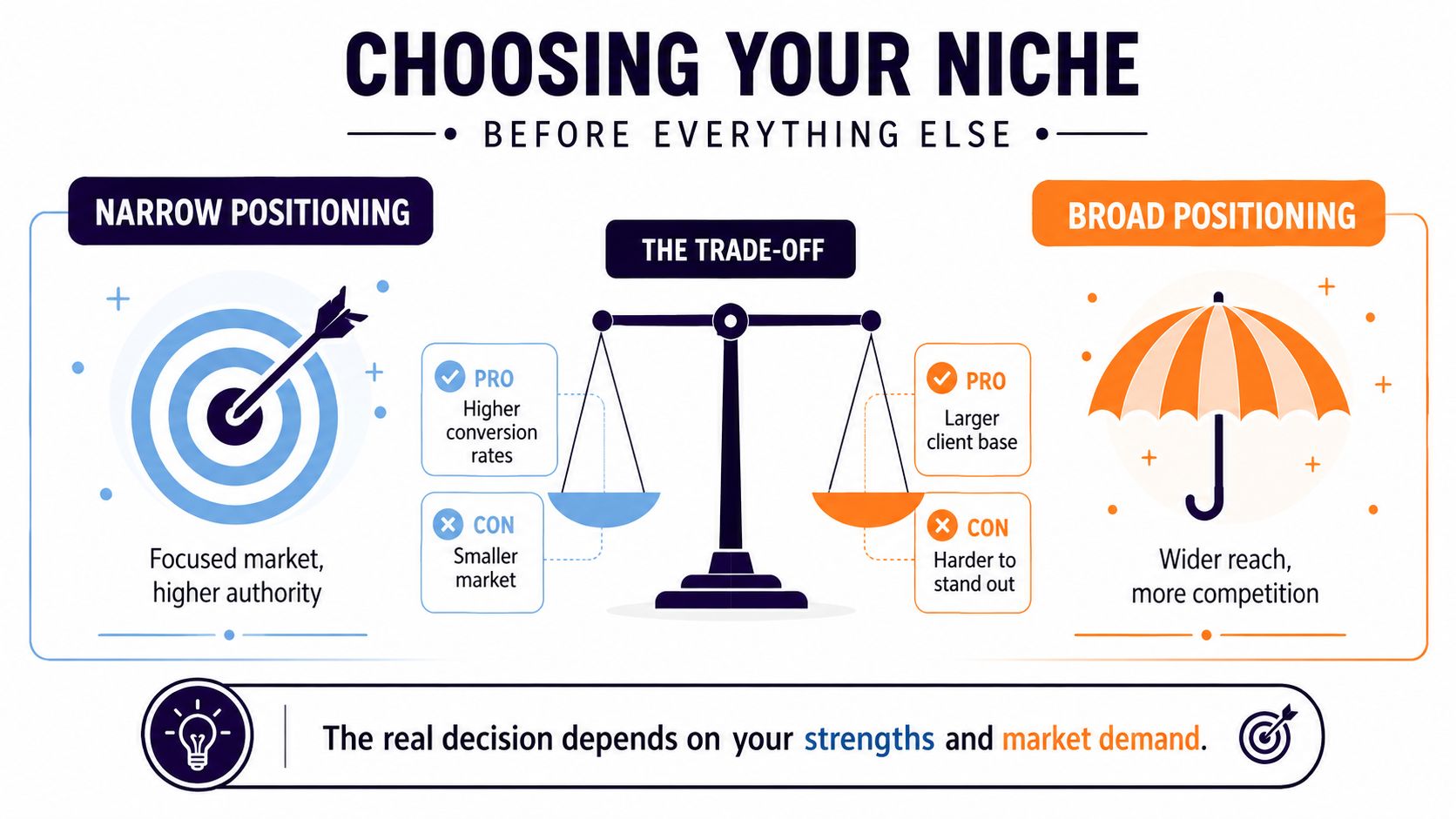
The most honest question isn't whether niche positioning sounds smart. It's whether the niche gives you enough pricing power to justify the constraint. A narrow offer can make you easier to trust, but if the addressable market is too small, you can end up starving while looking specialized. Broad positioning gives you reach, but it also throws you straight into price competition.
The weak version of niche selection is picking a vertical because it sounds trendy. The stronger version starts with evidence. Search demand, hiring signals, and competitor density tell you more than a founder gut feeling ever will, and recent niche-selection content points to overlooked categories like recruitment, trade schools, travel and adventure services, and equipment rental, all of which tend to be operationally messy and in need of competent help (niche-selection analysis).
Narrow enough to matter, broad enough to survive
The sweet spot is where competence, demand, and pricing power overlap. If you can speak the buyer's language, point to a real pain, and see that competitors aren't flooding the channel, you may have a viable niche. If any one of those is missing, pause.
Before you invest, create two or three simple case studies from freelance work, past roles, or tightly framed hypothetical examples if that's all you have. Then talk to a handful of potential buyers and verify that they face the problem you think they do. That's not glamorous work, but it's what keeps a launch from turning into a branding exercise with no customers.
Decision rule: pick the narrowest market that still gives you enough opportunities to learn, sell, and raise prices without constantly hunting for the next client.
One useful way to pressure-test your positioning is to ask whether the buyer already buys the type of work you sell. If they do, your job is easier. If they don't, you're not starting an agency, you're educating a market, and that changes the time horizon completely.
For a structured way to think about audience and offer fit, the segmentation framework in target market segmentation helps turn a fuzzy niche idea into a real commercial decision. That kind of clarity matters because the wrong niche choice can force you into low-margin work even when your delivery is strong.
Setting Up the Legal and Financial Foundation
The unglamorous setup work decides whether an agency survives its first stretch of real revenue. A loose brand can buy time, but messy ownership, mixed money, and no bookkeeping will catch up fast once client payments start moving. Upwork's agency-start guidance is direct about the order, clarify services, use the business model canvas, gather market data, then handle registration, tax setup, a separate bank account, and bookkeeping procedures before launch (Upwork guide to starting an agency).
Build the base before the first invoice
Pick the structure that fits your risk and how you operate. Many founders choose an LLC or an equivalent structure because it separates personal liability from business activity more cleanly, and that separation matters the moment a client dispute or contract problem shows up. A sole proprietorship is easier to set up, but easy is not the same thing as protected.
Do the administrative work in order. Register the business, get the tax number you need, open a separate business bank account, and put bookkeeping in place from day one. A clean ledger is not an accounting perk, it is how you see whether the agency is healthy.
The minimum financial discipline that works
Keep the system simple enough that you will maintain it. A spreadsheet can work early if it is updated consistently, and tools like QuickBooks or FreshBooks become useful once transaction volume grows. The point is to see income, expenses, and tax obligations every month, not to discover them at year-end under pressure.
Practical rule: if you cannot tell whether a client is profitable without doing math in your head, your financial system is not ready.
Conservative launching is the right default because agency survival is not forgiving. A lot of frameworks point to a hard failure rate for startups, and the implication is the same either way, keep overhead low, avoid office commitments, and do not hire full-time until revenue can support it. Fixed costs are where early agencies get trapped, especially when the founder confuses looking established with being financially stable.
The agencies I have seen fail fastest usually did one thing badly, they paid for appearance before they had repeatable sales. A polished website does not cover payroll. An office does not create demand. The legal and financial foundation exists to keep the business survivable long enough for the sales motion to prove itself.
A good pricing guide from the Jumpstart Partners agency pricing guide is useful here because it treats pricing as a profitability problem, not just a sales tactic.
Pricing and Packaging Services for Profit
Pricing is where many agencies sabotage themselves. They either sell hours and cap their own growth, or they sell projects and get crushed by scope creep. The smarter move is to choose a pricing model that matches the stage of the business and the type of value you can prove.
The three models worth comparing are hourly, retainer, and value-based pricing. Hourly pricing is easy to explain, but it ties revenue to time and invites clients to focus on busyness. Retainers are steadier, especially for ongoing work like SEO, content, and social management. Value-based pricing is the most powerful when you can connect your work to business outcomes clients care about.
What each model does well and where it breaks
| Pricing Model | Best For | Key Advantage | Main Risk |
|---|---|---|---|
| Hourly rates | Early services and undefined scopes | Simple to sell and easy to start | Caps income and rewards time, not outcomes |
| Monthly retainers | Ongoing delivery and recurring needs | Predictable cash flow and longer relationships | Scope can drift if boundaries aren't clear |
| Value-based pricing | Outcome-driven work with strong proof | Stronger positioning and better margins | Hard to justify without credible evidence |
A good pricing guide from Jumpstart Partners is useful here because it treats pricing as a profitability problem, not just a sales tactic (agency pricing strategy and service pricing profitability). That's the right frame. The wrong frame is trying to sound affordable to everyone.
Proof changes what you can charge
A strong case study needs the client's initial challenge, the approach you used, and specific measurable results. Testimonials land better when they come from named people at recognized brands and clearly state the business impact. Those proof points matter because they let the buyer defend your fee internally instead of treating it as a guess.
Bottom line: pricing is a positioning signal. Underpricing tells the market you're unsure. Pricing without proof tells the market you're improvising.
If you're early, start with a model you can deliver cleanly and explain easily. As the portfolio grows, move toward higher-value packages and stronger retainers. Agencies that do that well usually stop selling effort and start selling confidence.
Client Acquisition and Upwork Automation
Client acquisition is where new agencies most often stall. The founders who make it through don't wait for referrals to arrive, they build a repeatable outbound rhythm and keep it active long enough for the market to answer. One practical launch method recommends identifying 50 to 200 target businesses, creating 2 to 3 simple case studies, and setting a 3-month revenue target of about $3,000 to $5,000, which it says can be reachable with 2 to 3 decent-sized clients in many service categories (launch methodology for agencies).
Treat Upwork like a distribution channel, not a side quest
Upwork is still underused by many new agencies because founders assume it's only for freelancers or low-budget buyers. That's a mistake. It's a live marketplace with intent already present, and response speed matters there more than polish. Proposals submitted within about 10 minutes of a posting tend to get much more attention than late submissions, which means speed can beat a prettier portfolio in the first round of filtering.
That's where automation can matter. Earlybird AI is one option that connects to an Upwork account, learns what kinds of projects you want from simple feedback, and then searches, drafts personalized proposals, and replies to client messages automatically. For small agencies trying to stay responsive without adding manual sales labor too early, that kind of workflow can keep leads moving while the team focuses on delivery.
Build a prospecting rhythm you can sustain
Traditional methods still work, but they need structure. If you're using direct outreach, content, or marketplace bidding, you need a daily habit and a clear review loop. The agencies that convert consistently are the ones that treat proposals like a craft, not like a sporadic chore done after client work is finished.
For a broader list of approaches beyond paid channels, no-cost marketing strategies can help you think about organic visibility without turning acquisition into an expensive experiment. The practical point is simple, don't rely on a single lead source when you're trying to survive your first stretch of revenue.
Practical rule: if leads aren't coming in, don't immediately blame the niche. First check speed, specificity, and whether the message matches the buyer's problem.
If you're using marketplace automation, keep the human layer tight. Tools can help with response time and consistency, but the offer still has to be specific enough that a buyer can say yes without decoding it. That's the difference between automation that saves time and automation that just produces more noise.
Hiring, Workflows, and Early Growth
Hiring too early is expensive. Hiring too late is limiting. The right moment is usually when you consistently have more work than you can handle at the quality standard you've set, not when you feel busy or stressed. That distinction matters because busy founders often confuse emotional overload with operational need.
Start with contractors or fractional help before full-time roles. That keeps risk lower and gives you room to test working relationships without locking in payroll. It also lets you see where bottlenecks are, because the bottleneck is rarely where you first think it is.
Systems are the real scaling lever
Once you bring on help, document the work. Write down how proposals are created, how onboarding happens, what reports go out, and how client communication is handled. Agencies grow faster when the team can find answers in a shared system instead of interrupting the founder for every small decision.
Onboarding deserves extra attention because confusion early on creates churn later. A clean welcome call, a scope document, a timeline with milestones, and immediate access to the project management system can prevent a lot of avoidable friction. Clients want to feel guided from day one.
The niche-selection research points to underserved, operationally messy businesses as promising targets, and that matters once you start hiring because those clients often value responsiveness and clarity over flashy positioning. If your delivery system is clean, those relationships are easier to retain and easier to turn into referrals.
Measure growth by quality, not just volume
Track client acquisition cost, lifetime value, gross margin per client, and utilization rate. If revenue rises while margin falls, that's not a sales win, it's a delivery problem wearing a sales costume. Fix the delivery side before you add more accounts.
Growth gets easier when the founder stops being the only system holding the business together.
That's the milestone. Not a bigger team for its own sake, but a business that can take on more clients without multiplying chaos. Agencies that reach sustainable scale treat operations as seriously as outreach, because both determine whether the business survives long enough to matter.
If you want an agency that can respond to leads quickly, keep outreach consistent, and reduce the manual grind of Upwork prospecting, Earlybird AI can handle job search, personalized proposals, and follow-ups while you stay focused on strategy and delivery. Use it when you're ready to turn client acquisition into a system instead of a scramble, especially if you want more of the right conversations without adding a full-time sales hire too early.