
← Back To Blog
Upwork Membership Plans a 2026 Freelancer Comparison
You know the moment. A strong-fit job lands in your feed, the client is paying attention, your niche matches exactly, and then Upwork tells you you're low on Connects. That isn't just an annoyance. It's a capacity problem.
For solo freelancers, that problem feels tactical. For agencies and high-volume bidders, it's operational. Your plan determines how often you can compete, how much friction sits between your team and a submitted proposal, and whether your outreach system can run consistently or stall every few days.
Most advice about Upwork membership plans stops at feature lists. That misses the primary question. The primary question is whether a plan improves client acquisition enough to justify its cost. If you're already using outbound channels outside Upwork, it helps to compare the marketplace decision against other proven strategies for freelance clients, because the right answer depends on how much of your pipeline you expect Upwork to carry.
Are Upwork Membership Plans Worth the Investment
If you're actively trying to grow on Upwork, membership isn't a side setting. It's part of how the platform is built to function at scale. Upwork reported $618.3 million in revenue in 2022 and $4.1 billion in gross services volume that same year, according to this breakdown of Upwork revenue and marketplace scale. Those numbers matter because they show what you're participating in. This is a large marketplace with real transaction volume, not a casual job board.
That scale changes how I look at plan decisions. I don't treat Freelancer Plus as a vanity upgrade. I treat it like a tool for increasing proposal throughput and reducing delays inside a lead generation process.
For a selective specialist who sends only a few proposals and wins from referrals, paying for more capacity can be wasteful. For an agency running multiple bidder workflows, the opposite is true. Underpowered accounts create bottlenecks. The team starts rationing proposals, skipping decent-fit jobs, or waiting to replenish Connects instead of responding while a post is fresh.
Practical rule: If running out of proposal capacity changes who you bid on, when you bid, or how fast your team responds, you're no longer making a simple pricing decision. You're managing a sales constraint.
A lot of freelancers still frame this as “is Upwork free?” That's the wrong frame for anyone trying to scale. If you want a grounding in the platform's actual free-versus-paid setup, this breakdown of whether Upwork is free for freelancers is useful. The better question is whether your current plan supports the volume, speed, and consistency your pipeline requires.
Upwork Freelancer Plans An Overview
A freelancer sending three carefully chosen proposals a month can stay on Basic for a long time. An agency trying to keep two sales reps bidding daily will feel Basic as a constraint almost immediately. That is the split between Upwork's freelancer plans.

Upwork keeps the choice simple. There is a free tier, Basic, and a paid tier, Freelancer Plus. The feature list matters, but the better way to read these plans is by outreach capacity.
Basic suits low-volume, selective selling
Basic works for freelancers who treat Upwork as one channel among several. A specialist who gets referral work, applies only to tight-fit jobs, and does not need daily proposal volume can stay on Basic without creating much friction.
The trade-off is obvious once work gets busy. Proposal activity becomes inconsistent. Teams start saving Connects for only the best-looking posts, which sounds disciplined but often means slower response times and fewer tests of new offers or niches.
For a solo consultant, that can be fine.
For an agency trying to build repeatable outbound on Upwork, it usually is not.
Freelancer Plus fits accounts that use Upwork as an active acquisition channel
Freelancer Plus adds paid monthly capacity and gives active sellers more room to keep outreach moving. That matters less for occasional bidders and much more for anyone treating Upwork like a sales pipeline.
The practical benefit is not just “more features.” It is fewer interruptions. If your process involves checking new posts throughout the day, assigning proposals across team members, or testing multiple positioning angles, Plus reduces the stop-start behavior that hurts response speed.
That is why I rarely frame Plus as a profile upgrade. It is a workflow purchase.
Here is the quick comparison:
| Plan | Cost | Included Connects | Best fit |
|---|---|---|---|
| Basic | Free to start | Limited monthly capacity | Low-volume freelancers, selective specialists |
| Freelancer Plus | Monthly paid plan | Higher monthly capacity | Active freelancers, agencies, high-volume outreach |
The right plan depends on how you buy work
If Upwork produces only a few deals a quarter, Basic is usually enough. Paying monthly for unused bidding capacity is wasteful.
If Upwork is one of your main lead sources, the math changes. Plus starts making sense when the added proposal volume helps your team respond faster, cover more qualified posts, and keep outreach consistent enough to learn what converts. That is the point where a membership plan stops being an account setting and starts affecting revenue.
Freelancer Basic vs Plus A Detailed Feature Breakdown
A freelancer sending two carefully chosen proposals a week should not buy Plus by default. An agency running daily outreach usually should. The feature gap matters because it changes proposal volume, response speed, and how much manual work your team does to keep the pipeline full.
Connects and bidding power
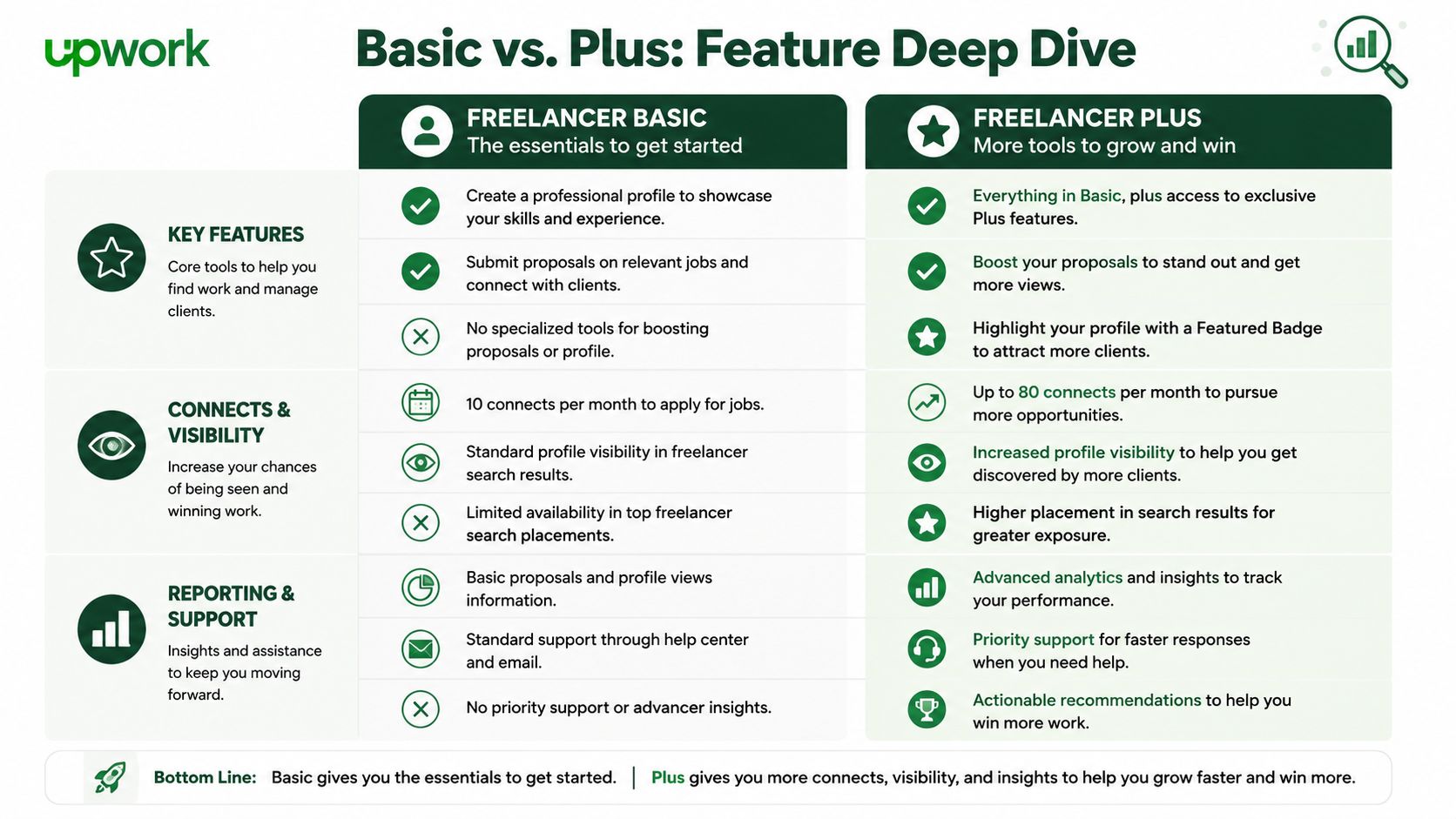
The paid plan changes the math first, and the workflow second. Upwork's Freelancer Plus guide says the plan costs $19.99 per month and includes 100 Connects per month, along with proposal insights, full access to Uma, job alerts, profile customization, and 0% freelancer service fees on Direct Contracts while the membership is active.
For low-volume freelancers, extra Connects are often wasted inventory. They already know which jobs fit, and they are not trying to keep a daily application target.
For agencies and high-volume freelancers, Connects are operating capacity. If your process includes checking fresh postings throughout the day, routing opportunities by niche, and submitting fast while the client is still reviewing early applicants, limited Connects create bottlenecks. The result is missed jobs, slower testing, and weaker feedback loops on what converts.
That is the difference. Basic supports selective bidding. Plus supports a managed outreach system.
Proposal insights and decision quality
Proposal insights help teams cut bad bids before they spend time drafting. That matters more than people think.
The common failure point on Upwork is not always weak copy. It is bad job selection. Bidders chase posts with poor budgets, unclear scopes, or overcrowded applicant pools, then blame conversion. Insight tools help reduce that waste if someone on the team is reviewing the signals and making go or no-go decisions.
This is also where scale changes the value of the plan. A solo specialist may rely on instinct and years of niche knowledge. An agency training junior sales staff needs a tighter decision process. Plus gives them more structure, which can reduce sloppy applications and protect Connects from being burned on jobs they should have skipped.
To see the platform mechanics in action, this walkthrough is worth a watch:
Profile customization and signaling
Profile customization is easy to dismiss until you are already getting profile views and need a better conversion rate from those views.
For a beginner with weak positioning, this feature has little ROI. Better formatting does not fix a generic offer, thin portfolio, or unclear niche.
For established freelancers and agency operators, profile control can improve how clearly each account maps to a service line. That matters when one profile is aimed at Shopify retention work and another is aimed at Google Ads management. Cleaner signaling reduces confusion and makes it easier for the client to connect the proposal to a specific outcome.
Small gains count here. If profile presentation lifts response quality even slightly across a large proposal volume, the feature starts paying for itself.
Full access to Uma and workflow speed
Uma matters if your team already has a disciplined proposal process. It can speed up first drafts, summarize job posts, and reduce repetitive writing work.
It does not fix weak strategy.
Agencies get the most value when they use AI for prep work, then have a human tailor the angle, proof the details, and decide whether the opportunity is worth pursuing at all. That setup cuts production time without flooding the market with obvious template proposals. If your team is submitting enough volume for time savings to add up each week, full access has real operational value. If you send only a handful of proposals a month, the feature is nice to have, not a reason to upgrade.
Direct Contracts fee difference
The Direct Contracts fee policy is one of the few Plus benefits with a very clear dollar impact. Plus members get 0% freelancer service fees on Direct Contracts while the membership is active, as noted earlier.
This only matters for freelancers and agencies who use Direct Contracts. If that workflow is a regular part of your business, the monthly subscription can pay for itself quickly. If you never bring clients in through Direct Contracts, this feature has no practical value and should stay out of your decision.
What changes day to day
Basic is the better plan for specialists with low proposal volume, inconsistent Upwork usage, or an offer that still needs work. Paying monthly before the sales process is stable usually just increases spend.
Plus makes sense once outreach is consistent enough to measure. The break-even point is not about liking extra features. It is about whether the added Connects, faster drafting, better filtering, and profile control help your team win enough qualified work to justify the fixed monthly cost.
That is why I treat Basic as a low-risk starting setup and Plus as a production plan. One keeps the door open. The other supports scale.
Who Benefits Most From Each Upwork Plan
The cleanest way to choose among Upwork membership plans is to stop thinking like a consumer and start thinking like an operator. Different plans fit different business models.
The part-time specialist
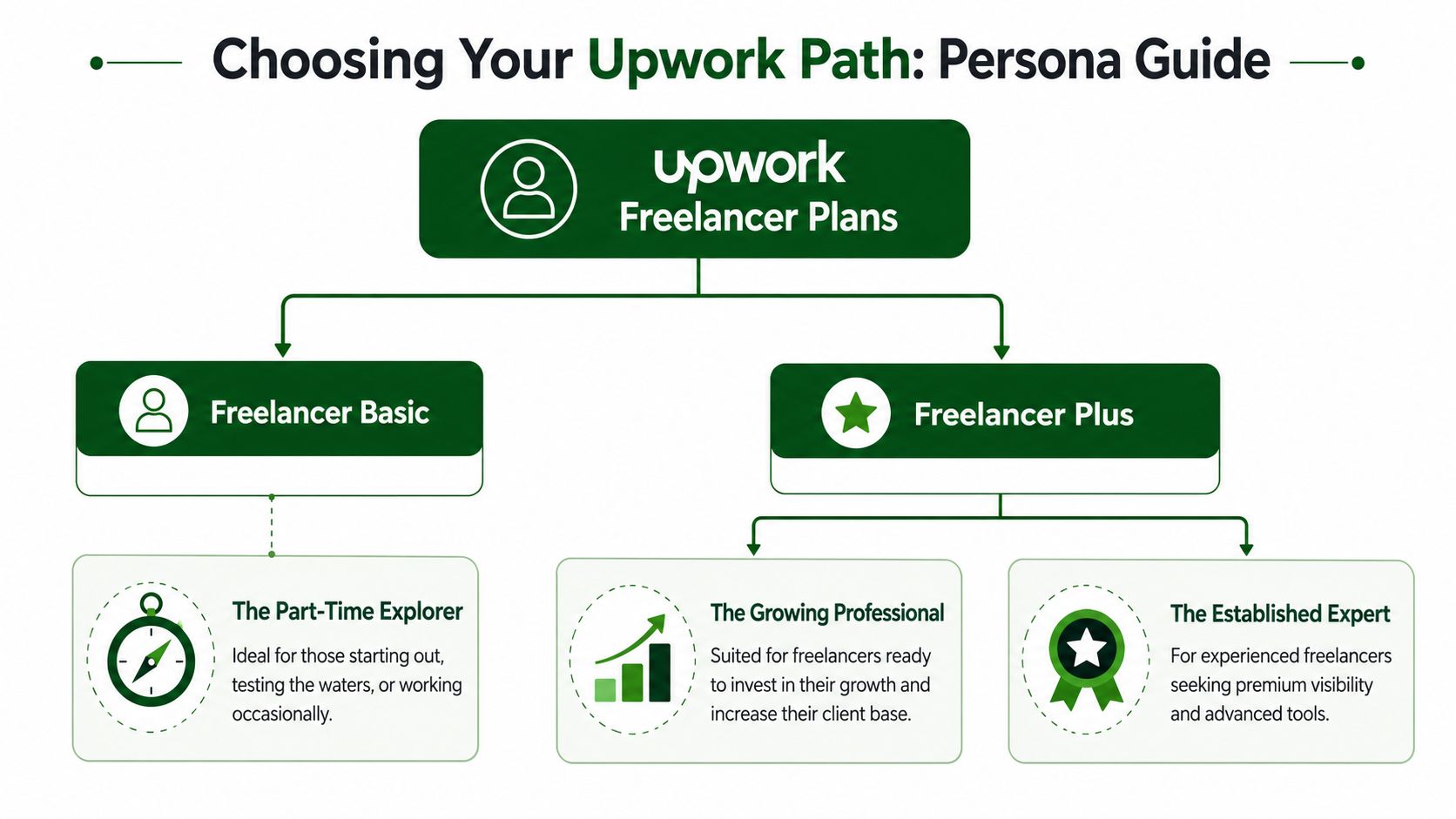
This freelancer knows their niche, checks the feed occasionally, and sends proposals only when a job is almost perfect. They may already get enough work from referrals, repeat clients, or another channel.
For this person, Basic is often the right call. The low monthly Connects count doesn't hurt much because they aren't trying to build volume. They care more about precision than activity.
Basic is also sensible for someone still validating their positioning. If your profile, niche, and offer are still shifting, paying for more proposal capacity can just accelerate bad habits.
The full-time solo professional
This seller treats Upwork as an active revenue channel. They check new postings regularly, respond quickly, and need enough Connects to stay in the market without second-guessing every application.
That person usually fits Freelancer Plus. Not because every feature is life-changing, but because consistency matters more than occasional access. A solo professional loses momentum when proposal volume becomes erratic.
This is also where proposal insights and job alerts start to earn their keep. A working freelancer benefits from better filtering and faster response loops because those small efficiencies stack across the month.
If Upwork is one of your main lead sources, unstable bidding capacity creates unstable revenue conversations.
The scaling agency
This is the group that is underserved with generic advice. Agencies don't just need “more features.” They need fewer bottlenecks.
An agency often has multiple specialties, multiple bidders, or at least a more structured intake process. The team may test several offer angles, rotate responsibility for proposals, and monitor response quality over time. In that environment, Plus isn't about convenience. It's infrastructure.
A scaling agency also feels the cost of inconsistency more sharply than a solo freelancer. When Connect limits interfere with timing, the problem doesn't stay isolated. It ripples into team coordination, pipeline forecasting, and close rates.
Here's the practical split:
- Basic fits freelancers who bid occasionally, rely on inbound or referrals, or are still learning what buyers respond to.
- Plus fits freelancers who want repeatable weekly proposal volume and care about reducing friction.
- Plus becomes hard to avoid when a team treats Upwork as a system rather than a side channel.
When the upgrade is a waste
Plus is a waste when your issue isn't plan capacity. If your proposals are generic, your niche is muddy, or your profile creates no trust, buying more Connects just lets you fail faster.
It's also a weak investment if you log in sporadically. A monthly plan only works when you use it consistently enough to benefit from the additional reach and workflow tools.
Calculating the ROI of Freelancer Plus
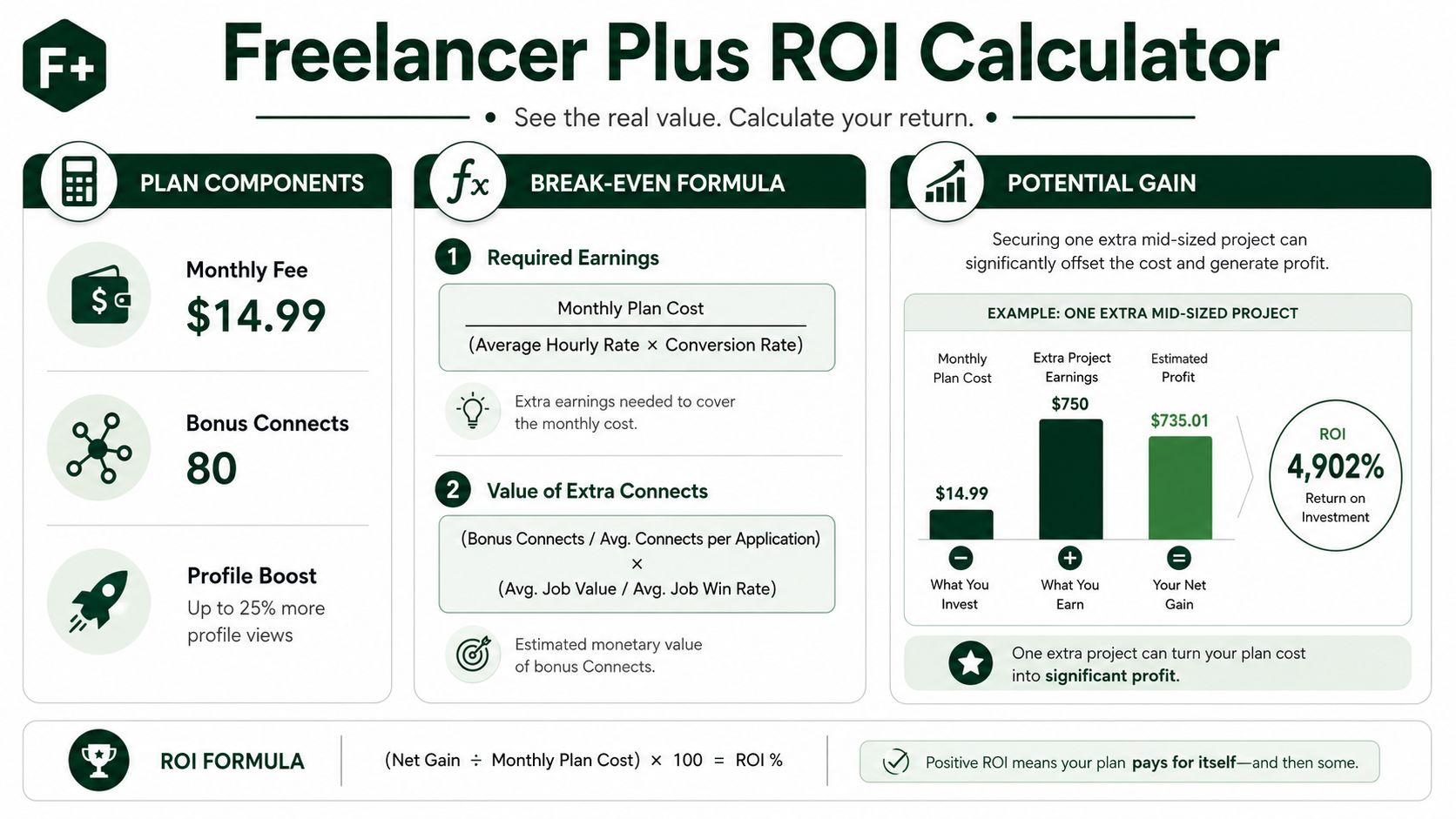
A common agency scenario looks like this. Monday morning brings a batch of fresh jobs, your bidder wants to test two proposal angles, and the account is already tight on Connects. That is the moment to calculate ROI properly. The question is not whether $19.99 feels cheap or expensive. The question is whether the plan removes a bottleneck that costs more than $19.99.
If you budget your freelance business seriously, it helps to streamline freelancer financial management so platform costs sit next to lead generation, software, and delivery costs instead of getting treated like random small expenses.
Start with the cheapest valid comparison
The first comparison is simple. Basic gives limited monthly bidding capacity. Plus gives a larger monthly bundle and reduces the need for separate Connect purchases, as noted earlier in this article.
That creates a practical break-even point. If you already buy enough extra Connects each month to get close to the Plus subscription cost, the paid plan is usually the cleaner choice. If you rarely run out, Plus is probably dead weight.
For solo freelancers, this is mostly a cash flow decision.
For agencies and high-volume freelancers, it is an operations decision. Buying Connects one batch at a time often means someone on the team hits a limit, pauses outreach, and resumes later. That stop-start pattern matters because response rates are usually highest when jobs are still fresh.
Measure proposal throughput, not just monthly spend
A lot of people calculate plan ROI too narrowly. They compare the subscription price to the cost of extra Connects and stop there. That misses the bigger question. How many qualified proposals can your team send each week without interruption?
If Plus lets you maintain a consistent proposal cadence, test more offer variations, and respond faster to strong-fit jobs, the gain is not just lower Connect friction. The gain is more chances to create sales conversations.
A simple operating check works well:
- Basic makes sense if your Connect balance almost never affects when or how often you bid.
- Plus makes sense if you regularly buy extra Connects or delay applications because you are managing the balance too tightly.
- Plus is usually underpriced for agencies if proposal volume is tied to revenue targets and multiple people rely on the same outreach system.
One missed proposal on a good-fit posting can cost more than a month of Plus. One extra low-quality proposal wins nothing. That is the trade-off.
Direct Contracts can make Plus pay back faster
There is a second ROI path that gets overlooked. Freelancer Plus can reduce costs on Direct Contracts while the membership is active. If that part of your sales process matters, review how Upwork fees apply to freelancers across different contract types.
This matters most for freelancers and agencies who use Upwork as the top of funnel, then manage some client relationships through Direct Contracts. In that setup, the membership is not just buying more outreach capacity. It can also lower transaction costs on the work that closes.
The math depends on your own deal size and frequency. Still, the decision is usually obvious after one review cycle. If Direct Contracts are rare, this benefit is minor. If they are part of your regular client mix, the subscription can pay back quickly.
Agencies should price the interruption cost
Agencies usually undercount ROI. They look at the plan fee and ignore the cost of inconsistent execution.
If your team uses Upwork as a repeatable acquisition channel, capacity affects more than bidding volume. It affects workflow stability. A constrained account slows testing, creates gaps in coverage, and makes outreach timing less predictable. That hurts any system built around speed and consistency.
The effect gets stronger when you use automation. Earlybird AI, for example, connects to your Upwork account to search for matching jobs, draft proposals, and automate replies and follow-ups. Automation only helps when the account can support steady outbound activity. If Connect availability keeps forcing pauses, the tool is still useful, but your process runs below capacity.
My rule for agencies is blunt. Upgrade when the paid plan protects a repeatable outreach system. Stay on Basic when your real problem is offer quality, targeting, or close rate. More capacity helps a working machine. It does not fix a broken one.
How to Upgrade or Downgrade Your Upwork Plan
Changing plans is simple, but the smart move is to time the change around your actual bidding cycle.
Upgrade when you need uninterrupted capacity
If your current volume is rising, upgrade before you hit a shortage. That keeps your proposal flow consistent and avoids the stop-start pattern that hurts response timing. Inside Upwork, the option sits in your account or membership settings, where you can switch from Basic to Freelancer Plus and review billing details before confirming.
Downgrade when your usage drops
If referrals pick up, repeat clients fill your calendar, or you're taking a break from active bidding, downgrading can make sense. The paid plan only has value when you're using the additional capacity and features often enough to matter.
Two practical checks help before you switch:
- Review your current proposal pace. Don't downgrade in the middle of a heavy outreach month.
- Check your billing timing. Make changes with your cycle in mind so you're not creating unnecessary friction.
If you're unsure, wait one more cycle and track how many times your work was limited by your current plan. That gives you a better answer than guessing.
FAQs for Agencies and Power Users
Can one Freelancer Plus plan solve an agency's bidding needs
Usually, no. One Plus plan helps one account operate with less friction. Agencies still need to think at the account and workflow level. If multiple people are involved in sourcing, writing, and replying, the plan is only one layer of the system.
The bigger question is whether each active bidding account has enough capacity and enough process discipline to justify being part of the agency's outreach machine.
Does Freelancer Plus matter more when you use automation
Yes, because automation only helps if the account can sustain consistent activity. If your workflow depends on quick discovery, fast proposal drafting, and reliable follow-up, low Connect capacity creates artificial limits.
That's why agencies using tools, templating systems, or shared bidder workflows often outgrow Basic faster than solo freelancers. They aren't just buying Connects. They're protecting process continuity.
Should agencies prioritize Plus or better proposal operations first
Better operations first. A paid plan amplifies whatever process you already have.
If your team hasn't defined qualification criteria, proposal standards, reply handling, and role ownership, Plus won't fix that. It just gives a messy system more room to stay messy. Once the process is solid, the upgrade starts to look much smarter.
Is Freelancer Plus the ceiling for agency investment on Upwork
No. It's closer to the floor for teams that bid seriously. The plan helps with capacity and workflow, but agencies usually need more than that. They need clear market positioning, repeatable proposal logic, message handling, and account management.
That's also why agency owners should understand how an Upwork agency account works in practice. Membership plans matter, but they sit inside a larger operating model.
When should a power user stay on Basic anyway
Stay on Basic if your pipeline is already full, your Upwork usage is occasional, or the account isn't central to revenue. Some experienced freelancers win more by being selective than by increasing volume.
That decision is strongest when it's deliberate. Basic works well when low activity is a strategy. It works badly when low activity is imposed by the plan and subtly limits growth.
If your team is already winning work on Upwork and the problem is scale, not capability, Earlybird AI is built for that stage. It connects to your Upwork account, helps identify matching jobs, drafts personalized proposals, automates replies and follow-ups, and supports multi-user workflows for agencies that need a steadier outreach engine.