
← Back To Blog
Upwork Readiness Test: Pass to Win More Jobs in 2026
You’ve finished your profile, added your skills, maybe even polished your first few proposals, and then Upwork stops you with one small gate: the upwork readiness test.
A lot of freelancers treat that moment like busywork. That’s a mistake. The test is small, but the ideas behind it shape nearly everything that matters on the platform: whether you work under a contract, how complete your profile is, how you communicate with clients, and how safely you get paid. If you run an agency, those basics matter even more because weak habits don’t stay small. They spread across every bidder, account, and client conversation.
In 2026, the primary value of the upwork readiness test isn’t the quiz itself. It’s that it teaches the rules of the road before you try to drive faster.
What Is the Upwork Readiness Test and Who Should Take It
The upwork readiness test is a short, foundational multiple-choice assessment introduced around 2020. It includes approximately 10 questions on platform policies, profile optimization, and core best practices, according to this overview of the Upwork Readiness Test.
That description sounds simple. In practice, it covers the things new freelancers get wrong most often.
What the test is really checking
The questions are built around practical platform behavior, not theory. You’re expected to understand basics like:
- Profile quality matters: Your photo, title, overview, employment history, skills, and portfolio all affect how credible you look.
- Contracts come first: You should never start work without a contract in place.
- Payment rules matter: Upwork wants freelancers to understand on-platform payment protection and why off-platform payments create risk.
- Client communication counts: Proposal quality, response habits, and professional conduct all shape your visibility and trust.
This is why I don’t treat the test as a checkbox. It’s Upwork’s way of making sure a new seller understands how business is supposed to run on the platform.
Practical rule: If a question seems obvious, ask what risk Upwork is trying to prevent. That usually leads you to the right answer.
Who should take it
If you’re new to Upwork, this test is for you. It’s the entry-level standard for understanding how the marketplace works before you start chasing jobs.
If you’re an experienced freelancer coming back after time away, it’s still worth reviewing the core principles because platform habits drift. Teams forget small rules. Agencies let junior bidders improvise. That’s where avoidable mistakes start.
For brand-new accounts, the smartest move is to build your setup and test prep together. If you’re still getting your basics in place, this guide on creating your Upwork account properly pairs well with the test because the same profile elements show up in both.
Why Upwork uses a test at all
Upwork operates at scale. It needs a baseline. The platform can’t assume every new freelancer understands contract safety, profile standards, and marketplace etiquette on day one.
So the test acts like a minimum operating standard. It tells Upwork, and indirectly your future clients, that you’ve at least learned the fundamentals. That’s not a guarantee of success. But without fundamentals, success usually doesn’t last.
Why the Readiness Test Is Your First Step to Winning Jobs
The upwork readiness test matters because it connects directly to visibility, trust, and momentum. Those aren’t abstract benefits. They affect whether clients even see you, whether they reply, and whether your first months on the platform are smooth or frustrating.
It improves your odds of being seen
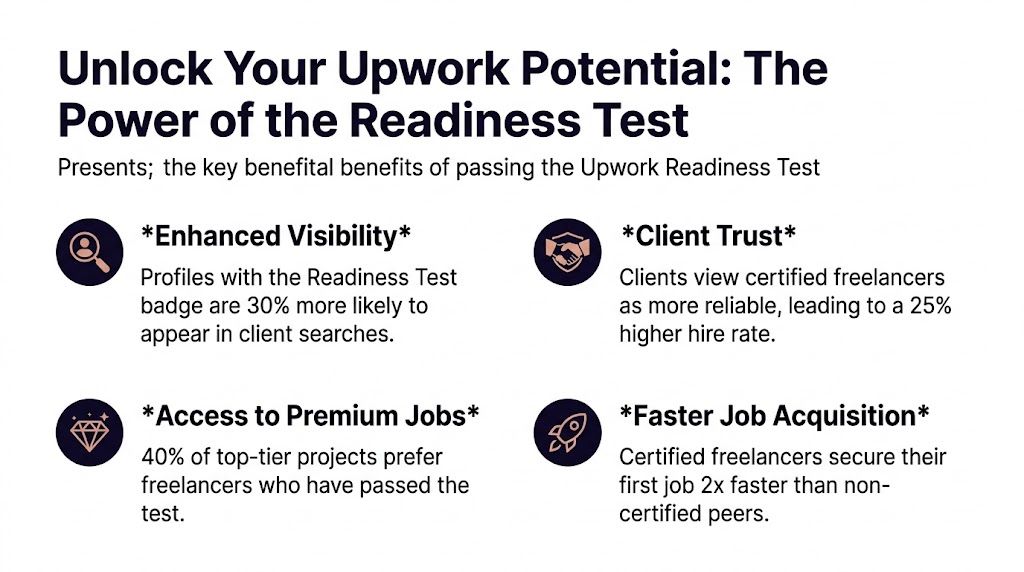
Passing the test directly influences eligibility for Rising Talent, which can boost profile visibility by up to 50% in client searches, according to this Scribd summary of the test’s marketplace impact.
That’s the part many new freelancers miss. The test is not just about proving you read the rules. It can affect whether your profile gets surfaced at all.
If you’re trying to win work in a crowded category, better visibility changes the whole game. More appearances in search lead to more profile views. More profile views create more chances for invites and replies. On Upwork, a lot of growth starts with being visible before you’re proven.
It gives clients a cleaner first impression
Clients don’t hire from skill alone. They hire from confidence. The readiness test reinforces the signals that create that confidence: complete profile, professional presentation, safe contracting behavior, and clear communication.
When a freelancer ignores these basics, clients feel it immediately. The profile looks unfinished. The proposal sounds generic. The messaging feels sloppy. Even strong skills can get buried under weak signals.
Clients don’t need to know you studied the rules. They notice when your profile and behavior show that you did.
It helps you build momentum early
The same Scribd source notes that profiles passing with high accuracy report 2.5x higher invitation rates in major markets because the test gates access to verified badges and foundational profile readiness.
That matters most at the beginning. Early traction changes how the rest of your account develops. When you get invites sooner, you get conversations sooner. When you get conversations sooner, you get proof sooner. Once you have proof, selling gets easier.
It teaches habits that scale later
A freelancer can sometimes brute-force early wins with hustle. An agency can’t scale on hustle alone. You need repeatable behavior.
That’s where the test becomes more valuable than it looks. It pushes you toward a system:
- Clean profile setup
- Contract-first work
- Better proposal discipline
- Faster, more professional communication
- Respect for platform rules
Those aren’t glamorous. They are profitable.
A Step-by-Step Guide to Passing the Test
Most guides on the upwork readiness test focus on memorizing answers. That approach works until Upwork changes wording, updates a prompt, or asks the same principle from a different angle. It’s better to learn how Upwork thinks.
Step 1: Find the test and take it seriously
The test is typically accessible after login through the Find Work area. Set aside a quiet block of time and don’t rush through it as if it’s a pop quiz.
The test is short enough to underestimate. Short assessments punish careless reading more than long ones do.
Step 2: Review the recurring themes
The question pool tends to revolve around a handful of platform fundamentals. Before you take it, make sure you can clearly explain these in your own words:
- When work should start: Only after a contract is active.
- How to protect payment: Use the platform correctly, especially for milestone-based fixed-price jobs.
- What a complete profile includes: Professional photo, title, overview, work history, top skills, and portfolio.
- What strong proposals do: They respond to the client’s job, not your ego.
- How responsiveness works: Prompt handling of invites matters and is visible to clients.
If you know those themes, the test becomes much easier because most questions are just different angles on the same operating rules.
Step 3: Answer from Upwork’s perspective
A common mistake is answering based on what feels convenient rather than what keeps the marketplace safe.
For example, if a question asks when to begin work, don’t answer based on trust, urgency, or a client promise. Upwork’s correct answer will always favor the active contract because the contract is what protects both sides.
Operator mindset: The right answer is usually the one that reduces disputes, improves trust, or keeps activity on-platform.
Sample question logic and strategic answers
Here’s how to think through the most common types of questions.
Contract safety questions
If the scenario is about a client asking you to start quickly before paperwork is finished, the right instinct is simple: don’t begin without a contract.
Why? Because Upwork is teaching you to protect your work and stay compliant. Speed never outranks contract safety.
Profile questions
If the question asks what makes a freelancer more attractive to clients, think completeness and professionalism. Upwork values a profile that looks like a real business presence, not a half-built placeholder.
That means photo, title, overview, work history, skills, and portfolio all matter.
Proposal questions
The strongest answer is usually the one that sounds specific and client-aware. The weak answer is the one that sounds like a template pasted into every job.
Good proposal logic usually includes:
- personalized greeting
- relevant experience tied to the job
- a clear approach
- direct answers to any screening questions
Later in the workflow, this video is a useful refresher on how people commonly prepare for the test and interpret the answer logic:
Step 4: Avoid two common traps
The first trap is overconfidence. People skim because the questions look basic.
The second is memorizing isolated answers without learning the reason behind them. If you understand the principle, you can handle wording changes. If you only memorize, you’re fragile.
Step 5: Treat the test as onboarding, not an exam
The goal isn’t just to pass once. The goal is to internalize the standards that keep your account healthy when real money and real clients are involved.
That shift matters. A freelancer studies to finish the test. A good operator studies to avoid future mistakes.
Maintaining Your Profile Health After You Pass
Passing the upwork readiness test is the easy part. Keeping your profile healthy is where most freelancers separate themselves from the pack.
The principles from the test turn into day-to-day business habits. That includes how you scope work, how you communicate, what you do when a client goes quiet, and whether your profile still looks sharp a month after setup.
The test doesn’t end after submission
A strong Job Success Score depends on outcomes that exceed expectations, and the same source notes that incomplete profiles can reduce client click-through by as much as 70%, while never starting work pre-contract prevents an estimated 40% of payment disputes, according to Upwork-related guidance summarized here.
That gives you a useful way to think about profile health. It’s not cosmetic. It directly affects clicks, trust, and dispute risk.

What profile health looks like in practice
A healthy profile isn’t just “complete.” It stays aligned with the work you want now.
Use this checklist regularly:
- Refresh your title: Keep it narrow and relevant to the clients you want.
- Update your overview: Remove vague claims and emphasize the problems you solve.
- Prune your skills: Keep the list focused so your positioning stays clear.
- Add recent work: A stale portfolio sends the wrong signal.
- Watch response habits: Slow replies create friction even when your service is excellent.
The habits that protect your JSS
Freelancers often think JSS is something that happens after delivery. It starts much earlier.
It starts when you choose the right jobs. It continues when you set expectations correctly. It gets protected when you use contracts and milestones the right way. By the time a client leaves feedback, the score has already been shaped by dozens of earlier decisions.
A healthy Upwork account usually looks boring from the outside. Clear scope, clean contracts, steady communication, no drama.
What works and what does not
What works:
- keeping promises slightly smaller than what you can deliver
- confirming milestones and scope in writing
- declining bad-fit work early
- communicating before a problem turns into a complaint
What doesn’t:
- starting “just to help” before the contract is live
- accepting vague fixed-price work without milestone clarity
- letting your portfolio and overview age out
- disappearing when a client asks a hard question
The freelancers and agencies that last on Upwork aren’t just good at their craft. They’re disciplined about account hygiene.
Enhancing Your Profile with Badges and Assessments
Once the basics are solid, the next layer is differentiation. The upwork readiness test shows that you understand the rules. Other profile features help show how you work.
One of the most useful optional signals is the Working Style Assessment. Upwork describes it as a 10-minute, 13-question evaluation that identifies 1 to 3 natural strengths such as accountability or solution-orientation, with results displayed on your profile. It’s also especially relevant in 2026 because Upwork notes a 40% increased demand for AI/ML professionals who need to demonstrate soft skills, as explained in Upwork’s Working Style Assessment help article.
Why this matters after the readiness test
The readiness test validates rule awareness. The Working Style Assessment adds a softer layer that clients care about when choosing between similar providers.
That distinction matters a lot in crowded categories. Many freelancers can claim they’re reliable. Fewer have profile signals that support that claim.
When to use optional assessments
These tools make the biggest difference when:
- you’re in a field where communication quality heavily affects outcomes
- clients compare several freelancers with similar technical skills
- you want your profile to feel more rounded, not just compliant
If you’re polishing your profile beyond the basics, this guide to building a stronger Upwork portfolio that supports your positioning fits well with assessments and badges because both work best when the profile tells one clear story.
The right way to think about badges
Badges and assessments are support signals, not substitutes for delivery. They won’t save a weak profile or fix weak proposals.
But they do help when the foundation is already strong. That’s why I treat them as the second layer of trust. First, prove you understand the platform. Then add signals that make clients more comfortable saying yes.
Common Myths and the Test's True Role in 2026
The oldest myth around the upwork readiness test is the idea that passing it gives you 40 free Connects.
That claim keeps circulating because old videos still mention it. But recent platform updates and support documents from 2024 and 2025 have largely omitted that reward, suggesting it has been deprecated as Upwork shifts attention toward AI-driven matching and ongoing badge qualifications, as discussed in this video summary about the outdated 40 Connects claim.
What that means in practice
If you’re taking the test mainly for a Connects reward, you’re using outdated logic. Don’t build your workflow around platform rumors.
Take it because it helps establish profile readiness and teaches the behaviors Upwork wants to reward over time.
The test has different value for different sellers
For a new freelancer, the test still matters a lot. It’s part of learning how to operate safely and become visible.
For an established freelancer or agency, the test itself is less important than the principles underneath it. Mature sellers don’t need a quiz to know they should use contracts, stay responsive, and keep profiles polished. But they absolutely need teams, systems, and automation that keep following those rules.
The real 2026 question isn’t “What do I get for passing?” It’s “Can my workflow keep applying these standards every day?”
That’s the test’s true role now. It’s less about reward and more about operational discipline.
Scaling Your Success with AI-Powered Automation
Once you understand the upwork readiness test, the next challenge is consistency. Most freelancers know what a good proposal looks like. Fewer send one quickly and well every single time. Most agencies know responsiveness matters. Fewer maintain that standard across multiple bidders and accounts.
That’s where automation becomes useful. Not as a shortcut around the rules, but as a way to execute the rules more consistently.
Where manual workflows usually break
Manual Upwork sales usually fail in predictable places:
- proposal quality drops when volume rises
- replies slow down outside working hours
- follow-ups get forgotten
- junior team members drift into weak messaging
- account activity becomes inconsistent across multiple profiles
Those aren’t strategy problems. They’re execution problems.

What scalable execution looks like
A strong system should preserve the core lessons from the test:
- proposals should still feel customized
- response time should stay fast
- contract safety should remain paramount
- profile quality should be monitored, not ignored
- follow-up should happen without becoming spammy
If you’re building that kind of workflow, this guide on how to automate Upwork proposals without losing quality is a practical next step.
For agencies, Upwork shifts from being a freelancer app to a sales channel. The fundamentals stay the same. The difference is that a good system helps you apply them at speed, without letting quality collapse.
Earlybird AI helps agencies and freelancers turn Upwork best practices into a repeatable sales system. It can search for relevant jobs, craft personalized proposals, reply to client messages quickly, and support multi-user workflows without turning your outreach into a mess. If you want to scale Upwork lead generation while staying aligned with the platform’s rules of the road, take a look at Earlybird AI.