
← Back To Blog
What Is Agentic Automation: Changing Work in 2026
If you run an agency or freelance shop, you already know the pattern. A promising project appears on Upwork. You spot it late because you were on a client call. Then you scramble to read the brief, write a proposal that doesn't sound generic, send it, and hope the client hasn't already filled the shortlist.
That work repeats every day. Search. Filter. Read. Write. Follow up. Reply. Log notes. Do it again tomorrow.
Individuals often try to solve that grind with templates, virtual assistants, or simple automations. Those help, but they usually break at the exact moment work becomes valuable. The client brief is messy. The scope is vague. The budget is unclear. The right response depends on context, timing, and judgment.
That's where agentic automation enters the conversation. Instead of following one rigid script, it works more like a digital operator that can understand a goal, break it into steps, use tools, and adjust as it goes. If you've been asking what is agentic automation, the simplest answer is this: it's automation that can pursue outcomes, not just execute instructions.
The Dawn of Autonomous Workflows
For agencies, business development often looks backward compared with the rest of the operation. You may deliver client work with polished systems, but you still win new business through manual effort that depends on speed and repetition.
A small agency owner might spend the early morning scanning Upwork, bookmarking jobs, and assigning someone to write proposals. By noon, half those jobs already have a pile of applicants. By evening, inbox follow-ups and client replies are mixed in with delivery work. The team stays busy, but not all that busyness moves revenue forward.
That friction explains why autonomous workflows are getting serious attention. Companies aren't treating AI agents like a side experiment anymore. MIT Sloan reported in 2025 that 35% of surveyed organizations had already adopted AI agents, with 44% planning to deploy them soon, and related market research projected the global agentic AI market to grow from USD 1,450.7 million in 2024 to USD 47,680.4 million by 2034, a 41.8% CAGR according to MIT Sloan's overview of agentic AI adoption and market growth.
That matters because this isn't just better task automation. It's a shift in how digital work gets handled.
Most agency owners don't need another dashboard. They need a system that notices work, decides what matters, and moves before an opportunity goes cold.
The big change is simple. Older automation waits for exact instructions. Agentic automation starts with a goal like “find strong-fit projects and respond quickly” and figures out the path. For a growth-minded agency, that's the difference between a helpful shortcut and a real operating lever.
Understanding Agentic Automation at Its Core
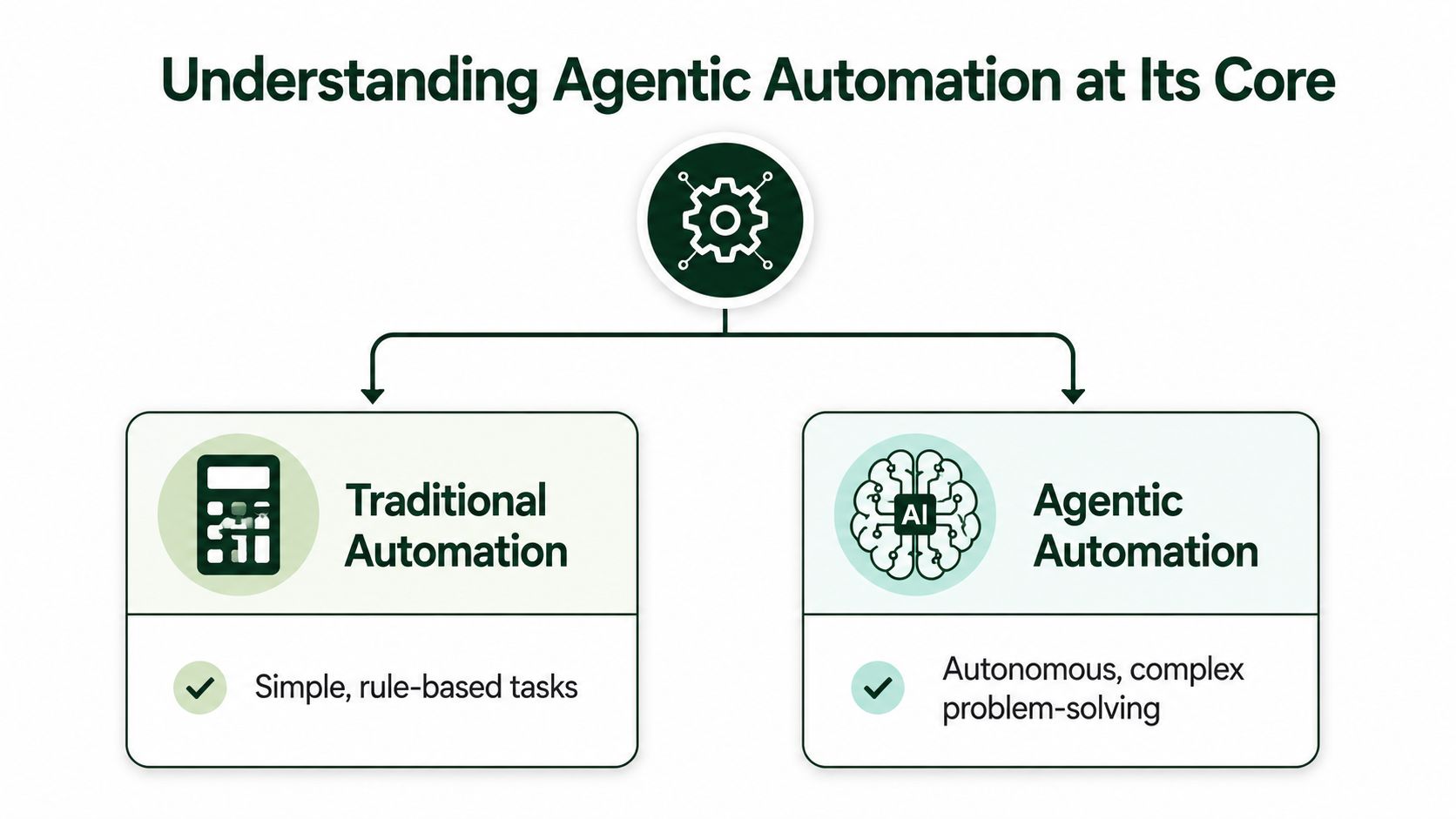
The easiest way to understand what agentic automation is is to compare two familiar things: a calculator and a smart intern.
A calculator is useful, fast, and precise. But it only works when you tell it exactly what to do. Traditional automation behaves the same way. It follows rules. If the input changes or the path gets messy, it stops being helpful.
A smart intern works differently. You give them a goal, some context, and a few boundaries. They can review information, decide what to do first, use the right tools, and come back with a result or a question. That's the basic mental model for agentic automation.
The four parts that matter
Most AI agents become easier to grasp when you break them into a few simple functions.
- Perception means the agent can read the digital room. It can inspect a job post, notice keywords, review messages, or detect what changed on a webpage.
- Planning means it doesn't just react. It maps a path from goal to action. If the goal is to pursue qualified leads, it can separate that into search, evaluate, draft, send, and monitor.
- Action means it can do the work. That could involve using a browser, interacting with software, calling APIs, or updating records.
- Memory means it can carry context from one step to the next. It remembers what happened earlier in the task and can use feedback to improve later actions.
That last point is where many readers get confused. Memory doesn't mean magical human-like understanding. It usually means the system can retain working context and prior outcomes well enough to avoid starting from zero every time.
Why this feels different from older tools
With simpler automation, you have to define the route in advance. Click here. Copy this field. Paste it there. If the page layout changes or an exception appears, someone has to fix the flow.
With agentic automation, you define the destination and the guardrails. The system handles more of the navigation.
Practical rule: If your process depends on interpreting language, handling exceptions, or choosing among several next steps, you're likely in agentic territory.
That's why this model fits outreach, qualification, and proposal work so well. Those jobs aren't repetitive in the clean, factory-like sense. They're repetitive in a human sense. The pattern repeats, but the details change every time.
How AI Agents Execute Complex Tasks
An AI agent becomes useful when it can take a broad instruction and turn it into real activity across tools. The core idea is multi-step autonomy. UiPath describes agentic automation as AI agents that can perceive a digital environment, reason about a goal, use APIs or other tools, and execute an end-to-end workflow with minimal human supervision in dynamic settings where rules aren't exact, as explained in UiPath's guide to agentic automation.
That sounds abstract until you trace one real workflow.
From goal to task list
Say you give an agent this instruction: find three strong-fit design projects on Upwork and prepare customized responses.
The agent doesn't treat that as one giant command. It breaks the job apart. It may identify the need to open the platform, apply search filters, inspect each listing, compare them against your service profile, extract the client's pain points, and draft responses that match the brief.
That decomposition matters because most business work is too fuzzy for one-step execution. The agent has to decide what “strong fit” means in context.
How the loop actually works
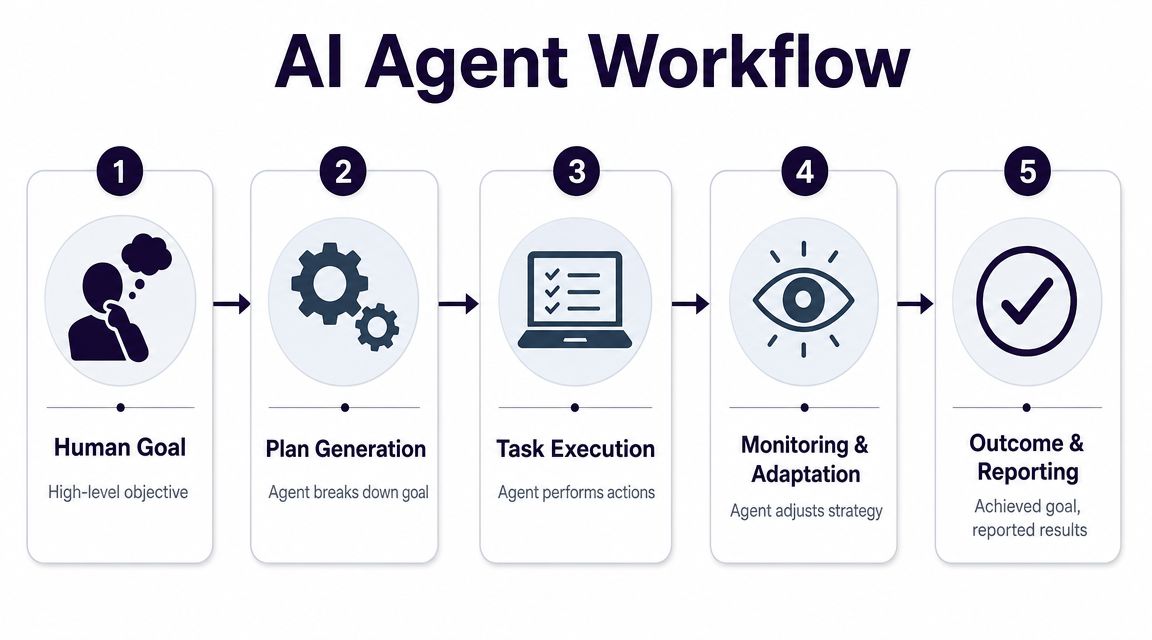
A useful way to picture the workflow is as a loop:
- Receive the goal
The human provides the objective and any constraints. For example: focus on Shopify design jobs, avoid low-budget listings, and keep the tone confident but concise. - Generate a plan
The agent decides which steps to take first. It may search, rank listings, then move into drafting. - Use tools
It interacts with software like a browser or connected apps. Through this interaction, it stops being a chatbot and starts acting. - Check the environment again
After each action, it reads the result. Did the page load? Did the search return weak matches? Did the client ask a question that changes the next move? - Adapt
If something changes, the agent revises the plan instead of failing outright.
For a related look at how AI changes pipeline work beyond job platforms, this overview of AI for sales prospecting shows why agents are becoming useful in outreach-heavy workflows.
Why adaptation is the real breakthrough
The old automation mindset says, “if X happens, do Y.” That works for fixed data entry. It struggles with digital environments that shift.
An agent can handle more variation. If a project title looks promising but the description reveals a mismatch, it can move on. If a message comes back with missing details, it can ask a clarifying question. If a form field changes location, a stronger system may still infer what needs to happen next from the surrounding context.
A good agent doesn't just perform actions. It judges whether the last action moved the task closer to the goal.
That's why agentic systems are attractive for outreach. Platforms change. client language varies. Requirements are often incomplete. The work still follows a pattern, but not a script.
Agentic Automation vs Traditional Automation
A lot of confusion comes from treating all automation as the same thing. It isn't.
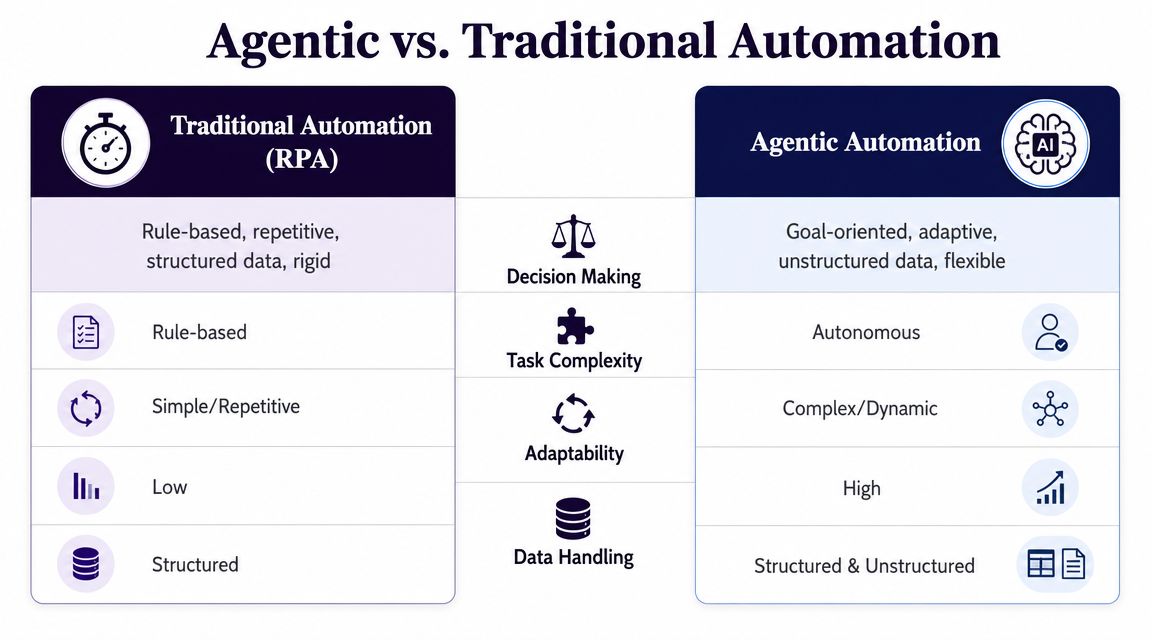
Traditional automation, often called RPA, is strong when work is repetitive, structured, and stable. If someone copies the same fields between the same systems every day, rule-based automation can handle that efficiently. It shines when the process rarely changes.
Agentic automation is built for a different category of work. Box explains that the agent doesn't just execute a fixed script. It breaks work into smaller decisions, evaluates context at each step, and chooses the next action across multiple tools, which makes it better suited to unstructured workflows, as described in Box's guide to agentic process automation.
Where traditional automation still wins
There's no reason to pretend older automation is obsolete. It's often the right choice when:
- The inputs are fixed and always arrive in the same format.
- The steps never change from one run to the next.
- The exceptions are rare and easy to route to a person.
- Speed matters more than judgment because the process is already defined.
Payroll exports, data syncs, and standard invoice routing often fit this model well.
Where agentic automation takes over
Agency growth work usually doesn't.
- Lead qualification is interpretive because project briefs are written in natural language.
- Proposal writing is contextual because the right message depends on industry, urgency, and scope.
- Client messaging changes shape because buyers ask questions in different ways.
- The platform environment moves because interfaces, listing patterns, and priorities shift over time.
That's why a rigid bot can feel brittle while an agent feels more like delegated work.
Traditional automation follows the map. Agentic automation can still move when the road changes.
The practical takeaway is simple. Use rule-based tools where the work is predictable. Use agentic systems where the work involves judgment, multiple tools, and frequent exceptions. Outreach, sales support, and client communication often land in the second category.
Agentic Automation in Action on Upwork
The clearest way to understand agentic automation is to watch it through a workflow you already care about. For many agencies, that workflow is Upwork lead generation.
You're not trying to automate one click. You're trying to automate the chain: identify a good-fit project, understand what the client wants, respond fast, keep the message relevant, and stay on top of replies.

What the workflow looks like in practice
Start with project discovery. An agent can monitor the platform continuously, not just when someone on your team has a free hour. It evaluates new listings against your preferred categories, skills, budget ranges, and positioning.
Then comes interpretation. A strong listing rarely says only one thing. A client may ask for a website redesign, but the deeper need is conversion improvement, clearer messaging, or a faster handoff to development. Agentic systems are useful because they can read for intent, not just keywords.
After that, the workflow turns into communication. Instead of dropping the same proposal into every listing, the agent can frame a response around the client's actual situation. It can mention the relevant service angle, mirror the client's language, and keep the message aligned with your positioning.
That's very different from bulk automation. It's closer to delegated business development.
Why Upwork is a strong fit for agents
Upwork has the exact traits that expose the limits of simpler tooling.
- The inputs are messy because job posts vary wildly in quality.
- Timing matters because being early can shape whether a proposal gets seen.
- Context matters because a generic response often blends into the pile.
- Conversation matters because the first proposal isn't the whole sale.
If you want to see how this category applies specifically to bidding and message workflows, this breakdown of Upwork automation is a useful companion.
The follow-up layer most people ignore
Many agency owners focus on the proposal and forget the rest of the funnel. But the main workload continues after the first message.
An agent can track whether a client replies, identify when a response needs a follow-up, and keep the thread moving with context-aware messages. That matters because dead time kills momentum. If a prospect asks a question while your team is offline, the opportunity can stall before a call is ever booked.
Here's a visual look at how these workflows play out in practice.
What agency owners usually get wrong
Many teams assume automation means sacrificing quality. In reality, the quality problem usually comes from shallow automation, not automation itself.
A weak system just fills in a template. A stronger agentic system does more of what a careful human would do:
- Read before responding so the message reflects the brief.
- Filter poor-fit jobs instead of chasing volume for its own sake.
- Adjust tone and content based on what the client appears to value.
- Keep context across the thread so follow-ups don't feel disconnected.
That's the “so what” for an agency owner. Agentic automation doesn't just save effort. It gives you a way to treat outreach as an operating system instead of an improvisation.
The Tangible Benefits and Business Impact
The business case gets stronger when you stop viewing this as an AI novelty and start viewing it as a workflow advantage.
Domo reports that agentic systems can cut certain processing times by over 80%, that some organizations see up to 18% gains in employee productivity, and eMarketer forecasts that 33% of enterprise software applications will incorporate agentic AI by 2028, according to Domo's summary of agentic automation outcomes and software adoption projections.
For an agency, those numbers map to practical effects more than abstract efficiency.
What changes in day-to-day operations
- Less manual prospecting work means your team spends less time searching and sorting.
- Faster response cycles improve your odds in time-sensitive marketplaces.
- More consistent follow-through reduces the number of opportunities that die from delay.
- Better use of skilled staff lets senior people focus on strategy, delivery, and closing.
That last point is easy to underestimate. Every hour your best operator spends scanning listings is an hour they aren't refining offers, managing accounts, or improving margins.
Why the value compounds
Agentic automation has a compounding effect because it doesn't just make one task faster. It links several dependent tasks together.
If project search improves, proposal timing improves. If proposal timing improves, reply volume can improve. If replies are handled faster and with better context, the sales cycle can tighten. You end up with a cleaner pipeline and less wasted effort between stages.
The strongest ROI often comes from work your team hates doing but can't afford to skip.
That's why agencies and freelancers are paying attention. The benefit isn't only labor reduction. It's more reliable business development without adding headcount for every extra unit of outreach.
Implementing Agentic Systems Safely and Smartly
Autonomy without controls is where good ideas turn into expensive mistakes.
Automation Anywhere notes that enterprise-style agentic systems can interact with business apps and manage APIs, which makes governance critical. It highlights the need for human oversight, approval steps, audit logs, and rollback controls, as outlined in Automation Anywhere's explanation of agentic process automation governance.
The safeguards that matter most
If you're evaluating an agentic system for outreach or operations, look for a few basics first:
- Human approval points for actions that carry brand, financial, or compliance risk.
- Clear operating boundaries so the system knows what it can and can't do.
- Audit visibility so you can review what happened and why.
- Rollback options so a bad action doesn't become a lasting mess.
For teams starting small, this guide on how to automate repetitive tasks is a practical way to think about where to begin.
A smart rollout approach
Don't start with your most sensitive workflow. Start with a narrow but painful one. Outreach monitoring, proposal drafting support, or reply triage are often better starting points than fully autonomous account management.
Choose a process with clear value, frequent repetition, and manageable downside if something goes wrong.
That's the balanced view of what agentic automation is. It's powerful, but it works best when you pair autonomy with rules, review, and accountability.
If you want help turning this from theory into a working acquisition system, Earlybird AI is built for agencies and freelancers who need an always-on Upwork sales workflow. It learns your ideal projects, drafts personalized proposals, manages replies, and helps your team scale outreach without living inside the platform all day.