
← Back To Blog
What Is Objection Handling: A 2026 Guide for Freelancers
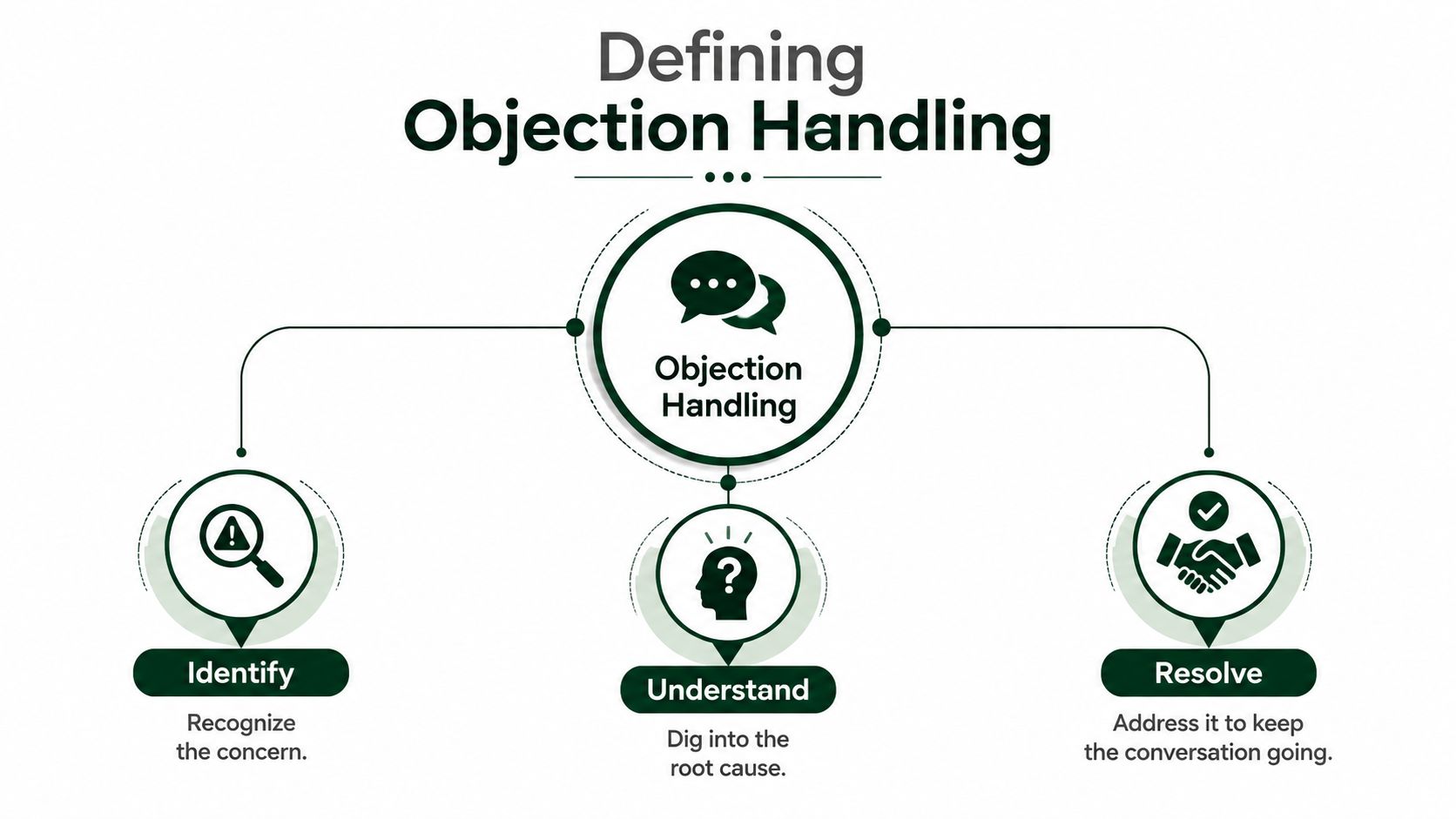
Objection handling is the process of identifying, understanding, and resolving a client's concern so the conversation can keep moving. In sales practice, reps often hear 2.4 objections in a single discovery or demo call, 80% of sales take about 5 follow-up calls to work through objections, and only 2% close on first contact, which is why the skill matters so much in a real inbox conversation (Apollo's objection handling guide).
If you sell on Upwork, you already know how fast a thread can turn. You send a thoughtful proposal, the client replies ten minutes later with “your price is too high,” and suddenly you're not selling a service anymore, you're trying to understand what the client means. The reply that wins usually isn't the cleverest rebuttal, it's the one that diagnoses the concern first and answers it cleanly.
Defining Objection Handling in Plain Language
A client objection is not a rejection, it's a signal. In plain English, objection handling means noticing the concern, understanding what's behind it, and responding in a way that keeps the buying conversation alive. That definition sounds simple, but it changes how you write every Upwork reply, because a short message in the inbox often hides a bigger question about risk, trust, timing, or value.
Here's the classic freelancer version. You submit a proposal for a landing page project, and the client replies, “Your price is too high.” A beginner hears a budget complaint and rushes to defend the number. A stronger seller reads it as a clue and asks, “Compared with what?” or “Is the concern budget, scope, or confidence in the outcome?”
The difference between rebuttal and diagnosis
Rebuttal tries to win the argument. Diagnosis tries to find the actual problem. On Upwork, that difference matters because clients rarely type the full story into one message, they compress it into a sentence and expect you to read between the lines.
Practical rule: if your first response starts with “Actually,” you're probably rebutting too early.
A useful way to think about it is a doctor, not a lawyer. A lawyer argues the case. A doctor asks where it hurts, checks for the underlying cause, and chooses the treatment accordingly. Good objection handling works the same way, and that's why a process like the one described in solution selling fits this topic so well.
The goal isn't to sound perfect. The goal is to sound specific enough that the client feels understood. That's a skill you build deliberately, not a personality trait you're born with.
Why Objection Handling Matters on Upwork
Upwork compresses the sales process into a few messages, so every reply has outsized weight. There's no long nurturing sequence, no trade-show handshake, and often no discovery call before the first objection lands. That means a single sentence about price, timing, or trust can decide whether the thread moves forward or disappears.
The economics are simple. If you answer poorly, you lose the conversation. If you answer well, you earn a reply, and that reply may turn into an interview, a call, or a hire. For freelancers and agencies handling several prospects at once, that matters because time spent on weak-fit leads is time not spent on better ones.
Why this skill is also about qualification
A lot of people think objection handling means persuading everyone. That's too narrow. Sometimes the smartest move is to recognize that the client isn't a fit, then step out gracefully and save your energy for a better opportunity.
SalesHive's glossary makes this nuance explicit, it says objection handling can also mean cleanly disqualify a lead when there isn't enough fit, which is a more disciplined approach than trying to force every thread into a yes (SalesHive objection handling glossary). That framing is especially useful on Upwork, where polished but low-probability leads can drain hours without ever hiring.
If you're already thinking about outreach beyond the marketplace inbox, a solid companion resource is outreach email strategies from Mail Merge for Gmail, because the same logic applies, short replies need clarity, not fluff. For consistent client communication, client communication best practices can also help you keep tone, timing, and follow-up tight.
Clients don't reward the most detailed reply. They reward the one that makes the next decision easy.
That's why objection handling matters so much for freelancers, agencies, and anyone selling services one thread at a time. It protects reply rate, sharpens qualification, and keeps you from wasting attention on the wrong conversations.
The Four Objection Types You Will Meet on Upwork
Most Upwork objections fall into four buckets, even when the client words them differently. Once you can name the bucket, you stop guessing and start choosing a response on purpose. That alone makes your replies faster, calmer, and more persuasive.
Price objections
Price objections sound obvious, but they're often not about money alone. A client may say, “Your bid is above our budget,” when what they really mean is, “I don't yet see why your offer is worth more than the other one.”
That's why a reply like “I can lower my rate” is usually too early. A better move is to anchor the result, the scope, or the risk reduction before you mention pricing flexibility. The keyword is value, because a number without context feels expensive, while a number tied to a clear outcome feels more reasonable.
Trust and experience objections
These show up as, “We need someone with more agency experience” or “Can you show relevant work?” The client isn't only asking for a portfolio, they're asking whether you'll understand their environment, constraints, and workflow.
Trust objections are usually shorthand for uncertainty. If the client can't yet picture how you'll handle the work, they'll lean on credentials, niche experience, or proof of similar outcomes. A relevant case study, a specific process explanation, or a narrowly matched example does more than a generic “I'm confident I can help.”
Timing and availability objections
This category includes messages like, “We need this done in 48 hours,” or “Can you start next week?” Sometimes the concern is a real deadline. Other times it's a test to see whether you're organized enough to respond clearly under pressure.
A timing objection is really a question about execution. Clients want to know whether you can absorb urgency without chaos. If your answer can name the first step, the handoff point, and the delivery sequence, you reduce anxiety fast.
Competitor or status quo objections
“We already have someone” is the classic example. So is, “We're comparing a few freelancers.” These replies usually mean the client hasn't yet seen a compelling reason to switch, or they haven't seen enough difference to justify change.
That's where lead qualification frameworks help, because some threads are worth pursuing and some are better left alone. If the client is already satisfied with a current provider, your job is to identify whether there's a gap worth solving, not to force a replacement conversation.
Proven Frameworks You Can Use Tonight
Frameworks matter because they stop you from improvising under pressure. On Upwork, you often have seconds, not hours, to decide whether a reply should be empathetic, probing, or direct. A simple structure keeps your message human without making it vague.
LAER for complex or emotional replies
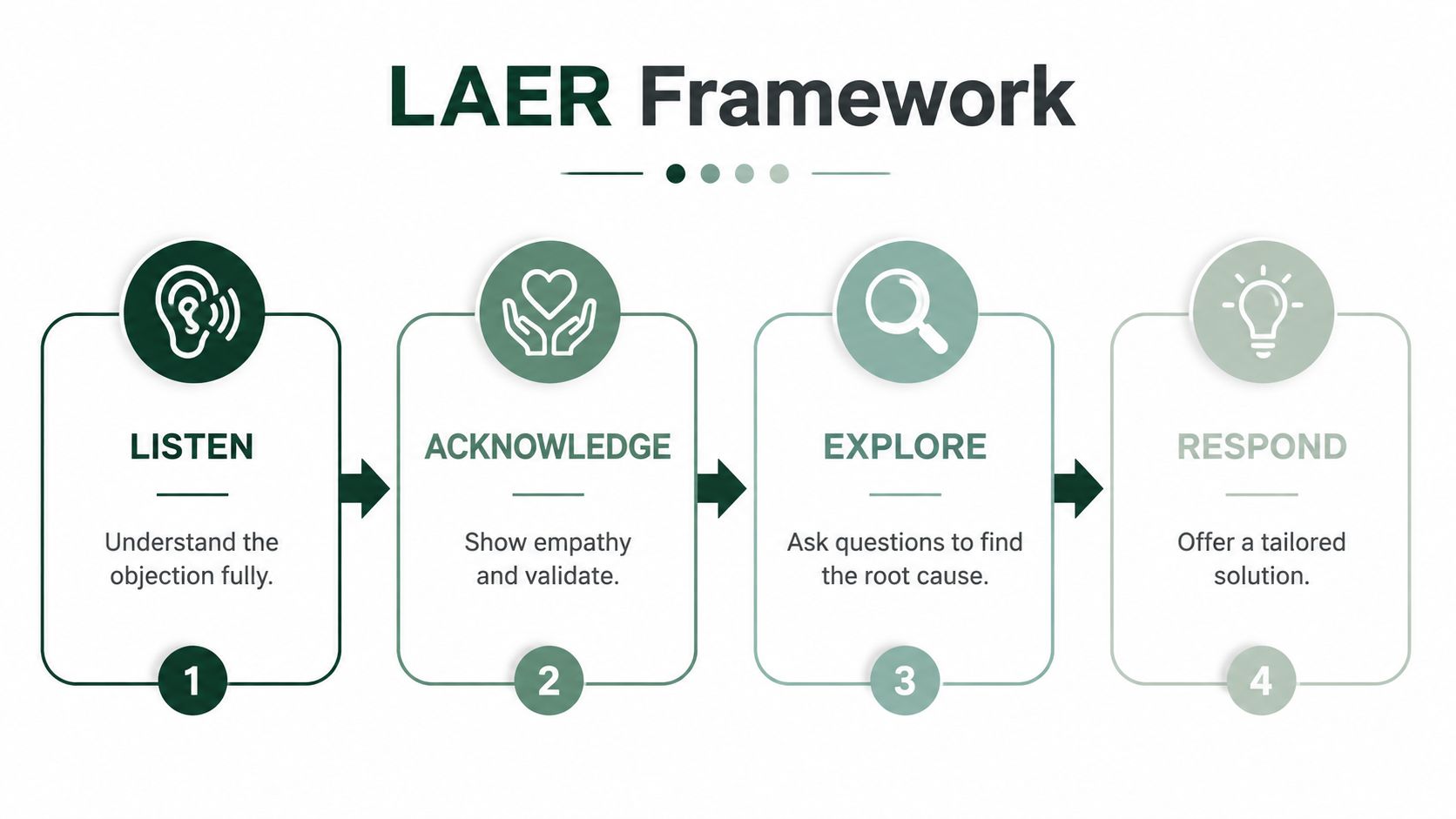
LAER stands for Listen, Acknowledge, Explore, Respond. It works best when the objection carries emotion, uncertainty, or more than one issue at once.
A proposal reply can look like this:
“Thanks for saying that. I hear the budget concern. Before I suggest anything, can I ask whether the main issue is total cost, expected ROI, or the scope you're comparing against?”
That's Listen and Acknowledge in one sentence, then Explore with a clean question. The final response should be customized to what they say next, not prewritten in a vacuum.
Feel-Felt-Found for fast social proof
The Feel-Felt-Found structure works well when the client needs reassurance quickly. It sounds natural, and it's especially useful when the thread is short and the buyer doesn't want a long explanation.
A simple version looks like this:
“I understand how that feels. Other clients have felt the same way before comparing bids. What they found was that the lower-priced option cost more later because it needed rework.”
Use this carefully. It's strongest when you have a comparable pattern and can state it without sounding scripted. If the objection is purely logistical, LAER is usually the safer choice.
A tighter sequence for messy inbox messages
Some client messages bundle everything together, price, urgency, and fit. In those cases, the acknowledge → reframe → surface the concern → commit to follow-up sequence is especially useful, because it turns a messy thread into a concrete next step (Rework's technical objection handling guidance).
A practical reply could be:
“I get the budget concern. The scope might be the bigger issue here, so I want to make sure I'm comparing the same outcome you need. If you're open to it, I can outline two versions by tomorrow, one lean and one fuller.”
That's not fancy, but it works because it moves the thread forward instead of circling the same complaint.
Real Upwork Conversations and How to Reply
Weak replies usually fail because they answer too broadly. Strong replies work because they match the exact objection, then move one step deeper. That difference is easy to miss when you're writing fast, but it's obvious once you compare side by side.
Price objection rewrite
Client message, “Your bid is above our budget.”
Beginner reply, “I understand, but my rate reflects the quality of my work and the value I provide. Let me know if you want to proceed.”
Upgraded reply, “I understand the budget concern. Before I adjust anything, can I ask whether the issue is total price, scope, or the outcome you're expecting? If scope is the issue, I can trim the deliverables and keep the result focused.”
The upgrade works because it doesn't defend the number immediately. It asks for the core constraint and offers a path that preserves value.
Trust objection rewrite
Client message, “We need someone with more agency experience.”
Beginner reply, “I've worked with many clients and I'm confident I can do this.”
Upgraded reply, “That makes sense. If agency workflow is the priority, I can share a similar project where I worked within approvals, multiple stakeholders, and faster handoffs. If helpful, I can also outline how I'd manage communication in your setup.”
This version is stronger because it makes the client feel seen and then gives them a reason to believe you understand the environment.
Timing objection rewrite
Client message, “We need this done in 48 hours.”
Beginner reply, “Yes, I can try.”
Upgraded reply, “I can work inside that window if the scope stays tight. If you send the top priority pieces today, I'll map the delivery order, confirm what lands first, and tell you right away if anything needs to be moved.”
That reply signals control. It doesn't promise the impossible, and it doesn't sound hesitant.
A few micro-edits improve almost any draft:
- Remove filler apologies: cut “sorry” when you don't need it.
- Replace broad claims with proof: name a project type, process, or outcome.
- Ask one sharper question: don't ask three at once.
- Match the client's pace: short message, short reply.
- Close with a next step: invite a reply, file, call, or clarification.
Common Mistakes That Cost Freelancers the Hire
The most expensive mistakes aren't dramatic. They're small habits that make the client feel unheard, pressured, or unsure. Once those patterns show up, the thread usually cools off fast.
The usual failure modes
Arguing about price is the fastest way to lose goodwill. So is over-apologizing, because it makes your rate or your competence sound shaky even when the client never questioned your value directly. A generic “thanks for considering me” reply also wastes a thread, because it adds no information and gives the client no reason to keep engaging.
Ignoring the objection is another common miss. Some freelancers paste portfolio links and hope the proof speaks for itself, but that often reads as evasive. The client asked about a concern, and the reply that wins is the one that answers the concern before selling anything else.
If the client asked a question, answer that question before you pitch anything new.
The subtle mistake most people miss
The harder mistake is treating every thread like a must-win. That mindset pushes freelancers to say yes too quickly, cut scope too aggressively, or chase a low-fit project because they're afraid of silence. In practice, a healthy pipeline needs some clean exits.
Disqualification is part of good objection handling. If the project doesn't fit your process, your niche, or your availability, a polite exit protects your time and keeps your inbox available for better leads. That's not failure, it's pipeline management.
One more trap deserves mention. Ghosting after a hard question creates doubt even when your work is strong. If you need time, say so. Silence reads like uncertainty, and uncertainty makes clients look elsewhere.
Measuring Success and Scaling With Automation
Good objection handling shows up in the numbers around your inbox, not just in the feeling that a reply “went well.” If you want to improve it, watch the parts of the process you can influence. On Upwork, that means tracking your reply rate on proposals, your time to first reply on incoming messages, the share of threads that move to interview, and the share of qualified conversations that become hires.
What to measure first
Start with consistency, not complexity. If your responses are slow, clients move on. If your responses are fast but generic, they still move on. The point is to build a repeatable rhythm where speed and specificity travel together.
A shared response library can help if you run an agency or juggle multiple bidders. It keeps your core language consistent, but the primary value is that it gives you a place to test which phrasing earns replies and which phrasing dies in the thread. Over time, the team learns what calms a worried client.
Where automation helps, and where it shouldn't decide
Automation is useful for speed, follow-up, and routing. It's not a substitute for judgment when the objection is sensitive, layered, or tied to scope risk. If a response needs nuance, a human should still own it.
That matters because modern objection handling doesn't only happen in one live conversation. It can surface in email, cold outreach, discovery, and negotiation, especially as buyers expect faster and more personalized responses across channels (Salesforce's sales guidance on effective objection handling). The operational challenge is to keep the first response quick without flattening the personal detail that earns trust.
Simple drills that sharpen the skill
- Rewrite one old reply: turn a defensive message into a question.
- Label ten old objections: sort them into price, trust, timing, or competitor.
- Draft two versions: one short, one detailed, then compare clarity.
- Review lost threads: find the first sentence where the conversation slowed.
- Practice follow-up timing: send a clean next step instead of a vague check-in.
The best teams don't just respond faster. They learn which response shapes the next move.
Objection Handling Questions Freelancers Actually Ask
How fast should I reply? Fast enough to stay present, but not so fast that you sound canned. A short, specific reply beats a long, rushed one.
What if the client doesn't respond after I address the objection? Send one clear follow-up with a next step, not a desperate bump. If they still don't answer, move on and protect your pipeline.
What if the client says they're comparing me with other freelancers? Ask what criteria matter most, then respond to that. If the choice is mostly price, you may be better off clarifying scope than lowering your rate.
Should I ever lower my price to close the thread? Sometimes, but only after you've checked whether the issue is scope or perceived value. A price cut without diagnosis usually solves the wrong problem.
Earlybird AI helps freelancers and agencies turn fast client messages into faster replies, cleaner qualification, and more booked calls without living in the inbox. If you want a system that learns your ideal projects, drafts personalized responses, and keeps follow-up moving, visit Earlybird AI and see how it fits your Upwork workflow.